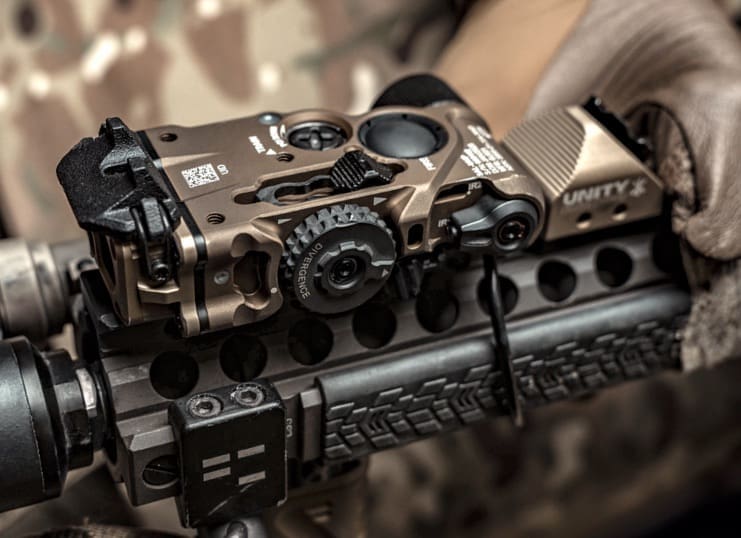
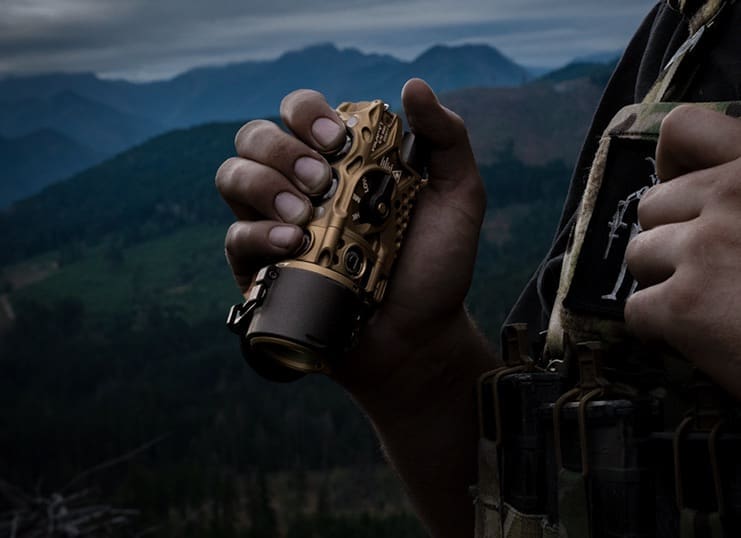
XC3 Weaponlight

American Revolutionary War Flags Flown to Inspire Patriotism

May 10th, 2026

The American flag is a symbol of freedom and patriotism, but before the Continental Congress adopted the first?official flag in 1777, many other flags were flown.

As America celebrates 250 years of freedom, here’s a look at a few of the various United States flags flown during combat by soldiers, sailors,?Marines and militia during the American Revolutionary War.

Flags were a significant part of the war, as they served to instill esprit de corps in the men and also aided in rallying the troops, as the flag carrier led from the front. They expressed liberty and national identity, as well as a means to assert sovereignty against British rule.

The use of colors — the term for the banners and flags — dates back to the Middle Ages in Europe, when knights displayed their distinctive symbols and colors on their shields to identify one another on the battlefield. The ancient Romans and Greeks also carried banners with symbols of their leaders into battle.

Today, the American flag, also known as the Stars and Stripes and Old Glory, serves to unite the nation and inspire patriotism. Although military units have their own colors, all fly the American flag higher, giving it the most prominent position.

The Hopkinson flag

Most historians agree that Francis Hopkinson was the designer of the first official American flag. On June 14, 1777, the Second Continental Congress adopted the Hopkinson flag, calling it the Stars and Stripes.

Since there were only 13 states then, the design featured 13 stripes and 13 six-pointed stars arranged in rows on the field of blue. He also designed a very similar flag for the Navy, which looks similar to today’s flag because the red stripes are located at the top and bottom.

The Hopkinson flag was first carried into combat during the Battle of Brandywine, Sept. 11, 1777, just outside Philadelphia.

Hopkinson also helped design the Great Seal of the United States and was a signer of the Declaration of Independence; many consider him a Founding Father.

The Serapis flag 

Featuring 13 blue, red and white stripes and 13 stars, the Serapis flag design is similar to the Hopkinson flag except for the arrangement of stars and the blue stripes. 

The flag has an unusual origin story: it was named for the Royal Navy frigate HMS Serapis. 

The Serapis engaged the American warship USS Bonhomme Richard under the command of Continental Navy Capt. John Paul Jones in the North Sea near England on Sept. 23, 1779. 

The battle resulted in the capture of the Serapis. Jones’ ship was badly damaged and sank, so he sailed the Serapis to the neutral Dutch port of Texel without a flag — technically making him a pirate. 

Benjamin Franklin, then an ambassador to France, was asked to provide a flag that Jones could use. Once created, the flag diffused the diplomatic tension, and Jones was released by the Dutch. 

The Serapis flag was one of the first flags of the United States, although it was never used in an official capacity. However, it is strongly associated with Jones and his heroics as one of the great captains of the Continental Navy and his contributions to the war effort. 

The flag is used to this day on the USS John Paul Jones, a missile destroyer commissioned in 1991 to honor the famous captain. It is sometimes called the Franklin flag in honor of the Founding Father who helped create it.

The Grand Union flag 

Also known as the Congress flag, the Cambridge flag and the Continental Union flag, the Grand Union flag is the first national flag of the United States; it was flown from 1775 to 1776.

The Grand Union flag consisted of 13 red and white stripes with the British Union Jack located in the area now occupied by stars. The flag was first flown by Continental Navy Lt. John Paul Jones on Dec. 3, 1775, on the USS Alfred.

The Betsy Ross flag 

Betsy Ross was a professional upholsterer in Philadelphia from the early 1770s until she retired in 1827. While there is no historical evidence, many people believe she designed the American flag. During and after the war, Ross made a variety of military flags over the course of 50 years.   

The Betsy Ross flag is similar to the other flags in that it has 13 stripes and 13 stars on a field of blue, but rather than rows, her design includes five-pointed stars arranged in a circle.

By David Vergun, Pentagon News

Yuma Test Center’s Proof Gun System Supports Army Goal to Increase Munition Production

May 10th, 2026

YUMA PROVING GROUND, Ariz. — In the past, testing a gun tube required an accompanying weapon system. The future is here where that is no longer necessary.

Yuma Test Center acquired a proof gun system, or PGS, developed by U.S. Army Combat Capabilities Development Command Armaments Center which allows a gun tube to be mounted and fired for testing without the weapon system.

“The idea was to build a system that would allow them to put a number of different tubes in,” explained Quentin Sorenson, the test officer with the Munitions and Weapons Division who oversaw the installation of the PGS at YTC.

He further explained, “There are no electronics, it’s hydraulic or mechanical. It was specifically designed to sit out in the desert. They are hoping for a 30–50-year lifespan.”

The timing of this advancement is no coincidence. In fact, its funding comes directly from the U.S. Army’s initiative to ramp up overall production capacity for 155mm artillery munitions. The Army’s goal is to produce 100,000 artillery rounds per month. The PGS will aid with production testing.

For the last several months, YTC has worked to acquire, assemble, emplace and test fire the first of two PGS. YTC crews placed the system on a reaction mass that was built to YTC standards by a U.S. Army Corps of Engineers contractor to sustain the immense power of firing.

“The concrete is about 7 feet deep and contains rebar grids and a fabricated cage that houses the removable mounting rods designed to secure the ground engagement system adapter plate,” explained Jered Ford, chief of the Indirect Fire Modernization and Mines Branch.

Sorenson added, “It took us most of the day to get the PGS on the reaction mass. We had to get the adapter plate cleaned up and prepared to emplace the saddle or lower portion, then we mounted the gun mount, or upper portion on top of that. Then we spent the rest of the week making sure everything was securely locked down.”

Crews used a special large pneumatic wrench to torque the mounting bolts to 3,100 foot-pounds. Then the carpenters constructed a wooden deck around the system to allow closer access to the PGS’s loading side. Once the system was set up Sorenson conducted acceptance firing.

“We fired at four [quadrant elevations] just to make sure everything was good as we elevated up and down. Most were done at zone five to introduce maximum shock and everything went well.”

YTC’s second PGS arrives in May. Currently, both systems work with M776 tube sleeves, yet there are plans to expand their capabilities to include other types.

This new capability provides industry partners testing artillery flexibility, efficiency and cost savings explains Sorenson.

“You just swap the tubes in and out as you need and then you are not trying to constantly maintain a chassis because you have this one system that will handle everything.”

Currently artillery testing requires a significant effort to prepare and emplace an entire weapon system at the test site.

“We have to tow in a towed howitzer, like an M777A2 or an M199 or you have to drive in an M109A6.You have to bring in the whole system and then you have to have ready and running to conduct your test.”

Omitting the weapon system cuts the extra time and effort needed on a test site and the time when switching between programs.

“It minimizes set up costs and it minimizes the mechanical effort of keeping the whole system functioning when all we really need is the tube,” said Sorenson of the new capability.

By Ana Henderson

Classified Networks AI Agreements

May 9th, 2026

The War Department Announces Agreements with Leading AI Companies to Deploy Capabilities on Classified Networks
The War Department has entered into agreements with eight of the world’s leading frontier artificial intelligence companies, SpaceX, OpenAI, Google, NVIDIA, Reflection, Microsoft, Amazon Web Services, and Oracle to deploy their advanced AI capabilities on the Department’s classified networks for lawful operational use. These agreements accelerate the transformation toward establishing the United States military as an AI-first fighting force and will strengthen our warfighters’ ability to maintain decision superiority across all domains of warfare.

Integrating secure frontier AI capabilities into the Department’s Impact Level 6 (IL6) and Impact Level 7 (IL7) network environments will streamline data synthesis, elevate situational understanding, and augment warfighter decision-making in complex operational environments. SpaceX, OpenAI, Google, NVIDIA, Reflection, Microsoft, Amazon Web Services, and Oracle will provide resources to deploy their capabilities on both IL6 and IL7 environments. This effort supports the Department’s AI Acceleration Strategy by enabling new capabilities across its three core tenets of warfighting, intelligence, and enterprise operations.


GenAI.mil, the War Department’s official AI platform, is already demonstrating the scale and impact of this acceleration. Over 1.3 million Department personnel have used the platform, generating tens of millions of prompts and deploying hundreds of thousands of agents in only five months. Warfighters, civilians and contractors are putting these capabilities to practical use right now, cutting many tasks from months to days.

The Department will continue to build an architecture that prevents AI vendor lock and ensures long-term flexibility for the Joint Force. Access to a diverse suite of AI capabilities from across the resilient American technology stack will give warfighters the tools they need to act with confidence and safeguard the nation against any threat.

Together, the War Department and these strategic partners share the conviction that American leadership in AI is indispensable to national security. This leadership depends on a thriving domestic ecosystem of capable model developers that enable the full and effective use of their capabilities in support of Department missions. As mandated by President Trump and Secretary Hegseth, the Department will continue to envelop our warfighters with advanced AI to meet the unprecedented emerging threats of tomorrow and to strengthen our Arsenal of Freedom.

Beez Combat Systems FPV Goggle Tactical Headband Strap

May 9th, 2026

The FPV Goggle Tactical Headband Strap is engineered for operators who demand reliability when it matters most. Designed from the ground up for tactical drone operations, this headband system eliminates the failure points found in stock goggle straps. 

The 2″ elastic headband paired with dual 2″ triglids provides a dialed-in fit with maximum comfort during extended wear, while the 1″ webbing and 1″ triglid system broadens compatibility across virtually every major FPV goggle platform on the market 

The FPV Goggle Tactical Headband Strap is purpose-built to keep your power source secure during tactical operations. The battery strap can be moved/removed to which ever position works best for the operator 

For additional information and availability –  Beez Combat Systems

RAF Regiment Counter-UAS: Defending the Airspace and Turning Threat into Intelligence

May 9th, 2026

A modern threat, a measured response. Across the world, the use of small, often commercially derived drones has become a defining feature of modern conflict. Cheap, adaptable and increasingly capable, these systems are used for surveillance, targeting and attack by both state and non-state actors.

In response, the RAF has developed a layered Counter-Unmanned Aerial System (UAS) capability, delivered on the ground by specialist RAF Regiment teams. Their role is clear: detect, track, identify and defeat hostile drones – while exploring opportunities to gather intelligence where possible.

How RAF Regiment Counter-UAS operates 

RAF Regiment Counter-UAS capability forms part of a wider UK and coalition air defence system. At its core are systems such as ORCUS, Ninja and Rapid Sentry, designed to address the full spectrum of drone threats.

Detect and track 

  • Sensors, including radar and radio frequency (RF) systems, are used to detect and track drones operating at low level and often provides the location of the drone operators
  • These systems help build a recognised air picture in complex environments

Identify and assess

  • Operators analyse signal data, flight behaviour and patterns and visually identify threats using an Ultra Long Range Electro Optical Surveillance System (or Daylight and Thermal Imaging Camera) 
  • This enables rapid assessment of whether a drone is benign, unknown or hostile 

Defeat or disrupt 

  • A mix of electronic warfare and, where required, kinetic options are used to counter the threat 
  • Electronic systems can interfere with the communications links used by many drones 

Can they take control of drones?

This is where precision matters. RAF information confirms that systems such as Ninja can:

Interfere with or disrupt control links used by many types of drones

Take control of the drone providing multiple options including redirecting the drone and even forcing it into a safe landing

This is not guaranteed in every case, and depends on:

The type of drone

How it is controlled

The operating environment

From threat to intelligence opportunity

Where a drone can be safely brought down and recovered intact, it becomes more than a neutralised threat.

Recovered systems may allow:

Analysis of onboard data and components

Insight into operating methods and technical capabilities

Potential understanding of launch points or networks involved

This turns a defensive action into an intelligence advantage – informing future operations and improving force protection.

Operational context: the Middle East 

RAF Regiment Counter-UAS teams No. 2 Counter-UAS Wing, have been deployed across the Middle East in support of UK and coalition operations.

Their role includes:

  • Protecting personnel, aircraft and infrastructure 
  • Countering persistent drone threats from hostile actors 
  • Contributing to a coordinated, coalition-wide air defence effort 

Part of a layered defence system 

Counter-UAS is one layer within a broader RAF approach: 

  • Ground-based air defence (RAF Regiment) – countering drones and low-level threats 
  • Combat air – providing high-end air dominance and response 
  • ISR and enablers – delivering intelligence, surveillance and operational coordination 

Together, these elements create a layered defence system capable of responding across the full spectrum of aerial threats.

RAF Regiment Counter-UAS operations reflect a deliberate shift in modern warfare:

  • From simply destroying threats 
  • To understanding, disrupting and, where possible, exploiting them 

Crucially, official RAF language is careful and precise: 

  • Control of hostile drones is possible in some cases, not all
  • Safe landing and recovery is conditional, not routine and the capability to destroy hostile drones using kinetic effects remains if they remain a threat

That realism underpins a capability that is both credible and operationally effective.

Bottom line

RAF Regiment Counter-UAS teams are delivering a critical role in today’s operational environment:

  • Protecting UK and allied forces from evolving drone threats
  • Denying adversaries freedom of action in the airspace
  • And, where conditions allow, turning hostile systems into valuable sources of intelligence

In a battlespace where drones are constant, control – when achievable – becomes a decisive advantage.

ABS Acquires RMC Global to Strengthen Cyber, Risk and Resilience Capabilities

May 8th, 2026

Acquisition to Deliver Stronger More Integrated Solutions for Clients


Photo Caption (L to R): Vince Kuchar, President, RMC Global, and David Wechsler, President and CEO, ABS Group

(HOUSTON) ABS, through its affiliate ABSG Consulting Inc. (ABS Consulting), has today announced the acquisition of?RMC Global (RMC), a leading provider of industrial cybersecurity, risk management?and resiliency solutions.

The acquisition strengthens ABS Consulting’s capabilities and market position, bringing together two organizations with complementary expertise, shared values and a common mission. Combining RMC’s capabilities with ABS Consulting’s scale, technical depth and global resources, unlocks more integrated solutions for clients operating in increasingly complex risk environments.

ABS Chairman and CEO John McDonald said: “Clients are facing increasing operational risk, cyber threats, and regulatory pressure. Bringing together the expertise of RMC and ABS Consulting strengthens our ability to deliver even greater value and support for our clients through comprehensive, integrated solutions.”

He highlighted that the acquisition is both a strategic and cultural fit. RMC’s strong culture of critical infrastructure protection and industrial cybersecurity aligns closely with ABS Consulting’s focus on protecting people, assets and critical operations around the world.

He said: “ABS and RMC make a strong fit in mission and culture. Both organizations are focused on work with real-world impact. Both value expertise, practical problem solving, and long-term trust. And both are committed to helping protect critical systems, support resilience, and solve complex challenges in environments where the stakes are high.”

ABS Consulting CEO David Wechsler said: “This acquisition builds on priority areas where we see sustained client demand and long-term growth opportunity. The combination strengthens our ability to support our customers’ evolving operational risk, cyber threats, and regulatory demands, while giving us a broader platform to deliver increasingly innovative solutions.”

RMC President Vince Kuchar said: “What brought our organizations together is a shared culture, mission, and purpose: delivering practical, trusted solutions that protect critical infrastructure and critical missions, enabling resilience in the face of growing risk. By joining ABS with its 164-year mission, we are better positioned to support our clients today and to adapt alongside them in the years ahead.”

More information about ABS Consulting is available here. More information about RMC is available here

Ocean State Innovations / 1947 LLC Attends SOF WEEK 2026

May 8th, 2026

Let’s connect in Tampa – peter@osinnovate.com

To preview our wide range of Military & Nylon Tactical Fabrics along with our specialty production products:

Curv Tactical / ITW Plastic Hardware / SX Defense Metal Hardware / CORDURA

Velcro / First Spear TUBES / Gladiator Stretch Wovens & Gladiator Air Mesh FR

MultiCam Fabrics

See Hudson Supplies at OTAB’s Canadian Tactical Conference

May 8th, 2026

Hudson will be exhibiting at Ontario Tactical Advisory Body’s Canadian Tactical Conference, May 13-14 at the Blue Mountain Conference Centre.