



Oct. 9, 2026 – Tickets are now on sale for a charity bourbon raffle hosted by the Veterans Association of Real Estate Professionals (VAREP) Northern Kentucky Chapter, featuring 10 premium prizes, including the grand prize: a six-bottle Weller “Rainbow” Vertical, plus an additional bottle of BTAC William Larue Weller.

Bonus prizes include a bottle of Daniel Weller, two bottles of Weller Single Barrel, two bottles of Weller C.Y.P.B., two bottles of Weller 12 year and two bottles of Weller Full Proof.
With tickets on sale now through Wednesday, Oct. 21, proceeds from the raffle will support the VAREP Northern Kentucky Chapter and their work to promote sustainable homeownership, financial literacy and VA loan awareness for military personnel and veterans.
The raffle is presented in partnership with Elizabethtown-based nonprofit Give 270. Known for supporting the central Kentucky region through charitable gaming initiatives and signature events, Give 270 launched bourbonraffles.org in 2024 to expand fundraising opportunities for a broader range of nonprofits and community initiatives.
“This raffle gives us a unique opportunity to raise funds while supporting our mission of helping veterans and military personnel build a stronger financial future,” said Michael Smith, VAREP Northern Kentucky Chapter Founding President. “We’re grateful to Give 270 for their partnership and for everyone who participates in supporting our work.”
The upcoming raffle, officially titled Bourbon Raffles Serial No. 016, will take place live on Give 270’s Facebook page and YouTube channel on Wednesday, Oct. 21, at 8 p.m., following Give 270’s weekly Whiskey Wednesdays raffle.
Tickets are $100 and will be available for purchase until 7 p.m. on the day of the drawing. A total of 500 tickets are available for purchase. There is no limit to the number of tickets purchased per individual, subject to availability.
To purchase tickets, visit bourbonraffles.org. To learn more about the Veterans Association of Real Estate Professionals, visit varep.org.
First-of-its-kind effort to close the gap between the benefits Veterans have earned and the benefits they receive
NEW YORK, Oct. 7, 2026 — CLEAR (NYSE: YOU), the secure identity company, announced today that the U.S. Department of Veterans Affairs (VA) has integrated CLEAR1, CLEAR’s secure identity platform, as part of a pilot to reimagine the Veteran experience across digital and physical touchpoints. The pilot provides a new, fast, simple, and secure way for Veterans to create or access their VA.gov account—online or in person at select VA Medical Centers.

VA serves a community of roughly 17 million living U.S. Veterans and operates the nation’s largest integrated health care system, serving 9.1 million enrolled Veterans each year. VA.gov is the critical digital connection to the care, benefits and services Veterans have earned, but that connection begins with the ability to create and access a VA.gov account. As part of VA’s broader modernization effort, the CLEAR1 pilot will make that first step simpler and more consistent, whether a Veteran begins online or at a VA facility.
Beginning today, Veterans can select CLEAR to create or access their VA.gov account. After a quick, one-time setup, future sign-ins take just seconds with a selfie. Veterans who prefer in-person support, do not have a smartphone, or face connectivity challenges can enroll with CLEAR Ambassadors using CLEAR Pods at six participating VA medical centers in Brooklyn, New York; Washington, D.C.; Palo Alto, California; Decatur, Georgia; Orlando, Florida; and San Juan, Puerto Rico.
Behind that experience, CLEAR1 uses multi-layered verification that combines biometrics, government-issued identification and trusted data sources to establish confidence in the person accessing the account. That assurance is increasingly important to combat fraud, waste, and abuse among benefit access. Federal agencies reported an estimated $186 billion in improper payments in fiscal year 2025 across 64 programs. At VA, the Government Accountability Office found that the Beneficiary Travel Program alone accumulated an estimated $1 billion in improper payments between 2018 and 2024, including confirmed cases of fraud. Verifying that the right person is receiving the right benefit is the first line of defense, and every dollar recovered is a dollar available to the roughly 17 million Veterans who deserve support and resources after their service.
In anticipation of the pilot’s launch, CLEAR invited Veterans to test CLEAR’s VA.gov sign-in experience and provide feedback. Cheffren C., a U.S. Army Veteran said: “My transition from military service to civilian life was tough, and the VA has been supportive of me as a veteran all along the way. I see the VA investing in this new technology with CLEAR, and that it’s only going to bring these benefits to veterans and their families faster and easier. It’s comforting to know the same technology and company I trust from travel is available for veterans accessing VA benefits.”
“I use VA.gov for health care, and when I was first separating, I was logging into the website basically every week,” said Erik B., a U.S. Navy Veteran who also tested CLEAR on VA.gov. “The sign-in experience with CLEAR is very easy to use. I had assumed there would be more steps or paperwork needed, so I was very impressed with how quick and easy it was. Often when signing in to systems, you have to keep track of different usernames and passwords. What I love about CLEAR is that all goes away. It’s a much more seamless process.”
Caryn Seidman Becker, CEO of CLEAR, said: “CLEAR’s mission is to make experiences safer and easier by securely connecting people to their true identity. We’re honored to work with the Department of Veterans Affairs to meet America’s Veterans and their loved ones where they are. Veterans earned these benefits, it should be easy for them to access them. Secure identity is the front door to care, and when that door works seamlessly and securely, Veterans get served faster and taxpayer dollars go where they belong.”
Verifying with CLEAR is free and optional. Veterans may continue using another sign-in method if they prefer, and choosing not to enroll will not affect their ability to access VA benefits or services. Veterans’ personal health information will remain with VA; CLEAR does not receive or access it through the identity verification process.
CLEAR has spent more than 16 years building identity infrastructure for the most highly regulated, highest-stakes environments in the country, from airport security checkpoints to health care. With over 43 million members, CLEAR is the leader in secure identity for the moments that matter most.
CLEAR1 is being deployed across federal health and civilian agencies, and CLEAR is under contract with the Centers for Medicare & Medicaid Services to modernize identity verification on Medicare.gov. CLEAR1 is Full Service certified by Kantara Initiative for NIST IAL2/AAL2 for its standard remote, self-service enrollment flow.
CLEAR is committed to privacy done right. Members are always in control of their own information, and the company does not sell biometric or sensitive personal data. There is no cost for Veterans to use CLEAR to sign in to VA.gov, enrollment is voluntary, and Veterans who choose not to enroll will continue to be served through existing VA processes. The VA and CLEAR will consider expanding this offering pending the results of this pilot program.
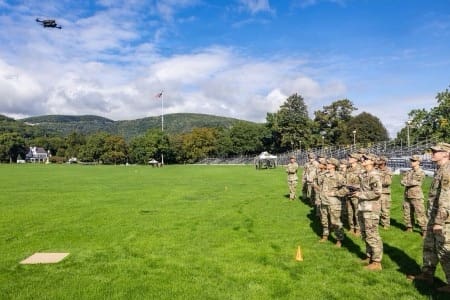
While some visions of the futuristic battlefield remain in the realm of science fiction, modern conflicts have demonstrated that many emerging technologies are already a reality.
Among them are Unmanned Aerial Vehicle (UAV) and Unmanned Aircraft Systems (UAS), commonly known as drones, which can operate via remote control or autonomously using onboard computers and GPS systems. Within the realm of military operations, drones can be used for surveillance, reconnaissance and combat missions.
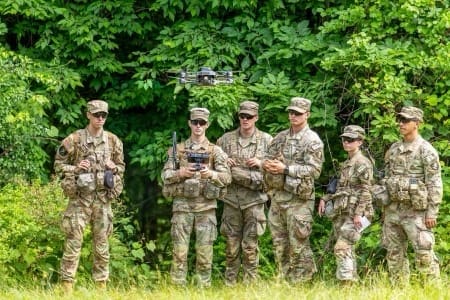
At the U.S. Military Academy, staying at the forefront of these technologies through field application, classroom instruction, and drone construction prepares cadets for what awaits them when they graduate and transition into their Army units as young leaders.
As the academic year gets underway, cadets are learning the functions and applications of drones through courses including Technology Innovation in Emerging Warfare and Computing Fundamentals, taught by the Department of Electrical Engineering and Computer Science (EECS).
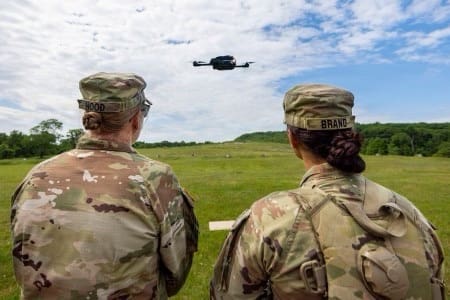
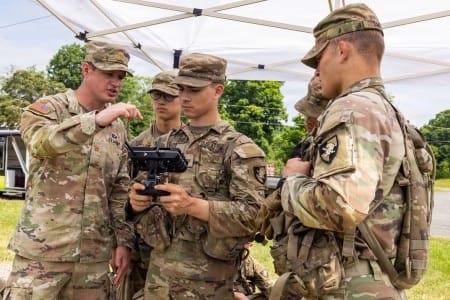
With the help of members of the Robotics Research Center (RRC) at West Point and its supply of drones, Technology Innovation in Emerging Warfare course instructors provided a culminating event called Drone Day on Sept. 29-30 on The Plain. The culminating event gave juniors and seniors enrolled in the course an opportunity to build upon their understanding of unmanned systems through hands-on application.
“The cadets get some hands-on experience operating the drones that are built at West Point after we have spent the last few weeks discussing how drones are shaping modern conflict,” said Maj. Tyler Bertles, EECS Cyber Foundations instructor.
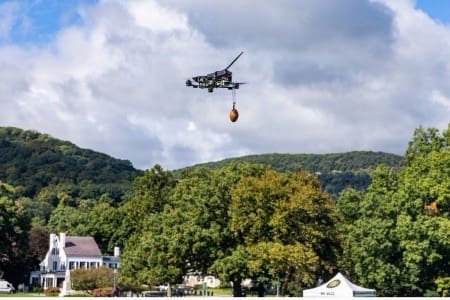
Over the past two years, drones have also been incorporated into Cadet Field Training (CFT) and Cadet Leader Development Training (CLDT), giving cadets opportunities to work with the technology during summer training. Drone Day provides additional exposure for cadets who may not have had that experience.
“Within EECS, we expect drone technology to continue to dominate modern conflict as we are seeing in Ukraine and the Middle East,” Bertles stated. “We are working to prepare cadets to both use and adapt drone technology for the diverse situations that they will encounter in the Army.”
Drone usage during Cadet Summer Training
As cadets embrace learning innovative technologies, they are guided by officers who have worked first-hand in the field with unmanned aerial systems (UAS).
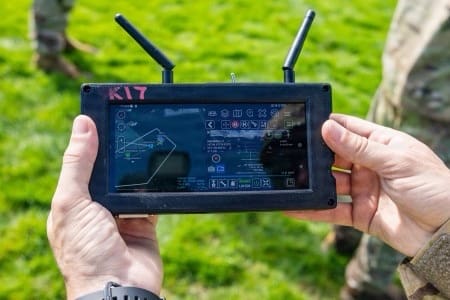
Maj. Vincent Kaple, with the Department of Military Instruction’s (DMI) Accessions Division, served with the 5th Battalion, 4th Air Defense Artillery Regiment in Ansbach, Germany, from 2021-24 as a battalion operations officer and battery commander. There, Kaple gained experience testing, fielding and employing short-range air defense capabilities against emerging aerial threats, including UAS. His unit also trained Ukrainian Armed Forces and special operations forces from NATO member states on short-range air defense platforms.
“That experience gave me significant exposure to emerging technology, particularly from the perspective of detecting, tracking and defeating UAS,” Kaple stated.
Kaple now brings that experience to cadet training, helping expose cadets early in their military careers to a capability becoming increasingly common across the Army, regardless of branch.
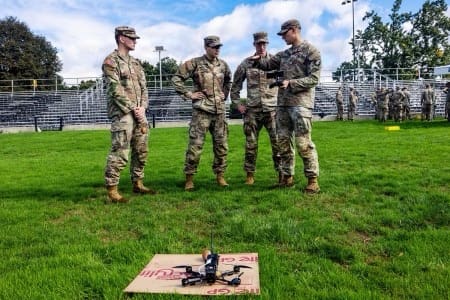
“There is tremendous value in giving cadets that exposure before they enter the operational force,” Kaple said. “It allows them to experiment in a relatively low-risk environment, understand both the capabilities and limitations of the technology, and begin thinking about how they would integrate it into tactical problems. More importantly, it develops comfort with adaptation.
“By the time they become platoon leaders, the specific drone they trained on may have changed, but their ability to rapidly learn, experiment with and integrate new technology will still be relevant,” he added. “My previous exposure to drones had largely been from the air defense perspective – detecting, tracking, integrating sensors and defeating aerial threats. Working directly with cadets employing drones forced me to look at the problem from the opposite perspective, which is how small units can employ UAS to support reconnaissance, fires correction, logistics resupply and other tactical operations.”
That early exposure to emerging technologies, Kaple said, is important because cadets are entering an Army where adapting to new systems will be “a routine part of leadership.” He added that instructors in the field are not simply teaching cadets how to operate a drone.
“We are teaching them how to think about technology as part of a tactical problem in what advantages it creates, what vulnerabilities it introduces, how it changes decision-making, and how an adversary might respond,” Kaple described.
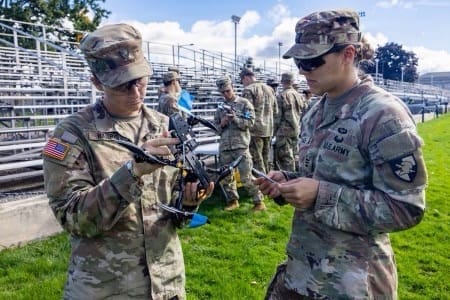
On the academic side, the RRC developed and manufactured the current Storm King drone with faculty and cadet involvement. Faculty and cadet feedback from CFT in 2025 was incorporated during the following academic year, leading to improvements in the drone’s capabilities and ease of use and helping move the system from the larger Harvey model to the current Storm King.
On the military side, cadet platoons employed drones during the five-day CFT field training exercise, primarily for reconnaissance and observing areas of interest throughout the training area.
“Platoon leadership had to deliberately determine how and when the drone would be employed to support their operations rather than simply launching it because it was available,” Kaple stated. “For me, it reinforced the idea that the real capability is not the platform itself, the capability comes from the combination of the technology, the operator, the tactical leader and the process for turning information into action.”
After this past summer’s CFT, Kaple said that dozens of cadets contacted him asking how they could become more involved in UAS development or what additional training opportunities were available to become drone operators.
“While the primary purpose of CFT remains developing cadets through small-unit, light infantry operations, the introduction of UAS appeared to generate significant additional interest in UAS,” Kaple said. “That was one of the most encouraging outcomes. We were not just teaching cadets how to operate a drone, we were generating curiosity and motivating them to continue learning about technology that is going to shape the Army they will eventually lead.”
RRC: A conduit to build adaptable leaders through technology
Kaple described the drone training during CFT and CLDT as an “outstanding partnership,” with the Robotics Research Center (RRC) bringing technical expertise and DMI providing the operational context and training objectives. Together, they developed a training plan that enabled approximately 1,200 cadets participating in CFT to develop basic drone piloting skills.
The five-day CFT field training exercise allowed each platoon access to a drone to support its operations, and the RRC and DMI partnership created an effective feedback loop.
“DMI could tell the RRC what we were seeing in the field … at the same time, the RRC could respond rapidly to that feedback by improving the system, troubleshooting technical issues and helping cadets understand how to maintain and employ the drones more effectively.
“The biggest lesson from that relationship was that successful technology integration requires connecting the people developing and understanding the technology with the people actually employing it,” Kaple said. “The RRC provided that connection and it allowed us to give cadets a much more meaningful experience than simply teaching them how to fly a drone.”
Established at West Point in 2017, the RRC is the Academy’s largest research center and serves as a resource for research and technical expertise in robotics and autonomous systems (RAS) and super intelligence. Led by Col. Joseph Davis, an academy professor with an aviation background, the center incorporates cadets and faculty into projects addressing real-world Army challenges.
“We do some amazing projects here … all that we do is centered around developing cadets and faculty,” Davis stated.
The RRC not only works with faculty and cadets from EECS, but also from across West Point in a wide variety of disciplines.
Those partnerships extend across West Point, including work with Keller Army Community Hospital involving super intelligence and medical applications.
“Our cadets have been teaming with Keller to design and prototype medical delivery drones that are capable of flying medicine between the hospital and the barracks,” Davis said.
The RRC aligns its priorities with the warfighter and what it needs to be successful on modern and future battlefields.
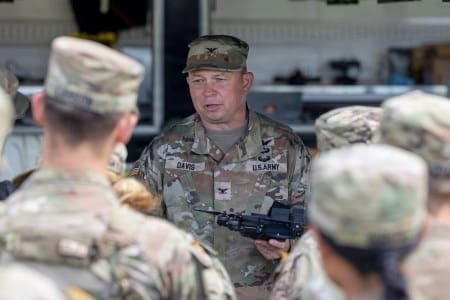
“Autonomy, super intelligence and robotics are at the forefront of where we believe that the future fight is going,” Davis said. “We want to see weapons mature faster, and we want to see this happen at a lower cost.”
The RRC has put that approach into practice with the Storm King drones used during cadet training this past summer. The goal is to achieve approximately 80% of commercial capability at 20% of the cost. The RRC has built baseline Storm King models for just over $3,000, compared with commercial systems costing over $30,000.
Part of the challenge in reducing costs and sourcing off-the-shelf components is the supply chain. Because the drones must meet National Defense Authorization Act requirements, the RRC must identify compliant sources for critical components. Davis said the industry’s reliance on Chinese-manufactured components made sourcing parts for the original Harvey drones particularly difficult, although an expanding domestic drone market and War Department initiatives are beginning to improve availability.
“It wasn’t the technical challenge of putting together a drone,” Davis said. “It was trying to find sources of supplies for drone parts that are not made in China.”
“That is changing with the drone dominance initiatives, the drone foundry, the drone marketplace, and other initiatives started by the War Department,” he added. “We’re starting to get drone parts quicker.”
The Storm King replaced the larger Harvey version from the previous summer training. The Storm King is much smaller, folds for easier transport and is more durable, although its flight time of roughly 25-28 minutes is significantly less than the Harvey version.
“In year one, the Harvey could stay in the air for almost an hour, but it was large and basically a giant flying battery,” Davis said.
The RRC designed the Harvey drone in about a month. With a deadline driven by summer training, they rushed to prepare 18 drones for training.
“We learned that summer that they did not need to be in the air for a full hour,” Davis explained. “They needed about 20-to-25minutes worth of flight time, and certain other design considerations were more important, like having the drone be lighter and easily transportable. So, we designed the Storm King to be smaller, lighter, more compact, and a lot more robust and resilient. It doesn’t break as easy and it has flown effectively in the rain.”
In the future, Davis hopes to increase the Storm King’s capabilities through the addition of new technologies and move the system from a prototype to a production-level drone, with the ability to support repairs at the unit level using inexpensive, locally produced parts.
Software upgrades are also planned to bring Storm King closer to industry capabilities while maintaining the goal of achieving 80% of the capability at 20% of the cost, with some of that work incorporated into the classroom.
“Storm King is the drone that we’re going to have every cadet learn how to build and repair in Computing Fundamentals,” Davis said. “The course is a freshman-level course that every cadet at West Point takes, and as part of the course there is a drone build and repair block, which culminates with flying the drone that they either built or repaired themselves.”
In 2026, a total of 11 individual classes were offered through the pilot program. Beginning in 2027, every freshman will get an opportunity to do that on a yearly basis.
“The vision is that a freshman cadet coming into West Point learns to assemble this drone their first year, they learn to repair it, they learn how to fly it and operate it, so they’ve done it in the classroom,” Davis said. “Then by the summer, when they get to Cadet Field Training, those drones get issued to the CFT companies and they take them out to the field for their FTX and conduct realistic military training with it.
“Later on, when they take Technology Innovation in Emerging Warfare, they see the same drone again, and they integrate higher-level super intelligence capabilities onto that drone,” he added. “One of the things we’re looking at is integrating computational systems on board the drones capable of Aided Target Recognition (AiTR).”
Once that happens, the drones can start recognizing targets, and the cadets can even write code to do it. Later, during CLDT, cadets would use the drones tactically in the field during force-on-force engagements.
By that point, cadets would have encountered drones through four different academic and military training experiences. The overall vision is for cadets to leave West Point and enter the Army as leaders who are comfortable with the technology and prepared to adapt alongside it.
“We want to inculcate this concept of tech craft into our formations as you see happening in Russia and Ukraine where Soldiers are being adaptive to emerging technologies,” Davis stated. “Cadets are learning trade skills that are going to serve them well in combat. They’re learning how to repair systems.”
At a time when unmanned systems are playing an increasingly significant role on the battlefield, Davis said developing these skills is critically important.
“You start thinking about what do we need to get good at as Soldiers, and I would argue one of those key skills is learning to employ and survive against unmanned aircraft systems,” Davis said. “I think that’s becoming arguably as important as learning how to shoot a rifle.”
Cadets seeking more advanced experience with drones and other emerging technologies can also pursue opportunities through groups including the West Point Robotics Club, Future Applied Systems and Tactics Team, Black Knight Drone Racing Team and Combat Aerial Weapons Team.
“Those cadets are using and developing drones with much more enhanced capability,” Davis explained. “These specialized cadets get to design and employ drones that drop clusters of grenades, drones with exoskeletons that can fly through windows and bounce around stairwells. They’re seeing first-person viewer drones that you’re seeing in Ukraine right now.”
Overall, the speed of innovation has created opportunities for faculty at West Point to provide intellectual capital and develop solutions for the Army while giving cadets opportunities to engage with emerging technologies throughout the academic year and summer training.
The 12 rotating faculty, like Kaple, who helped teach cadets on the training lanes during the summer were also an important part of the process.
“That second graduating class, as we call them, and their ability to use the skills they learned in graduate school and in the field to apply toward leadership and warfighting is making the cadets here better,” Davis said. “It’s going to make them better when they go back out into the operational Army. They’ll be more prepared to be future battalion commanders having been exposed to this kind of technology.”
Ultimately, the goal is not simply to teach cadets how to use today’s technology, but to develop leaders who can think critically and adapt as technology continues to evolve.
“They are the best and brightest, and they impress me with their adaptability and their young capable minds that are full of creativity,” Davis concluded. “We also have disciplined faculty members who come up with challenging ways of teaching and inspiring them. This is about developing their critical thinking skills.
“They’re highly capable, smart cadets who can learn through tough problems, and they will rise to the suitable level if you challenge them appropriately.”
By Eric Bartelt West Point Public Affairs Specialist
WESTFIELD, Massachusetts – October 8, 2026 Savage Arms®, an iconic firearm manufacturer, has expanded its REVEL series with the introduction of the REVEL Tactical, a modern lever-action rifle designed for versatility and performance. This new model joins the existing REVEL Classic and REVEL DLX, offering shooters enhanced features tailored for tactical applications.
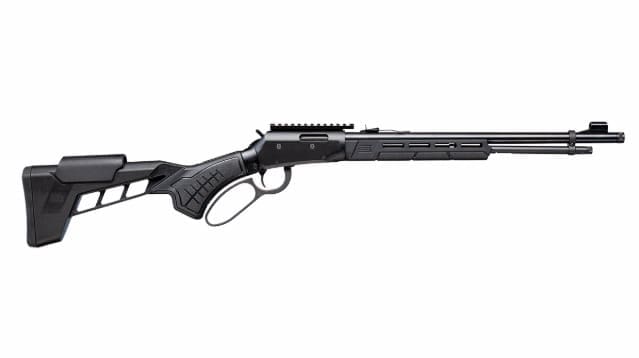
The REVEL Tactical is equipped with an MDT Tactical stock, providing enhanced grip touchpoints for improved handling. Its smooth lever action ensures reliable cycling, while the one-piece Picatinny rail facilitates the attachment of various optics and accessories. The rifle features an 18-inch medium-profile barrel with a 1/2″x28 threaded muzzle, accommodating suppressors and other muzzle devices.
“The REVEL Tactical represents the next evolution of our REVEL platform, combining the timeless appeal of a lever-action rifle with the modern features today’s shooters demand,” said Beth Shimanski, Vice President of Marketing at Savage Arms. “From its customizable fit and accessory-ready design to the smooth action Savage is known for, the REVEL Tactical delivers the versatility, reliability and performance needed for everything from range days to small-game hunting and recreational shooting.”
Adjustable iron sights, including a hooded front sight, offer versatility in targeting. M-LOK® slots on the fore-end allow for the attachment of additional accessories. The rifle’s stock offers comb height adaptability, achieved through a clip-on cheek riser, enabling shooters to customize the fit to their preferences. A custom designed pistol grip enhances ergonomics, and the simple takedown mechanism ensures ease of maintenance and transport.
The REVEL Tactical’s design reflects Savage Arms’ commitment to innovation in the firearms industry. By combining traditional lever-action mechanics with modern tactical features, the rifle caters to a diverse range of shooting disciplines, from hunting to tactical training.
The REVEL Tactical is available in 22 LR, 22 WMR and 17 HMR cartridges, catering to various shooting preferences and applications.
SKU / Description/ MSRP
46040 / REVEL Tactical 22 LR / $629
46140 / REVEL Tactical 22 WMR / $659
46240 / REVEL Tactical 17 HMR / $659
For more information about Savage Arms and its extensive line of leading firearms, visit savagearms.com.
Stop by Booth #3907 from October 12-14 to request a hands-on demonstration and explore VIPR’s capabilities with a Wilcox Industries team member.
QUANTICO, Va. (AFNS) —
For the first time, the Air Force Office of Special Investigations has certified a cadre of special agents to both operate and instruct others on the Skydio X10D as part of a broader effort to expand small unmanned aircraft system operations across the agency.
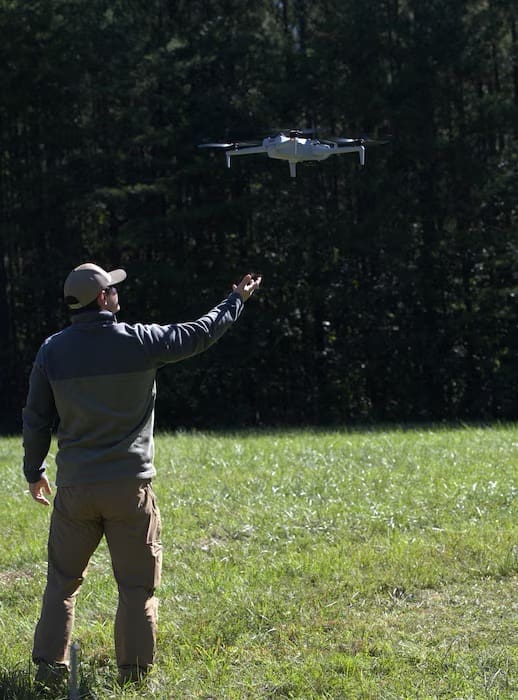
Last month, six personnel completed a weeklong course at AFOSI headquarters in Quantico, Virginia, creating the first group of instructors positioned to bring the capability back to technical operations units in the field.
“We not only learned how to operate the drones, but also how to properly instruct other individuals on how to fly successfully to meet mission needs,” said Special Agent Logan Trigg, assigned to the 2nd Field Investigations Squadron Technical Operations Program.
That instructor qualification is what gives the course its broader impact. Rather than returning to their units as individual operators, the six graduates can now begin building additional capacity across AFOSI.
“My plan is to train the entire 2 FIS Technical Operations flight on drone operations because it enables every member to carry out the mission regardless of where or when the capability is needed,” Trigg said. “Having everyone certified creates the ability to attack the mission effectively.”
That train-the-trainer model is central to how AFOSI intends to grow the program. The capability could support surveillance, outdoor crime scenes, protective-service support and other missions requiring what Trigg called an “an eye in the sky.”
The work to build AFOSI’s agency-level capability has been an ongoing effort since early 2024, with Detachment 111 at Edwards Air Force Base, California, serving as a working pilot program well before the five X10Ds will be used by Technical Operations agents in January 2027.
Creating multipliers
The course was structured around more than basic flight instruction. Agents first completed roughly 16 hours of classroom work covering airspace, Federal Aviation Administration requirements, mission planning and the administrative requirements behind government sUAS operations.
“After the classroom portion, we transitioned to the field for hands-on flight operations,” said Special Agent Scott Zawacki, AFOSI Technical Operations program manager. “We focused on the fundamentals of takeoff and landing, then progressed to the system’s autonomous capabilities and how those features can be applied to meet operational requirements.”
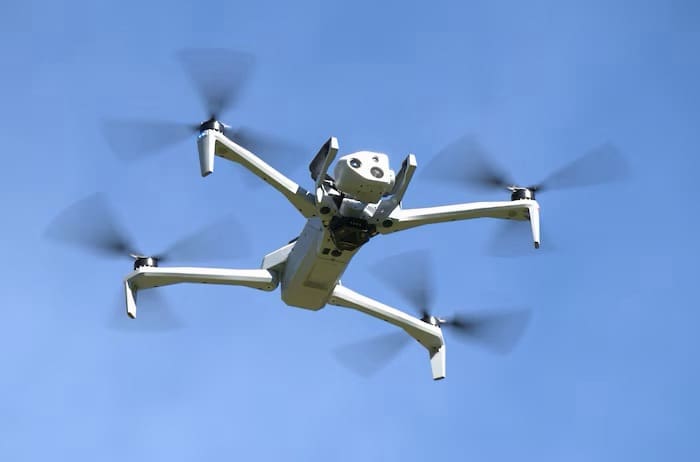
Once students were comfortable with the aircraft, the training shifted to approximately 16 hours of flight scenarios built around AFOSI missions.
In one exercise, students lifted to roughly 400 feet, identified a vehicle’s license plate and tracked the vehicle for roughly a mile. In another, they used the aircraft’s thermal camera at night to locate a person concealed in a wooded area.
“The real advantage is our ability to design highly specialized training scenarios that directly support AFOSI’s unique mission requirements,” Zawacki said.
By the end of the week, all six had qualified as both operators and instructors. The course was the latest step in an effort that began years earlier at Edwards AFB.
Building the program
At Edwards AFB, Anthony Zutten, AFOSI Det. 111 criminal indexing and investigations specialist, in coordination with Zawacki, developed a sUAS capability before AFOSI moved to establish a broader program in 2024.
To do this, Zutten worked through the approvals, funding and training requirements needed to stand up the local effort, which soon moved beyond demonstration flights.
Prior to the latest training, agents at Edwards AFB used drones to support reconnaissance related to illegal marijuana growing operations near the installation, map the site of a recent B-52 crash for the 412th Test Wing and assist with search-and-rescue efforts across the installation’s expansive operating area.
In one case, Zutten said a drone helped narrow the search area for a 12-year-old believed to be in danger before the child was eventually located. Those missions gave AFOSI early proof of concept for how sUAS could support investigations and other operational needs.
Meanwhile, at AFOSI headquarters, Zawacki examined the same capability from an agency-wide perspective. The two efforts eventually converged.
“Det. 111 helped establish the proof of concept for a broader expansion,” Zawacki said.
As AFOSI’s new MAJCOM sUAS program manager, Zawacki, in collaboration with Zutten, brought the Edwards AFB effort under the developing AFOSI structure, building on roughly two years of policy work, testing, coordination and funding efforts to establish a broader command capability. Zutten’s experience also made him a natural choice to lead AFOSI’s first broader operator-instructor course.
“He did a lot of the legwork in finding the policy, finding the people to talk to, coordinating everything and helping get this off the ground,” Zawacki said.
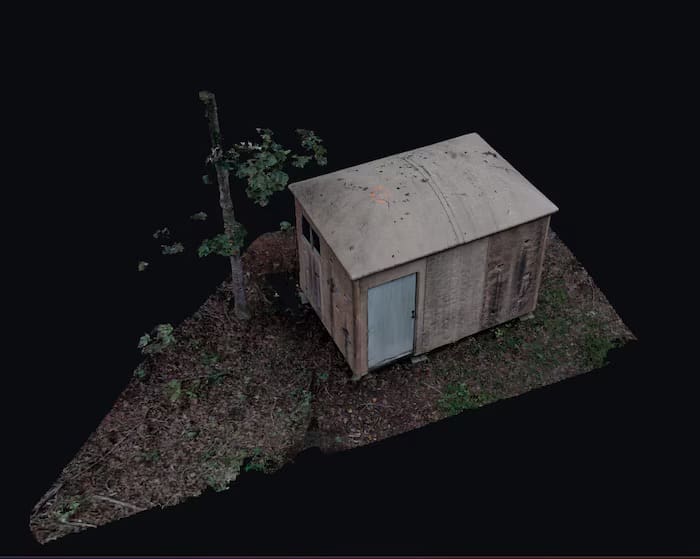
Drone technology also shows potential for detailed crime-scene documentation, he said. In one demonstration, operators captured 126 images that were stitched together to develop two- and three-dimensional crime-scene models.
“When reviewing crime-scene map captures, the detail is so clear you can zoom in and see each individual bullet casing, easily identify placards and see exactly where key evidence rests in relation to the scene,” Zutten said.
With compatible software, agents can also mark evidence and measure distances using spatial data captured through the drone’s imagery, incorporate telemetry data and upload the information directly into AFOSI’s case management system.
“By utilizing sUAS to assist with crime scenes, we can effectively cut tens of hours of work from our field agents by digitizing everything on scene in real time,” Zutten said.
AFOSI has not yet used that capability in an actual case. For now, demonstrations are helping officials determine where the technology can best support field operations.
“Our job is to give agents the capabilities they need to accomplish the mission,” Zutten said. “If this technology can help us collect detailed information faster, reduce risk to our people and better support a case or operation, then that’s where its value shines.”
By Thomas Brading
AFOSI Public Affairs

Nampa, Idaho (October 2026) – Caracal USA, a leading US-based manufacturer of small arms for the law enforcement and defense markets, will co-exhibit with the Pacific Northwest Defense Coalition (PNDC)in Booth 4325 at the 2026 Association of the United States Army (AUSA) Annual Meeting & Exposition, Oct. 12 – 15, 2026, in Washington, D.C. Billed as the premier land power exposition and professional development forum in North America, the AUSA Annual Meeting draws more than 40,000 attendees, including senior Army leaders, industry members, policymakers, and international delegations from more than 100 countries, with more than 750 exhibits.
At Booth 4325, Caracal USA will feature platforms engineered for military end users:
CAR816 A2 – A 5.56×45 mm NATO short-stroke piston rifle with a three-position adjustable gas valve, offered in 11.5-, 14.5-, and 16-inch barrel lengths with optional select-fire. The CAR816 A2 is built to exceed NATO test protocols, including bore obstruction and “over the beach” testing.
CAR814 A2 Patrol – A direct impingement rifle designed with military and law enforcement users in mind, available in 5.56×45 mm NATO and .300 AAC Blackout, with barrel lengths from 7.5 to 16 inches and optional select-fire.
CMP9 and CMP9K – 9mm pistol-caliber carbines derived from Caracal’s select-fire CMP9 submachine gun, featuring cold hammer-forged barrels, fully ambidextrous AR/M4-style controls, and MP5-pattern magazines. The 6-inch barreled CMP9K is sized for close-quarters and vehicle operations.
CSR 338 – A .338 Lapua Magnum bolt-action precision rifle with a 27-inch barrel, adjustable folding stock with integrated monopod, and a ½-MOA accuracy guarantee with factory match-grade ammunition. The CSR 338 is built to exceed NATO and U.S. testing protocols for light arms and shoulder-fired weapon systems.
?“AUSA puts us in front of the leaders who decide what soldiers carry into the field,” said Jeffrey Spalding, president and CEO of Caracal USA. “Our rifles and carbines are engineered and tested to meet NATO standards, and we’re proud to stand alongside PNDC and its member companies to show the Army and our allies what the Pacific Northwest defense industrial base can deliver.”

PNDC works to bring more defense and security contracts to the Pacific Northwest and to strengthen the supply chain that supports them. Its more than 300 member companies range from Fortune 100 firms to small machine shops serving aerospace, unmanned systems, advanced manufacturing, tactical equipment, information technology, maritime defense, homeland security, and space exploration.
Caracal USA will share Booth 4325 with fellow PNDC co-exhibitors APEX Space & Defense Systems, Decavo, Encoder Products Company, Genesis Arms, Gladiator Technologies, Heven AeroTech, LKD Aerospace, Lumibird, National Precision Bearing, New Use Energy Solutions Inc., nLight, Northwest Fourslide, Northwest UAV, Overwatch Imaging, Sightline Intelligence, Solarcore, Star-Batt, Tracer Tactical, and Umbragroup.
Spalding and Joey Harris, inside sales, will staff the Caracal USA table throughout the show. To schedule a meeting at AUSA, contact Harris at jharris@caracalusa.com.