Phantom Lights

Warrior East 21 – Ex-Power 2000 Multi-Fuel Generator

July 28th, 2021

The Ex-Power 2000 is from Novatio Engineering and only sold to the US military.

Based on a Honda Eu2200i generator, this multi fuel model will burn JP-8, F24, MOGAS and DF-2 emergency fuel. They’ve also integrated a BB2590 with weather shroud into the system.

It offers 4.2 hours at 1250W and 5.6 hours at 1000W.

Units and agencies can procure Novatio Engineering products shown during Warrior East by contacting Atlantic Diving Supply.

Warrior East 21 – Beyond Warrior Giveaway

July 28th, 2021

Beyond is conducting a Warrior Giveaway in conjunction with Bradford Knives for the Guardian 4.5 a pair of Firebird Airwalk MultiCam shoes and this spiffy glass and shemagh.

You can enter by scanning this QR code.

Warrior East 21 – Eleven 10 ETAK Tear-Away

July 28th, 2021

Eleven 10 ETAK (Enhanced Trauma Aid Kit) can be worn on your belt or mounted to any PALS webbing.

Features:
* Rapid Deployment utilizing a Releasable Platform and Fidlok® Strap
* Modular Internal Elastic Loop Organizers
* Medical Identifying PVC MED Patch Included
* Zippered Closure
* Can be Attached to MOLLE/PALS Using the Included Malice Clips
* Sewn-In Belt Channel

Kit Includes:

(1) ETAK Med Pouch with Elastic Loop Organizers
(1) Eleven 10® Compact Medical Trauma Dressing 4”
(1) QuikClot Combat Gauze LE or Frog Gauze
(1) Nitrile Exam Gloves – Pair, Size L
(1) Eleven 10® Frog Tape
(1) North American Rescue Hyfin Vent Compact Chest Seal, Twin Pack
(1) 4” ChemLight Light Stick
(1) 5.5” Trauma Shears

Offered in Black, Coyote, Ranger Green and MultiCam.

www.1110gear.com

Units and agencies can procure all products shown during Warrior East by contacting Atlantic Diving Supply.

Jason Redman – Warrior EAST 21 Keynote Speaker

July 28th, 2021

In his speech which discusses his “Overcome Mindset” to help you “Get off the X,” Retired SEAL Lieutenant Jason Redman provides many of the points from his books The Trident: The Forging, Reforging of a Navy SEAL Leader and Overcome: Crush Adversity with the Leadership Techniques of America’s Toughest Warriors.

He was wounded in September, 2007 which requires months of recovery at Bethesda Naval Medical Center. While in the hospital, an Orange sign hung on his door which stated:

Attention to all who enter here. If you are coming into this room with sorrow or to feel sorry for my wounds, go elsewhere. The wounds I received I got in a job I love, doing it for people I love, supporting the freedom of a country I deeply love. I am incredibly tough and will make a full recovery. What is full? That is the absolute utmost physically my body has the ability to recover. Then I will push that about 20 percent further through sheer mental tenacity. This room you are about to enter is a room of fun, optimism, and intense rapid regrowth. If you are not prepared for that, go elsewhere.

-The Management

But it took him awhile to get into that mindset. He remembers laying in bed thinking, “My Special Operations career is over, I’m going to be disabled, and I’m going to be disfigured.” But his experience setting ambushes and then being caught in one himself, he knew he had to “Get off the X” and overcome this situation. He vowed to never again feel sorry for himself, nor let anyone else. Hence, the sign. Its impact was felt.

From this experience, Redman created his own new beginning and vowed to be a light in the darkness for others facing adversity. He now urges others to serve as pointmen, setting the example and offering that there is always hope.

He reminds us that there is something you can always do. Through individual actions, you can make positive changes in others in a way that a single drop on a pond effects everything else through the ripple effect.

Redman advises that most people will encounter five “ambushes” in their life, major life changing events. Rather than focusing on our own misery, we must work to Get off the X and make positive change.

His answer is in the acronym R.E.A.C.T.

Recognize Your Reality
Evaluate Your Assets
Assess Possible Options & Outcomes
Choose a Direction & Communicate It
Take Action

He followed this up by urging us to seek leadership balance. He teaches the Pentagon of PEAK performance.

His final point was about perspective. When he has a hard day, he thinks back on what happened the day he was injured, reminding us that if you’re still breathing, it’s a great day.

Redman has much more to offer than the points I’ve shared here and they are applicable to every aspect of your life, not just the professional part.

To lean more, visit getoffx.com/redmanreact.

2021 Warrior EAST Expo

July 28th, 2021

This morning we are kicking off our 2021 Warrior East coverage. There’s a lot of energy, a great crowd of attendees and a massive trade show floor.

Like Warrior West there’s more than I can cover in two days, let alone see.

SureFire Field Notes Ep. 64: Practical Shooting with Matt Pranka

July 28th, 2021

SureFire Field Notes is an informational video series with tips and techniques from subject matter experts of all backgrounds. In this episode, Matt Pranka discusses the importance of competitive shooting and relevance to tactical shooters.

Matt Pranka is the owner of Xray Alpha, has 26 years of military experience in Special Operations and is a USPSA Grand Master in production Division.

Xray Alpha instructors has spent decades being sent to all of the hot-beds of action, hunting the enemies of the United States.  We actively put our training to the test on a regular cycle.  We continue to work in this capacity and will consistently be putting ourselves into the fray. Xray Alpha training is driven from the passion of its founder to relay timely and effective training and tactics to the individuals that use them to save others, protect their family, and protect this nation. This isn’t something we want to do for fun or a quick buck, we are driven to give back as something we must do.

Special thanks to Route 66 Shooting Sports Park and the Norco Running Gun IPSC Club.

www.xrayalpha.com

www.surefire.com

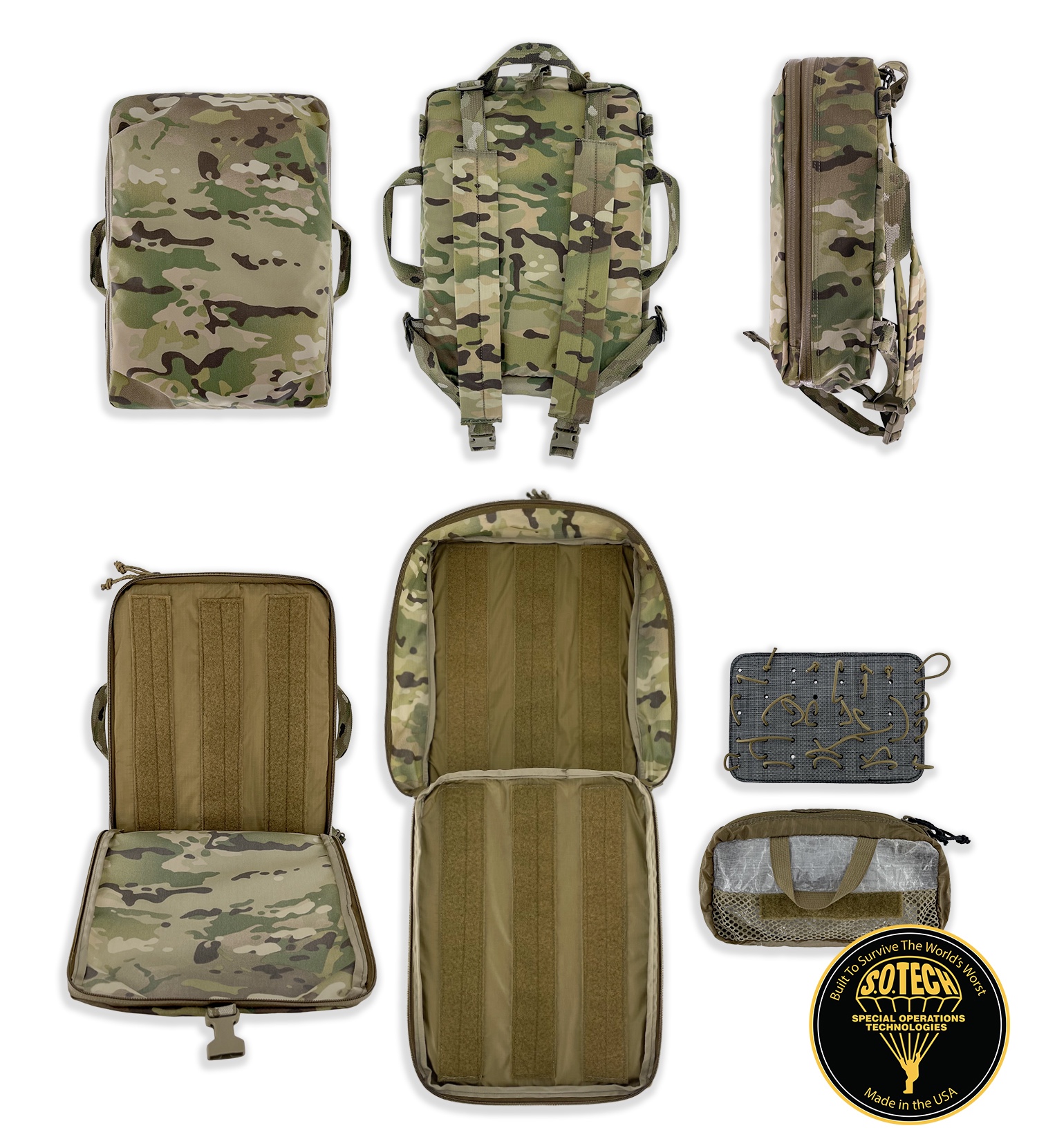
SOARescue x Haley Strategic Partners M3 Med Mag Mount

July 28th, 2021

We are proud to introduce the M3 Med mag mount a collaboration between SOARescue & Haley Strategic Partners.

SOARescue is a premier provider of lifesaving equipment and training for the military, law enforcement, and the responsible armed citizen. The M3 is a mounting platform for the low-profile med mag developed by SOARescue.

The Med mag is designed to be the most versatile individual trauma kits available in a small streamline package. IFAKs can get bulky and the genesis of the Medmag came from a need to have a medical kit that could fit in the mag pouch on an officer or soldier. The mount is reloadable with a wide variety of inserts currently offered by SOARescue. If there is a need for a specific type of medical kit you can swap the components within seconds.

The M3 is constructed of laser cut squadron laminate for durability and strength while also having a heavy woven elastic portion for retaining tourniquets, chemlights, sharpies and needle decompression needles.

Get it in Coyote, Black and MultiCam.

Get it at SOARescue or Haley Strategic Partners.

Bird’s-eye View Could be Key to Navigating Without GPS

July 28th, 2021

RESEARCH TRIANGLE PARK, N.C. — A bird’s-eye view may take on new meaning thanks to Army-funded research. Scientists found that a protein in bird’s retinas is sensitive to the Earth’s magnetic field thus guiding its migratory patterns. That finding could be key to Army navigation of both autonomous and manned vehicles where GPS is unavailable.

For decades, scientists have been investigating how animals such as birds, sea turtles, fish and insects sense the Earth’s magnetic field and use it to find their way.

Researchers at the Universities of Oxford and Oldenburg, supported through a co-funded effort of the U.S. Army Combat Capabilities Development Command, known as DEVCOM, Army Research Laboratory and the Office of Naval Research Global, and Air Force Office of Scientific Research were the first to demonstrate that a protein in birds’ retinas is sensitive to magnetic fields and may be a long-sought sensor for biological navigation.

The team discovered that the magnetic sense of migratory birds such as European robins is based on a specific light-sensitive protein in the eye. The research, published in Nature, identified the protein that the scientists believe allows these songbirds to detect the direction of the Earth’s magnetic field and navigate their migration.

“This research not only demonstrated that cryptochrome 4 is sensitive to magnetic fields, but importantly also identified the molecular mechanism underlying this sensitivity,” Dr. Stephanie McElhinny, a program manager at the laboratory. “This fundamental knowledge is critical for informing future technology development efforts aimed at exploiting this mechanism for highly sensitive magnetic field sensors that could enable Army navigation where GPS is unavailable, compromised or denied.”

The researchers extracted the genetic code for the potentially magnetically sensitive cryptochrome 4 and produced the photoactive protein in large quantities using bacterial cell cultures. The team then used a wide range of magnetic resonance and novel optical spectroscopy techniques to study the protein and demonstrate its pronounced sensitivity to magnetic fields.

The team showed that the protein is sensitive to magnetic fields due to electron transfer reactions triggered by absorption of blue light. They believe that these highly-specialized chemical reactions give the birds information about the direction of the Earth’s magnetic field, which acts like a magnetic compass.

“While more research needs to be done to fully understand how cryptochrome 4 senses the weak magnetic field of Earth and how this is ultimately translated into signals that are understood by the migrating bird, this new knowledge is an exciting first step toward potential navigation systems that would rely only on the magnetic field of Earth, unaffected by weather or light levels,” McElhinny said.

Because the magnetic field modifies the cryptochrome protein in a measurable way, cryptochrome proteins or synthetic molecules that mimic the mechanism of cryptochrome’s magnetic sensing could be used in a future navigation device.

Detectable changes in the protein would be decoded to indicate the strength and direction of the magnetic field, and thus the navigational position on Earth.

Proteins like cryptochrome consist of chains of amino acids. Cyrptochrome 4 contains four tryptophan amino acids that are organized in series. According to the research team’s calculations, electrons hop from one tryptophan to the next through the series, generating so-called radical pairs which are magnetically sensitive.

To prove this experimentally, the team from Oldenburg University produced slightly modified versions of the robin cryptochrome, in which each of the tryptophans in turn was replaced by a different amino acid to block the movement of electrons.

Using these modified proteins, the Oxford University chemistry groups experimentally demonstrated that electrons move within the cryptochrome as predicted in the calculations and that the generated radical pairs are essential to explain the observed magnetic field effects.

The team also expressed cryptochrome 4 from chickens and pigeons, which do not migrate. The researchers found that the protein is more magnetically sensitive in the migratory birds than either the chickens or pigeons.

“We think these results are very important because they show for the first time that a molecule from the visual apparatus of a migratory bird is sensitive to magnetic fields,” said Professor Henrik Mouritsen, Institute of Biology and Environmental Sciences at Oldenburg University.

But, he adds, this is not definitive proof that cryptochrome 4 is the magnetic sensor the team is looking for. In all experiments, the researchers examined isolated proteins in the laboratory and the magnetic fields used were also stronger than the Earth’s magnetic field.

“It therefore still needs to be shown that this is happening in the eyes of birds,” Mouritsen said.

Such studies are not yet technically possible; however, the authors think the proteins involved could be significantly more sensitive in their native environment.

In cells in the retina, the proteins are probably fixed and aligned, increasing their sensitivity to the direction of the magnetic field. Moreover, they are also likely to be associated with other proteins that could amplify the sensory signals. The team is currently searching for these as yet unknown interaction partners.

“If we can prove that cryptochrome 4 is the magnetic sensor we will have demonstrated a fundamentally quantum mechanism that makes animals sensitive to environmental stimuli a million times weaker than previously thought possible,” said Peter Hore, professor of Chemistry at the University of Oxford.

Operation in a GPS-denied environment is a U.S. Army goal.

The Army has to be prepared to operate in environments where the technology has been degraded or denied by enemy action, officials said.

In additional to the Army, Navy, and Air Force, the European Research Council also supported this research. The collaboration is also a key part of a Collaborative Research Center funded by the German Research Foundation.