SIG SAUER - Never Settle

Army Seeks Airborne Assault Pack

December 21st, 2009

Natick has issued a Sources Sought Notice for a Large Airborne Assault Pack. Oddly enough, the actual title of the notice is, “Tactical Load Carriage Equipment capable of being used in a combat environment that are additionally suited for Army Airborne Operations that are based in the United States or U.S. Possessions.” What a mouthful, and what the heck does that even mean? How about just shortening the title to, “Large Airborne Assault Pack?” Then you can get into that it will be used for both combat and training operations in the narrative.

Specific requirements include, “internal storage capacity of 2900 cubic inches. The large assault pack will be made of the same unique fabrics, finishings and findings available in the current Modular Lightweight Load Carriage (MOLLE) Large Ruck-Sack. Additionally the large assault pack must have an integrated single point release system and hook-pile-tape lowering line that is either permanently attached, or is part of the overall design of the assault pack, that is capable of meeting the stringent requirements of rotary and fixed wing personnel airborne operations. The large assault pack must have a storage pocket for the hook-pile-tape lowering line, 18 personnel attaching straps and the single point release handle when the large assault pack is not rigged for airborne operations.”

Please note that this is an assault pack. This means no frame required. On another note, I am personally no fan of permanently attaching air items to a pack that a guy has to schlep around all day, particularly a single point release. Additionally, carting your lowering line around only adds insult to injury.

Interested vendors have until 30 December to answer but have to include a jump ready pack in their answer. It is important to note that whether or not you answer the Sources Sought you may still answer a formal Request For Proposals if one issued, but it is important to the Government that you do answer this current request as the information gathered will help shape any further procurement decisions. They need to know what the state of the art consists of.

A similar project was undertaken in late Summer to support a requirement out of the 82d Airborne Division. Several commercial packs were assessed under conditions which included airborne operations overseen by the Airborne Special Operations Test Directorate (ACE Board) and the Advanced Airborne School. I received information during AUSA that a winner had been chosen and when I spoke to that company they were surprised to hear it. Even now, I have seen no formal award nor announcement on the project by the Army so perhaps this new project has supplanted the earlier work.
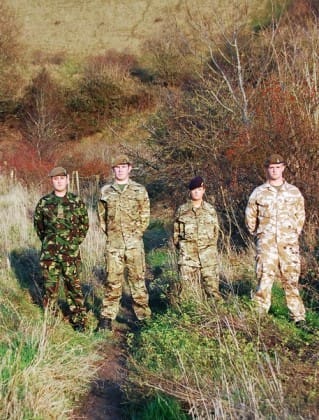
Testing the New British Camouflage

December 21st, 2009

Our friend Dom Hyde, posted this article from the UK’s Defence Science and Technology Laboratory (Dstl).

According to the article, which goes into great depth about their goals and methodology, “Dstl assessed whether a multi-terrain camouflage was better than the standard army woodland camouflage disruptive pattern material (DPM) or the desert DPM and if so what is the best pattern, or balance of colours. The two current camouflage schemes were tested alongside an existing off-the-shelf multi-terrain camouflage to see which performed best across various backgrounds that soldiers are likely to encounter across the landscape in Afghanistan.” Sounds an awful lot like what the US is currently doing.

Perhaps, based on the UK experience of adapting the Crye color palette to their pattern, the right answer for the US is to do something similar. It seems that the MultiCam pattern is challenging for the supply chain to sustain due to its complexity in printing. Apparently it is difficult for inspectors to quickly approve material printed in the pattern as they must look over the sample and decide whether it meets spec for color shading and blending. Due to the US obsession with so-called digital patterns, if a pixelated version were created, it would be much easier to print and quicker for the inspectors to proof. However, it would lose some of its effectiveness due to the loss of the fades in the pattern.

UK MoD releases MTP Photo

December 21st, 2009

The UK MoD has released a photo that shows the new Multi-Terrain Pattern (MTP) with the currently issued Woodland and Desert Disruptive Pattern Material (DPM) patterns.

MTP Pattern, Photo from UKMoD

German Military Awards Pre-Production Contract for Future Soldier System

December 21st, 2009

The German Bundesamt für Wehrtechnik und Beschaffung (Federal Agency for Defense Technology and Procurement) in Koblenz, awarded Rheinmetall Defence a contract for pre-production examples of the IdZ-ES (Infanterist der Zukunft – Erweitertes System or Future Soldier – Expanded System) last Thursday, 17 December.

IdZ system from Rheinmetall

The program began in 2004 but in 2006 Rheinmetall Defence assumed lead for development of the system after an EADS led “Projekthaus System Soldat” version proved to have deficiencies. Rheinmetall claims this is an entirely new system. Full-scale procurement is to begin in 2012. Ultimately, they plan to purchase 1000 kits for all three armed services with each kit equipping 10 men.

Sniper: Inside the Crosshairs

December 20th, 2009

The History Channel presents “Sniper: Inside the Crosshairs” tonight at 9PM Eastern. Portions of the show were filmed at Tier 1 Group’s facility near Memphis, Tennessee and this two-hour special will feature a discussion by EOTAC’s Fernando Coelho of ballistic gelatin and its use in wound profiles for various rounds.

Schedule

More on New Brit Camo

December 20th, 2009

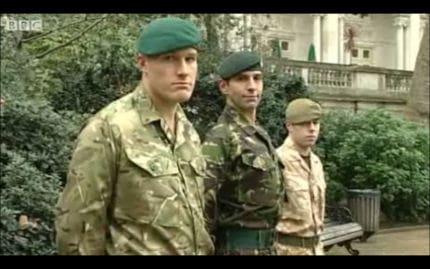
The BBC has reported on the new Multi-Terrain Pattern meant to replace the Woodland pattern found on No. 8 DPM uniform in service for the past 40 years. However, the No.5 Desert Combat Dress will remain in service. As we reported earlier, Crye Precision developed the pattern for the exclusive use of the UK Ministry of Defence.

MTP, Woodland, and Desert Camo Patterns - Photo BBC

In the BBC video Lieutenant Colonel Toby Evans identified as “a military advisor with the Government’s Defence Science and Technology Laboratory,” speaks quite a bit about the importance of the camo pattern as a “corporate image” and how it represented the “British Army brand.” In effect, the British Army has adopted a new woodland pattern that is more relevant in a wide variety of environments than the previous pattern which was more developed for use in Northern Europe. They will retain their desert pattern for specialist use so they will continue to have a two pattern system but with one of the patterns being more universal in nature rather than tuned specifically for verdant areas. Finally, in addition to uniforms in the CS95 cut, the British Soldier will receive armor and helmet covers, packs and webbing in MTP. However, this will happen over time while the new uniforms as soon as this Spring.

Zombie Targets

December 20th, 2009

Zombie Targets - FransOne of our readers clued us in on these new targets featuring zombie silhouettes. Billed as “The only target that will eat your brain”, many will find these entertaining and a nice diversion from standard targets. In addition to the four different black and white figures offered by the manufacturer, Law Enforcement Targets has six different color versions including the dreaded Frans – Nazi Zombie. Each target is 25″ x 35″ and printed on 60 lbs paper. Competition-style target zones are included on the torso and brain but cannot be seen from a distance.

They are available, aptly enough, from www.zombietargets.net.

Kiwis Update Kit

December 19th, 2009

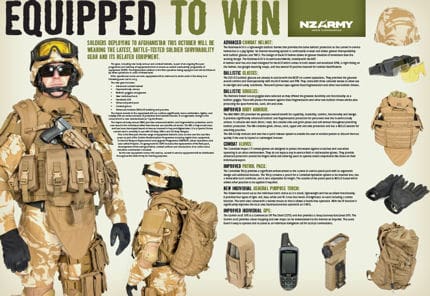
We have been receiving reports regularly from our readers that the New Zealand Army is updating its individual equipment but the Army itself issued a great poster detailing the features of the new Soldier Survivability Gear.

According to Chief of the Army MAJ GEN Rhys Jones, “There are currently 790 New Zealand Defence Force personnel deployed on 14 operations, UN missions and defence exercises in 10 countries around the world.” The NZ Army began issuing the equipment to these troops in October and much of it would be familiar to Soldier Systems Daily readers. In addition to the SOCOM issued BAE RBAV and BPG Serpa holster, the Kiwis are also receiving the Camelbak Trizip based on a Mystery Ranch design. Additionally, they are being issued Camelbak gloves, Streamlight Sidewinder lights, ESS ballistic glasses, Revision ballistic goggles, Garmin GPS. The only item that you would have trouble finding here in the US is the Rabintex helmet.

New Zealand Army - Equipped to Win

•The new advanced combat helmet is 0.5kg lighter than its predecessor, has an internal mounting system that makes it more comfortable to wear and allows greater functionality with ballistic glasses or communications equipment.
•The improved body armour (IBA) provides enhanced ballistic and fragmentation protection and is now sized to the individual rather than one-size-fits-all. The IBA also includes side, groin and bicep protection should it be required by the wearer and has a modular webbing system so soldiers can customise the pouches they attach directly to their webbing.
•The IBA is fully modular and also has a quick release system to enable the user or another person to discard the vest quickly if the user is injured or submerged in water.
•The improved patrol pack is ergonomic in design, has an adjustable, removable back comforter and is adjustable for height.
•The Revision Desert Locust ballistic goggles were selected as they offered the greatest durability and functionality. These protect the wearer against blast fragmentation and other non-ballistic threats whilst also protecting the eyes from wind, sand, dirt and snow.
•New individual general purpose torch: The Sidewinder stood out as the individual torch choice as it is small, light-weight and has excellent functionality. It provides four types of light: red, blue, white and Infra-red. It has four levels of brightness on each including a strobe function. The torch also comes with a helmet mount so that it allows a hands-free operation. With the IR function it significantly improves the local area illumination when used with an night vision goggles.
•Improved individual GPS: The Garmin 60cX GPS is a unit that provides a cheap but very functional GPS. The Garmin provides colour mapping and new maps can be downloaded via the internet as required. The users found it easy to operate and accurate as an individual navigation aid for tactical commanders.