XC3 Weaponlight

Archive for September, 2025

Drone Busting: Smart Devices Work Together to Knock Out UAS Threats

Sunday, September 28th, 2025

FORT SILL, Okla. — What’s harder to shoot down than a small drone in the sky? Students at the War Department’s only joint training center for countering aerial threats will likely say it’s what they practice on — balloons attached to those small drones.

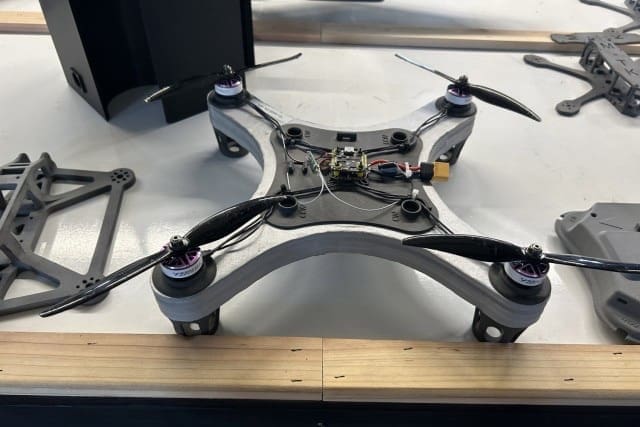
Drones can fly at racecar speeds, making them difficult targets to hit by an individual on the ground. At the Joint Counter-Small Unmanned Aircraft System University, located at Fort Sill, students use handheld smart devices to help them increase their probability of scoring a hit.

Known as the Dronebuster and Smart Shooter, these two handheld systems work in tandem as a layered defense that uses electronic and kinetic warfare to do the hard work for the shooter.

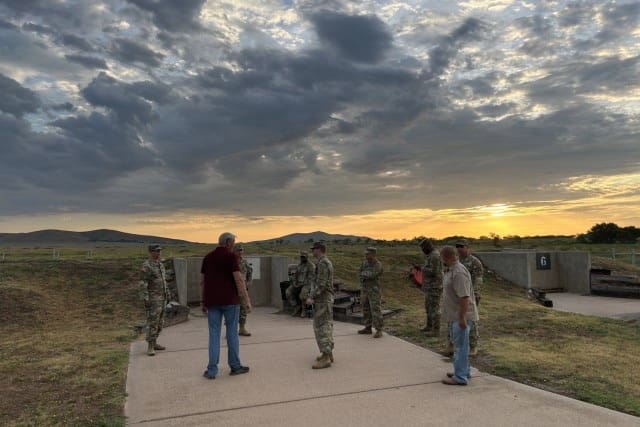
Students who attend JCU learn about various drones and the intricate service-specific systems used to engage with them. The Dronebuster and Smart Shooter, however, are two of the few used by service members on the ground, such as patrol members or personnel guarding installation towers.

So, how do these tandem devices work?

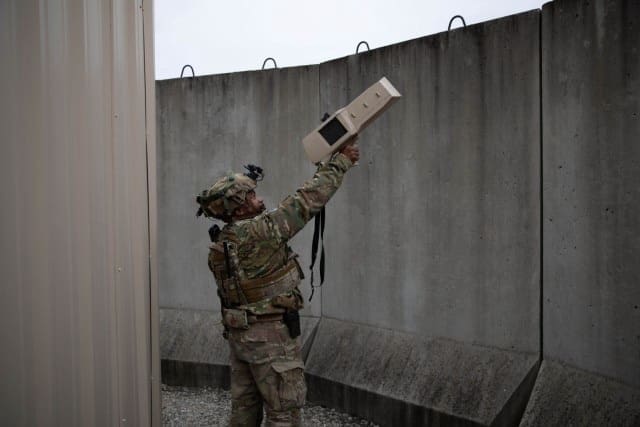
When service members are warned of a drone presence, the Dronebuster can be held up like a weapon to scan the area. Once it identifies a hostile target, the service member simply presses a button on the device to disrupt the target using electronic warfare.

Joint Counter-small Unmanned Aircraft Systems (C-sUAS) University Instructor U.S. Army Sgt. 1st Class Alan Buhl and JCU Operators Course Supervisor Fred Hill talk about the smart shooter optic for the M4 and the JCU operators course at Fort Sill, Oklahoma, Aug. 19-20, 2025. (DoW video by U.S. Air Force Staff Sgt. Madelyn Keech)

“It’ll start jamming the command and controls, severing that connection between the drone and the operator,” explained JCU operator’s course instructor Paul Bliefernich.

The drone remains frozen in the air. That’s when a second operator picks up the Smart Shooter, an optic system that attaches to a weapon to control how it fires.

“Typically, when you pull the trigger, you’re used to a gun going ‘bang.’ [The Smart Shooter] doesn’t do that,” explained JCU operator’s course supervisor Fred Hill. “It calculates, and then it shoots when it’s ready to shoot.”

“When [shooters] get to the target they want, they’ll hit the ‘lock’ button … and start squeezing the trigger,” Bliefernich explained. However, the weapon doesn’t immediately fire. Instead, its computer takes over and displays a set of crosshairs in the scope that the operator aligns with the target. When the computer decides there’s a good probability of a hit, it sends a command to the pistol grip, allowing the operator to complete the trigger pull and fire the weapon.

Bliefernich said it can take from a few seconds up to two minutes. “It’s doing calculations and taking a lot into consideration,” he added.

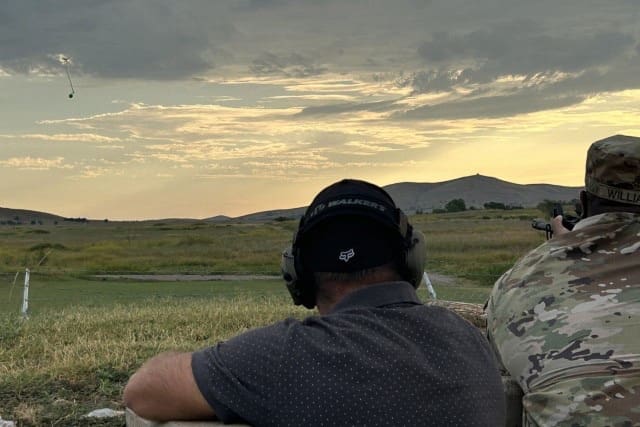
Since shooting down several drones per class isn’t cost-effective, JCU students mostly shoot balloons attached to drones. It’s a more challenging target, but with practice, it can make them a better shot.

“The balloons are harder to shoot than the drone,” Hill said. “Once the shooter gets toward the end of the training, we’ll put up the aircraft and let them shoot at the aircraft.”

“It takes a lot of time and practice,” Bliefernich said.

The students are also able to train on the Smart Shooter in the virtual reality lab beforehand, which instructors said is both cost-effective and safer.

“It’s getting the Soldiers, airmen and sailors familiar with the equipment before they ever come and start shooting on the ground,” said Army Sgt. 1st Class Alan Buhl, JCU instructor.

The school teaches Soldiers, sailors, airmen and Marines much more than just how to operate handheld drone equipment. Students also learn how to use various fixed-site counter-small UAS systems, as well as how to plan strategies, train others and better prepare their installations for future threats.

Joint Counter-Small Unmanned Aircraft System University became operational in 2023. Fort Sill is home to the Army Field Artillery School, the Army Air Defense Artillery School, the 75th Fires Brigade and the 31st Air Defense Artillery Brigade, all of which have nurtured counter-small UAS strategies since the threat first emerged.

By Katie Lange, Pentagon News

1st Special Forces Command – “What Makes Us Exceptional?”

Sunday, September 28th, 2025

Video by SPC Kyle Chacon 
1st Special Forces Command (Airborne)

ASA & Second Amendment Coalition Call Out Big Banks for Whitewashing History of Discriminatory Debanking

Sunday, September 28th, 2025

ASA & Second Amendment Coalition Call Out Big Banks for Whitewashing History of Discriminatory Debanking
WASHINGTON, D.C. – Today, the American Suppressor Association (ASA) led a coalition of major Second Amendment groups in a letter to prominent American financial institutions demanding a public repudiation of their political debanking practices. The coalition, which includes the National Rifle Association (NRA), Second Amendment Foundation (SAF), Gun Owners of America (GOA), the National Association for Gun Rights (NAGR), and the Citizens Committee for the Right to Keep and Bear Arms (CCRKBA), represents the unified voice of the Second Amendment community and millions of law-abiding gun owners across the United States.

The letter makes clear that the gun industry has “faced relentless attacks and discriminatory treatment for decades,” noting how companies have been “shut out of mainstream financial institutions, including by your banks and those you represent.” These attacks on gun manufacturers, retailers, and aligned organizations have been a “brazen and ideologically driven campaign to undermine the constitutionally protected right of all Americans to keep and bear arms.”

The letter specifically calls out JPMorgan Chase CEO Jamie Dimon and Bank of America CEO Brian Moynihan for their record of restricting services to businesses and organizations in the firearms industry. The letter calls out recent attempts by these banks to shift blame onto Obama- and Biden-era regulators, noting that some of the banks most restrictive policies came when neither were in office. Their blame shifting follows the Trump administration’s strong executive order to prevent this behavior in the future. The letter concludes: 

“President Donald J. Trump and his administration have taken decisive action to undo the decades-long erosion of Americans’ Second Amendment rights. Through amicus briefs in Barnett v. Raoul and Peterson, as well as the most pro-Second Amendment executive order in our nation’s history signed by President Trump in February, it is clear that protecting the tens of millions of firearms owners across the country is a top priority for him.”

“An equal application of rules and standards across industries is critical for fairness and ensuring the rights of law-abiding gun owners are not infringed.”

Click here to read the full coalition letter to the banks.

Garand Thumb: How To Navigate In The Wilderness

Saturday, September 27th, 2025

Navigating with a map and compass is one of the most fundamental skills anyone who spends time in the outdoors needs to master.

Mike Jones aka Garand Thumb spent a good portion of his career teaching military personnel how to survive in a variety of environments. Leveraging his expertise he’s produced this video to help others learn the fundamentals up to medium capability.

Here’s the video description:

Learn the fundamentals of land navigation with a map, compass, and protractor. This video covers essential skills from reading and plotting MGRS coordinates to applying magnetic declination correctly. We’ll also demonstrate how to navigate between points, use practical movement techniques, and even cover burden carrying methods for real-world field conditions. Whether you’re preparing for military training, outdoor survival, or just want to sharpen your backcountry skills, this guide provides the medium-difficulty level instruction you need to become confident with traditional navigation tools.

Check it out below for what he describes as a full hour and 36 mins of knowledge and autism.

“The Caliber Cluster” by LAV

Saturday, September 27th, 2025

This is a guest post by my longtime friend MSG Larry Vickers, (USA, Ret) or as he’s known by many, LAV. He discusses a situation the Us military has created for itself which he refers to as the “The Caliber Cluster” and by cluster I think he intends it as half a word. I too am concerned with the logistics of so many small arms cartridges and I fear it will only get worse as we continue to chase the next great thing.
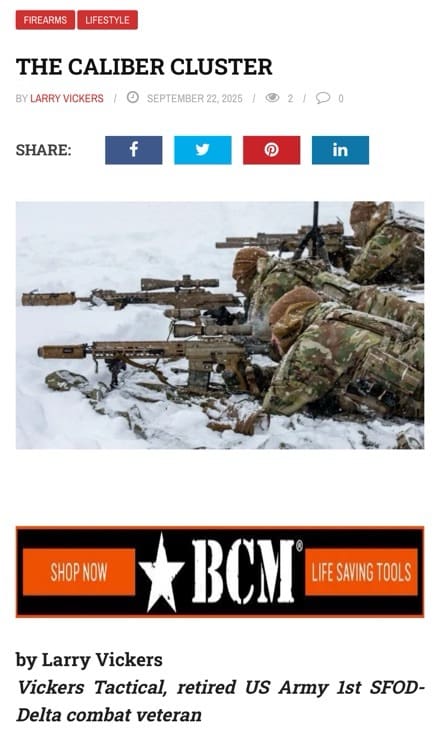
Alright, folks, let’s dive into the absolute train wreck that is the U.S. military’s small arms and ammo situation, specifically with the Army and Special Operations Forces (SOF), and why the current mess of guns and calibers is a logistical nightmare that’d make even a seasoned logistician’s head spin.

We’re talking a situation so convoluted it makes the Germans’ multi-caliber chaos in WWII look like a well-oiled machine. And trust me, that’s saying something.

General Omar Bradley is credited with the saying “Amateurs study tactics; professionals study logistics,” and that hits the nail on the head here. In war, logistics is king. You can have the fanciest tactics and the slickest operators, but if your supply chain is a dumpster fire, you’re done. Interoperability—ensuring your weapons and ammo work seamlessly across units—is critical to keeping the fight going. Right now, the Army and SOF are juggling so many calibers and platforms if they don’t reel them in soon they will have serious problems in any prolonged conflict.

The Caliber Cluster

Let’s run through the ammo mess. The U.S. military is fielding a ever growing number of calibers, each with its own quirks, supply chains, and compatibility issues. Here’s what we’re dealing with, based on my own digging:

5.56x45mm NATO: The bread-and-butter round for the M4 and M16 platforms. It’s lightweight, allows soldiers to carry a ton of rounds (standard combat load is about 210 rounds—seven 30-round mags), and it’s been the standard since NATO adopted it in 1980. But it’s got issues: limited stopping power and range, especially against modern body armor. Stories from the field, like in Afghanistan, have guys dumping multiple rounds into targets with minimal effect unless you hit something vital.

7.62x51mm NATO: The old-school heavy hitter, used in everything from the M14 to modern designated marksman rifles like the M110. It’s got range and punch but weighs a ton compared to 5.56mm—about half as many rounds per soldier due to the weight. Still in use for machine guns like the M240 and sniper platforms, but it’s a bear to hump around.

6.8mm (XM1186): The Army’s new darling, part of the Next Generation Squad Weapon (NGSW) program with SIG Sauer’s MCX Spear (NGSW-R) and MG 6.8 (NGSW-AR). Designed to split the difference between 5.56mm’s portability and 7.62mm’s lethality, it’s supposed to offer better range and terminal ballistics. Problem? It’s a whole new supply chain, and the Army’s betting big on it replacing both 5.56mm and 7.62mm. Good luck with that transition in a war zone.

6mm ARC: This one’s a niche player, primarily tied to the Surefire MGX gun that Delta Force is reportedly messing with. It’s a lightweight, high-performance round for long-range shooting, with better ballistics than 5.56mm but less recoil than 7.62mm. Sounds great, except it’s another caliber to stock, and reliability issues with the larger case diameter have been noted.

6.5mm Creedmoor: SOCOM’s been hot on this one for a while, with new rifles like the Mid-Range Gas Gun-Assault (MRGG-A) and machine guns like the FN Mk 48 Mod 2. It’s got better range and accuracy than 5.56mm, less weight than 7.62mm, and is seeing use in designated marksman rifles and now machine guns. The Secret Service is even sniffing around it to replace their M110s. But again, another caliber, another logistics headache.

Others in the Mix: Let’s not forget .300 Blackout, used in SIG Sauer’s MCX Rattler for SOF close-quarters work. It’s got subsonic options for suppressed shooting and mimics 7.62x39mm ballistics in short barrels. Then there’s .338 Norma Magnum, which the Army’s eyeing for long-range machine guns to outrange the M240. And don’t get me started on the 9mm for pistols and submachine guns or the .50 BMG for heavy snipers like the Barrett M82. Each of these adds another layer of complexity.

This isn’t just a list; it’s a logistical disaster. Every caliber needs its own ammo production, shipping, storage, and distribution. In a high-intensity conflict, you’re begging for shortages, mix-ups, or units stuck with the wrong rounds. The Germans in WWII had a mess with captured weapons and mismatched calibers, but at least they had the excuse of desperation. We’re doing this to ourselves.

The Guns: A Hardware Nightmare

Now let’s talk platforms. The Army and SOF are running a gun show with so many rifles. Here’s the rundown:

M4/M4A1 Carbine (5.56mm): The workhorse of the Army and SOF, with the M4A1’s full-auto capability and SOPMOD kit (rails, optics, lasers) making it versatile. It’s reliable, lightweight, and proven, but the 5.56mm round’s limitations are dragging it down. SOF units like Delta and SEALs still use it, but they’re supplementing with other options.

HK416 (5.56mm): I personally assisted in developing this rifle for Delta Force so yeah, I’m partial to this one, it’s essentially an M4 with a gas piston system for better reliability in harsh conditions. It’s replaced the M4A1 in some SOF units and is used by over 20 nations’ special forces. It’s a stud, but it’s still 5.56mm, so same range and stopping power issues.

SCAR-L (Mk 16, 5.56mm) and SCAR-H (Mk 17, 7.62mm): FN’s modular platform was supposed to solve the caliber debate by letting operators swap barrels and bolts. In practice, it’s a step up from the M4 but heavier, and SOF units love the flexibility. Problem is, it’s another system to maintain, and the 7.62mm version is a beast to carry.

KAC M110 SASS (7.62mm): Knight’s Armament’s semi-auto sniper rifle. It’s accurate but has reliability issues—rounds flying off target by eight MOA or more in some cases. Operators loved its predecessor, the SR-25, but the M110’s been a letdown for some.

HK M110A1 (7.62mm, 6.5mm Creedmoor): A newer semi-auto sniper system based on the HK G28. It’s part of SOCOM’s push to replace older 7.62mm sniper rifles with 6.5mm Creedmoor for better range and less weight. It’s solid but, again, adds another caliber.

Geissele SOF Gun: This is likely the Geissele Super Duty rifle, a high-end AR platform used by some SOF units. It’s 5.56mm, built like a tank, and tricked out with top-tier components. Great for close-quarters, but it’s still tied to the 5.56mm’s limits.

Surefire MGX (6mm ARC): Delta’s experimenting with this lightweight rifle for long-range engagements. It’s cutting-edge, but the 6mm ARC’s reliability issues and niche status make it a risky bet for widespread adoption.

SIG Sauer MCX Spear (6.8mm): The Army’s NGSW-R, meant to replace the M4. It’s a beast with better ballistics, but it’s heavier, and the 6.8mm round means a whole new ammo pipeline. The MG 6.8, the light machine gun version, is also part of this program. Early feedback is promising, but scaling this across the Army is going to be a logistical beast.

FN Mk 48 Mod 2 (6.5mm Creedmoor): SOCOM’s new “assault” machine gun, offering better range than 5.56mm M249s but lighter than 7.62mm platforms. It’s a step toward standardizing 6.5mm Creedmoor in SOF, but it’s yet another system to support.

Why This Is a Train Wreck

Here’s the deal: every new gun and caliber adds complexity. Different parts, different maintenance, different training. In WWII, the Germans struggled with a hodgepodge of captured weapons and calibers, which screwed their logistics when supply lines got tight. We’re doing the same thing, voluntarily.

The Army’s pushing 6.8mm as the future, but SOF is playing with 6.5mm Creedmoor, 6mm ARC, and .300 Blackout, while still relying on 5.56mm and 7.62mm. That’s five major rifle calibers, not counting pistol or heavy rounds. In a prolonged conflict, good luck keeping everyone supplied without cross-unit cannibalization or ammo shortages.

SOCOM’s agile acquisition process is a double-edged sword. They can field new toys fast—6.5mm Creedmoor rifles, .300 Blackout Rattlers—but it creates a patchwork of systems that don’t play nice together. The Army’s NGSW program is trying to streamline things, but it’s years from fully replacing the M4 and M249, and the transition’s going to be messy.

Meanwhile, SOF’s modular platforms like the SCAR are cool but heavy, and the M110’s reliability issues show what happens when bureaucracy rushes a system into service.

Fixing the Mess

If I were king for a day, I’d tell the Pentagon to pick a lane. Standardize on two calibers max for rifles—say, 5.56mm for close-in work and 6.8mm for everything else—and phase out the rest over a decade. Push modularity like the SCAR but simplify the platforms. One rifle, one machine gun, interchangeable parts, done. SOF can keep their niche toys like the .300 Blackout for covert ops, but the big Army needs to stop chasing shiny objects. And for the love of all that’s holy, test these systems to death before fielding them—no more M110-style flops.

The Germans learned the hard way in WWII that too many calibers kill your supply chain. We’re not there yet, but we’re flirting with disaster. Logistics isn’t sexy, but it wins wars. Time to stop playing gear tickler and start thinking like professionals.

Let’s take a page from our grandfathers’ book. The U.S. “Green Machine” in WWII—the only country to fight and win on two fronts did it with just four main calibers: .45 ACP for pistols and submachine guns, .30 Carbine for the M1 Carbine, .30-06 for rifles like the M1 Garand and BAR, and .50 BMG for heavy hitters like the M2 Browning. Four calibers, that’s it. No fuss, no muss. They supplied entire theaters—Pacific and Europe—without the logistical nightmare we’re building today. Those boys didn’t need a dozen rounds to get the job done; they standardized, simplified, and steamrolled. We could learn a thing or two.

LAV out

If you like whether you’ve read, LAV has a regular column over at Firearms Fridays.

77th Intelligence Wing Activates on JBAB

Saturday, September 27th, 2025

JOINT BASE ANACOSTIA-BOLLING, Washington, D.C.  –  

Joint Base Anacostia-Bolling hosted an historic ceremony for the activation of the 77th Intelligence Wing at JBAB, Washington, D.C., July 24, 2025.

Established during WWII as the 77th Observation Group of the U.S. Army Air Forces, the 77th has evolved over more than 80 years of service, supporting various Army and Air Force mission sets. In its next mission as the 77th IW, the wing will support the Defense Intelligence Agency by aligning Air Force competencies with mission assets, supporting Airmen development and retention, and empowering mission command at the appropriate levels.


“This activation will ensure we have mission-ready Airmen trained and equipped to support the Defense Intelligence Agency mission,” said Chief Master Sgt. Jermaine Evans, the senior enlisted leader for the 77th IW.  “The new wing’s construct, with wing and squadron leadership, is familiar to our Airmen and will help as they communicate issues and solve problems.”

The 77th IW traces its roots to a rich history of supporting the warfighter since 1942.

“We want to ensure our Airmen receive the same, if not better, support, development, and advocacy they would receive in a traditional Air Force organization while becoming the premier wing that Airmen volunteer to be a part of,” said Evans.

The 77th IW continues its legacy of supporting the warfighter by ensuring Airmen are equipped to support the DIA mission – to prevent and decisively win wars.

“My number one job is to normalize and standardize Air Force training, force development, and adherence to regulations in order to ensure the Airmen of the 77th IW can meet the demands of the DIA mission and peer competition,” said Col. Ryan O’Neal, commander of the 77th IW.  “I foresee the 77th Intelligence Wing becoming a critical link aligning the Air Force intelligence community with all source intelligence analysis and tradecraft provided by DIA as the intelligence community’s functional lead.”

As an effective case study, the Air Force currently operates the 70th Intelligence, Surveillance and Reconnaissance Wing, which trains and equips Airmen to support world-wide cryptologic and cyber missions from its headquarters at the National Security Agency, Fort George G. Meade, Maryland.

O’Neal explained that the proven concept of the 70th ISR being a force multiplier to the NSA is what the 77th IW will be to DIA. Units under the 77th IW include the 2nd and 15th Intelligence Squadrons along with the 5th and 6th Intelligence Support Squadrons, which are slated to conduct activation ceremonies on JBAB in late July and early August.

According to O’Neal and Evans, Airmen in the 77th IW can expect a tradition of excellence and an emphasis on honing their skillsets, which bring value to the Air Force, the intelligence community and the American people.

Colt-CZ Group Announced as Supporting Sponsor for Industry Day at the Range 2026

Friday, September 26th, 2025

BOULDER CITY, Nev. – September 26, 2025 – SHOT Show® Industry Day at the Range, the highly anticipated hands-on event held annually the day before SHOT Show®, is thrilled to announce Colt-CZ Group as a Supporting Sponsor of the 21st annual event, taking place January 19, 2026, at the Boulder Rifle and Pistol Club in Boulder City, Nevada.

Colt-CZ Group is one of the world’s leading manufacturers of firearms and ammunition for military and law enforcement, personal defense, hunting, sport shooting and other commercial uses. With its strong portfolio of renowned brands such as Colt, CZ (?eská zbrojovka), Dan Wesson, Sellier & Bellot and Colt Canada, Colt-CZ Group is known for its precision engineering and innovative firearm solutions. The company’s commitment to quality and excellence aligns perfectly with the spirit of Industry Day at the Range.

Industry Day offers an unparalleled opportunity for exhibitors to introduce new products, engage with top-tier media and influencers and create direct connections with SHOT Show attendees in a hands-on environment. This exclusive event provides early momentum that extends well into the SHOT Show itself, ensuring maximum exposure for brands ahead of the main event.

“We’re thrilled to welcome Colt-CZ Group as a Supporting Sponsor for the 2026 event,” said Kelsey Puryear, Industry Day at the Range co-owner. “Its legacy of delivering top-tier firearms and ammunition, combined with its dedication to innovation, makes it the perfect partner for Industry Day at the Range.”

As a Supporting Sponsor, Colt-CZ Group reinforces its role as an industry leader committed to providing the highest quality products for a wide range of users. Its participation in Industry Day highlights its dedication to engaging with the most influential voices and decision-makers in the firearms community.

Supported by the National Shooting Sports Foundation as title sponsor through 2028, Industry Day at the Range remains the only official range event associated with the SHOT Show. Exhibitor space is limited, and early registration is strongly encouraged.

New exhibitors can register online now to secure their space. Sponsorship information is also available online. For additional details and answers to frequently asked questions, please visit the event website.

For more information about the 2026 SHOT Show Industry Day at the Range visit ShotShowRangeDay.com

INVISIO Earns US Coast Guard 10-year Contract for Wireless boat crew Communications System, with a First Order Worth Almost SEK 25 Million

Friday, September 26th, 2025

INVISIO has secured a 10-year Production Other Transaction Agreement (P-OTA) with the US Coast Guard worth up to SEK 930 million. The first SEK 25 million order of INVISIO systems will be delivered in 2025.

Under the agreement, INVISIO will provide wireless interface and integration systems consisting of the INVISIO Intercom system in combination with the new INVISIO Link™ wireless solution, as well as headsets, controllers, intelligent cables, training, and installation materials for all the Coast Guard’s small boats.

The systems enable consistent boat crew communication, overcoming loud ambient noise and adverse weather conditions while reducing manual input for tactical communications.

INVISIO Group CEO Lars Højgård Hansen said: “INVISIO is proud to provide the US Coast Guard with an advanced solution for its boat crew communication system (BCCS) capability gap. This milestone contract confirms our expectation that this product category, including the INVISIO Intercom system and INVISIO Link™, will drive strong growth for many years to come.”

INVISIO Inc. CEO (North America) Ray Clarke commented: “We are excited to continue to work with the US Coast Guard installing the INVISIO Link™ system, connecting crew members with each other, and providing customer satisfaction, training, and ongoing support in executing this contract.”

In mid-2022, INVISIO responded to a Defense Innovation Unit (DIU) Area of Interest seeking solutions to integrate multiple tactical or non-tactical radios via wireless and hardwired links. The aim was to enable consistent and effective two-way communications among vehicular crews, between vehicles, and with command authorities.

INVISIO was selected from over 16 other proposals to refine and deploy its technology solution through DIU’s Prototype Other Transaction Agreement (OTA), which aims to enhance the mission effectiveness of Department of Defense personnel by improving platforms or systems in use by the armed services. The OTA commenced a two-phase prototype demonstrating wired and wireless equipment that could effectively operate in the harsh maritime environment and ultimately enable boat crews to communicate both internally and externally over wired and wireless connections already onboard.