SIG SAUER - Never Settle

Archive for February, 2026

Thyrm Launches New SwitchBack Flashlight Ring For Surefire EDC1-DFT and EDC2-DFT Turbo

Monday, February 2nd, 2026

Sunnyvale, CA – January 30, 2026 – Thyrm, a leading innovator in tactical and everyday carry gear, today announced the release of a new addition to its popular SwitchBack line of flashlight accessories: the SwitchBack 3.0 EDC-DFT. Thyrm’s SwitchBack Flashlight Ring llineup is known as one of the most innovative accessories that enhance the functionality of tactical flashlights, providing repeatable deployment, improved retention, and allows users to keep their hands free for other critical tasks.

The SwitchBack 3.0 EDC-DFT is specifically designed for the Surefire EDC1-DFT and EDC2-DFT Turbo flashlights. It features a premium wire pocket clip that drops the light below the pocket line for discreet carry. The steel wire clip provides a low visual profile and a premium feel. Users can also remove the wire clip and use the clip that comes with the Surefire. Thyrm includes a small, color-matched plug to fill the mounting slot after removing the stock clip.

Key Features:

  • Fast, reliable deployment for optimal firearm and flashlight techniques
  • Premium pocket clip for secure retention and deep carry with low visual signature
  • Factory pocket clip can be added or omitted; omit it and use the included plug
  • Ring traction elements make grip and manipulation easier, even when wet
  • Pocket clip made of nitride-treated steel that prevents scratches on other surfaces and is durable and discrete
  • Pocket clip plug protects from sharp edges and creates a finished look and feel
  • Breakaway finger ring that can be reset
  • Available in Tan, Urban Grey, or Black
  • Made in USA

Target Audience:

Responsible citizens, military, law enforcement, and search and rescue teams.

Pricing:

SwitchBack 3.0 EDC-DFT – MSRP $29.99

thyrm.com/collections/switchback/products/switchback-3-edcdft

USAMU Builds Lethality During M7 Fielding with 25th Infantry Division

Monday, February 2nd, 2026

Soldiers assigned to the 25th Infantry Division are training on the Army’s newest service rifle as part of the ongoing fielding of the M7, with instructors from the U.S. Army Marksmanship Unit providing hands-on support focused on marksmanship fundamentals.

USAMU instructors are working alongside Soldiers to reinforce proven shooting techniques that apply across weapon systems. While the M7 introduces new capabilities, instructors emphasized that effective marksmanship still depends on mastering the basics.

“We’re not here to reinvent the wheel,” said Sgt. 1st Class Alexander Deal, team chief for the U.S. Army Marksmanship Unit Service Rifle Team. “The fundamentals of marksmanship don’t change, even when the weapon system does.”

Deal said the training focuses on consistency and efficiency behind the rifle, especially as Soldiers transition to a new platform.

“When Soldiers pick up a new weapon, it’s easy to focus on the equipment,” Deal said. “What we’re reinforcing is that grip, trigger control, and follow-through still matter. If you have solid fundamentals, the weapon becomes easier to run.”

According to Deal, the techniques taught by USAMU instructors are rooted in competition shooting, where performance is measured under pressure.

“Competition shooting forces you to balance speed and accuracy,” Deal said. “Those same principles translate directly to combat. You have to be accountable for every shot, and you have to be consistent.”

Throughout the fielding, instructors observed Soldiers adapting quickly as they applied those principles during live-fire training.

“We’ve seen Soldiers gain confidence fast once they trust the fundamentals,” Deal said. “When they understand what right looks like, their performance improves.”

Deal said the intent of the training is to give units tools they can continue to use long after the fielding event ends.

“Our goal is to leave units better than we found them,” Deal said. “If leaders and Soldiers walk away with a stronger foundation in marksmanship, that training continues long after we leave.”

Training like this supports the Army’s broader effort to increase lethality across the force by pairing modern equipment with disciplined marksmanship.

SFC Timothy Hamlin

Saab Selected by Missile Defense Agency for the SHIELD Program

Sunday, February 1st, 2026

Saab, Inc. was awarded a contract for the Missile Defense Agency Scalable Homeland Innovative Enterprise Layered Defense (SHIELD) indefinite-delivery/indefinite-quantity (IDIQ) contract. This contract encompasses a broad range of work areas that allows for the rapid delivery of innovative capabilities to the warfighter with increased speed and agility.

“Saab’s proven systems integration and layered defense capabilities deliver scalable missile defense solutions that directly support the warfighter,” said Erik Smith, President and CEO of Saab, Inc. “By bringing together advanced sensors, command and control, and rapid integration expertise, we execute at the pace the mission demands—helping accelerate capability delivery and stay ahead of evolving and complex threats.”

Saab has extensive experience and knowledge in implementing technologies such as advanced weapons and sensors, artificial intelligence and machine learning, and practices including model-based systems engineering and agile acquisition and development. Saab is building a state-of-the-art munitions facility in the U.S., increasing domestic production capacity for shoulder-launched weapons and precision fire systems.

This award enables Saab to compete for future task orders over the contract’s period of performance. Saab has not received an order or signed a contract for deliveries relating to this program.  

Grand Forks AFB Selected to Lead Point Defense Battle Lab

Sunday, February 1st, 2026

GRAND FORKS AIR FORCE BASE, N.D. —  

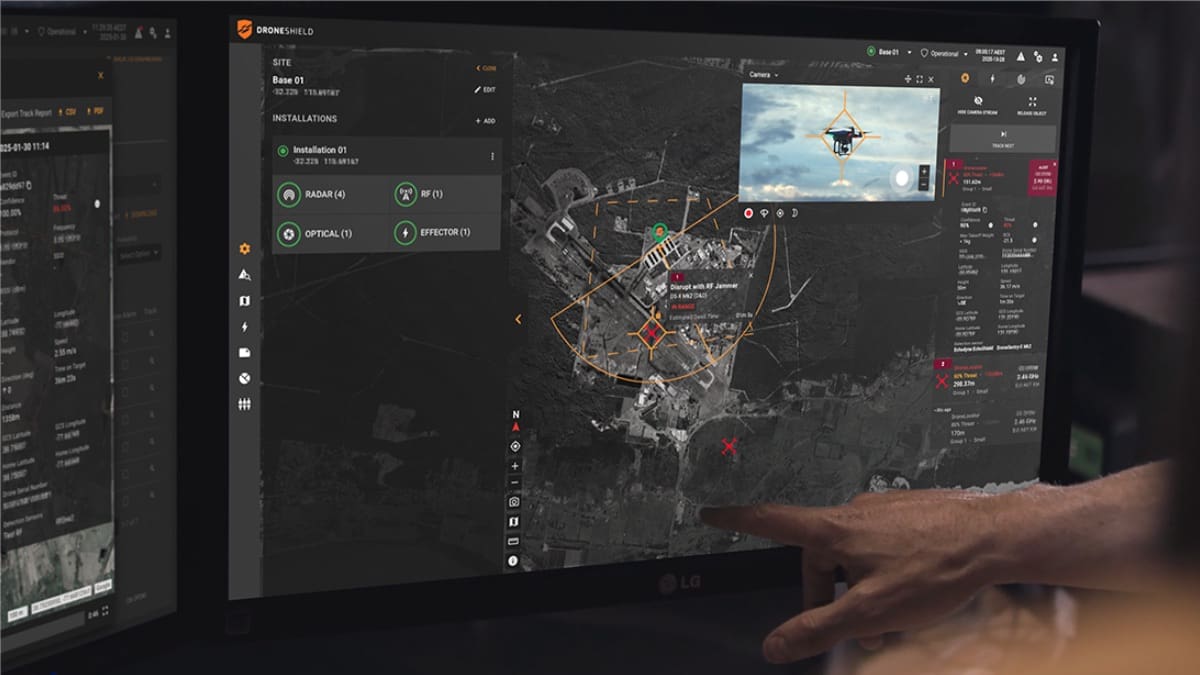
In October 2025, the 319th Reconnaissance Wing assigned to Grand Forks Air Force Base was selected to lead the Point Defense Battle Lab, supported by the 184th Wing, Kansas Air National Guard. The Total Force team at the battle lab supports Air Combat Command’s Point Defense Task Force, a larger Counter Small Unmanned Aircraft System (C-sUAS) effort within the Department of the Air Force.

The Point Defense Battle Lab will serve as a hub for collaboration, pushing boundaries in C-sUAS capabilities, ensuring the Air Force maintains tactical superiority against evolving threats, and is a key part of the service’s effort to develop and evaluate advanced technologies to defend installations from sUAS threats.

“The 319th Reconnaissance Wing is honored to lead the Point Defense Battle Lab alongside our Air National Guard partners,” said Col. Alfred Rosales, 319th RW commander. “Total Force integration enhances our ability to field emerging technologies and match our capabilities to the threat environment. The men and women of the 319th RW have extensive knowledge with unmanned, remotely piloted technology and will ensure our force is poised to secure our installations and defend the homeland.”

The PDBL is a critical initiative within the Department of the Air Force, designed to safeguard installations, protect vital assets, and ensure continuity of air operations. Specifically, the PDBL will focus on developing and validating tactics, techniques, and procedures for countering a wide range of airborne threats, including small Unmanned Aircraft Systems. The Battle Lab’s efforts will enhance the Air Force’s ability to detect, track, and neutralize these airborne threats effectively.

ACC selected the 184th Wing, in partnership with the 319th Reconnaissance Wing, based on combined current capabilities, missions, industry and academia partnerships and alignment with counter-small UAS fielding timelines. The 184th Wing was specifically selected for its expertise in air battle management, cyber operations, and AI-enabled intelligence, surveillance, and reconnaissance. The 134th Air Control Squadron’s continued efforts with the Air Base Air Defense System-Missile Defense, which has already positioned the 184th Wing as a leader in airbase defense, will also be contributing to the efforts of the Battle Lab.

“This is a significant opportunity for the 184th Wing to leverage our expertise and contribute to a critical national security mission,” said Col. Joe Deeds, commander of the 184th Wing. “Our Air Battle Managers, cyber warriors, ISR operators, and AI specialists are ready to work alongside the 319th Reconnaissance Wing to ensure the success of the Point Defense Battle Lab and to enhance the security of Air Force installations.”

The Point Defense Battle Lab (PDBL) will drive innovation and collaboration across the Total Force to address the growing challenges from increasingly widespread use of small Unmanned Aircraft Systems (sUAS). By integrating the expertise of the 319th Reconnaissance Wing and the 184th Wing, the PDBL will deliver critical tactical-level data, advanced site design concepts, and cutting-edge integration strategies for emerging technologies. Additionally, the lab will spearhead operational experiments and red teaming initiatives, ensuring the Air Force remains agile and prepared to counter evolving threats. Through its efforts, the PDBL strengthens the Point Defense Task Force’s ability to safeguard airpower, maintain combat readiness, and confidently respond to emerging challenges, further securing Air Force installations and operations.





By MSgt BreeAnn Sachs

319th Reconnaissance Wing Public Affairs

Fort Buchanan Advances Army Transformation Through Innovative Training Capability

Sunday, February 1st, 2026

FORT BUCHANAN, Puerto Rico —The Army’s home in the Caribbean is supporting the service’s transformation into a leaner, more lethal, and more agile force by modernizing how Soldiers train and generate readiness across the region.

Central to this effort is theMobile Marksmanship Training Simulator (MMTS), a deployable capability operated by Fort Buchanan’sTraining Support Center (TSC). The MMTS enhances marksmanship and engagement-skills training while reducing logistical demands and costs, directly supporting the goals of theArmy Transformation Initiative (ATI).

“Combined with the full range of capabilities available at the TSC, the MMTS has enabled Fort Buchanan to adapt how we support the warfighter. It has strengthened our training support and helped develop combat-ready formations across the region,” saidLuis Reyes, TSC manager.

The MMTS features full mobility, CO?-powered weapons that generate realistic recoil, and immersive, interactive scenarios that replicate operational environments. These capabilities allow units to train consistently regardless of range of availability or geographic constraints.

“The fact that we can take this system directly to Soldiers is a game-changer. It saves time and resources, allowing troops to focus on warfighter tasks instead of traveling long distances to training sites,” Reyes added.

Fiscal year 2025 marked the first year the MMTS was employed in Puerto Rico, and its impact was immediate. During the year, the system delivered more than800 hours of training to approximately 1,600 Soldiers, significantly expanding access to high-quality training while conserving time and resources.

According to Reyes, the MMTS does not replace Fort Buchanan’s fixedEngagement Skills Trainer (EST) 2000. Instead, it complements existing capabilities by extending training beyond fixed facilities. Together, EST 2000 and MMTS provide a layered, flexible approach that increases training frequency and efficiency while maintaining established standards.

“What the team at the Fort Buchanan TSC is doing—especially with the MMTS—is a clear indicator of the installation’s role as a warfighter readiness enabler. This capability strengthens readiness across the region and supports the Department of the Army enterprise,” saidBerenisse Rodriguez, chief of the Directorate of Plans, Training, Mobilization and Security.

By expanding access to modern training and delivering measurable results, Fort Buchanan’s Training Support Center continues to implement Army transformation concepts—ensuring forces remain ready, lethal, and responsive to mission requirements across the Western Hemisphere.

“Whether preparing units for contingency response, disaster relief, homeland defense, or overseas deployments, the TSC ensures leaders and Soldiers have access to the tools and resources they need to succeed,” saidRodriguez.

With an annual budget exceeding$500 million, Fort Buchanan supports a military community of approximately15,000 personnel, including Active Duty, Reserve, Puerto Rico National Guard, Marine Corps Reserve, and Navy Reserve members. The installation’s mission is to enhance readiness and facilitate the deployment of military personnel to any location, at any time.

Story by Carlos Cuebas 

U.S. Army Garrison Fort Buchanan