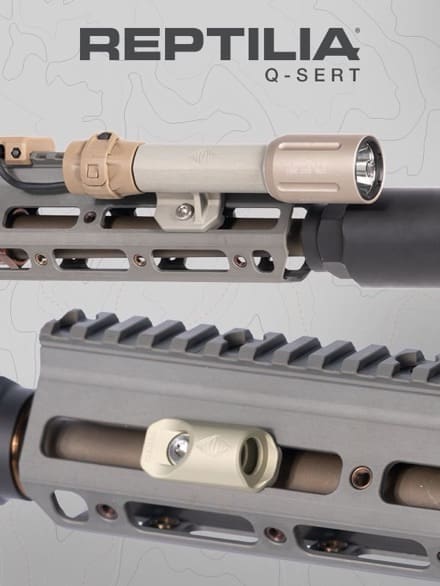
New mounting options bring two established Reptilia accessories to Q-Sert-equipped handguards.
Reptilia announces the launch of the TORCH™ 6V/18650 Q-Sert Light Body and SOCKET™ Q-Sert QD Sling Mount, expanding its accessory lineup with dedicated options for the Q-Sert mounting system.
Both products attach directly to Q-Sert-equipped handguards, providing compact mounting solutions for lights and slings without separate adapters.
TORCH™ 6V/18650 Q-Sert Light Body
The TORCH combines the light body and mounting interface in a single component, keeping the light close to the handguard and reducing unnecessary bulk. Offered in left- and right-side configurations, it allows users to choose the placement that suits their setup.
The TORCH is compatible with Modlite Systems and SureFire® M600DF Scout light heads and tail caps. It is sold as a light body only, not a complete light.
The SOCKET brings Reptilia’s low-profile, anti-snag sling attachment design to the Q-Sert mounting system. Originally developed in response to an end-user request for a streamlined QD attachment, the SOCKET provides a compact connection point while minimizing protrusions that can catch on equipment.
The new Q-Sert version extends that approach to users seeking a dedicated sling attachment for their Q-Sert-equipped handguards.
The TORCH™ 6V/18650 Q-Sert Light Body and SOCKET™ Q-Sert QD Sling Mount are available through Reptilia. For product details and ordering information, visit ReptiliaCorp.com.
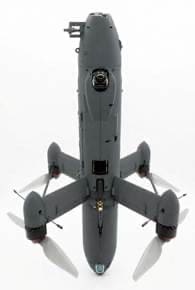
Washington DC. Israel Aerospace Industries (IAI) and SIG SAUER have completed a firing test of FIRE STORM 250, an innovative tactical unmanned system (UAS) equipped with a SIG SAUER MICROLIGHT Remote Controlled Weapon Station (RCWS) mounted with a M250 machine gun. The successful test demonstrated the system’s ability to combine airborne surveillance, target identification and precision firepower in a realistic battlefield scenario, providing tactical forces with an organic airborne capability for missions including Close Air Support (CAS), border security, suppressive fire and homeland security.
Guy Bar Lev, President and CEO of Israel Aerospace Industries (IAI), stated, “The future of the battlefield will be determined by the power of weapons systems, and by the ability to integrate intelligence, technology, and operational capabilities into a single, precise, and effective solution. The successful test demonstrates our vision of developing integrated solutions that provide forces in the field with an operational advantage, expand their capabilities, and enable them to address the evolving challenges of the modern battlefield. Our collaboration with SIG SAUER reflects the importance we place on strategic partnerships with leading companies worldwide, bringing together complementary capabilities to deliver innovative solutions to the market. We will continue to lead the next generation of unmanned systems, driven by our commitment to strengthening Israel’s security and meeting the needs of our customers and partners around the world.”
Moshe Levy, EVP and GM of IAI’s Military Aircraft Group,said, “The next generation of unmanned systems will be defined not only by autonomy, but by how effectively they integrate sensing, decision-making and action within the operational environment. FIRE STORM 250 brings these capabilities into a single operational loop, enabling tactical forces to extend their reach and maintain continuous awareness while retaining human control over engagement decisions. The firing test demonstrates the potential of this approach in a realistic operational scenario.”
During the test, FIRE STORM 250 system hovered over the simulated battlefield, identified targets using its onboard camera and engaged them in both single-shot and semi-automatic firing modes. Firing was conducted from varying distances and altitudes, demonstrating the system’s operational flexibility, integrated safety and accuracy under different conditions.
FIRE STORM 250 is designed to put persistent surveillance and firepower directly in the hands of tactical forces. The system can remain airborne for up to three hours while carrying 200 rounds of ammunition, and its VTOL configuration enables takeoff and landing from forward areas without requiring a runway or dedicated aviation infrastructure.
The system integrates the SIG SAUER RCWS, the world’s lightest aerial RCWS. With a complete combat-ready weight of only 53 pounds, including the RCWS, the M250 machine gun, and 200 rounds of ammunition, the system delivers stabilised precision fire. Sensor information and fire-control data are combined into a unified targeting solution, giving the operator a continuous operational picture and supporting a rapid sensor-to-shooter cycle.
Sali Okanin, Israel General Manager for SIG SAUER, commented, “FIRE STORM 250 brings together the most advanced technologies in the world including IAI’s drone platform and SIG SAUER’s MICROLIGHT RCWS mounted with the M250 machine gun to deliver a new level of operational flexibility. We’re proud of the new SIG SAUER M250, which is combat-proven technology. It is a belt-fed platform with greater range than legacy systems and weight savings that not only provide squad-level benefits but also make drone capabilities possible.”
FIRE STORM 250 maintains a human-in-the-loop fire-control architecture, with the operator receiving real-time sensor imagery, target-tracking data and engagement options, while retaining control of the engagement process and authorising the use of fire. This combines advanced automation with human judgment and operational control.
Powered by a multi-fuel internal-combustion engine, the system can be refueled in the field using commonly available operational fuel, avoiding lengthy battery-charging cycles or specialised aviation infrastructure. The platform is rapidly deployable and designed to accompany tactical units with limited manpower and support requirements. It can support various missions including persistent overwatch for manoeuvring forces, intelligence gathering, force protection, border defence, protection of strategic sites and special operations.
Multiple systems can operate simultaneously to provide persistent day-and-night surveillance. At the same time, the system can also provide advance observation, identify threats along movement routes and maintain overwatch during operations and extraction.
FIRE STORM will be on display at the IAI booth (HALL C, Booth #3525) and the SIG SAUER booth (Hall E, Booth #8015) at AUSA 2026 in Washington, DC.
Advanced disturbed reticle technology utilizes remote weapon station platform applied to a mounted electro-optic
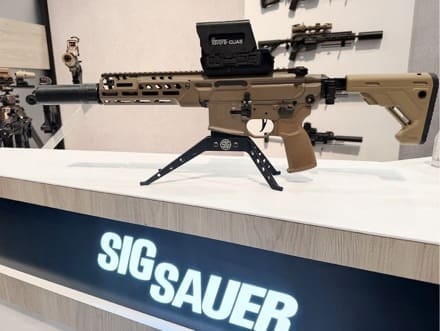
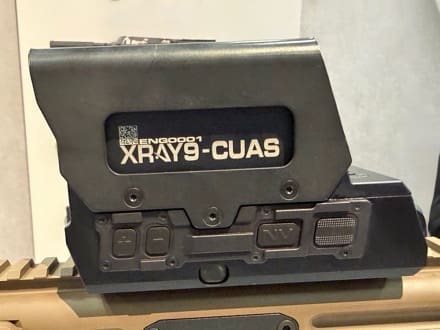
NEWINGTON, N.H., (October 13, 2026)– SIG SAUER, an industry-leading manufacturer of cutting-edge firearms, electro-optics, ammunition, and advanced concepts, unveiled at the Association of the United States Army (AUSA) trade show the SIG SAUER XRAY9-CUAS. The all-new counter unmanned aircraft systems (CUAS) electro-optic from SIG SAUER combines several technologies to deliver a new capability to combat drone attacks.
“We fast-tracked the XRAY9-CUAS because the capability is needed for today’s battlefield,” said Andy York, President, SIG SAUER Electro-Optics. “Our heritage began and continues in firearms. We’re also driving innovation in remote weapon stations and electro-optics because at our core our focus is to protect and support our men and women in uniform. With the XRAY9-CUAS, a soldier can point and shoot to combat drones with the new electro-optic compensating for a range of factors to eliminate the threat.”
Mounted to a counter-UAS weapon system, the XRAY9-CUAS uses advanced electro-optical technologies to quickly engage drones, similar to the targeting system in the SIG SAUER remote-controlled weapon station.
The XRAY9-CUAS uses a proprietary SWIR laser rangefinder system and onboard slew-rate sensors to instantly calculate drone distance, speed, and vector and create a custom disturbed reticle with dynamic targeting solutions. The XRAY9-CUAS can be integrated with CMOS and thermal sensors to provide a day, night, and fused capable fire control system.
The XRAY9-CUAS tracks and engages up to 300 yards with exact capabilities varying depending on drone size. The small and lightweight optic is 5.25’’x2.5’’x3.3’’ (LxWxH) and 24 ounces. Battery life is up to 50 hours with continuous use, and the display is 640×480 with a window size of 48mm clear aperture.
Army’s Global Tactical Edge Acquisition Directorate turns soldier feedback into fielded upgrades in weeks, not program cycles
SARASOTA, Fla. – (Oct. 12, 2026) – Mountain Horse Solutions, a Global Ordnance company focused on mission-critical support, unmanned systems and integrated defense solutions, is delivering additional FD-1 interceptors to the U.S. Army under a second contract awarded by the U.S. Army’s Global Tactical Edge Acquisition Directorate (G-TEAD). The award, issued under an Other Transaction Agreement (OTA), follows an initial G-TEAD OTA awarded this spring. This marks two awards and a fielded capability within a single year, reflecting G-TEAD’s emphasis on accelerating new systems to soldiers.
“G-TEAD changed what is possible, allowing us to combine soldier feedback with our ability to rapidly improve and deliver capability,” said Bill Allen, president of Mountain Horse Solutions. “Soldiers assessed the FD-1 and told us what needed improvement. We turned those updates around within weeks, and G-TEAD provided a way to buy the revised version without waiting on a requirements cycle. That sequence did not exist three years ago.”
The FD-1 is a compact, dual-use interceptor designed to defeat Group 1–3+ Unmanned Aircraft Systems (UAS) as well as ground targets. It can be emplaced and airborne in under two minutes, is employed by a single operator rather than a crew and is designed to integrate behind an existing detection and tracking layer as the defeat capability, or to operate as a standalone system. The operator maintains positive control throughout the engagement, and a human authorizes every engagement.
The system was developed to address a cost problem that has strained conventional air defense: inexpensive, expendable drones fielded in volume against interceptors that cost far more than the threats they defeat. The FD-1 is intended to close that gap while remaining simple enough for one soldier to set up and employ in the field.
G-TEAD, the Army’s acquisition hub for the tactical edge and a core component of the Army Pathway for Innovation and Technology (PIT), was established to close the gap between how quickly threats evolve and how quickly the Army can field a response. It brings acquisition expertise and authorities closer to Army Service Component Commands while connecting them with research, development, test and evaluation resources.
Through Accelerated Capability Events (ACE), soldiers can assess operationally ready equipment and software, provide feedback and help shape systems before broader fielding. The process is designed to accelerate validated technologies toward acquisition and operational use.
Supporting the process, the 409th Contracting Support Brigade provides contracting expertise and execution for G-TEAD efforts, helping move validated capabilities into acquisition actions on accelerated timelines. The brigade played a key role in the FD-1 award, providing the contracting support needed to maintain momentum from evaluation and refinement into procurement.
The FD-1 has been evaluated by G-TEAD, the 52nd Air Defense Artillery and the Army Test and Evaluation Command (ATEC), with Mountain Horse Solutions incorporating feedback throughout development. Following the initial operational assessment, the company delivered a series of user-driven upgrades within five weeks, a cycle it repeated after each subsequent assessment.
“The value of these assessments is that they are extremely insightful,” said Richard Budniewski, director of UAS/C-UAS Programs at Mountain Horse Solutions. “Soldiers find things a test range never will. G-TEAD built the pathway that turns their feedback into fielded improvements within weeks instead of program cycles and then gave the Army a way to order it. That is the part industry has been waiting on.”
The system took first prize in the U.S. Army xTech Counter Strike competition in November 2025, and its technical review by ATEC is complete.
G-TEAD’s Accelerated Capability Events are designed to move technologies from event conception to capability transition within 180 days. The FD-1 effort has tracked within that timeline from operational assessment through this award.
Mountain Horse Solutions is currently producing the FD-1 and has capacity to scale to meet additional demand, including orders placed by allied and partner nations.
System quantities and contract value are not disclosed.
Leading small arms manufacturer to highlight combat-proven firearms, remote-control weapon stations, drones, and counter-UAS
NEWINGTON, N.H. (October 12, 2026) – SIG SAUER, an industry-leading manufacturer of cutting-edge firearms, electro-optics, ammunition, and advanced concepts, will showcase its next-gen military small arms at the Association of the United States Army (AUSA) trade show in Washington, D.C., October 12 – 1
“We always look forward to AUSA. It’s an opportunity to showcase our made-in-America technology developed in partnership with the United States Army, ranging from next-gen carbines and machine guns to ammunition,” said Robby Johnson, EVP and CMO, SIG SAUER. “We ramped up production of the SIG XM8 to successfully meet the Army’s schedule, and it’s set to begin fielding in December to support the Close Combat Force. We will have the XM8 and additional SIG products on display.
SIG SAUER Unmanned Capabilities & Training
In addition to premier firearms, SIG SAUER offers the most advanced small arms unmanned systems, including drones, counter-UAS, and remote-controlled weapon stations (RCWS) to support modern combat. Along with the product capabilities, SIG SAUER provides world-class training for customers and partners. The SIG unmanned training instructors’ experience extends across aerospace engineering, flight testing, readiness, and all operational environments to support first-time users to the most experienced technicians.
“We’ve invested in a full offering of unmanned capabilities,” said Ryan Scott, Director of Advanced Concepts, SIG SAUER, who served 22 years in the Army, including over a decade with unmanned systems. “We’re doubling our square footage and workforce at our North Carolina facility with a multi-million-dollar expansion across R&D, engineering, manufacturing, and training. This investment continues our support for the U.S. Armed Forces and allies, which now also includes our battlefield-ready counter-UAS.”
The all-new SIG SAUER XRAY9-CUAS, a mounted electro-optic, uses advanced technologies to quickly target and engage drones using a proprietary laser rangefinder.
SIG SAUER AUSA Location and Product Display
The SIG SAUER AUSA exhibit is located at booth #8015 Hall E at the Walter E. Washington Convention Center. A media kit with images, video, and additional information is available here. Included below is a selection of SIG SAUER products that will be on hand at AUSA:
SIG SAUER M250: The U.S. Army’s Next Generation light machine gun, the M250 represents a major leap in squad-level firepower. It replaces legacy systems with a belt-fed, gas-operated, and reduced-recoil design that fires a powerful 6.8×51 mm hybrid cartridge to give infantry units greater range and lethality against advanced body armor. With a SIG optic and suppressor, the M250 is a complete weapon solution.
SIG SAUER MMG: A belt-fed, lightweight, man-portable medium machine gun chambered .338NM, 6.8 hybrid, and 7.62 NATO hybrid. The SIG MMG provides heavy machine gun range in a highly controllable and maneuverable MMG package and, when paired with a SIG optic and suppressor, is a complete weapon solution.
SIG SAUER XM8: The U.S. Army’s next-generation carbine, the XM8 was developed with soldier feedback and SIG innovation, delivering enhanced lethality, greater range, and new features (e.g., full ambi safety and bolt release, heat shield, suppressor) when compared to the M4 it replaced. Against the SIG M7, it is 12 percent lighter.
SIG SAUER Hybrid Ammunition: Engineered to meet the requirements of the U.S. Army’s Next Generation Squad Weapon program, SIG Hybrid ammo delivers revolutionary pressures that significantly increase velocity, range, and lethality.
SIG SAUER RCWS: An advanced lightweight system, the SIG RCWS bolsters operator safety and situational awareness by enabling point-and-shoot remote machine gun operation.
SIG SAUER Advanced Concepts: Designed to dominate the future of unmanned capabilities, SIG drone technologies are built to meet the evolving demands of defense and security missions. The product lineup includes the fixed-wing SCYTHE aircraft, the SABER quad-copter, and the M-HORNET 22 LR payload attachment.
A select lineup of advanced SIG SAUER electro-optics and suppressors will also be on hand, including the XRAY9-CUAS.
For more than a decade, the Tarsier Eclipse has been MATBOCK’s number-one selling product. Today MATBOCK introduces its successor, the Tarsier Eclipse Pro.
The original Tarsier Eclipse was built on the streets of Sadr City around one problem we kept facing: the need to see near and far targets simultaneously. The answer was a lightweight, infinitely adjustable iris with a replaceable sacrificial lens. It went from a trade show booth to team rooms across the world.
The Eclipse Pro keeps what worked and adds what users asked for next:
Redesigned body. Soft rubber exterior for shock absorption and a hardened interior for smoother action.
Kill flash built in. A honeycomb kill flash sits on a Gorilla Glass sacrificial lens with an anti-reflective coating, cutting objective glint without a separate accessory.
Fully closing iris. The anti-reflective coated iris closes completely, so one unit handles light control, daytime protection, and lens cover.
Simplify Logistics. The Pro is a native 37mm unit and ships with a barrel gasket for 34mm OD objectives (this covers 98% of NVGs)
Retention. An optional 50 lb test lanyard is included.
The range is quiet except for the sound of a sling shifting across nylon and metal. The rifle moves from one position to the next. Nothing dramatic happens. No missed targets. No timer. No visible failure.
Then the stock catches on a piece of gear.
The sling binds during a transition.
The muzzle drifts somewhere it shouldn’t.
A grip that felt secure a moment ago suddenly feels awkward.
Those small moments are easy to dismiss, but they are often the most valuable information a training session can provide.
Most shooters use training to measure performance. A timer records speed, a target records accuracy, and the results show whether the shooter met the standard. Those metrics matter, but some drills serve a different purpose. Instead of measuring performance, they expose inefficiencies in equipment setup, weapon handling, and movement mechanics that might otherwise go unnoticed until stress magnifies them.
The Carbine Flow Drill moves the shooter through six practical positions:
• Retention
• High Ready
• High Carry
• Low Ready
• Rear Sling
• Low Carry
The sequence is simple by design. Its value comes from what happens during the transitions.
In a real-world environment, controlling a carbine is critical. What was a safe direction one moment may no longer be safe the next. The established rules of firearm safety do not disappear when someone leaves the flat range. If anything, they become even more important.
Working through these positions forces shooters to evaluate how well they maintain positive control of the weapon as its orientation and relationship to the body change.
Each position also serves a practical purpose. Low Ready and Low Carry can be useful when people occupy upper floors or other elevated locations. Rear Sling moves the carbine out of the immediate workspace while keeping it attached to the body. This may be necessary when a law enforcement officer needs to climb a ladder, operate a breaching tool, or go hands-on with a subject.
Understanding when and why to use each position is important. Equally important is understanding how efficiently a shooter can move between them.
That is where the real value of the drill emerges.
A carbine sling that feels comfortable while standing still may suddenly feel too loose during movement. A pouch that never seemed problematic might interfere with a transition into Retention. A rifle that hangs correctly in one position may become an obstacle when moved into Rear Sling.
None of these issues represent a major equipment failure, but each creates friction. The drill brings that friction to the surface.
As the transitions accumulate, patterns begin to emerge. The shooter may notice unnecessary hand movement, inconsistent rifle placement, or equipment that shifts unpredictably. Maintaining muzzle awareness may require more attention than expected.
These observations are not setbacks. They are feedback.
The Carbine Flow Drill creates a controlled environment where those lessons can be learned early. Instead of discovering a problem during a qualification, competition, or operational task, shooters can identify and correct it beforehand. The flat range becomes a laboratory for experimentation, adjustment, and refinement.
This is why some of the most productive training sessions generate more questions than answers.
Why did that transition feel awkward?
Why did the sling bind?
Why did the rifle move differently than expected?
Each answer leads to a better understanding of the shooter, the equipment, and the interaction between the two.
Improvement is rarely about adding more complexity. More often, it comes from eliminating the small obstacles that create hesitation, inconsistency, and wasted motion. Once those obstacles are removed, the shooter can devote more attention to observation, decision-making, and the task at hand.
Not every range session needs to be measured by speed, score, or round count. Some of the most valuable sessions are the ones that expose problems before they become habits.
The objective is not simply to complete the sequence.
The objective is to discover what is not working.
The problems you discover today are the problems that will not surprise you tomorrow.
The best way to understand the Carbine Flow Drill is to run it yourself. Before your next range session, take a few minutes to watch the full walkthrough from Blue Force Gear, then put your rifle, sling, and equipment through the same sequence. What you discover may be the most valuable lesson of the day.