GORE-TEX Professional

Archive for the ‘Air Force’ Category

Air Mobility Liaison Officers Sharpen Their Tactical Edge with IZLID

Saturday, October 10th, 2020

JOINT BASE MCGUIRE-DIX-LAKEHURST, N.J. —

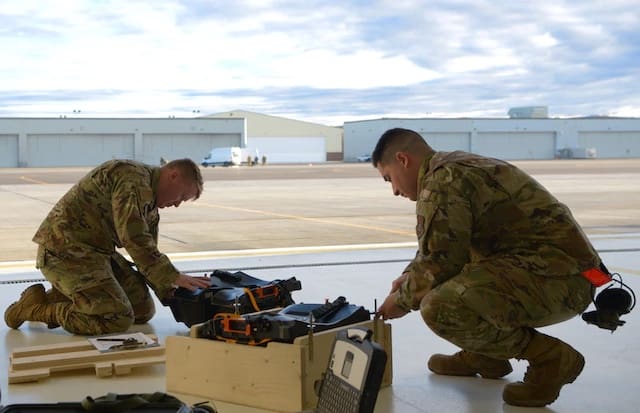
The 621st Mobility Support Operations Squadron is adding another weapon to an already stocked arsenal to enhance situational awareness and tactical edge for its air mobility liaison officers.

The Infrared Zoom Laser Illuminator Designator will replace the dated signal light gun currently used by AMLOs to signal and direct aircraft.

“AMLOs use this equipment in a tactical environment, designating the landing zone for inbound aircraft,” said Maj. Stephen Quinn, 621st MSOS AMLO. “The IR beam is covert, but highly visible for the night vision goggle-wearing aircrew, and allows the AMLO to easily guide the aircraft to the threshold.”

The IZLID is a compact, lightweight infrared laser used for pointing and marking by military forces. The laser is a powerful long-range illuminator, small enough to fit in the user’s pocket and sufficient enough to direct airstrikes.

The new laser is “covert and portable compared to the old light guns,” said Quinn, and more effective in a tactical environment.

“The most important aspect is enhanced situational awareness for aircrew at the push of a button,” Quinn said. “Landing zone approach lights vary in effectiveness, but a quick lase with the IZLID can prevent a crew from selecting the wrong aimpoint.”

The expectation is to utilize the IZLID for all future landing zone operations in-theater. The squadron is planning on purchasing five IZLIDs for deployment use and in garrison training.

“It’s awesome and worth the price,” Quinn said. “AMLOs are basically Jedis already, and this gives us a lightsaber to help with the job.”

A win for AMLOs is a win for the whole squadron. 

“Every day, week, month, and year we get closer and closer to what is needed for MSOS and AMLO Nation equipment-wise,” said Staff Sgt. Sededrick Parks, 621st MSOS supply and equipment manager. “I believe this equipment has catapulted us further in that direction.”

By TSgt Luther Mitchell Jr., 621st Contingency Response Wing Public Affairs

High Ground Wins Next Gen ANG Helmet Cover

Tuesday, October 6th, 2020

Ehmke Manufacturing Company, Inc., home of High Ground is pleased to announce that the Air National Guard (ANG), has awarded a contract to purchase High Ground’s newly designed “TANGO-SFS” helmet cover for their special operations and security forces units.

High Ground’s TANGO-SFS helmet cover is specifically developed for operators that require demanding performance criteria, functionality and Berry Compliance. High Ground’s technical staff and application engineers worked directly with the Air National Guard to evaluate, research and test downrange feedback that resulted in product enhancements and the incorporation of unique design elements in the ANG’s head borne protection systems.


“Our team of engineers working under the direction of Executive Vice President Michael Runella, were able to develop a helmet cover that exceeds the requirements to support the mission of our Air National Guard (ANG),” said High Ground President Glenn Aust. “Our mission at High Ground is and has always been to focus on what we can do to support our war fighters as they selflessly work each day to protect us and the interests of our country.”  

“These advancements position High Ground as a major contributor to future head borne systems that will benefit the military. High Ground now offers a 100% Berry Compliant, made in the U.S.A., commercial off the shelf (COTS) product,” said Mike Runella, Executive Vice President.

“Mike Runella and his product development team did an excellent job of translating the Air National Guard’s performance criteria into a robust head borne systems product. The joint collaboration between the soldier and our technical team has resulted in a high-performing product for our front-line soldiers,” commented Ehmke CEO Bob Rosania. “I see this as just the first product we will develop with the help of the Air National Guard.

The complete High Ground product catalogue of tactical gear and armor can be found at www.highgroundgear.com.

High Ground: We Make Every Stitch Count…


RCO Delivers Department of the Air Force Capabilities

Monday, October 5th, 2020

WASHINGTON (AFNS) —

Less than 200 personnel assigned to the Department of the Air Force Rapid Capabilities Office rapidly develop capabilities to outpace and counter the increasing threats of adversaries.

Their primary focus incorporates cutting-edge approaches to standard acquisition processes to produce capabilities for both the Department of Defense and the DAF, which includes the U.S. Air Force and the U.S. Space Force.

The mission of the DAF RCO is to expedite development and fielding of select DoD combat support and weapon systems by leveraging defense-wide technology development efforts and existing operational capabilities.

“Built on using speed and efficiency, we expedite the fielding of critical capabilities to the warfighter,” said Randy Walden, director and program executive officer for the DAF RCO. “This includes operators in both the United States Air Force and the United States Space Force in support of the National Defense Strategy.

Originally activated in April 2003, one of its first projects was to deploy significant upgrades to the Integrated Air Defense System, now operational around the National Capital Region, to meet critical counter-terrorism objectives before the January 2005 Presidential Inauguration Day.

Today, the DAF RCO portfolio includes several high priority developmental and experimental programs.

For example, the X?37B Orbital Test Vehicle program is an experimental test platform that supports the U.S. Space Force to meet DAF objectives. Space Professionals conduct X-37B launch and on-orbit operations, and the DAF RCO program office team will include Space Force members as the new service continues to stand up.

The X-37B is an experimental test program to demonstrate technologies for a reliable, reusable, unmanned space test platform. The primary objectives of the X-37B are twofold: reusable spacecraft technologies for America’s future in space; and operating experiments, which can be returned and examined on Earth.

Currently, the X-37B is conducting on-orbit operations in its sixth mission.

The DAF RCO is also home to the B-21 Raider program. The B-21 is a U.S. Air Force priority, which will provide critical operational capability and flexibility across a wide range of military objectives, providing both conventional and nuclear capabilities in fulfillment of national objectives.

The B-21 is being designed to be highly survivable with the ability to penetrate modern air defenses to strike any target, anywhere on the globe in a contested area of operations.

The program plans to deliver the first B-21 aircraft to operational bases in the mid-2020s.

“The DAF RCO is a unique organization because it supports priorities for both the Space Force and Air Force,” Walden said. “The office is staffed with a variety of functional DAF specialists who form a collaborative melting pot of expertise built specifically to operate within the gray areas of the standard acquisition processes.”

The DAF RCO conducts streamlined acquisitions in response to Air and Space Forces and Combatant Command requirements. It reports directly to a board of directors comprising of the Under Secretary of Defense for Acquisition and Sustainment; Under Secretary of Defense for Research and Engineering; Secretary of the Air Force; Assistant Secretary of the Air Force for Acquisition, Technology and Logistics; U.S. Space Force Chief of Space Operations; and Chief of Staff of the Air Force.

“Whether it’s digital engineering, prototyping or modern software development, the DAF RCO is committed to advancing the capabilities of the Department of the Air Force,” Walden added.

By Secretary of the Air Force Public Affairs

17th STS Moves from 720th STG to 724th STG

Friday, October 2nd, 2020

The 24th SOW transitions responsibility of the 17th STS

FORT BENNING, Ga. —

The 24th Special Operations Wing transitioned responsibility of the 17th Special Tactics Squadron from the 720th Special Tactics Group to the 724th Special Tactics Group during a re-assignment ceremony at the 17th STS headquarters, Fort Benning, Georgia, Oct. 1, 2020.

“Today we recognize the end of a tremendous era under the 720th Special Tactics Group and the start of an exciting opportunity as part of the 724th Special Tactics Group,” said Lt. Col. Travis Deutman, commander of the 17th STS. “Reassignment is nothing new for the 17th.”

In August of 2013, the squadron, originally known as the 17th Air Operations Support Squadron, was re-designated as the 17th STS by then-Col. Robert Armfield, the 24th SOWs first wing commander. This time around, Col. Matt Allen, the current 24th SOW commander, presided over the ceremony and the presentation of the new guidon.

 “The 17th STS continues to forge its voice as one of the premiere units within Air Force Special Operations Command and the United States Air Force,” said Allen. “I want to thank the individuals within this unit who have built this legacy of honor and valor.”

The primary mission of the 17th STS is to provide Special Tactics Tactical Air Control Party Airmen to the U.S. Army’s 75th Ranger Regiment for unconventional operations and the transition will provide further opportunities to continue supporting the regiment.

“We look forward to continuing steadfast fires and reconnaissance support to the Ranger mission and its objectives,” said Deutman. “Reassignment to the [724th Special Tactics Group] will realize synergies, efficiencies and unite of command to push our operational alignment with the Ranger Regiment to the next level.” 

The 724th STG is one of two subordinate groups under the 24th SOW, which provides training and technical assistance in the development of tactics, techniques, and procedures to ensure standardization across the AFSOC Special Tactics community. 

“The [17th STS] has always been part of the family, but this will put them in the right organizational construct to become even more effective,” said Col. Mark McGill, commander of the 724th STG. “It’s all about optimizing our ability to train as well as generate mission effectiveness and this is a necessary step to actualize that.”

The 17th STS is geographically separated in three locations so the unit can train and deploy alongside all five of the U.S. Army Special Operations Command’s 75th Ranger Regiment battalions. The squadron is headquartered at Fort Benning, Georgia, alongside the Regimental Headquarters, 3rd Ranger Battalion, Regimental Special Troops Battalion, and Regimental Military Intelligence Battalion. Two operational detachments are located at Hunter Army Airfield, Georgia, alongside the 1st Ranger Battalion, and Joint Base Lewis-McChord, Washington, alongside the 2nd Ranger Battalion. The unit’s physical locations will remain the same through the transition. 

“While a lot might be changing, I can guarantee the commitment, professionalism and excellence of the 17th STS members will remain,” said Deutman.

Another aspect which will remain is the application process for future ST TACP candidates looking to join the 17th STS’ community of warriors. The 24th SOW will continue to host assessment and selection iterations for Special Tactics TACPs at Hurlburt Field, Florida, hand-selecting the most skilled operators to carry out the wing’s special operations precision strike mission.

“You have furthered the reach of America’s combat power,” said Allen. “You’ve held at bay violent extremist organizations and state actors as they challenge us from abroad, and you have kept a promise to Americans … especially to our joint teammates, that no matter where they are on the battlespace, they will never be outmatched.”

Air Force Special Tactics is U.S. Special Operations Command’s air-ground integration force and the Air Force’s ground force specializing in Global Access, Precision Strike, Personnel Recovery and Battlefield Surgery operations. 

For anyone wanting more information on how to join the 17th Special Tactics Squadron, email SDScreening@jdi.socom.mil

By Lt Alejandra Fontalvo, 24th Special Operations Wing

USAF and Microsoft Partner to Empower Airmen with Modern IT

Wednesday, September 23rd, 2020

The U.S. Air Force is breaking the glass as a leader in harnessing the power of cloud, rapidly rolling out modern services to enable airmen to advance the mission through more effective collaboration. As part of their digital transformation journey to achieve global access, persistence, and awareness for the 21st century, the U.S. Air Force is deploying targeted workloads that allow airmen to focus on their missions rather than spending time managing IT infrastructure.

Mission focus and efficiency

A key part of their digital transformation strategy is leveraging the technology industry’s capabilities for cloud infrastructure, allowing the U.S. Air Force to re-tool and refocus their resources. As part of our collaboration with the U.S. Air Force, we’re deeply aligned on a joint mission to drive IT enhancements that enable airmen to be more efficient and effective. Building out the capabilities for this targeted mission focus started with planning for how the organization will manage their data in the future, deploying core functions such as Exchange Online, SharePoint Online, OneDrive and other capabilities delivered through the Microsoft 365 suite of productivity applications.

Improved total cost of ownership

The rapid deployment of cloud tools at this scale is made possible by the U.S. Air Force’s leadership in building the multi-cloud factory Cloud One, a migration center of excellence designed as a foundation for future innovation. Leapfrogging more traditional cloud migration strategies with a Platform as a service (PaaS)-first approach and secure systems boundary, Cloud One enables the U.S. Air Force to rapidly transform legacy systems into modern apps and exploit the agility, scale and global presence afforded by the cloud.

William Marion, U.S. Air Force Deputy Chief Information Officer, says that Cloud One is the U.S. Air Force’s “path to the cloud, but further it is fundamental to the Digital Air Force and the future of Multi-Domain Operations. It enables our teams to achieve unprecedented cost efficiencies and productivity through automation, agile software development at scale, and a streamlined process for moving applications to production.”

Cloud One has recalibrated what internal teams expect from a cloud migration, providing all the foundational cloud capabilities including networking, monitoring, access control and identity. In addition, apps deployed to Azure Government inherit the platform’s security controls by design, further reducing operational costs and freeing up resources to focus on the mission.

Focus on security and compliance

The U.S. Air Force understands the importance of a dynamic, foundational risk management framework that can react quickly to cyber-attacks and changes in the threat landscape. With Microsoft 365 Government and Azure Government, they can obtain the scale and performance of modern cloud tools while maintaining compliance with the strict compliance requirements of the Department of Defense (DoD), including DoD Impact Level 5.

Next-generation collaboration

One of the primary goals of the U.S. Air Force is to empower airmen to collaborate and execute their missions with modern technology best practices. The Air Force Life Cycle Management Center, Enterprise IT and Cyber Infrastructure Division (AFLCMC/HNI) at Hanscom Air Force Base in Massachusetts has planned, tested and started deployment of Microsoft Teams to improve project management and teamwork. With geographically separated organizations, Teams will streamline collaboration and communication between airmen across the globe.

The massive scale of this U.S. Air Force organization – wide rollout requires massive change management – so we’ve developed a joint plan with focused training, deployment and service adoption to drive mission-focused use cases. The plan includes learning events with modern modalities, creating consumable resources to enable airmen to learn more about how Teams can work for their unit. This includes product immersion events, ask-me-anything events, and video content so airmen can learn efficiently from wherever they are in the world.

These advances in productivity, cloud acceleration, and collaboration are a result of ongoing teamwork across the 16th Air Force, the Air Force Life Cycle Management Center, and the Defense Information Systems Agency. As thought leaders and innovators, these organization have planned, built and deployed modern IT experiences at massive scale using Microsoft 365 Government and Azure Government, enabling airmen to continue to fly, fight and win in air, space and cyberspace.

By Leigh Madden – Microsoft General Manager, National Security

Photo – US Air Force

SECAF Unveils New “eSeries” Classification in Nod to Department’s Digital Future

Sunday, September 20th, 2020

ARLINGTON, Va. (AFNS) —

Secretary of the Air Force Barbara Barrett told Air Force Association conference attendees that the future of Air and Space technology will include aircraft, weapons and satellites which will be digitally engineered and virtually tested before ever taking physical form.

A true paradigm shift, systems being considered for acquisition will be designed, developed and manufactured on a digital foundation, just like the Boeing eT-7A Red Hawk advanced trainer. The new process is part of the Department’s digital eSeries approach.

The secretary made her remarks during the keynote speech at this year’s Air Force Association Air, Space and Cyber Conference, which is being held virtually due to the global pandemic.

“To inspire companies to embrace the possibilities presented by digital engineering, today the Department of the Air Force is announcing a new weapons system designator—the ‘e’ series,” Barrett said. “Aircraft, satellites, weapon systems and more that are digitally engineered will receive an ‘e’ prefix.”

The first U.S. Air Force aircraft designed using the digital approach, the eT-7A Red Hawk, embraced model-based engineering and 3D design tools which reduced assembly hours by 80% and cut software development time in half. The aircraft moved from computer screen to first flight in just 36 months.

Other Air and Space Force programs have leveraged the power of digital engineering to reduce design and testing time. In the future, more Air and Space Force acquisition programs will be using digital engineering principles to design, code and build systems.

According to Air Force officials, an eSeries digital acquisition program will be a fully-connected, end-to-end virtual environment that will produce an almost perfect replica of what the physical weapon system will be. It will bring unprecedented speed and agility to help compete in the technology battlespace by enabling thousands, even millions, of virtual iterations at machine speeds to design the best possible system — but only build the single, best design.

By Secretary of the Air Force Public Affairs

Happy Birthday US Air Force!

Friday, September 18th, 2020

Please enjoy this recruiting song from the 1950s.

Quantico Tactical Announces a $950,000,000 Award for Air Force Special Warfare

Tuesday, September 15th, 2020

Aberdeen, North Carolina – September 2, 2020 – Quantico Tactical is pleased to announce the award of up to $950,000,000 as part of the United States Air Force Special Warfare – Multiple Award Contract, SW-MAC, for the Special Warfare Acquisition Group and Refresh (SWAGR) program.  The contract was approved by the Air Force Life Cycle Management Center to provide a convenient contract vehicle for Air Force Special Warfare.

“We have an extensive history of supporting the U.S. Air Force with our rapid and simplified procurement processes,” said Sam Lerman, Vice President of Sales & Marketing.  “This contract award demonstrates our unwavering customer commitment and support for the varying mission requirements within Air Force Special Warfare.”

“This contract award is a result of the reputation Quantico Tactical has developed throughout the U.S. Military and federal agencies for providing on-time worldwide delivery of high-quality products from leading manufacturers.  We value our relationships with customers, suppliers, and contracting professionals,” said David Hensley, Founder and CEO.

The contract is a 10-year Indefinite Delivery/Indefinite Quantity (IDIQ) award to provide equipment, training, and product support to approximately 3,500 Air Force Special Warfare operators, as well as authorized users in support of Special Warfare mission requirements.  The contract’s overall objective is to rapidly procure supplies, provide supply chain management, product training, and support, and integrate into larger systems in support of mission requirements.

This contract provides support in the following areas:

Assault Zones (AZ): Capabilities supporting tactical zones of action, including drop zones and fixed-wing and rotary-wing landing zones supporting the forward projection of a force by air.  AZ capabilities to be equipped under this contract include survey equipment for data collection and analysis, assessment of runway surface distress, and airfield geometrics to include obstacles and approach paths.  Also required is airfield control equipment, including airfield markings/lighting, signaling devices, airspace de-confliction tools, and navigational aids.

Fires: Equipping operators for close air support, surface-based and air-to-surface fires, communications architecture, weapons data, digital fire support, and target designation and marking.  For the contract’s purposes, this may include support to ACC-assigned Joint Terminal Attack Controller (JTAC)s.

Weather: Equipping operators to collect, analyze, tailor, and report critical meteorological and oceanographic information.  Additional capabilities include environment analysis and forecasting, vertical atmospheric data collection, processing externally produced weather data, portable environmental observation, and unattended ground-based weather collection.

Personnel Recovery (PR): Equipping Pararescue Jumpers to prepare, recover, and reintegrate isolated personnel.  PR capabilities include, but are not limited to, PR information management, locating survivors, rescue and recovery tools, analyzing environmental conditions, mass casualty management, recovery support, and reintegration.  For the contract’s purposes, this includes the Guardian Angle Mission.

Enabling Capabilities: Common across all mission sets and career fields; include mission management, friendly force detection, geo-locating and range finding, visual augmentation, communications, unmanned capabilities, infiltration/exfiltration, and enhanced training.