Lowa Zephyr Mk 2 GTX

Archive for the ‘Air Force’ Category

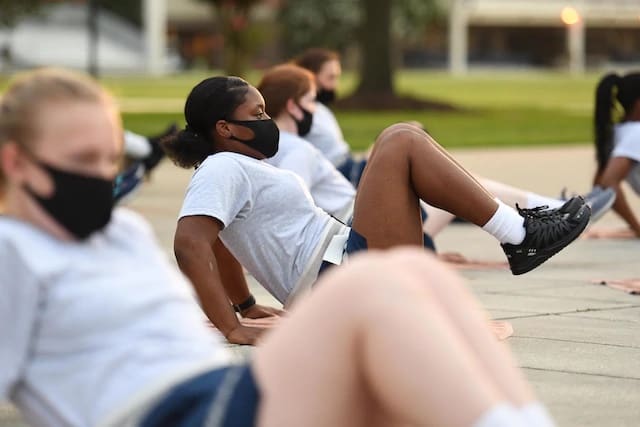
Special Warfare Preparatory Course Changes the Way Airmen Train

Sunday, November 29th, 2020

JOINT BASE SAN ANTONIO-CHAPMAN TRAINING ANNEX, Texas – The Air Force’s Special Warfare Training Wing has refined its training program for Airmen attempting to enter the Tactical Air Control Party, Special Tactics or Guardian Angel weapons systems, in an effort to create more well-rounded future operators.

Following graduation from Basic Military Training, new enlisted Airmen interested in becoming a candidate for a career in special warfare must complete the eight week Special Warfare Preparatory Course (SWPC). In this course, training coaches, dieticians, counselors and other staff members expose Airmen to the tools needed to become successful within the various special warfare training pipelines. Upon completion of SWPC, Airmen enter into the course of initial entry for their particular career field.

“Our course is meant to better develop operators,” said Master Sgt. Michael Blout, Special Warfare Preparatory Course superintendent. “We are providing better, more well-rounded training, which provides the Air Force with more capable operators straight out of the training pipeline.”

This deliberate approach to training takes a more holistic edge involving multiple disciplines and modalities consisting of strength & conditioning, mental toughness, nutrition, sleep hygiene and active recovery. Additionally, the SWPC staff incorporates Human Performance monitoring to track conditioning throughout the 8 week course. This Human Performance capability informs the staff on the level of effectiveness for each of the SW candidates.

“In the past, candidates arrived unprepared both mentally and physically for the rigors of the special warfare pipeline, which drove historical levels of high attrition,” said Chief Master Sgt. Todd Popovic, Special Warfare Training Wing command chief. “However, this course provides a firm foundation to educate and prepare each Airmen for what’s ahead and has proven to decrease attrition in the follow-on courses.”


For more information on special warfare career fields visit www.airforce.com/careers/indemand-careers/special-warfare.

By 1st Lt Jeremy Huggins, Special Warfare Training Wing

Son Tay Raiders Commemorate 50th Anniversary of Operation, Release New Book, Film Documentary

Saturday, November 21st, 2020

Today is the 50th anniversary of Operation Ivory Coast, the famous joint service raid deep into North Vietnam to rescue American POWs held by the communists in a camp near Son Tay.

Principally, the assaulters were members of Army Special Forces recruited for a secret mission from units in Fort Bragg and the Aircrews who were responsible for getting them there were Air Force.

The Raiders flew to the target from an Intermediate Staging Base in Thailand on HH-3s and were refueled by HC-130s. An MC-130 served as pathfinder, leading the mission. There was also armed overwatch via AC-130 gunship and A-1E Skyraider. A myriad of other aircraft provided support from afar for the assault element, including command and control, intelligence overwatch and suppression of enemy air defense.

The Navy also played a vital, although unwitting role by flying MIG Combat Air Patrols and conducting deception operations to keep the North’s air defense system busy. Thanks to their efforts, the North Vietnamese didn’t get one aircraft off the ground that night. Ironically, none of the Navy crews knew what they were doing until was all over.

But to get the ball rolling, the task force was assembled at Eglin Air Force in Florida where it trained for the mission in isolation and secrecy. So careful were planners that rehearsals were conducted only when Soviet satellites weren’t overhead so as not to alert the communist bloc of an impending operation. They even went so far as to disassemble the target camp in between rehearsals. Planners also had access to ‘Barbara’, the code name for a scale model of the compound.

Elements and aircraft were assigned code names. All of this secrecy led to the infamous commemorative patch created by the Air Force crews featuring a mushroom with the letters KITD FOHS for Kept In The Dark, Fed Only Horse Shit.

The actual raid was called Operation Kingpin and was initiated when an HH-3, call sign Banana-1, purposefully killed the engine and autorotated into the POW camp, Raiders running out of the stricken aircraft once it came to rest. In all, the ground force consisted of three teams: an assault group, a support group, and a command and security group.

Although the task force succeeded in breaching the compound, it turned out to be a dry hole, the POWs having been moved days earlier. The ground force having spent 28 minutes in the ground.

Despite this tactical loss, the operations proved a strategic victory. The North Vietnamese moved American POWs together and improved their conditions which greatly raised morale.

As you can see, Operation Ivory Coast was a major operation, serving as the template for multiple deep enemy ration raids for decades.

Unfortunately, United Special Special Operations Command had to cancel their event due to COVID-19 restrictions so the Silent Warrior Foundation stepped in and out a great weekend together. It is an amazing event and Silent Warrior Foundation even worked with a Hollywood prop house to recreate the clothing and equipment each man wore on the raid.


Seen above are Neal Westbrook, Colonel USAF, Ret. Son Tay Raider (Lime 2), Terry Buckler, Sergeant, USA Son Tay Raider (Red Wine), Vladimir “Jake” Jakovenko, Sergeant Major, USA Ret. Son Tay Raider (Green Leaf) John Gargus, Colonel, USAF, Ret. Son Tay Raider (Cherry 2) Tyrone Adderly, Sergeant Major, USA Ret. Son Tay Raider (Red Wine)

There’s not enough room on SSD to tell the whole tale and numerous books have been written about the operation like “The Son Tay Raid” by air planner and pilot Col. John Gargus.

However, a new book has just been released, “Who Will Go” by Terry Buckler. It is the first time the tale has been told by a Raider with actual boots on the ground. He was assisted in his effort by CI-author Cliff Westbrook. Author Terry Buckler was there as the RTO for the Redwine element. Even better, he was the “baby” of the group and had not served in combat in SE Asia prior to the assault.

For those of you interested, you can get a copy of “Who Will Go” signed by the Raiders on hand for the event by visiting silentwarriorfoundation.com/collections/gear-accessories/products/signed-book-who-will-go.

During the event, a documentary is also being produced. “Operation Kingpin” can use your support to finish their work.

27 SOCS Tests New Equipment, Supports Special Tactics Training

Saturday, November 21st, 2020

CANNON AIR FORCE BASE, N.M. —

The 27th Special Operations Communications Squadron utilized new equipment to provide over 60 special tactics Airmen assigned to the 22nd Special Tactics Squadron, Joint Base Lewis-McChord, Washington, with network access to ensure that the teams could have full access to the necessary resources to ensure proper training while at Cannon.

The tactical local access network is a piece of mobile tactical equipment that provides the ability for more online services in an isolated area. It is utilized by pairing with a satellite dish network, which normally provides support for five to ten computers, and moves the workload off of the SDN to the TACLAN, which provides access for 75 computers.

“The TACLAN gives us the same capabilities as the base’s network system,” said Staff Sgt. Thomas Jara, 27 SOCS non-commissioned officer in charge of the TACLAN team. “Printers, shared drives, we can control everything the base would on the TACLAN. As of right now, Cannon is the only base in the Air Force Special Operations Command and United States Special Operations Command utilizing this model.”

This is the first time that the current TACLAN model has been mobilized to provide mission support. While the team was able to properly operate the system for the 22 STS’s training operations, the TACLAN team is currently planning to receive more training on how to better utilize the equipment.

“We are deployable with this capability, but I want to be better,” Jara said. “While we are able to fix any issues that arise while working the system, I want more people to learn the system so it becomes commonplace.”

While the team maintained the system so it was fully operational, Maj. Emily Short 27 SOCS commander, came by to receive a brief overview on what they were working on.

“The TACLAN team is phenomenal,” Short said. “This training gives them an opportunity to learn more, allow younger Airmen to grow alongside them, and this operation has given us the opportunity to link up with other organizations for cross-utilization which can only lead to further growth for our efforts.”

While the satellite currently used with the TACLAN system allows up to 75 users, the 27 SOCS has access to equipment that would allow over 300 users on the system.

“I think the system absolutely bolsters our capabilities,” Short said. “It helps our users, people like mission planners and members of the 22 STS during this training operation. Speeding up their network gives them better planning control and speeds up the planning process. It all leads to increased lethality in the end.”

By Senior Airman Vernon R. Walter III, 27th Special Operations Wing Public Affairs

USAF Rated Preparatory Program Now Accepting Applications for FY21 Spring Class – Open to Enlisted

Thursday, November 19th, 2020

WASHINGTON (AFNS) —

Active duty Department of the Air Force officers and enlisted Airmen and Space Professionals interested in becoming a rated officer have until Dec. 31, 2020 to apply for the Spring 2021 Rated Preparatory Program.

This will be the third year that the Air Force has partnered with the Civil Air Patrol for this training. The 2021 class will take place at the Denton Enterprise Airport in Denton, Texas.

“The Rated Preparatory Program provides Department of the Air Force officers and for the first time enlisted applicants, who are interested in cross-training to a rated career field the opportunity to gain and strengthen their basic aviation skills,” said Col. Scott Linck, Aircrew Task Force deputy director. “This program will allow them to enhance their knowledge through developmental modules and acquire valuable flight time in order to increase their competitiveness as candidates for future undergraduate flying training boards.”

Applicants selected for the RPP will first complete an online self-paced ground course followed by a one-week in-resident course to introduce them to aviation fundamentals. Program participants will garner approximately seven to nine flight hours, ground instruction and additional training time in a flight simulator.

Officers who complete the program are required to apply to the next available Undergraduate Flying Training selection board. Enlisted participants who complete the program are required to apply to at least one of three Air Force commissioning sources: U.S. Air Force Academy, Reserve Officer Training Corps or Officer Training School.

Airmen who can meet the requirements below are encouraged to apply:

1. Any active duty officer who meets UFT board requirements.

2. Any active duty enlisted Airman or Space Professional who meets UFT board requirements and qualifies for a commission through one of the three commissioning sources (Reference PSDM 20-96 for further information).

3. Be a U.S. Citizen.

4. Be of high moral character and personal qualifications (members currently having open law violations or criminal investigations, previously convicted by court-martial or having received an Article 15 are ineligible to apply).

5. Have the unit commander’s approval and endorsement.

6. Have a current passing Physical Fitness Test score.

7. Have a Pilot Candidate Selection Method score prior to the RPP class start date.

8. Have less than 5 hours of total civilian flight time (applicants with greater than 5 hours of civilian flight time may apply, but will only be considered on a space available basis).

9. Officers: Obtain a U.S. Air Force Initial Flying Class I, 1A, Ground Based Controller or III flight physical prior to entry into the RPP.

10. Enlisted: Obtain an FAA Class III physical prior to entry into the RPP (Reference PSDM 20-96; consult a local Aviation Medical Examiner).

11. Complete an on-line self-paced ground course that will be provided prior to the class start date.

12. Be prepared to retake the Air Force Officer Qualifying Test and Test of Basic Aviation Skills at the first available opportunity upon completion of RPP, preferably within two to four weeks.

“When comparing applicant scores pre- and post-RPP, results show, on average, a 20% improvement in student AFOQT scores and a 35-point increase in PCSM scores,” said Maj. Sean Stumpf, Aircrew Task Force talent management branch chief. “Approximately 90% of officers who went through the program in 2019 and applied for UFT were selected. We are hoping for the same results from the most recent class that went through the program this summer.”

Interested applicants can find additional information on how to apply through the MyPers website.

ZOLL Partners With US Air Force Research Laboratory to Improve How Combat Medics Treat Their Patients

Wednesday, November 18th, 2020

November 17, 2020 — CHELMSFORD, MASS. — ZOLL® Medical Corporation, an Asahi Kasei company that manufactures medical devices and related software solutions, and the U.S. Air Force Research Laboratory announced today the signing of a patent license agreement to make it easier for the deployed medic to document vitals, help administer critical care, integrate patient data and identify exact location of casualties in austere combat environments.

The agreement reinforces the integration of ZOLL’s Propaq patient monitors and monitor/defibrillators into the Battlefield Assisted Trauma Distributed Observation Kit, or BATDOK, point-of-injury software tool. BATDOK is a trademark of the United States Air Force.

According to Dr. Gregory Burnett, airman-machine integration product line lead at the AFRL 711th Human Performance Wing, Wright-Patterson Air Force Base, “The ability to monitor and document care for multiple patients from point of injury all the way through to a definitive care facility can improve quality and continuity of treatment for an injured service member.”

The integration of the Propaq monitors and monitor/defibrillators with the BATDOK software tool enables combat medics to wirelessly and automatically monitor multiple patients’ vitals simultaneously at the point of injury through medical evacuation, and follow-on transfer to the next level of care.

“This facilitates maximum awareness and documentation of in-field patient care while providing state-of-the-art patient monitoring and best-in-class diagnostic and resuscitation capabilities to the wounded service member,” said Jonathan A. Rennert, CEO of ZOLL.

The Propaq M and Propaq MD are ultra-lightweight, airworthy and telemedicine-capable monitors or monitor/defibrillators that provide advanced patient-monitoring capabilities. They are designed specifically for the rigors of military and aeromedical operations. Next to ZOLL´s portable ventilators, the EMV+ and the 330 Multifunction Aspirator, the Propaq M and MD are part of the standard patient movement item equipment for the different branches of the U.S. military and are essential critical care devices for many military medical corps worldwide.

For more than 25 years, ZOLL has been a trusted partner delivering acute critical care technologies to the military, Rennert explained. “ZOLL products are extensively utilized throughout the entire military healthcare system in support of the warfighter and casualty care treatment within all roles of operational En-Route Care System, disaster and humanitarian response.”

“ZOLL’s leading resuscitation and critical care technologies are field-proven in all roles of operational medical care on the battlefield, in aeromedical evacuation and transport, in field hospitals and in garrison for definitive care,” he added.

USAF Vice Chief’s Challenge Creates New Document Templates, Saves Airmen Time

Friday, November 13th, 2020

Before I share the USAF story, I want to ask the obvious question, “Why didn’t this happen decades ago?”

For Air Force members, The Tongue and Quill is one of the most painful document ever devised by man and I believe was created simply so that those without any talent other than enforcing rules would have something to do.

Templates for commonly used documents should have already been created by those same shoe clerks who get upset if you didn’t put the signature block on a memorandum, in the exact spot, meticulously checking all of the measurements with their ever present ruler.

The Tongue and Quill was the bane of my existence at Officer Training School. In some ways the pain continued throughout my career in the Air Force as someone would tell you to check The Tongue and Quill for some odd format, only to find out that it was wrong.

Most of us made our own templates and then just rewrote over the last one and saved a new file, but having something Air Force-wide should have happened long ago.

Finally, based on the way this USAF story is written, I’ll lament that this seems to be the biggest innovation our Airmen could come up with to help us counter near-peer threats. Boy, are we in for a wakeup call.

ARLINGTON, Va. (AFNS) —

As teleworking and social distancing became a part of daily life, the Department of the Air Force was hard at work. Not only were Airmen delivering on daily mission requirements, they were also working hard to improve the department from within.

The 2020 Vice Chief’s Challenge launched in February with a focus on working faster and smarter, and finding innovative ways to give Airmen back their time.

“Competing in an environment dominated by near-peer threats requires that we unleash our Airmen to think differently and to put their tremendous talents to use,” said Air Force Vice Chief of Staff Gen. Stephen W. Wilson at the launch of the challenge. “Doing so will transform our Air Force to meet the rigorous demands of the next generation of warfare.”

Airmen were encouraged to participate in the challenge by submitting ideas via the Airmen Powered by Innovation platform to solve problems related to automation or elimination of menial tasks.

One idea stood out as simple and straight-forward, and required only a head nod from Wilson to get started. The idea was to create official templates for common Air Force documents such as memorandums, Air Force biographies, talking papers and more.

“We asked for our Airmen’s help in identifying and eliminating drains on their time that do not directly contribute to warfighting readiness — and our Airmen delivered,” Wilson said. “The support for this idea was overwhelming. And for such a simple idea, it was clear that we could start work immediately.”

The Department of the Air Force uses Air Force Handbook 33-337, The Tongue & Quill, to describe how official documents should be formatted and written. The handbook, which is a static file, was last updated in 2015, and includes images of what a properly formatted document should look like.

The average Airman typically makes a new document by opening the Tongue & Quill, reading the formatting instructions, opening their word processing software, and begins formatting a document before beginning the first sentence.

An Airman having to format a blank document is exactly the kind of “menial task” Wilson was referring to when he launched the Vice Chief’s Challenge.

Now, thanks to this idea submission, nine official templates are available for download on the service’s e-publishing website. This website is available online and doesn’t require a Common Access Card or other special login to gain access.

“Giving Airmen back the time they need to drive innovation and build our future is a warfighting imperative,” Wilson said. “No one knows better what processes or tasks weigh on our Airmen, than Airmen themselves. We’re excited to see what other innovative ideas come next.”

The next step is to push the templates to the Air Force standard desktop, which would make the templates available to Airmen when they open a new Word document on an Air Force computer. This system update is expected to be accomplished before the end of November.

By Secretary of the Air Force Public Affairs

Which Retro Blues Would You Want The Air Force To Adopt?

Monday, November 9th, 2020

The Air Force has toyed a couple of times in the recent past with going back to the future with its service dress. But now that the Army has settled on a modernized version of the World War Two-era optional “Pinks and Greens” Officer’s uniform, perhaps it’s time for the Air Force to take another look.

Interestingly, the Army has adopted two distinctly Air Force affectations with this latest uniform reset.

First, is the service cap complete with crush, an unintentional feature created when Air Corps rated officers wore headphones over their caps while in flight.

Second, is a proposed optional wear leather flight jacket that is laughable referred to by the Army as a “bomber jacket.”

The Air Force has come up with a few throwback ideas of their own which borrow from its Army origins. Anyone remember the Billy Mitchell Heritage Coat trotted out awhile back? It harkens back to the early days of the Army Air Corps, and by early, I mean World War One and the inter-war years.

You may recognize a similar uniform being worn by the Air Force Band.

Another variant on this theme lives on as a rarely seen special ceremonial uniform reserved solely for the Air Force Chief of Staff and the Chief Master Sergeant of the Air Force.

Then, came the Hap Arnold, with its more World War Two feel, but still quite Army in style.

Here’s a montage of the USAF dress uniform going back to its first days as a stand alone service. Initially, the Air Force wore the same green Army Air Forces uniform it shared with its ground counterparts. Actual Air Force Blues weren’t a thing until 1949 and even then, weren’t initially seen in great numbers.

The current Service Dress has long been the target of ire amongst Airmen with it initially being referred to as an airline uniform, complete with sleeve braid for the Officer ranks. Former CSAF Gen Merrill “Tony” McPeak designed it himself.

Eventually, the service dropped the sleeve rank, reinstated name tags as well as US insignia, and started wearing ribbons again, but the stigma lives on, almost 30 years later.

This is Gen Charles Q Brown Jr, the current CSAF wearing the latest version of Blues.

So, if you could adopt a “new,” retro-style service dress for the United States Air Force, which one would you pick?

Air Force’s Spectrum Management Office Officially Transfers to ISR and Cyber Effects Operations Staff to Continue to Integrate ‘Information Warfare’

Monday, November 9th, 2020

ARLINGTON, Va. (AFNS) — The Air Force’s Spectrum Management Office, or AFSMO, officially transferred Oct. 23 from a function under Air Combat Command to full integration under the Headquarters Air Force Staff.

AFMSO joins the Cyberspace Operations and Warfighter Communications Directorate assigned to the Deputy Chief of Staff for Intelligence, Surveillance, Reconnaissance and Cyber Effects Operations. This is a vital move in a larger plan to support, from a Headquarters Air Force perspective, the synchronization of Information Warfare functions; a move which is happening at the right time for on-going developmental work to enable all-domain operations.

Air and Space Force weapon systems depend on the electromagnetic spectrum (EMS) to connect warfighters around the world and across all domains. The Air Force’s growing need for spectrum requires AFSMO to maintain continuous engagement across the federal government, commercial industry and the international community.

Coming just 18 months after the HAF Staff merger of ISR and Cyber Effects Operations, this move is another step in the shift toward great power competition under the 2018 National Defense Strategy.

“This is a critical step to information warfare integration and synchronization because command, control, communications, computers, intelligence, surveillance and reconnaissance (C4ISR) is inextricably linked to EMS management,” said Lt. Gen. Mary O’Brien, deputy chief of staff for ISR and Cyber Effects Operations. “To compete and win in competition as well as a high-end fight, our Air and Space Force activities and capabilities like EMS must not only be de-conflicted, but integrated with our service counterparts. The heart of JADC2 (Joint All Domain Command and Control) is that military activities in one domain must enhance the effectiveness of those in other domains and compensate for vulnerabilities, and I believe this move will help us in this area.”

AFSMO, continuing to work out of Fort George G. Meade, Maryland, remains integral to helping the Air Force integrate new technologies and adopt new approaches to spectrum management. As the Air Force increases focus on JADC2, effective and efficient management of EMS is exceedingly important because it is a finite and essential resource.

“Given the Air Force-wide scope of AFSMO’s roles and responsibilities, bringing it back to the Air Staff is a natural fit,” said Brig. Gen. Eric DeLange, director of Cyber Operations and Warfighter Communications. DeLange will oversee the AFSMO efforts as part of the HAF Staff. “As we look to advance our efforts in Information Warfare, and with our focus squarely on cyberspace and warfighter communications that so heavily depend on the electromagnetic spectrum, I have no doubt that bringing AFSMO into the Directorate fold will create new and important synergies. I’m definitely excited to have them join the team!”

The current commander, Col. Kenneth Miller best describes their work as “…ensuring Airmen have access to the spectrum they need, when and where they need it.”

The electromagnetic spectrum transcends all physical domains and the information environment and extends beyond defined borders and boundaries. “The Air Force’s insatiable appetite for spectrum requires AFSMO to maintain continuous engagement across the federal government, commercial industry and the international community to ensure our Air Force spectrum equities are protected,” Miller said.

The EMS is a finite resource, and the Air Force must integrate new technologies and adopt new approaches to spectrum management to increase sharing between federal and nonfederal users. An example of this was AFSMO’s efforts to support the federal government response to the COVID-19 pandemic. As much of the American workforce transitioned to telework, the demand for commercial broadband reached new heights. In response, the Federal Communications Commission granted commercial broadband carriers special authorizations to increase bandwidth capacity across several basic economic areas throughout the U.S.

Another top Secretary of the Air Force’s priority is modernizing the Air Force with new technologies and innovating with urgency. In support of this priority, AFSMO has been working closely with the MAJCOMs responsible for hosting ongoing Advanced Battle Management System, or ABMS, onramps to ensure all spectrum requirements are properly identified and documented. In early September, the second ABMS onramp concluded at Andrews Air Force Base. During this event, live fire demonstrations utilized both 4G- and 5G-networks for access to over 60 data sources. In preparation for the next ABMS onramp, the AFSMO team is gearing up to ensure warfighters will have the spectrum they need to accelerate change.

By Secretary of the Air Force Public Affairs