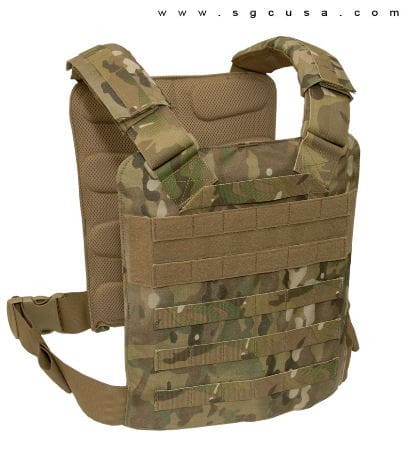
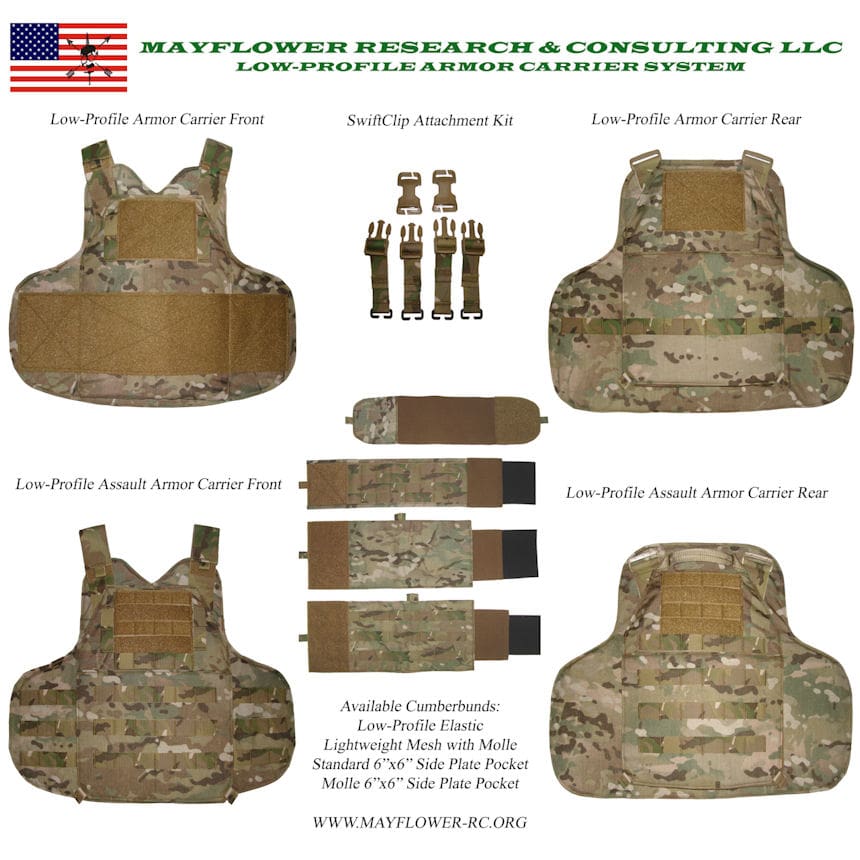
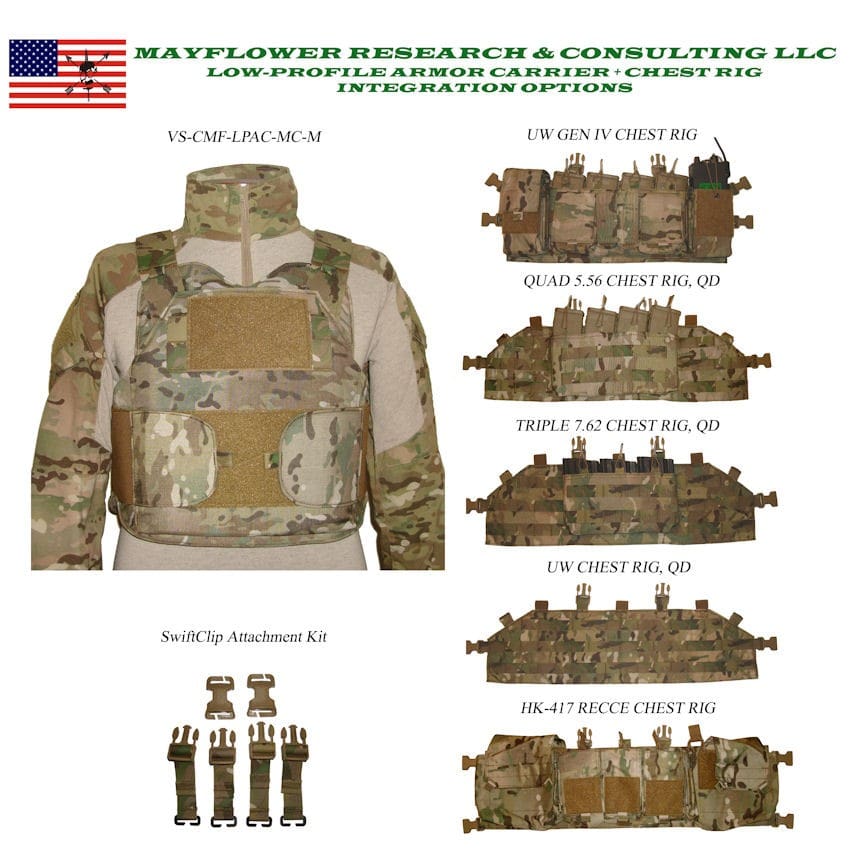
Mayflower Research and Consulting, LLC has offered their Low-Profile Armor Carrier for some time but they are constantly improving the system. Additional options are regularly produced for specialized customer requirements. The most popular make it to full production. The system is modular and you can combine front and back panels with various cummerbunds to build the perfect vest for your application.
Additional information coming soon from www.Mayflower-rc.org. The complete system, including new cummerbund options is coming this Fall to your favorite military outfitters.
D-Back Acquisition Co., parent company of Diamondback Tactical, announced yesterday that it has acquired the assets of First Choice Armor & Equipment, Inc. This transaction unites the quality and exceptional delivery capabilities of Diamondback with the technology and broad product portfolio of First Choice, creating a market-leader in personal and tactical protection products for the domestic and international law enforcement and military markets.
“The addition of First Choice brands and capabilities sets the stage for Diamondback’s growth strategy,†said Lt Gen Greg Newbold, USMC (Ret) of Torch Hill Investment Partners, an investor of Diamondback. “The existing technology and manufacturing know-how acquired from First Choice provides Diamondback with state-of-the-art soft and hard ballistic armor technology development and manufacturing capability allowing Diamondback to offer its strong customer base with new and expanded product lines.â€
Diamondback has also announced the appointment of Dan Walsh, former President of First Choice, as Chief Executive Officer of Diamondback Tactical, overseeing all company operations. In addition, Paul Larkin assumes the role of Executive Vice President Sales and Marketing, Brad Ditchfield continues as Executive Vice President Operations and Dale Taylor as Executive Vice President Product Development.
“The First Choice team is delighted to join forces with Diamondback,†said Dan Walsh. â€Diamondback’s reputation for high-quality tactical gear and its vision and commitment to the domestic and international personal protection markets, creates a potent combination for future company growth.â€
With the acquisition of First Choice’s assets, Diamondback now manufactures a complete range of personal protection products from concealable and tactical body armor, to hard armor plates, ballistic/riot shields and vehicle armor. Diamondback is an ISO 9001:2008 and ANAB accredited certified company that has pioneered the development of innovative NIJ 0101.06 certified concealable and tactical armor and is a global leader in ballistic technology and design. www.diamondbacktactical.com

Tags: Diamondback Tactical Posted in Armor, Industry | Comments Off on Diamondback Tactical Acquires Assets of First Choice Armor & Equipment
Special Operations Technologies has been refining the patent pending design of their latest plate carrier for the past few months and is ready to debut it. The Acrobat document pretty much sums it all up. If you are at the Infantry Warfighting Conference this week at Ft Benning be sure to stop by booth # 600 and try it on for size.
I first met the guys from P2 Systems at SHOT Show 2009 in Orlando. Between trips overseas on security contracts and developing new products they have remained steadily busy. David Crane over at Defense Review was able to track them down and had an opportunity to try out their various armor carriers. Take a moment to check out his review.

PEO-Soldier announced earlier this week that it had begun fielding the Gen II Improved Outer Tactical Vest (IOTV) in the Operation Enduring Freedom Camouflage Pattern (OCP). The pictures associated with the article are awesome and give you a great look at the new pattern. The photo below also shows a mounted TAP.

There are 17 improvements in the Gen II IOTV. Ultimately, the biggest improvement is probably the new sideplate pocket that is adjustable to the wearer. Many Soldiers found wearing sideplates almost unbearable. While the Army’s copy makes it sound like this is a whole new vest that is modular and scalable, ultimately, nothing is really that new. This is the same IOTV they have been issuing since earlier this year but what is important is that Soldiers deploying to OEF will be getting the latest in everything.
Having said that, it’s still an IOTV. Is it effective? Yes. Does it hinder mobility? Sometimes, like say if you are walking or climbing. Is it scalable? Sort of. If the IOTV were truly “all that”, the Army wouldn’t have fielded the Soldier Plate Carrier System and there would be no reason to undertake Soldier Protection Demonstration (SPD) 8 which is currently assessing Scalable, Modular armor vests from four different vendors including BAE, Point Blank, Armor Works, and PPI. These vests allow a Soldier to go from a concealable set up all the way out to full IOTV protection with all of the add-ons. The catch is that it has to be accomplished with one set up and must shave at least 10% off the weight of a fully jocked up IOTV.

Unfortunately, PEO-Soldier is staying mum on the subject of SPD 8 so we will wait to reveal more until they are ready.
DuPont’s Spruance facility in Richmond, Virginia recently hosted SSD for an in depth look at Fire Resistance and Ballistic Protection.
Back in the 60s a new class of fabrics was developed, called Aramids with DuPont at the forefront of their creation. Two fabrics in this class have become the cornerstones of modern Soldier Survivability; Kevlar and Nomex. They provide Ballistic and Fire protection respectively. Kevlar was initially developed by DuPont for tire belts but not put to its current use until the early 70s. Nomex on the other hand was quickly integrated into flying and space suits not long after its creation.
The most compelling portion of the visit was the ThermoMan lab. Composed of 122 sensors, ThermoMan was designed with the assistance of NC State. In addition to the mannequin, there is also a skin burn injury model that takes data collected at the sensors and displays how a thermal threat would equate to an injury to the human body. One interesting aspect of the ThermoMan over other testing methods such as the commonly used vertical flame test is that the ThermoMan tests not only the material’s performance but also the garment’s overall design and construction. This is a critical factor in protecting a wearer from thermal threats. If a flame can get inside a garment then the wearer might as well not be wearing FR at all. Interestingly, the pocket configuration of the issue flight suit is designed to provide additional protection for the wearer by doubling the layers of Nomex in certain key areas. Testing has revealed that most injuries actually occur after the flame threat is removed and the wearer is subjected to residual heat retained by the garment.
We witnessed two burns consisting of a 3 second burn delivering 6 calories. It is intended to replicate a JP4 fire. In the first burn, an issue CWU-27/P US issue flight suit manufactured from Nomex III.
As you can see, minimal damage was sustained by the ThermoMan due to the material and design of the flight suit. it is important to note that while the ThermoMan does a great job predicting injuries, actual injuries may vary due to a wearers body and the fit of the garment. Experience has shown that 1% injury equates to 1 day in the hospital. In this case, the ThermoMan indicated 7% injuries.
In the second, a similar looking flight suit manufactured from 65/35 PolyCotton was subjected to the same threat. PolyCotton, a mixture of 65% Polyester and 35% Cotton is commonly found in Chinese made garments. There IS a place for this fabric, but as you will see in the video, it isn’t in a flame threat environment. Rather, PolyCotton is a cool fabric and very good for use in warm climates. The choice of materials goes back to our recent article concerning knowing your equipment, the threat, and environmental conditions and making an informed choice about which equipment to choose. As you can see the PolyCotton not only caught on fire but it continued to burn even after a direct flame was removed. In this case, the ThermoMan sustained 75% injuries.
During our visit to the ballistics lab we witnessed a demonstration of testing of an armor vest and were introduced to the various apparatus used during testing. Additionally, we were given the opportunity to try out first hand correctional armor which is designed to stop stab and puncture threats. We were amazed at how much differently ballistic and correctional armor reacted to the icepick type of shiv commonly found in correctional facilities. The bottom line is that correctional armor works.
We were fortunate enough to be able to discuss a variety of current Soldier Systems issues with the DuPont team but probably the most important message we got was that DuPont is constantly looking at new ways to use their flagship products. Adaptability is the key as they not work to improve the performance of their materials but also as they seek new ways to use their products as well as combine them with other fibers.
While in years past many vendors would have pushed monolithic solutions to threats, it makes more sense now to develop hybrid solutions that combine multiple fibers into a more robust material. This way, the best characteristics of different materials can be combined into a common solution.
Overall, the meeting was excellent and we left with a greater appreciation of the level of commitment DuPont has to protecting our troops and public safety professionals.
Velocity Systems was well represented at the recent TREXPO in Chantilly, Virginia. One of their most interesting new innovations is the SwiftClip attachment system which eliminates the need to wear yet another harness over your armor. Working with Mayflower to develop a way to more rapidly integrate chest rigs as well as other specialty items on to an armor vest or plate carrier, they wanted something system and adaptable to a wide variety of gear and was simple to use. They found it with the SwiftClip which is not only simple, but also provides a stable mounting solution.
The SwiftClip is designed to accept any chest rig or other item with an ITW 1″ male side release buckle. Both Velocity Systems and Mayflower products are Berry Compliant and available in a variety of colors and patterns including the US Army’s new OCP (MultiCam).