For those of you that missed it, this is a digital copy of the catalog handed out at SHOT Show. They ran out of them on the first day! Items are beginning to trickle out to dealers like the Gun Clip.


MultiCam was developed by Crye Precision and is currently one of the most popular camouflage patterns on the market. It’s been adopted by numerous countries including the US, UK, and Australia. Consequently, we run across MultiCam knockoffs all of the time. Readers send them to us often asking if they are authentic or not. In fact, we received one yesterday that really caught our eye. Generally, copycat patterns are intended for the MilSim or consumer markets which are often more driven by price than performance. But this one was different. It was developed by the US Army and oddly enough, for much the same reasons. Intended as a cost savings measure and yet still be MultiCam compatible, we’re not too sure they have succeeded at either goal. Take a look, and you’ll see what we mean.
(more…)
 BAE held a ceremony yesterday at their Phoenix, Arizona facility to celebrate the production of their millionth hard armor insert for the Department of Defense. These include the Small Arms Protective Insert (SAPI) as well as the newer generation Enhanced or ESAPI and Next Generation XSAPI plates as well as smaller Side variants.
“A hard armor insert helps protect a warfighter’s vital organs and has been proven as a critical lifesaver on the battlefield. Our employees come to work each day knowing that the work they do could save a life and bring a loved one home to their family,†said Joe Coltman, vice president of BAE Systems’ Protection Systems. “Manufacturing one million of these plates is a significant milestone for BAE Systems and its employees to achieve. It brings into perspective the number of lives we are protecting.â€
On hand for the celebration were U.S. Rep. Ed Pastor (Dem, AZ), COL William Cole, Program Manager for Soldier Protection and Individual Equipment, LTC (P) Jon Rickey, Product Manager for Soldier Protective Equipment and COL John Womack, Commander for the Defense Contract Management Agency in Phoenix.
5.11 Tactical produced an excellent video featuring Kyle Lamb using a full array of their clothing and equipment. However, Kyle’s plate carrier somehow went uncredited. Once we took a look at it we realized it was a Tyr Tactical LWPC. We will say that 5.11 makes a great line of tactical products and their new MultiCam lineup is very well designed. We particularly like their Rapid Assault Shirt. But, they are missing a plate carrier. We wonder if this isn’t an indication of things to come?
5.11 products are available from a wide variety of military and police outfitters. For info on their latest products visit www.511tactical.com. For more info on Tyr Tactical visit www.tyrtactical.com.
Safariland, a BAE Systems line of business, has announced a partnership with Digital Concealment Systems, LLC to exclusively offer the A-TACS® (Advanced Tactical Concealment System) camouflage pattern within the body armor category.
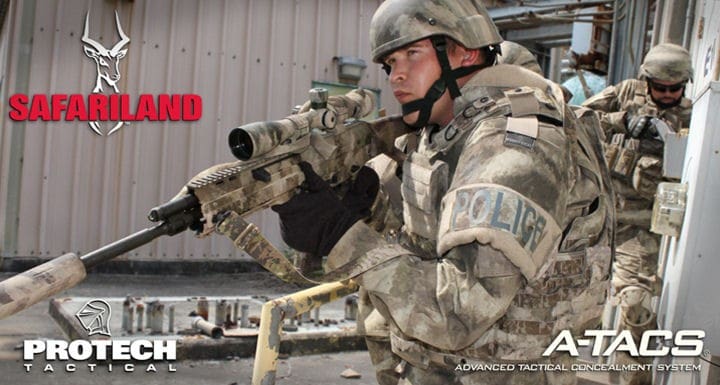
“We are excited to add the A-TACS line of camouflage offerings to our PROTECH brand,†said Dan McNeil, Category Director for Armor Tactical products. “Our partnership with A-TACS is another step in the right direction of providing products that meet and exceed the requirements of law enforcement officers and agencies serving our communities every day.â€
A-TACS will be available as a color option for all of PROTECH’s tactical carriers and soft tactical armor accessories such as yokes, throats, collars, biceps, groin protectors and pouches.
For more information on PROTECH’s offerings visit www.safariland.com/bodyarmor.

KDH Defense Systems is producing its new, lightweight ballistic pack, called “Convergence,” for the Army’s Improved Outer Tactical Vest (IOTV). Tested to ensure that the new package meets or exceeds all Army ballistic testing standards, according to KDH Convergence has reduced the weight of the IOTV’s armor package by more than 10%.
“KDH Defense Systems continues to make significant advances in reducing the weight of Soldier borne protective technologies,” stated Jeff Payne, Special Projects Manager, Research and Development, for KDH. “This milestone marks the first actual weight reduction under the current soft ballistic requirement and the first considerable reduction since the 1.1 psf requirement was implemented in the late 1990s. With the Convergence IOTV lightweight ballistic pack nearly 10% lighter than specification, the Soldier can now much more easily accomplish his combat missions regardless of the enemy, the terrain, and the weather encountered. Reducing the weight of the armor system also provides for the opportunity to add other potential life-saving equipment such as additional ammunition to the load. This innovative, new technology has the potential to reduce the weight of every armor system under the current requirement regardless of style,” Mr. Payne concluded.
“Lighten the load has been the resounding command from the military for more than a decade,” stated SGM (Ret) William T. (Butch) Hancock, Jr., Military Program Development for KDH. He continued, “The Afghan surge, which requires more foot patrols than were carried out in Iraq, has fueled the need to make our Soldiers more agile in their protective gear by reducing the weight of their armor systems. KDH’s new IOTV lightweight ballistic pack, Convergence, is one of the lightest and most flexible packages ever selected by the United States Army.”
“The emphasis to increase the ballistic protection of the Soldier has increased his survivability while hindering his mobility and endurance,” stated David Herbener, President and Chief Executive Officer of KDH Defense Systems, Inc. “We know what we have today works, but the challenge is reducing the weight while maintaining or exceeding the identical amount of protection. We are pleased that the United States Army has chosen KDH’s new, lightweight Convergence ballistic package and we continue to look beyond the current Soldier protection systems in an effort to protect against threats that Soldiers haven’t yet encountered. KDH remains steadfast in its commitment to developing solutions that will make Soldiers more agile in their protective gear by reducing the weight and bulk of the systems while making the design of such armor much more flexible and comfortable to wear.”
KDH currently manufactures the Amy’s IOTV and Soldier Plate Carrier System as well as the USMC IMTV and Plate Carrier. They moved completely to their current ISO 9001 facility in Eden, North Carolina from Johnstown, Pennsylvania in early 2010.
Bravo to the Army as well as KDH for making this happen as reducing the weight of armor is one of our biggest challenges. KDH did receive Congressional earmarks in 2008 and 2010 to improve ballistic protection the tune of $3.36 Mil so it’s good to see a return on the investment. But, this isn’t exactly a technological breakthrough. KDH did what it could based on the materials it was allowed to work with. There are myriad armor packages available commercially that blow the previous IOTV weight per square foot standard away if you move in a different direction.
Industry insiders estimate there are currently between eight and ten certified armor packages for the IOTV with the point Blank developed Pathfinder-S being the most popular and serving as a de facto baseline that everyone else varies from. There are several methods to reduce cost for these packages but reducing weight proves very tricky considering the Army has stood by woven aramids such as Twaron or Kevlar KM2 rather than introducing unidirectional technologies which can be made from polyethylene such as Dyneema or aramids such as Goldflex. While weights drop when using the unidirectional fabrics due to their higher performance, conversely costs rise. Naturally, the lower the weight, the higher the cost.
As we have said before, if there is a true desire to reduce the load, particularly on the armor side, true quantifiable measures can be made, but someone has to foot the bill.
“Army conducting ‘full-court press’ to reduce weight Soldiers carry” – That’s the title of latest story from the Army News Service discussing testimony provided last week by Army officials before the House Armed Services Committee on the Army’s budget and modernization. Afghanistan as you know is a very Soldier-centric environment and the Soldier serves as our most important combat system. Since the onset of hostilities in 2001 the Army has made huge strides to improve the Personal Protective Equipment (PPE) of our Soldiers but it has come at a cost.
However, the article leads the reader to believe a couple of things that are untrue and hopefully, the article is incorrect and these same misstatements weren’t provided to Congress as testimony.
For example, according to the article the Army’s Vice Chief of Staff GEN Pete Chiarelli “said the Army has given Soldiers the option between the Improved Outer Tactical Vest and the new light-weight plate carrier. That provides a weight savings of 8 pounds…” Actually, the Army provides both systems but it is not up to the Soldier which he will wear but rather up to his chain of command. While it isn’t an out and out mistruth, it is a bit misleading. Individual Soldiers don’t get to apply METT-T and decide which PPE to wear.
He went on to state, “And the Army “continues to look at ways to further lighten body armor,” though he told lawmakers it’s not likely that the most common protective gear for Soldiers, the ceramic protective plates worn close to the body, could become lighter — because the technology isn’t there yet.
“I have not heard of any technologies now that will give us the required protection — as enemy capabilities continue to increase — at a lighter weight,” Chiarelli said.”
Once again, not entirely true. Industry can drop weight, but the Army doesn’t want to foot the bill associated with the reduction.
But, according the article GEN Chiarelli wasn’t the only one putting out incorrect info. LTG William N. Phillips, the military deputy to the assistant secretary of the Army (Acquisition, Logistics and Technology) apparently hailed the Army’s new “Danner” boot due to its weight reduction. Unfortunately for him, the Army chose the Belleville boot instead. While the boots are very similar, the fact that a senior Army leader is passing out bad info is a bit disconcerting. What else is he getting wrong? It might be the tidbit about the “added” $5.8 Million for armor R&D. Yes, it’s a new line item, but the money isn’t. Most of it was pulled out of the old single line item that covered armor as well as Organization Clothing and Individual Equipment. Now they are separate.
Soldiers are our most precious resource. When it comes to their protection, we’re not opposed to a little gold plating. But please, no sugar coating.
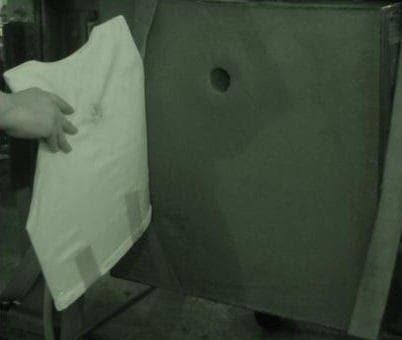
H.P. White Laboratory, Inc., the world’s largest independent test laboratory for body armor, has contracted to work with the Police Executive Research Forum (PERF; policeforum.org) to conduct comparative ballistics resistance testing on new and used law enforcement body armor for the research study: Physical and Environmental Effects on the Performance of Body Armor. In a 18-month study funded by the National Institute of Justice (NIJ) they will integrate data collected in a two stage process. In phase one, PERF will conduct a survey to evaluate how body armor is used, maintained and stored over time. In phase II, used soft body armor samples (and usage histories) will be collected from officers in 30 agencies across a range of US climates.
“HP White is honored to work with PERF and support the NIJ in its mission of advancing body armor design and the protection of law enforcement personnel,†said Mike Parker, president of HP White. “This is critically important work that will give law enforcement empirical data on body armor performance over the life of the protective equipment.â€
Then, through a series of abbreviated tests based on the NIJ 0101.06 standard, HP White will then conduct comparative evaluations to match the ballistics properties of used body armor samples against an equivalent control group of new body armor samples. These comparative data will identify the variables, with each used body armor sample, which contribute to armor failure.
For more information visit www.hpwhite.com, or call 1-410-838-6550.

















































































































