TYR Tactical

Archive for the ‘Army’ Category

Army Transforms Acquisition Process to Enhance Ammunition Support for Warfighters

Thursday, February 5th, 2026

PICATINNY ARSENAL, N.J. – The U.S. Army has established the Portfolio Acquisition Executive for Agile Sustainment and Ammunition, PAE AS&A, at Picatinny Arsenal under the command of Maj. Gen. John T. Reim. The move is a key part of broader Continuous Transformation efforts intended to increase efficiency and accelerate the delivery of critical capabilities to the warfighter.

The new organization was activated at a ceremony held on January 20 at Picatinny Arsenal where several thousand team members from all involved organizations were introduced to the new command. The Assistant Secretary of the Army for Acquisition, Logistics and Technology, the Honorable Brent Ingraham, presided over the ceremony and spoke to the significance of the new organization as a key part of the Army’s Acquisition reform initiative.



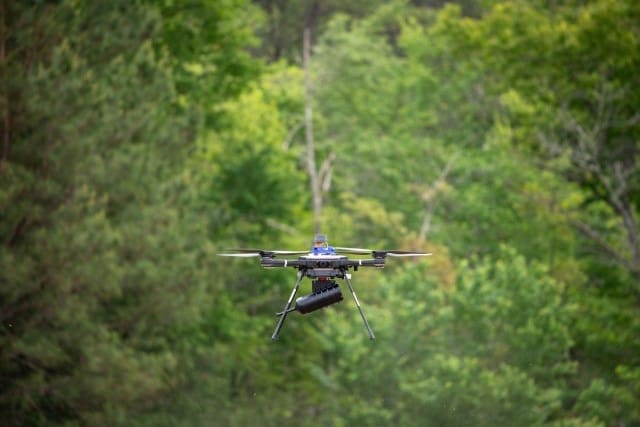
Following the ceremony, Ingraham witnessed a live demonstration featuring the Purpose Built Attritable System and a TRV-150 drone dropping smoke and a M69 training grenade onto a target simulating a small group of enemy Soldiers with a vehicle. This showed off one of DEVCOM’s latest innovations, the Picatinny Common Lethality Integration Kit or Picatinny CLIK. These are just a few of the of lethal UAS and counter-UAS technologies being developed by U.S. Army Combat Capabilities Development Command Armaments Center. The DEVCOM Armaments Center now serves as the Systems Center, a key enabler, of the PAE AS&A.

Subject matter experts from the PAE AS&A and DEVCOM Armaments Center then also briefed Ingraham on other lethal UAS, counter-UAS munitions, advanced artillery, next-gen energetics, expeditionary logistics and supply chain enabling systems that are the result of joint efforts of the two Picatinny based organizations.

“This marks a significant milestone in our journey to modernize Army Acquisition,” Ingraham said as he addressed the audience. “We are combining the capabilities of the Joint Program Executive Office for Armaments and Ammunition with critical combat logistic capabilities from PEO Combat Support and Combat Support Services to ensure fully capability alignment under our new structure.”

“Today we turn the page to an exciting new chapter in Army Acquisition,” Ingraham continued. “Every role in the organization plays an invaluable part in this journey. Cross organization engagement and agility are essential in ensuring the success of this transition. The future of Army Acquisition is bright and PAE AS&A is poised to lead the way.”

Ingraham’s visit underscored the installation’s vital role the various commands at Picatinny Arsenal play in maintaining readiness — delivering the capabilities, expertise, and innovation that ensures our Warfighters and allies are equipped to succeed in any environment.

“As we embark on this journey, we align our actions with the strategic guidance provided by our leadership including the President of the United States, the Secretary of War, the Secretary of the Army and the Chief of Staff of the Army,” said Reim who followed Ingraham. “This initiative is not merely a restructuring of our acquisition processes. It is a fundamental rethinking of how we approach the delivery of capabilities to our Soldiers, our joint warfighters, and our international partners.”

Legacies of Excellence

The Army is fundamentally restructuring its acquisition process to prioritize speed and efficiency over traditional approaches. As part of this initiative, the Army is establishing six Portfolio Acquisition Executives with increased focus on capabilities over specific programs.

The transformation includes the integration of the former Program Executive Office Combat Support and Combat Service Support, PEO CS&CSS, into the Capability Program Executive for Combat Logistics, CPE CL, led by Brig. Gen. Camilla White. PEO CS&CSS brings an unmatched history of logistics and sustainment support to the new CPE CL. It encompasses more than 200 programs spanning the Army’s transportation, ordnance, quartermaster, engineer, and training equipment portfolios.

As the CPE CL, it will continue to develop and deliver modernized tactical wheeled vehicles, engineering equipment, watercraft, power generation systems, and other force sustainment capabilities to Army, Joint, and global partners.

At the same time, the Joint Program Executive Office for Armaments and Ammunition, JPEO A&A, will realign into the Capability Program Executive for Ammunition & Energetics, CPE A&E, led by Col. Jason Bohannon. JPEO A&A has consistently delivered innovative acquisition solutions to provide Joint Warfighters and allied partners with overmatch capabilities. The JPEO was comprised of four project offices covering Combat Ammunition Systems, Close Combat Systems, Maneuver Ammunition Systems and Joint Services.

As the CPE A&E, it retains responsibility for life-cycle acquisition management of all conventional ammunition, which includes integrating budgets, acquisition strategies, research and development and life-cycle management across all ammunition families.

CPE CL will be headquartered at Detroit Arsenal, Michigan, while CPE A&E will remain at Picatinny Arsenal. Unlike the previous Program Executive Offices, each PAE will have comprehensive responsibilities and accountability for managing the full spectrum of acquisition activities, including requirements development, technology maturation, product development, testing, contracting, fielding, sustainment, and international sales. This flattened acquisition system empowers PAEs to make timely, risk-based decisions and accelerates capability delivery to Warfighters through problem-focused requirements, smarter contracts, informed risks, and faster pivots.

“This restructure achieves unity of command by establishing and empowering PAE AS&A with the full authority to direct research and development, prototyping, testing, production, and sustainment,” said Reim. “By prioritizing outcomes over processes, this new construct empowers us to award contracts faster by cutting through bureaucracy. Overall, this approach unburdens the acquisition enterprise and allows us to deliver warfighting capabilities at speed and scale.”

Accelerating Ammunition Acquisitions

Under the leadership of Maj. Gen. Reim, PAE AS&A will oversee an entire capability area including all conventional ammunition requirements including direct and indirect fire ammunition, close combat systems, explosives, and pyrotechnics, in addition to logistics, fielding, and sustainment. PAE AS&A will have oversight of the organic munition production facilities.

Maj. Gen. Sean Davis will serve as the new Deputy Portfolio Acquisition Executive adding the sustainment capabilities of the Army’s Combined Arms Support Command, CASCOM to PAE AS&A. CASCOM trains and develops adaptive Sustainment professionals for the total force while integrating innovative Army and Joint Sustainment capabilities, concepts and doctrine to sustain large scale combat operations in a multi-domain operations environment. It is also a part of Transformation and Training Command and is located at Fort Lee, Virginia. PAE AS&A is committed to supporting the warfighter through an innovative approach to ammunition acquisition and sustainment that leverages existing authorities to deliver tangible benefits, including accelerated capability delivery, smarter contracts, and informed risk management.

In addition to the two new CPEs, PAE AS&A will oversee multiple acquisition enablers including senior contracting officials, a test and evaluation integrator, the Sustainment Future Capability Directorate and the system center lead overseeing coordination among Army Combat Capabilities Development Command Centers. The PAE AS&A System Center Lead is Chris J. Grassano, the firector of the DEVCOM Armaments Center. The new structure will enable holistic management of conventional ammunition development, production and sustainment under a single command resulting in increased efficiencies and accelerated delivery of lethality aligned with the emerging Army Warfighting Concept.

Looking Ahead

In conjunction with this reform, the Army is investing $1.1 billion per year to overhaul depots, arsenals, and ammunition plants that produce and sustain Army equipment. This commitment will not only modernize facilities but also strengthen the defense supply chain and create jobs.

For industry partners, these reforms will mean faster contracts, clearer points of entry, and fewer bureaucratic hurdles. Soldiers will benefit from receiving new capabilities, such as drones, long-range fires, and next-generation command and control systems, years faster than before.

By Michael Chambers and Eric Kowal

Army Security Cooperation Group-South: First of Its Kind Stands Up in Georgia

Tuesday, February 3rd, 2026

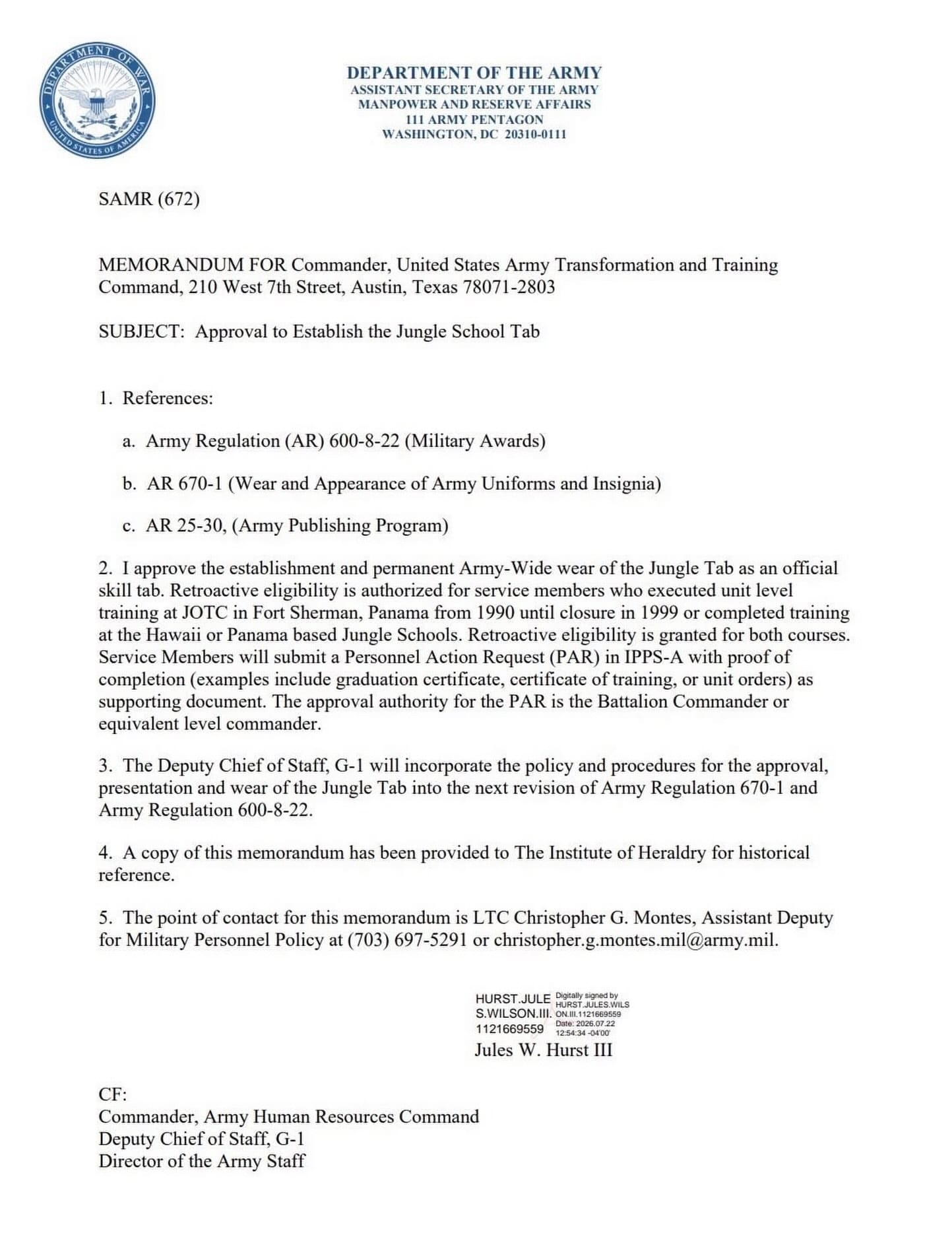
FORT BENNING, Ga. – On January 27, 2026, the Army Security Cooperation Group – South (ASCG-S) conducted a small ceremony on Kelley Hill, Fort Benning, Georgia to commemorate its ongoing transformation. ASCG-S, formerly 1st Security Force Assistance Brigade (1st SFAB), has become central to security cooperation in Panama, through its assumption of the Joint Security Cooperation Group-Panama (JSCG-P) and the combined Jungle Operations Training Center (JOTC) missions.

The ceremony was presided over by Col. Keith W. Benedict and Cmd. Sgt. Maj. Pedro Chavez, the command team for the ASCG-S. During the ceremony – coinciding with the furling of the colors and near-term departure of two organic battalions and one National Guard battalion from 54th SFAB. Col. Benedict reflected on 1st SFAB’s legacy and how it’s accomplishments and achievements will have long-lasting effects on the U.S. Army and our regional partners. Those bound for Panama then donned their jungle boonie headgear, and all donned the U.S. Army South’s 6th Army patch.

1st Security Force Assistance Brigade was activated in October 2017 to fill the growing requirement for Advisors for Afghan security forces, alleviating the existing practice of pulling leaders from their formations to help Afghan units. 1st SFAB conducted one deployment to southwest Asia, where Cmd. Sgt. Maj. Timothy Bolyard, the senior enlisted advisor of 3rd Squadron, 1st SFAB made the ultimate sacrifice. After the Afghanistan tour, 1st SFAB became regionally aligned to the Southern Command area of operations, where they conducted security force assistance with Colombia, Argentina, Panama, and Honduras, among other partners.

The Army Security Cooperation Group – South is a unique unit within the Army, that falls under the newly-established United States Western Hemisphere Command (USAWHC), leading efforts to deepen and widen interoperability with Panamanian partners on strategic terrain within the 2025 National Security Strategy’s priority region. “Our soldiers are excited to build upon their experience working in Panama to establish a digitized training environment and work with our partners,” states Col. Benedict, “to test and evaluate our warfighting capabilities in one of the most challenging jungle environs in the world.”

Under the new force restructure, ASCG-S has assumed responsibility for JSCG-P, which is working with the government of Panama to increase cooperation efforts between the U.S. Military and Panamanian security forces. JSCG-P is also crucial to the staging and reception of all U.S. military personnel coming to Panama to learn from partners and to test their mettle. “We are actively seeking jungle expertise and look forward to units across the joint force and the international community joining us this summer for Panamax 2026,” CSM Chavez states, “I assure you, this environment isn’t for the timid or entitled.”

JSCG-P is working with Panamanian partners to re-invigorate a combined JOTC at Aeronaval Base Cristobal Colon (formerly Fort Sherman). Panamanian security forces have run a unilateral course like the U.S. Army-run, combined course that existed for Panama for nearly 40 years until 1999. Now, once again JOTC students and cadre from both U.S. and Panamanian security forces convene in the “Green Hell.” The current course is 18 days and goes over primitive fire and shelter training followed by tracking and patrol exercises that test the students’ resilience and perseverance.

The activation of the ASCG-S is yet another visible step in the Army and U.S. military’s ongoing effort to revitalize security in the western hemisphere and with the regional partners therein. The Army Security Cooperation Group-South is excited to evolve into a premier jungle force capable of enabling training and readiness for and looking for units to train in this environment and individual soldiers seeking opportunities to enter the triple-canopy arena.

MAJ Val Bryant

USAMU Builds Lethality During M7 Fielding with 25th Infantry Division

Monday, February 2nd, 2026

Soldiers assigned to the 25th Infantry Division are training on the Army’s newest service rifle as part of the ongoing fielding of the M7, with instructors from the U.S. Army Marksmanship Unit providing hands-on support focused on marksmanship fundamentals.

USAMU instructors are working alongside Soldiers to reinforce proven shooting techniques that apply across weapon systems. While the M7 introduces new capabilities, instructors emphasized that effective marksmanship still depends on mastering the basics.

“We’re not here to reinvent the wheel,” said Sgt. 1st Class Alexander Deal, team chief for the U.S. Army Marksmanship Unit Service Rifle Team. “The fundamentals of marksmanship don’t change, even when the weapon system does.”

Deal said the training focuses on consistency and efficiency behind the rifle, especially as Soldiers transition to a new platform.

“When Soldiers pick up a new weapon, it’s easy to focus on the equipment,” Deal said. “What we’re reinforcing is that grip, trigger control, and follow-through still matter. If you have solid fundamentals, the weapon becomes easier to run.”

According to Deal, the techniques taught by USAMU instructors are rooted in competition shooting, where performance is measured under pressure.

“Competition shooting forces you to balance speed and accuracy,” Deal said. “Those same principles translate directly to combat. You have to be accountable for every shot, and you have to be consistent.”

Throughout the fielding, instructors observed Soldiers adapting quickly as they applied those principles during live-fire training.

“We’ve seen Soldiers gain confidence fast once they trust the fundamentals,” Deal said. “When they understand what right looks like, their performance improves.”

Deal said the intent of the training is to give units tools they can continue to use long after the fielding event ends.

“Our goal is to leave units better than we found them,” Deal said. “If leaders and Soldiers walk away with a stronger foundation in marksmanship, that training continues long after we leave.”

Training like this supports the Army’s broader effort to increase lethality across the force by pairing modern equipment with disciplined marksmanship.

SFC Timothy Hamlin

Fort Buchanan Advances Army Transformation Through Innovative Training Capability

Sunday, February 1st, 2026

FORT BUCHANAN, Puerto Rico —The Army’s home in the Caribbean is supporting the service’s transformation into a leaner, more lethal, and more agile force by modernizing how Soldiers train and generate readiness across the region.

Central to this effort is theMobile Marksmanship Training Simulator (MMTS), a deployable capability operated by Fort Buchanan’sTraining Support Center (TSC). The MMTS enhances marksmanship and engagement-skills training while reducing logistical demands and costs, directly supporting the goals of theArmy Transformation Initiative (ATI).

“Combined with the full range of capabilities available at the TSC, the MMTS has enabled Fort Buchanan to adapt how we support the warfighter. It has strengthened our training support and helped develop combat-ready formations across the region,” saidLuis Reyes, TSC manager.

The MMTS features full mobility, CO?-powered weapons that generate realistic recoil, and immersive, interactive scenarios that replicate operational environments. These capabilities allow units to train consistently regardless of range of availability or geographic constraints.

“The fact that we can take this system directly to Soldiers is a game-changer. It saves time and resources, allowing troops to focus on warfighter tasks instead of traveling long distances to training sites,” Reyes added.

Fiscal year 2025 marked the first year the MMTS was employed in Puerto Rico, and its impact was immediate. During the year, the system delivered more than800 hours of training to approximately 1,600 Soldiers, significantly expanding access to high-quality training while conserving time and resources.

According to Reyes, the MMTS does not replace Fort Buchanan’s fixedEngagement Skills Trainer (EST) 2000. Instead, it complements existing capabilities by extending training beyond fixed facilities. Together, EST 2000 and MMTS provide a layered, flexible approach that increases training frequency and efficiency while maintaining established standards.

“What the team at the Fort Buchanan TSC is doing—especially with the MMTS—is a clear indicator of the installation’s role as a warfighter readiness enabler. This capability strengthens readiness across the region and supports the Department of the Army enterprise,” saidBerenisse Rodriguez, chief of the Directorate of Plans, Training, Mobilization and Security.

By expanding access to modern training and delivering measurable results, Fort Buchanan’s Training Support Center continues to implement Army transformation concepts—ensuring forces remain ready, lethal, and responsive to mission requirements across the Western Hemisphere.

“Whether preparing units for contingency response, disaster relief, homeland defense, or overseas deployments, the TSC ensures leaders and Soldiers have access to the tools and resources they need to succeed,” saidRodriguez.

With an annual budget exceeding$500 million, Fort Buchanan supports a military community of approximately15,000 personnel, including Active Duty, Reserve, Puerto Rico National Guard, Marine Corps Reserve, and Navy Reserve members. The installation’s mission is to enhance readiness and facilitate the deployment of military personnel to any location, at any time.

Story by Carlos Cuebas 

U.S. Army Garrison Fort Buchanan

The Army and AMTEC Unveil New Production Line and Testing Range in Wisconsin

Saturday, January 31st, 2026

JANESVILLE, WI — In the latest effort to modernize the Defense Industrial Base (DIB), the Army has partnered with AMTEC Corporation to open a new 40mm grenade production line and test range at AMTEC’s Janesville, WI facility. This is another milestone in the Army’s ongoing campaign of industrial expansion and modernization of munitions production for the Joint force.

The ribbon cutting ceremony was held on January 22 with Maj. Gen. John T. Reim, Portfolio Acquisition Executive for Agile Sustainment and Ammunition and Commanding General of Picatinny Arsenal, Mr. Mark Nielsen, Veterans and Military Affairs Constituent Services Representative for Wisconsin Senator Ronald Johnson, and Ms. Susie Liston, District Director for Wisconsin Congressman Bryan Steil in attendance. Following the ribbon cutting, AMTEC executives walked the guests through the capabilities of the new line as they toured the production facility and the test range.

The grand opening of AMTEC’s new indoor 200m test range and the 72,000-square-foot manufacturing facility that houses the new, state-of-the-art 40mm M918E2 production line is the latest in a string of new facilities coming online as the Army continues to increase munitions production capacity and safety through modernization. The Army has invested $21M to open the new production line.

“The new line brings much-needed automation and flexibility as the manufacturing process shifts from a highly artisan process to an automated, high-volume production process,” said Reim. “Since 2022, $5.5B has been pushed into the DIB making it the largest investment in infrastructure and munitions production since World War II. This is the 11th new facility that the Army has stood up demonstrating our commitment to increasing production capacity, modernizing equipment and facilities, and improving safety and efficiency by deploying advanced manufacturing technologies.”

The M918E2 High Velocity Target Practice – Day Night Thermal (HV TP-DNT) cartridge provides Warfighters with a safer and more reliable cartridge that allows them the ability to maneuver during training in more realistic “Train as they Fight” scenarios. The new training cartridge is non-dud producing, meaning troops can now safely move across areas that once posed an unexploded ordnance (UXO) hazard. It also provides a day, night, and thermal visible impact signature that can be seen by the unaided eye, and thermal and night vision sights.

AMTEC will also realize cost savings and efficiency improvements with their new on-site test range. Previously, the company tested rounds at a nearby police test range, which required expensive satellite tasking and protection. The new test range accommodates the MK19, M203, and M320 weapon system platforms familiar to the 40mm portfolio. The test range will enhance precision testing capabilities for medium-caliber munitions, supporting quality assurance, rapid prototyping, and delivery of reliable munitions to U.S. Army and international allies.

“This investment provides a trifecta for the Army: advanced manufacturing capability, safety, and a modernized round that allows units to train as they fight,” said Reim.

A subsidiary of National Defense Corporation, AMTEC serves as the Department of War’s prime contractor for 40mm grenade ammunition and fuzing systems. AMTEC is a long-time partner and the largest manufacturer of 40mm ammunition in the world.

By Michael Chambers

Army Intelligence Data Platform-Next (AIDP-Next) Virtual Industry Day 12 Feb 2026

Thursday, January 29th, 2026

Project Manager Intelligence Systems & Analytics is hosting an Army Intelligence Data Platform-Next (AIDP-Next) Virtual Industry Day 12 Feb 2026 from 10 a.m. to 1 p.m. EST.

The Industry Day will facilitate industry exchange, market research, and information sharing related to the future of AIDP-Next.

For more information and registration, visit forms.osi.apps.mil/pages/responsepage.

CACI to Strengthen US Army Readiness and Spectrum Dominance with Next-Gen Electronic Warfare

Wednesday, January 28th, 2026

RESTON, Va.-CACI International Inc (NYSE: CACI) announced today that it has been awarded a five-year task order valued at up to $250 million to enhance spectrum dominance for the U.S. Army Capability Program Executive – Intelligence, Electronic Warfare & Sensors (CPE IEW&S).

“At CACI, we are making bold investments in battle-proven, software-defined EW solutions that allow us to stay one step ahead of the enemy and drive decisive action,” said John Mengucci, CACI President and Chief Executive Officer. “We empower warfighters to achieve and maintain spectrum dominance, especially when their lives are on the line in highly contested environments.”

CACI will leverage its intrinsic knowledge to provide comprehensive integration and sustainment of the technology to advance the Army’s multi-domain EW and spectrum dominance capabilities.

Fort Bragg Opens Lieutenant General Gavin Joint Innovation Outpost

Tuesday, January 27th, 2026

FORT BRAGG, N.C. — In support of the Department of War’s transformation initiative, Fort Bragg and the XVIII Airborne Corps officially opened the Lt. Gen. James Gavin Joint Innovation Outpost on January 23, 2026.

As the first facility of its kind, building on U.S. Army Division innovation labs, the JIOP serves as a center that bridges tactical and operational challenges with rapid innovative solutions. Designed as a hub for military personnel, academia, and industry, the JIOP aims to collaboratively address problems faced on the modern battlefield.

The facility is named in honor of Lt. Gen. James Gavin, who commanded the 82nd Airborne Division during World War II, leading the division through pivotal moments such as D-Day, Operation Market Garden and the Battle of the Bulge. Following World War II, Gavin became the head of U.S. Army Research and Development and was renowned for his innovative concepts, including the use of helicopters to transport infantry ? air assault ? and the development of modern air cavalry.

“We are honored to name this facility after Lt. Gen. James Gavin, a true visionary who understood the importance of innovation,” said Lt. Gen. Greg Anderson, XVIII Airborne Corps commanding general. “The JIOP will carry on his legacy by fostering the kind of bold thinking and collaboration that he championed throughout his career.”

Appropriately named after Lt. Gen. Gavin, the JIOP focuses on rapid innovation for the modern and future global battlefields.

“The future of warfare is here,” said Rob Braun, XVIII Airborne Corps Chief Technology Officer. “It’s driven by technology and success is impossible without partnerships. The Lt. Gen. James M. Gavin Joint Innovation Outpost is an investment in that future, where we will develop and test cutting-edge capabilities while forging enduring new partnerships with the best of the military, industry, and academia to meet the future head on.”

While the U.S. Army currently collaborates with industry through the Assistant Secretary of the Army for Acquisition, Logistics and Technology office, the JIOP represents the first concerted effort to focus on rapid innovation coordinated with industry and academia at the operational level. The JIOP will connect Soldiers from all ranks and levels to innovative teams capable of developing solutions for current battlefield challenges.

“Every piece of technology we develop at the JIOP has one ultimate purpose: to enhance the lethality and survivability of our Soldiers on the battlefield,” said Col. Thomas Monaghan, director of the Joint Innovation Outpost. “This is about ensuring our warfighters can dominate any adversary, anywhere in the world.”

In addition to addressing modern battlefield problems, the JIOP will foster and strengthen ties between Fort Bragg and regional academic and industrial partners. “At the JIOP, we are creating a dynamic ecosystem where our Soldiers can collaborate directly with the brightest minds in industry and academia,” said Anderson. “This partnership is essential for accelerating innovation and maintaining our competitive edge.”

In recent years, Fort Bragg and the XVIII Airborne Corps have led the way in Soldier innovation through events like Dragon’s Lair and exercises such as Scarlet Dragon. Dragon’s Lair is a competition similar to Shark Tank, where Soldiers pitch innovative technological solutions that range from battlefield applications to improvements in daily quality of life. Scarlet Dragon involves industry partners field testing new technologies with the XVIII Airborne Corps and its subordinate units.

Looking ahead, Dragon’s Lair will feed the JIOP with innovative ideas, which will then flow into Scarlet Dragon for testing, creating a quick, tri-series process to rapidly address challenges for Soldiers in modern and future combat environments. “Fort Bragg has always been a proving ground for Army innovation, and the JIOP is the next chapter in that legacy,” added Monaghan.

MAJ Matthew St. Clair