Wilcox Ind VIPR

Archive for the ‘Army’ Category

Army Researchers Modernize Breaching for Ground Platforms Through AI-Enabled Explosive Hazard Detection

Thursday, July 2nd, 2026

FORT BELVOIR, Va. (June 4, 2026) — To defeat adversaries’ explosive hazards on today’s battlefield, U.S. Army researchers are integrating the latest advances in artificial intelligence to deliver greater lethality and survivability to Soldiers.

With Soldiers facing increasingly sophisticated and complex threats, Army scientists and engineers are developing capabilities to enable persistent ground situational awareness for maximum force protection. The Army’s Command, Control, Communications, Computers, Cyber, Intelligence, Surveillance and Reconnaissance (C5ISR) Center leads the Ground-based Multi-Mission Payload project.

Breaching minefields has historically been one of the most dangerous tasks for troops. By automating the monotonous and fatiguing task of manual threat scanning, Soldiers can focus their attention on the broader tactical environment while easing the cognitive load. While unmanned aerial systems can cover wide areas, ground systems remain essential to detect threats aerial assets can’t see.

“Our S&T and technical expertise across core competencies including advanced sensing, intelligence, and command and control are delivering critical advantages for our Soldiers — situational awareness, enhanced operational speed, and safety,” said C5ISR Center Director Beth Ferry.

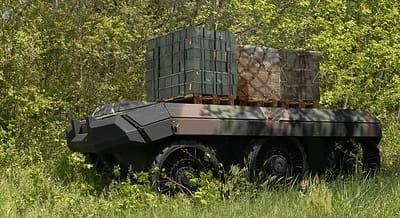
The GMMP proof-of-concept prototype includes a suite of hardware and AI-enabled software with advanced sensors, which have been outfitted onto a variety of ground vehicles and robotic platforms: a specially equipped military vehicle; a robot dog; and a Squad Multipurpose Equipment Transport, an unmanned, eight-wheeled heavy-duty robotic platform with instruments to complete multiple threat removal and complex mission sets, according to C5ISR Center physicist Kendall Johnson, the project’s technical lead.

An AI model detects, classifies, and reports explosive threats in real-time, integrating seamlessly into the Tactical Assault Kit ecosystem that populates a common operating picture for the entire team, both inside the vehicles and in the command post. Soldiers can identify hazards from a safe standoff distance, turning hours of manual scanning into a millisecond-fast automated process.

“The system incorporates a government-developed and -owned open AI architecture built by Army subject-matter experts,” Johnson said of the project’s plans for multi-algorithm support. “The Army can add the best algorithms from any source, at any time. The concept remains relevant into the future with the ability to incorporate new technologies as they emerge.”

C5ISR Center Countermine Ground to Ground Portfolio lead Dr. Amin Abbasi Baghbadorani said another project goal is transitioning from current counter-explosive systems that are often built with proprietary software and hardware while limited to a single purpose.

“GMMP is based on a modular concept to integrate commercial off-the-shelf hardware,” Abbasi Baghbadorani said. “Its open architecture is designed for rapid adaptation to new vehicles, sensors, and AI algorithms. The capabilities can be used with any platform and are easy to transition.”

Working with noncommissioned officers assigned to the Center is critical to providing Soldiers with the best tools for lethality and survivability, Johnson said.

“Feedback from NCOs has been incredible as we get feedback on-site,” Johnson said. “We’re able to make changes the same day and update the systems. It’s optimized the speed and pace of our project.”

Sgt. 1st Class Michael Havens, a C5ISR Center enlisted adviser, is working with the project’s scientists and engineers to bring his operational expertise as a network communication systems specialist into the technology development cycle.

“There’s an instant feedback loop,” Havens said. “What we do as enlisted Soldiers for C5ISR Center is they will give us their technology, show us how operate it, and run us through scenarios. We’ll tell them how to design the system to make it easier to use, more functional. Situational awareness is key. The more you have SA of the battlefield, the more you can devise a plan to execute, navigate, and negotiate.”

The GMMP team’s next steps are to mature the prototype into a cross-platform demonstrator with activities planned in additional climates and locations in the near future. It’s imperative the system performs across the wide range of conditions Soldiers face — extreme temperatures and humidity, sand, dust, foliage, snow, ice, and varying grass and soil types.

“The focus is adapting the system to more complex environments to prove its end-to-end capability,” Abbasi Baghbadorani said.

By Dan Lafontaine, DEVCOM C5ISR Center Public Affairs

Soldiers Test Drone-Delivered Breach Capability

Tuesday, June 30th, 2026

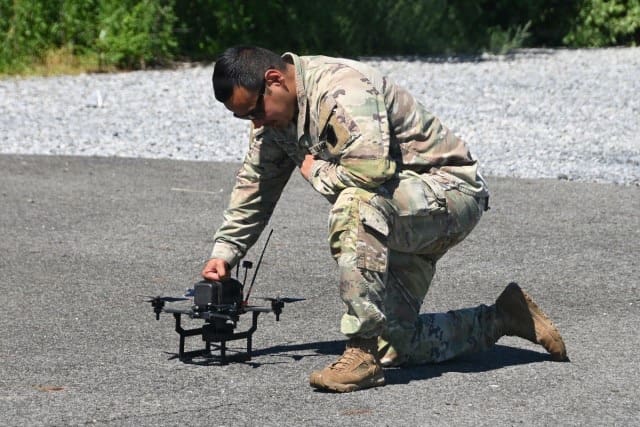
ORCHARD COMBAT TRAINING CENTER, Idaho — A heavy-lift drone climbed into 25 mph gusts above the high desert June 22, carrying a live Bangalore torpedo toward a wire obstacle.

For combat engineers, breaching that kind of obstacle is one of the most dangerous missions on the battlefield. Army doctrine accounts for that risk with a 50 percent casualty planning factor for a deliberate breach.

This time, no Soldier had to sprint forward to place the charge.

Soldiers from Bravo Company, 741st Brigade Engineer Battalion, 41st Infantry Brigade Combat Team, Oregon Army National Guard, used a drone-delivered Bangalore torpedo to breach the wire obstacle on Range 22. The drone released the charge, shock tube unspooled behind it and the Soldiers took cover before the Bangalore detonated, opening a lane through the wire.

The proof of concept marked the close of a months-long innovation effort by the 741st BEB’s drone working group. Battalion commander Lt. Col. Eric Zimmerman established the group with a directive to defeat a wire obstacle using a commercial off-the-shelf or similar drone during the battalion’s annual training. The working group’s research found no precedent for the tactic in the U.S. Army.

“Mostly Ukraine,” Zimmerman said when asked what drove the concept. “Watching what was going on in Ukraine, and how innovative they are, it inspires you to get better and think bigger.”

The doctrinal cost of a breach added urgency to the effort.

“The most casualty-producing thing that Army engineers do is the breach,” said 1st Lt. Andrew Lucas, who co-led the working group from the battalion S-3 operations section. “Expect 50 percent casualties. If you can deliver something to clear the breach with a $40,000 drone, instead of putting Soldiers in harm’s way, that’s worth experimenting with.”

Innovation surrounded by doctrine

Zimmerman said his intent was to apply emerging technology to a problem engineers already know how to solve.

“I want us to talk about drones around something we already do really well, which is defeating obstacles,” he said. “So let’s do this non-doctrinal thing, but surround it with doctrine.”

The working group was led by Lucas and Capt. Samuel Cushing, the battalion’s plans officer, with input from senior noncommissioned officers, including 1st Sgt. Joshua Martin. The team first studied commercially available drones priced from $2,000 to $40,000.

After funding for a commercial purchase did not come through, the team turned to the Oregon Army National Guard’s 249th Regional Training Institute. The RTI’s existing drone-build program could not produce an airframe with the lift capacity required by the mission. Lt. Col. Mark Timmons, the 249th RTI commander, told the working group his program could not meet the requirement within the available timeline.

Rather than abandon the effort, the battalion operations section continued pursuing alternatives. Working from specifications developed by the drone working group, Maj. Harvey, the battalion S-3, and Martin, the battalion operations noncommissioned officer, vetted industry partners before determining Lorica Technologies could meet the requirement.

When Lucas arrived for annual training, he believed the search had come up short.

“We’d been told no, it’s not going to happen, we’re not going to get a drone,” he said. “And that’s when Maj. Harvey said, ‘Oh, we actually got a drone.’ So, full speed ahead.”

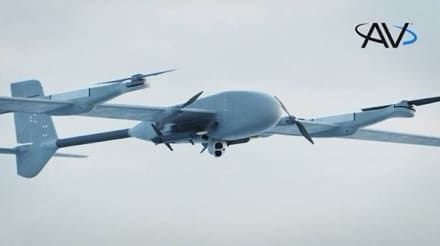
The Mule 28

Lorica’s contribution was the Mule 28, a heavy-lift, multi-mission unmanned aerial system designed and built in-house at the company’s Ashland facility.

The airframe weighs about 45 pounds, can lift about 200 pounds and is powered by eight motors turning eight 28-inch bi-blade propellers. It carries onboard artificial intelligence processing, software-defined radios and a sensor package designed to support recognition and targeting functions. The drone can also derive coordinates from its camera using trigonometry and focal length, allowing it to mark drop points on objects it identifies.

Lorica founder and CEO Christopher Dye said the company’s software, including a swarm-control system called Hive, is what makes the platform distinct.

“It doesn’t matter what the vehicle is, as long as we understand the capabilities and the parameters of the vehicle,” Dye said. “We can task the swarm based on what the job needs to get done. Right now, we’re working on natural language control, so that you can just talk to the bird and tell it, ‘Hey, I want a reconnaissance around this building. I need to know how big that ditch is before we get there, how many steps, how high the windows are.'”

Lorica currently fields three Mule 28 prototypes. The company had about six weeks to develop the airframe for the Oregon project.

Cushing said working with a domestic manufacturer to build to specification, rather than buying a commercial drone with Chinese components, was a deliberate choice that helped reduce electronic warfare and supply chain vulnerabilities.

“It’s been helpful to have contractors that can meet every specification we’re asking for and produce a drone that also meets the Army’s intent for any sort of technology that we integrate,” he said.

Soldiers with Bravo Company, 741st Brigade Engineer Battalion, 41st Infantry Brigade Combat Team, conducted a proof-of-concept drone-delivered breach against a wire obstacle June 22, 2026, on Range 22 at Orchard Combat Training Center, Idaho. U.S. Army video by Maj. W. Chris Clyne, Oregon National Guard Public Affairs.

Building the safety case

The team built safety into the project by increasing risk in stages. The drone first carried an inert training aid identical in size and weight to the M1A3 Bangalore. Once the platform could reliably deliver an inert charge on target, the team progressed through limited live-fire iterations before flying a live, two-section M1A3 Bangalore torpedo.

Every iteration involving live explosives was initiated using a shock tube spooled from the drone to the obstacle. The team deliberately avoided an electronic trigger that could be jammed or prematurely activated.

“Ideally, you would love to be able to remote-detonate this without having to have a spool of shock tube,” Lucas said. “But in the LSCO environment, we’ve seen so many other systems jammed that if you have the ability to, it’s not a detriment that we’re doing it this way.”

The M1A3 Bangalore torpedo demolition kit consists of 10 tube sections, each 2.5 feet long and containing a 5-pound composition B4 main explosive charge. Doctrine permits up to four sections joined together for a single shot. The working group used two-section assemblies June 22 and made one small adjustment to prevent the blasting cap junction from pulling loose in flight.

“We’re trying to introduce a new TTP here anyway,” Cushing said. “We want to see if we can deliver a Bangalore remotely and defeat a wire obstacle. Everything beyond that is something we’ll take into consideration as the project evolves.”

Both working group officers said the broader value of the project is giving engineers a tool tailored to their core mission rather than relying only on infantry-focused drone applications that have dominated the field.

“Mobility, counter-mobility is the bread and butter of the engineers, so we should focus on leaning into that versus infantry tasks,” Lucas said.

Cushing said the Bangalore breach could become a foundation for broader experimentation.

“The platform they’ve built, if we got an entire annual training with plenty of explosives, range time, and the ability to make modifications as we go, I think we could be defeating 10, 20 times more obstacles than we’re talking about today.”

Lucas said the next conceptual step is autonomy.

“We’re not that far technologically from a drone that has an AI processor on it that could identify where concertina wire is. And you could put in a rough coordinate of, ‘Hey, I know the obstacle’s there,’ and you could send it to autonomously deploy the Bangalore on the wire with near-perfect precision, where there’s no possibility of it being jammed, because it’s all running off of internal direction.”

Dye said the next iteration of the Mule 28 will refine flight controls, dropping mechanisms and safety systems, with the goal of integrating AI-driven obstacle recognition that could allow the drone to identify a wire obstacle, position itself and release the charge autonomously. Lorica plans to return to additional inert drops in the coming weeks and is preparing for follow-on demonstrations.

Zimmerman said the successful demonstration reflected more than a new capability. It showed collaboration across the battalion.

“I’m really proud. We have a true group project that highlights innovation across everything we do is possible,” he said. “The Soldiers of Bravo Company took an idea from the battalion staff and applied their expertise to make that idea functional and effective.”

For Dye, watching the live Bangalore release and detonate as planned was, in a word, “relief.”

“It’s been very nerve-wracking the last few days,” he said.

The 741st BEB plans to capture lessons learned in a battalion white paper and forward the concept to the engineer community.

By MAJ Wayne Clyne

Army Armaments Center Develops New Counter-UAS Capability

Monday, June 29th, 2026

PICATINNY ARSENAL, N.J. — A new effort led by the U.S. Army Combat Capabilities Development Command Armaments Center demonstrated advancements developed for fire control, enabling the ability to engage and defeat drones with a common remotely operated weapon station while shooting on the move.

The fire control project is a Science and Technology Integration Office software effort that is designing, developing and demonstrating advanced counter-drone fire control capabilities. The project underwent testing in April at the Aberdeen Proving Ground in Aberdeen, Maryland.

According to Nick Cascia, project officer, the initiative began as a mission-driven response to the emerging small unmanned aerial system threat after leadership directed the team to pursue an advanced fire control capability to defeat small drones.

The effort integrated the Armaments Center’s Gunslinger fire control, originally developed under the Future Attack Reconnaissance Aircraft program, and adapted it for ground-to-air targeting. The remote weapon station is able to defeat small moving targets while the vehicle is in motion by using the Gunslinger’s fire control, as well as various vehicle sensor feeds, to provide real-time data, ensuring the weapon is accurately aimed at the target drone.

This fire control solution uses a modular open system approach, so the developed software as well as any future enhancements can be shared across the Army. Once matured, the software will improve system accuracy against drones, reducing the number of rounds needed to defeat the threat.

According to James Little, deputy project lead, the development team received promising results from their April tests and will iterate and build upon these results in subsequent tests to improve system performance. With these tests, developers will continue to increase the speed of both the vehicle and drone.

“It’s a great start to the effort,” Cascia explained. “The [project] team has put considerable time and effort into developing our advanced fire control algorithms and preparing for this test. Once we started destroying drones, it showed the hard work was paying off.”

By Tyler Barth

Avon Technologies Announces NG IHPS Delivery Orders

Friday, June 26th, 2026

Avon Technologies plc is pleased to confirm that Team Wendy Ceradyne has received delivery orders totalling over $40m from the US Army (ACC) and Defense Logistics Agency (DLA) under the Next Generation Integrated Head Protection System (NG-IHPS) helmet contract, which was previously awarded in September 2021.

Jos Sclater, Chief Executive Officer, commented: 
“Securing the highest share of both DLA and ACC delivery orders against competition is a strong endorsement of Team Wendy’s product performance and improving operational execution. These awards build our order book and provide important long-term visibility, underpinning our confidence in the Group as we continue to deliver and strengthen our position with the US DoW.”

Nester Hosiery Awarded US Army and US Marine Corps Cold Weather Sock Contracts

Friday, June 26th, 2026

Leading U.S. sock manufacturer strengthens position as the warfighters choice for military cold weather performance hosiery.


June 25, 2026 – Mount Airy, NC – Nester Hosiery, a leading U.S.-based manufacturer of high-performance Merino wool socks, announced today that it has been awarded contracts supporting both the U.S. Army Cold Weather Sock Program and the U.S. Marine Corps Intense Cold Weather Sock Program following the successful novation of the programs from Fox River.

These awards reinforce Nester Hosiery’s position as a leading provider of Berry Amendment compliant cold weather and performance sock systems for the U.S. military, delivering mission-critical products that are designed, engineered, and manufactured entirely in the United States.

Under the awards:

Nester Hosiery will serve as the provider of record for the U.S. Army Cold Weather Sock Program under a three-year contract structure.

Nester Hosiery was also awarded the U.S. Marine Corps Intense Cold Weather Sock Program under a three-year term.

“These two major awards reflect the trust placed in our team, our domestic manufacturing capabilities, and our longstanding commitment to delivering premium performance products to the warfighter,” said Kelly Nester, CEO of Nester Hosiery.

With manufacturing operations rooted in North Carolina and a decades-long legacy of domestic sock manufacturing expertise, Nester Hosiery continues to invest in its U.S.-based workforce, product innovation, and resilient supply chain capable of supporting both military and commercial markets.

The company’s military programs are supported through advanced knitting technology, technical product development expertise, and a commitment to delivering consistent quality and performance in the most demanding of operational environments.

To learn more about Nester Hosiery’s support with the Military community, please visit nesterhosiery.com/military.

US Army Establishes Space Operations Branch to Enable Multidomain Dominance

Friday, June 26th, 2026

WASHINGTON — Today, the U.S. Army announced it established its newest branch, the Space Operations Branch, marking an historic milestone in the service’s continuous transformation to meet the challenges of modern, multidomain warfare.

The Space Operations Branch consolidates and formalizes the career paths of the Army’s space professionals. The new branch brings together Army Space Operations Officers, currently designated as Functional Area 40, and enlisted Tactical Space Operations Specialists, designated under the recently established Military Occupational Specialty 40D.

“Land power requires warfighting expertise in all domains. What makes me proud is that our Army is not just building a capability, we’re growing professionals at every echelon,” said Gen. Christopher LaNeve, U.S. Army Vice Chief of Staff. “That’s what the 40D MOS is about—Soldiers delivering the foundational excellence our Joint Force depends on.”


Space Operations Branch serves as a critical component in the utilization of space capabilities and supports the ongoing transformation of Army force structure for multidomain operations.

Combat credibility demands resilient space systems and dedicated counterspace capabilities to protect U.S. assets and deny adversaries the ability to target joint forces from outside the Earth’s atmosphere. Army space professionals ensure our forces maintain the initiative and operate from positions of relative advantage across all domains.

The new Space Branch provides highly trained, ready and deployable Soldiers and formations, equipped to deliver specialized capabilities to enable successful Army and joint force operations while effectively denying, disrupting and degrading adversary operations within the space domain.

“The Army is the largest user of space capabilities in the joint force, and space integration is absolutely critical to multidomain operations at every echelon,” said Lt. Gen. John Rafferty, commanding general, U.S. Army Space and Missile Defense Command. “Establishing the Space Operations Branch is an important step in the Army’s continuous transformation. It provides the Army with the professional structure to deliver space-based effects directly to our Soldiers and units at the tactical edge enabling commanders to fight and win in a contested, multidomain environment.”

Establishing the new branch also relieves operational pressure, primarily on the ADA, Signal, and MI branches, which previously provided enlisted personnel to execute space missions on temporary tours. The transition allows these branches to decrease non-mission-essential billets and redistribute Soldiers to critical vacancies, optimizing readiness across the wider Army.

The Army currently integrates hundreds of thousands of space-enabled systems to enhance maneuver and enable multidomain operations. This structural transformation ensures the service keeps pace with the growing space operations force structure required across the joint force, particularly within its modern multidomain task forces and theater strike effects groups. The Space Operations Branch will produce well-rounded experts to deliver close space support and space interdiction capabilities that maneuver commanders depend on to gain and maintain the initiative.

The transition to the new branch will leverage existing training pipelines. Officer and enlisted training will continue to be conducted at the Space and Missile Defense School, part of Army Space and Missile Defense Command’s Center of Excellence in Colorado Springs, Colo. Eligible Soldiers in grades E-3 through E-9 have the opportunity to request reclassification to MOS 40D through a central selection board process, with the transfer window officially opening in October 2026. Officers may continue to request acceptance to become FA40s, including Assured Functional Area Transfer, after serving in their basic branch.

US Army Public Affairs

US Army Revises Wear of Chaplain Corps Identification on the ACU and ECWCS

Thursday, June 25th, 2026

Today the US Army issued guidance for Chaplain Corps uniforms emphasizing their role as religious leaders and pastoral care providers across the force.

“A chaplain is first and foremost a chaplain, and an officer second. This change is a visual representation of that fact.”

– Secretary of War Pete Hegseth

Within 90 days, Chaplains will remove chaplain rank insignia on the Army combat uniform (ACU) and place the branch insignia to a position of prominence at the collar.

According to the guidance this emphasizes a chaplain’s primary role as a pastoral care provider and enhances approachability, ensuring all Soldiers feel comfortable accessing religious support.

The branch insignia is worn centered on both collars of the ACU coat, with the centerline of the insignia bisecting the points of the collar. Subdued pin-on or sew-on branch insignia may be worn. Sew-on insignia width will not exceed one inch. Chaplains will not wear rank on the ACU. Chaplains must remove the hook-and-loop fastener from the center of the chest and will not wear a blank hook-and-loop fastener. The guidance also includes instructions for the Extended Cold Weather Clothing System.

The approved designs consist of the Latin cross, the Jewish tablets (with the Star of David superimposed), the Muslim crescent moon, the Buddhist wheel of righteousness, and the Hindu Om.

Army and Industry Align on Common Data Baseline, as Next Generation Command and Control Moves from Prototyping to Delivery

Thursday, June 25th, 2026

WASHINGTON — The U.S. Army announced today it has established the Next Generation Command and Control (NGC2) common data layer baseline, following NGC2 operational validations at the 4th Infantry Division Ivy Sting-Ivy Mass series and 25th Infantry Division Lightning Surge events.

Anduril Industries will be responsible for leading the common data baseline initiative. They will remain partnered with Palantir to provide an edge-to-cloud data mesh via Anduril’s Lattice and Palantir’s Foundry along with associated software deployment tools. They will also partner with Raft for NGC2 data and services registries, data transformation tools, and data federation via Raft Data Platform.

With this decision, the 4th Infantry Division and 25th Infantry Division will quickly begin to implement NGC2 common components through their respective operational implementation leads as they continue through operational training and campaign exercises at Project Convergence Capstone 6 and Lightning Surge events.

“We are already moving out with the converged data layer architecture,” said Joseph Welch, portfolio acquisition executive for Command and Control (C2)/Counter C2. “Our vendor partners have demonstrated great teamwork and flexibility in helping us establish this baseline and set the groundwork for rapid scaling.”

Vendor Teaming

Anduril Industries will continue to serve as lead for 4th ID operational implementation of the “full stack” of NGC2 hardware and software, with Lockheed Martin continuing to lead the “full stack” operational implementation at 25th ID. These team leads leverage numerous other companies to ensure each division has a tailored “full stack” technology ecosystem, comprised of C2 applications, data, and the underlying infrastructure, network and transport solutions that connect Soldiers on the battlefield, even in contested and denied environments.

Operational implementation leads are also responsible for partnering with units to meet commander priorities by tailoring specific applications, algorithms and hardware relevant to their operational missions and theaters, such as new app development, incorporation of edge compute devices, integration of private 5G and other communications solutions, and fusion of electromagnetic spectrum effectors.

Operational Validation

The Army’s establishment of a common data layer is informed by ten months of feedback and data from operational training events with the 4th ID and 25th ID, where industry formed teams led by Anduril Industries and Lockheed Martin, respectively, have teamed with commanders and Soldiers on the ground to rapidly scale and improve NGC2 capabilities.

Most recently, in May 2026, the 4th ID’s Ivy Mass exercise stressed every element of NGC2 at division scale across the expanse of Fort Carson and Pinon Canyon Maneuver Site, Colorado, including fighting through cyber and electromagnetic attacks based on real-world threats. Also in May, the 25th ID conducted Lightning Surge 3 during Exercise Balikatan 2026 demonstrated, simultaneously from Hawaii, the continental United States and the Philippines, the integration of sensors, fires systems and airspace management through a unified data platform providing a real-time view of the battlefield across the Indo-Pacific.

Looking ahead, Project Convergence-Capstone 6, or PC-C6 in July 2026 will serve as the culminating event for a division-scale force-on-force NGC2 validation at the National Training Center, allowing the Army to rapidly advance from prototyping to scaling product delivery.

“This is a major step forward as NGC2 evolves into a phase of continuous delivery and we provide this capability at the speed of relevance,” said Brig. Gen. Shane Taylor, capability program executive for Command and Control Information Network, or CPE C2IN. “We continue to encourage industry self-teaming and collaboration to adjust capabilities to commander priorities, operational needs and emerging technologies.”

– US Army Public Affairs