Celebrate 20 years of the TLR-1

Archive for the ‘Army’ Category

US Army Selects Countermeasures Against Drones

Tuesday, July 7th, 2020

WASHINGTON – The Army is leading a joint effort to align its counter-drone systems into a streamlined command and control architecture, officials said, enabling more “plug and play” technology on an increasingly joint battlefield.

All types of drone-zappers were assessed and evaluated on multiple criteria, said Maj. Gen. Sean A. Gainey, director of the Joint Counter-Small Unmanned Aircraft Systems office, or JCO, but the most prominent question remained: “Will it plug and play with emerging industry technologies?”

The Defense Department is bringing “an enterprise approach to a critical capability area, and providing the tools [needed] to enable U.S. forces to adapt when facing UAS threats,” Gainey said. “Our goal is to align existing and future technology solutions to operational needs while applying resources more efficiently.”

In November, the Army was tapped to be the executive agent for the Counter-Small Unmanned Aircraft System, or C-sUAS, office to counter hostile drone systems. By January, when Gainey took command, the 60-person team started identifying and prioritizing joint gaps in readily-available systems.

By using a “system of systems approach,” Gainey said, the C-sUAS office initially gauged 40 systems needed to primarily detect, access, and engage with enemy drones. That initial list whittled down to seven defense systems, and one streamlined command and control, or C2, system. The official list was released Thursday.

However, currently fielded anti-drone systems not listed won’t be immediately scrapped. They will stay in use until they can be replaced with something from the approved list, Gainey said. “This method won’t just determine the selection of current systems today, but also future investments based on criteria such as effectiveness, usability, and integration.”

The phased selection process for the chosen systems was measured on an array of criteria that focused on a system’s ability to detect, track, and defeat threats along with their overall usability, sustainment, ease of integration, and relationship toward enduring solutions, Gainey said. The most important, however, was how the system operated on a C2 battlefield.

Armed with that criteria, the C-sUAS office worked with the Rapid Capabilities and Critical Technologies Office and put together a board represented by all the services, including the United States Special Operations Command.

The joint team came together and figured out which systems would be here for good, he said. Their final selections splintered into three target areas, including fixed and semi-fixed systems, mobile mounted systems, and handheld dismounted systems for troops on foot.

“Each service has each been assigned to sponsor one of those systems,” Gainey said. “So as we move this forward as a joint approach, we’ll coordinate the future upgrades of these systems and the contracting of these systems across the Joint Force.”

One of the fixed or semi-fixed systems chosen was FS-LIDS, which is a fixed site – low, slow, small unmanned aircraft system integrated defeat system. The FS-LIDS system is an Army-led “system of systems” approach, Gainey said, which means it’s not a standalone electronic system, but rather a kinetic capabilities system with multiple hardware and software parts that are interoperable.

As the Army takes responsibility to further develop the FS-LIDS system, the Navy opted to refine another fixed technology — CORIAN, a counter-remote control model aircraft integrated air defense network. Both systems are used to disrupt drone signals, and they are interoperable with each other.

The last fixed system chosen was the Air Force’s NINJA system, or Negation of Improvised Non-state Joint Aerial threats. Like the others, NINJA zaps radiofrequency communications between a UAS and its operator, and is interoperable with its counterparts.

Each of the three fixed or semi-fixed systems kinetically fuse, Gainey said, adding, “that’s what we found during this assessment. A ‘system of systems’ approach gives the best opportunity to defeat the threat as opposed to a single-system employed technology.”

When it comes to mounted systems, the LMADIS, or light-mobile air defense integrated system, was the single, go-to pick. The LMADIS is a portable jammer system, sponsored by the Marine Corps, and is capable of breaking up communications between drones and their operators from a mounted vehicle.

Only one of three mobile devices are currently sponsored, however all three are available for service use, Gainey said. SOCOM will sponsor the Bal Chatri, but the Drone Buster and Smart Shooter devices will not be sponsored. Each handheld device can be used while patrolling an area.

The guiding principle behind every selection is interoperability, Gainey said. “The command and control technology brings it all together. This initiative will bring an enterprise approach to a critical capability area and provide the tools warfighters [need] to better adapt to changing threats.”

The success of their choices relies on the service’s ability to embrace the command and control standards, or C2, Gainey said. “This will allow the plug-in-play of emerging technology from industry into our architecture.”

Regarding C2, the Army has FAAD-C2, Forward Area Air Defense Command and Control, along with its interoperable systems: the ADSI, the Air Defense System Integrator, and the MEDUSA C2, or Multi-Environmental Domain Unmanned Systems Application Command and Control. However, the MEDUSA C2 is still in the works to be interoperable with the FAAD-C2.

All that said, there is no interim timeline, Gainey said, despite the interim selections. As the C-sUAS office continues to work with industry, test new devices, and bring on emerging technologies to the DOD, “Our strategy is to continually improve the current capability we have, while testing and looking at the new technology to bring it on, not through this sort of slow, methodical way.”

Moving forward, the objective is clear: continually improving the systems with joint solutions. C-sUAS is working on a capability development document, or CDD, to lay out a blueprint for those emerging technologies. The first draft, slated for a fall release, will also open the door for industry to compete as the military moves forward, Gainey said.

Although unpublished, the initial draft of the CDD focuses on the interim capabilities identified in the assessment, and how it bridges the strategy of current system-to-objective joint solutions.

“We will continue to work with industry to bring these systems to full maturity or replacement with follow-on enduring solutions,” Gainey said. “Future research, testing and investment decisions on capability modernization will consider not only the most up-to-date existing technologies but, more importantly, those new and emerging technologies currently in development.”

By Thomas Brading, Army News Service

Soldiers Test New Night Vision Capabilities

Thursday, July 2nd, 2020

FORT BENNING, Ga. – “Really good” was never really going to be good enough for the Army team developing the Enhanced Night Vision Goggle – Binocular. Nine months after equipping the first unit with the ENVG-B, developers are testing the rigor of system enhancements at the Joint Readiness Training Center in Fort Polk, La., in order to assess new augmented reality technologies and the hardware that delivers them.

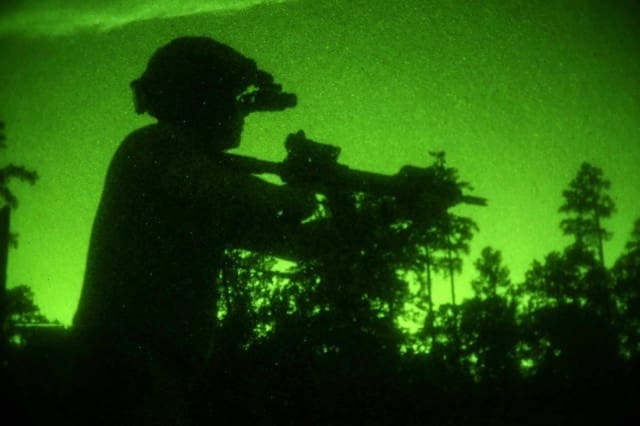
As a night vision device, the ENVG-B’s dual thermal and infrared sensing capabilities deliver unmatched clarity in situations where visibility is diminished, including the complete absence of light. It was fielded for the first time last fall as part of an initial Directed Requirement to get those next generation night vision capabilities in the hands of Soldiers at Fort Riley who have since deployed with them to Korea.

But that was just the beginning, said Maj. John Nikiforakis, the Assistant Product Manager for PEO Soldier. New applications are being tested and refined for delivery to the Close Combat Force.

“We put an incredible tool in the hands of Soldiers who need it now,” Nikiforakis said. “But the goal always is to treat the Soldier as a system, to equip Soldiers and squads holistically with weapons and system elements that work together to make them more lethal and more survivable. That’s what we’re doing here, testing the ENVG-B as a system.”

It’s a system that includes augmented reality capabilities and a heads-up display that integrates wirelessly with weapon optics. Those kind of capabilities make it possible for a Soldier to detect and even fire on a target around an obstacle with limited exposure to the enemy.

In what is called a reliability growth test (RGT), the first of three planned for the ENVG-B system, Soldiers from C Troop, 3rd Squadron, 89th Cavalry Regiment, 10th Mountain Division, put the system to the test during field training exercises throughout the month of June. After a week of classroom training with the systems, a week of marksmanship training on the range, and a week of nighttime situational training exercises, the event culminated in a 72-hour field training exercise with an opposing force. Thirty participants used the ENVG-Bs, and others used PVS-14 night vision devices in order for data collectors and observers to draw comparisons.

There was no comparison, said Capt. Will Hess, the C Troop commander.

“In terms of target detection and clarity, the difference between the (ENVG-B) and the PVS-14 is night and day,” Hess said. “The guys wearing the ENVG-Bs were taking targets out to 300 meters and even beyond, whereas our guys with 14s are having trouble seeing beyond 150. I can’t say enough about the ENVG-Bs. There’s really no comparison.”

Which doesn’t mean the tests all ran smoothly. By design, RGTs are iterative Soldier Touch Points that expose weaknesses in the software or hardware early and often throughout the development process in order to shape a final product that is beneficial to the Soldier and wholly accepted. That’s the Soldier Centered Design methodology employed by the Soldier Lethality Cross Functional Team that leads the ENVG-B program, one of Army Future Command’s signature modernization efforts. Soldiers are involved in design and development every step of the way.

“The focus for this is getting it the hands of the Soldiers and just figuring out early on what are some issues with the device and how do Soldiers actually use it,” Hess said. “They developed it and tested it in the lab based on how they think Soldiers are going to use it. Now, we give to Soldiers and run them through our training and see how they actually use it and to test its durability, to see how it stands up to the kind of rigorous use Soldiers put it through in a dense, rugged environment doing dismounted squad maneuvers.”

The rugged environment at Fort Polk includes swamps, and swamps present Soldiers with a different kind of challenge.

“Snakes. Two water moccasins, two feet away,” said 2nd Lt Phillip Davis, who spotted the threat using ENVG-Bs in thermal mode. “The guys using the 14s couldn’t see them at all. There’s no comparison between the two. Just the difference in depth perception and clarity is drastic. The ENVG-Bs are incredible for situational awareness alone. Having that augmented reality with Rapid Target Acquisition allows us to make decisions quicker, and that’s going to save a lot of lives.”

With all the additional “gee whiz features” on the ENVG-Bs, like see-through map overlays and a compass, Davis said he needs more time with the goggle to prevent cognitive overload.

“The potential is astonishing,” he said. “These are capabilities I never thought I’d see in the Army, but it’s a lot like learning to drive a stick shift; we just need practice. Our guys are picking up on it very quickly, so I can see it being a great benefit a few months from now.”

In the coming months, the ENVG-B team will continue to conduct Soldier Touch Points, including RGTs, to address any issues identified during the exercise at Fort Polk, Nikiforakis said. It’s an iterative “test-fix-test” cycle.

“We rely on Soldier feedback to ensure the equipment we field is exactly what they want and what they need to be more lethal and more survivable on the battlefield,” he said. “The need to restore overmatch is urgent. The key to staying on track is keeping Soldiers involved every step of the way and finding ways to work around the challenge of the (COVID-19) pandemic.”

When employees of the two vendors manufacturing the ENVG-B prototypes were diagnosed with the virus, Elbit and L3 found work-around solutions, including telework and alternate schedules, to mitigate risk without delaying production.

“Everything we do is a team effort,” Nikiforakis said. “But nothing speaks to the ingenuity and dedication of the team like what we’ve seen over the past few months, as everyone from every corner of the (Army Modernization) enterprise has persistently found ways to succeed at a time when it would’ve been easy to hit pause. We just keep our eyes on the finish line, because modernization can’t wait.”

For more information about the ENVG-B, email bridgett.d.siter.civ@mail.mil.

Army Futures Command and its subordinate cross functional teams partner with ASA(ALT) and its PEO subsidiaries, CCDC, and multiple branches of the Army Modernization Enterprise to deliver the next generation capabilities necessary to establish and sustain a clear and decisive overmatch for the Army of 2028 and beyond.

FT Polk’s 3rd Squadron, 89th Cavalry Regiment Trains and Fields Enhanced Night Vision Goggles-Binoculars

Wednesday, July 1st, 2020

FORT POLK, La. — Throughout June, C Troop, 3rd Squadron, 89th Cavalry Regiment is conducting in-class and field training with the latest in night-vision goggle (NVG) technology. The new equipment, the enhanced night vision goggles-binoculars (ENVG-B), not only provides an all-around upgrade in clarity, but also comes with thermal vision capabilities, augmented reality with heads-up display and integrates with weapon optics.

As with all training efforts, the unit is keeping COVID-19 precautions in mind by using the “same social-distancing guidelines that they use at Ranger School and here at the Joint Readiness Training Center. This includes limiting the number of Soldiers and new equipment trainers allowed in the classroom at a given time,” said Capt. William Hess, commander, C Troop 3rd Sqdn, 89th Cav Reg.

During the first week of June, 30 Soldiers received the new equipment training in a classroom environment. Twenty-eight Soldiers, with two on stand-by, completed a range density week beginning June 8, “logging hours with the equipment, executing training according to the Army’s standard qualification tables,” said Hess.

The last two weeks of June are dedicated to situational training exercises. The STX lanes will “use the tactical environment to allow the unit to integrate the newly learned capabilities into our troop leader procedures,” said Hess.

“These Soldiers will be getting a lot of training with the ENVG-Bs.”

Program Executive Office Soldier (PEO Soldier) members from Fort Belvoir, Virginia prompted and supported the ENVG-B training for C troop. Maj. John Nikiforakis, assistant program manager, ENVG-B, PEO Soldier said, “We need to test our night vision technology in a simulated combat environment, so that, by the time it gets to combat, the equipment is refined and ready.”

“As PEO, we are the material developers for technology for the warfighter. Everything we do is geared toward making our Soldiers more lethal, more survivable, and more capable on the battlefield.”

Throughout their training, within and outside of the classroom, Soldiers will gain direct insight into equipment functionality. According to Hess, the Soldiers will also run through the training with the monocular night vision device (PVS-14) — the older NVG model — and then with the ENVG-Bs. Their performance and experiences will be logged, creating a dataset for analysis.

“What we rely on is ‘Soldiers in the loop,’ and that is the Soldier feedback, which ensures the equipment that they are going to fight with is something they actually want to use,” said Nikiforakis.

C Troop Soldiers are excited about the ENVG-B’s and the opportunity to train with the equipment.

Pfc. Hunter Shor, C Troop, 3rd Sqdn, 89th Cav Reg, said, “Compared to the PVS-14s, I just feel the ENVG-B’s are exponentially ahead of their time with thermal technology and integrated systems.”

Similarly, Spc. Simon Ly, C Troop, 3rd Sqdn, 89th Cav Reg said, “It’s been really interesting. I’ve never used equipment with these capabilities before. There are things we can do with the ENVG-Bs that I didn’t think we could do before. For example, the augmented reality that allows us to see checkpoints in the NVGs: I just didn’t know the technology had reached that point.”

With the Soldiers’ feedback and training data, PEO Soldier is able to further ready the device for combat, exceed expectations and meet the needs of Soldiers on the battlefield.

“We go beyond ‘own the night’. We want to be able to identify all threats, under all conditions and be able to shoot first,” said Nikiforakis.

By Christy Graham

Domestic N95 Mask Production Expected to Exceed 1 Billion in 2021

Sunday, June 28th, 2020

WASHINGTON — Thanks to work by the Defense Department’s COVID-19 Joint Acquisition Task Force, U.S. industry is expected to greatly increase the production of N95 masks next year, the task force’s director said.

During a House Armed Services Committee hearing yesterday, Stacy Cummings told lawmakers that nationally, the U.S. was consuming about 50 million N95 masks each year. During the COVID-19 crisis, demand for masks increased substantially to about 140 million during a 90-day peak-use period.

DOD investments to help domestic industry ramp up production of those masks and other equipment will help ensure that in the future the U.S. will better be able to meet demand for personal protective equipment with domestic production, she said.

Based on the investments made by the department, Cummings told the House panel, an increase in production of 450 million masks a year will be attained by October, with a rate of more than 800 million masks per year by January.

“Starting in 2021, we anticipate our total domestic production to be in excess of a billion per year,” Cummings said.

Ellen Lord, the undersecretary of defense for acquisition and sustainment, told lawmakers that increasing domestic production capabilities has been a focus of the department.

“In order to decrease our dependence on foreign suppliers for medical resources, DOD has focused on increasing domestic industrial capacity and capabilities,” she said. “To that end, we executed some $284 million in industrial expansion efforts during the first two weeks of May 2020. Reconstituting domestic production or creating new production that shifted offshore years ago often requires capital expenditure, capital equipment expenditures, retooling and retraining of the workforce.”

Lord also said DOD has been focused on maintaining the health of the defense industrial base during the COVID-19 pandemic. The DIB includes a wide array of businesses that produce weapons, equipment and supplies for the U.S. military.

During the COVID-19 pandemic, businesses that make up the DIB suffered as other U.S. businesses did, Lord said. Should some of those businesses fail as a result of COVID-19-related disruptions, it might result in the department not being able to procure important defense-related supplies, equipment or weapons, she added.

Lord said the department is using $688 million of CARES Act funding to address impacts to the DIB by directly offsetting financial distress and providing investments to regions most severely affected.

She also said that increased communication between the department and the DIB were key in allowing defense officials to better understand where the industry was hurting most, and where the need existed most. When first she stepped into the A&S leadership role in 2017, she said, she set up quarterly meetings with DIB representatives to better assess their needs. The COVID-19 pandemic accelerated that communication.

“When the pandemic hit and we saw how catastrophic it could be to our defense industrial base, what we did was just really amped up those engagements,” she said. “So starting on March 17, we had our first [teleconference] with industry, and we broadened beyond just the three industry associations that we worked with, to really start including nontraditionals and others.”

The number of industry representatives involved in those meetings also increased, Lord said, “For multiple weeks, we had calls three times a week. One of those calls per week was focused on small business, and we listened to what the problems were,” she said. “As a result of that, … a lot of the leadership of A&S listened to what the issues were, and we tried to start taking the first small steps.”

Lord said as a result of that communication, the department worked to simplify how to do business with the military, including raising the threshold for micropurchases and increasing the progress payment rate from 80% to 90% for large businesses, and from 90% to 95% for small businesses.

“This change will infuse an estimated $3 billion in cash to all levels of the DIB,” Lord said. “Further, the department has partnered with the major primes to ensure this increase in cash makes its way throughout the supply chain.”

By C. Todd Lopez, Defense.gov

ACFT 2.0: Changes Sparked by COVID-19

Friday, June 26th, 2020

FORT EUSTIS, Va. – The Army Combat Fitness Test, or ACFT, will be the force’s test of record Oct. 1, but the Army’s top enlisted Soldier says troops will have more time to train for and pass the six-event test — without fear of it negatively impacting their careers during that time.

Despite hold ups caused by COVID-19, Sgt. Maj. of the Army Michael A. Grinston is confident the long-planned ACFT will stay on track. In addition to the new training timeline, he also announced a handful of other modifications to the test, dubbing it ACFT 2.0.

It’s the same six-event physical fitness test — just an updated version, Grinston said. So even though troops don’t have to pass the test this year, they still have to take the ACFT as scheduled.

“When it’s the test of record, you have to put it into the system of record, and that’s the only requirement right now,” Grinston said. This means the Army won’t take administrative actions against Soldiers for potential ACFT failures.

Potential career impacts like separation, derogatory or referred evaluation reports, and a Soldier’s Order of Merit List standing are all off the table to be negatively impacted due to an ACFT failure.

This news comes as the Army,  in response to social distancing guidelines, hit the brakes on all physical fitness tests in March. Although fitness tests slowed down, Army leaders went full-steam ahead to plan how Soldiers will jump from the 40-year-old Army Physical Fitness Test, or APFT, to the new ACFT 2.0.

So what are the changes?

First, for many, the APFT is gone for good. Once testing suspensions are lifted, the only Soldiers required to take an APFT ever again will be troops without a current passing score, the sergeant major confirmed.

“As for everyone else [with a current passing APFT score] — they should start training for the ACFT,” he added.

As far as the evolution of the ACFT, the biggest change for Soldiers is the option to substitute a two-minute plank, once a Soldier has attempted the leg tuck.

The other six events are still locked in; the 3 repetition maximum dead-lift, standing power throw, hand release pushups, leg tuck, 2-mile run, and sprint, drag, carry. The plank is just an interim assessment.

The plank is seen as a transitioning tool for Soldiers jumping from the APFT to the six ACFT events, said Maj. Gen. Lonnie G. Hibbard, the U.S. Army Center for Initial Military Training commanding general.

Depending on an individual’s physical starting point, switching back to the leg tuck should take “anywhere between six to three months,” Hibbard added, but for now, the plank is an alternative.

Planks are a core muscle-burning exercise, completed by individuals who remain static with their elbows planted to the ground directly beneath the shoulders at a 90-degree angle while maintaining a straight posture.

Plank exercises can be conducted almost anywhere, Hibbard said, and do not require equipment to train for. Under the current COVID-19 conditions, this could be an ideal transitional assessment.

Also, the stationary bike event dropped its initial 15,000-meter standard down to a 12,000-meter standard. Biking is an Alternate Assessment for Soldiers with permanent profiles unable to complete the two-mile run.

Additional changes for fiscal year 2021 also include scoring standards. All Soldiers are challenged to pass the ACFT at the “Gold Standard,” Hibbard confirmed, which is an overall minimum total score of 60.

To pass, all troops are required to meet the  moderately challenging “gold standard” instead of the more grueling “grey or black” scoring minimums — typically reserved for harsher, more physically demanding career fields. This standard applies to all Soldiers, regardless of age or gender.

Until COVID-19 hit, “we were seeing vast improvements with the ACFT,” Grinston said, adding the changes to the ACFT promotes a better physical fitness standard that will mirror the physical demands of the Army, while also decreasing injuries and having more effective Soldiers within the ranks.

For New Infantry Troops on Hold During COVID-19, Fort Benning Offers Chance to Seek Sniper Training

Wednesday, June 24th, 2020

FORT BENNING, Ga. – One clear morning a few months ago, among the tall pines and broad sprawl of Fort Benning, 1st Sgt. Kevin L. Sipes phoned someone he knows over at the big unit here that trains Soldiers for the Infantry.

It was late March, a time when the COVID-19 pandemic had brought restrictions on military travel. Many newly-trained Soldiers were on hold, waiting to be shipped to their first units.

Sipes had an idea on how Fort Benning could help the whole Army, by adding to the quality of its sniper units. Snipers are exceptionally good marksmen. They’re specially trained in spotting and killing enemy targets, ideally on the first shot. They’re also trained to gather eyes-and-ears battlefield intelligence that can help commanders manage the fight.

Fort Benning’s U.S. Army Maneuver Center of Excellence trains them through its seven-week U.S. Army Sniper Course, which is part of MCoE’s U.S. Army Infantry School here.

He’d had the idea for about two years, long before the pandemic. But “it kind of got put on the backburner,” he said.

“Then the COVID situation happens, and there were trainees that were here on Benning that weren’t going anywhere for a while,” said Sipes. “COVID-19 was sort of the catalyst to make it happen,” he said. “It was sort of a no-brainer.”

So, he thought, now’s the time for another try.

The call was to Sgt. Maj. Vincent M. Lewis, operations sergeant major of the 198th Infantry Brigade. The brigade runs Infantry One-Station Unit Training, or OSUT, which trains Soldiers to serve with the Infantry.

Sure, said Lewis, come on by.

With Sipes was Capt. Zach Lemke. Lemke commands Charlie Company, 1st Battalion, 29th Infantry Regiment, 199th Infantry Brigade. Sipes is the company’s first sergeant. It’s Charlie Company that runs the Sniper Course.

“We popped in – ‘Hey good to see you’ – and got right to the point,” Sipes said.

He made the pitch to Lewis: How about giving new Infantry OSUT Soldiers the chance to volunteer for sniper training while they’re still right here at Fort Benning?

Sipes recalls Lewis’ answer: “‘He said, ‘Man, that sounds like an awesome idea. How do you plan to do it?'”

“We talked about it for about 30, 45 minutes, just laying out the groundwork for what we we’re trying to accomplish,” Sipes said.

Their idea, Sipes told Lewis, was to offer Infantry OSUT Soldiers a chance to volunteer for a kind of five-day tryout for the formal, seven-week Sniper Course. It would condense the course to key sniper basics.

“Obviously, if you go to a basic training company full of privates and you asked, ‘How many of you wanna go to sniper school?’ every single one of ’em’s gonna raise their hand, basically, I would assume.” – Capt. Zach Lemke, commander, U.S. Army Sniper Course, Fort Benning, Georgia

We’d put them through the training, he told Lewis, and if they show the right degree of mental sharpness and other aptitudes, we’ll send them on to the Sniper Course.

Then, if they made the grade in the Sniper Course, those recent OSUT graduates would arrive at their new units sniper-qualified, and stamped virtually from the start of their Army service formally schooled in the best, state-of-the-art, sniper skills and methods.

Infantry units may train their own Soldiers to serve in their sniper squads, but they sometimes decide they want to send a Soldier to Fort Benning for formal sniper training at the Sniper Course’s level of quality. Taking some of the Army’s newest Soldiers and putting them through the Sniper Course – especially while they’re here already – would be “a win-win,” Sipes said.

“The units won’t have to work as hard to train a Soldier,” he said. “They are ready to succeed on day one. The only thing they lack is experience within the job, but that can be done through training. They’ve met the requirements. They know how to perform the specialized tasks. Now they just need the experience that comes from working in that organization.”

Lewis took it to the brigade leadership, Sipes said, including Command Sgt. Maj. Ronnie E. Blount Jr., who in turn discussed it with Col. Dave Voorhies, the brigade’s commander at the time.

“They came back and told us we were good to go,” said Sipes. “It took about a week to 10 days to get the final approval on it. We created the schedule, sent it over to them.”

The 198th helped with finding volunteers, said Lemke.

The brigade’s drill sergeants formed up the trainees, Lemke said, told them there was a chance to try out for the Sniper Course, then asked for a show of hands. Among Soldiers who’d enlisted for the Infantry, the chance to specialize as a sniper had warrior appeal. Hands went up.

“Obviously,” said Lemke, “if you go to a basic training company full of privates and you asked, ‘How many of you wanna go to sniper school?’ every single one of ’em’s gonna raise their hand, basically, I would assume.”

To be considered, candidates while in OSUT would have to have gotten the highest possible marksmanship score, which is “Expert,” and have a score of at least 270 on the Army Physical Fitness Test, or APFT. And they’d have to be in the Army’s Infantryman job category, which it codes administratively as 11B, commonly referred to as 11 Bravo.

The brigade’s drill sergeants jotted their names and sent forward a list of 20 who met the requirements, said Lemke.

“We got a list of names probably within the next 48 hours,” said Sipes, “and then we went and picked them up and started to train ’em. So from flash to bang was probably 18 days or so.”

They’re calling the five days’ training the OSUT Soldier Sniper Assessment, Lemke said.

Charlie Company instructors teach the sniper-hopefuls how to spot targets, how to estimate the distance from themselves to the target, how to gauge the wind’s movements so they can adjust for it in taking their shot, how to use a sniper’s high-tech optical gear to trace the path of a shot. They’re also taught basics of stalking a target, and are tested on their ability to fire the M110 sniper rifle, using live ammunition.

But throughout the five days the trainers also put a keen eye on whether a candidate has the “cognitive ability” to absorb the instruction, including its many technical fine points, and then apply it all properly,” Sipes said.

Sipes consulted a sports psychologist who works at Fort Benning for tips on how best to evaluate each candidate’s “ability to receive new information, learn how to apply it, apply it, and then work to improve performance in the future,” he said.

Charlie Company ran the first assessment April 20 – 24 and a second May 11-15.

Ten OSUT Soldiers went from the Assessment into the Sniper Course’s Class 4, which ran April 27 to June 12 and started with a total of 47 students. Fourteen graduated, four of them OSUT Soldiers who’d gone through the Assessment. Two OSUT Soldiers washed out and the remaining four were allowed another try, in Class 5, which began May 18 and ends July 2, Lemke said.

As the time approached to run another Sniper Assessement, the 198th sent Charlie Company another list of 20 candidates.

Class 5 started with a total of 36 students and is now at 29, 11 of them OSUT graduates who had gone through the Assessment, Lemke said.

Lemke and Sipes think the results of Class 4 – four out of 10 OSUT Soldiers who were still virtual rookies to the Army making it to Sniper Course graduation – suggests the effort to seek sniper candidates from Infantry OSUT right at Fort Benning, has big potential.

“And that’s only gonna improve over time as we master how we assess them and select,” said Sipes. “That was our first two attempts, he said of the OSUT-Sniper Assessment-Sniper Course. effort. “We’ve taken notes on how to improve it and it’ll only get better.”

But that wasn’t the only encouraging sign, Lemke and Sipes said.

Of those four OSUT graduates who completed Class 4, two achieved special distinction: one received the Top Shot award for highest marksmanship scores in the class. Another took the Fieldcraft Award for top grades in stalking, target detection, and range estimation, Lemke said.

“We have these Soldiers here, on post, already,” said Sipes, “that are brand new, hungry, they’re physically fit. They’re already in that training mindset.”

“We can see the potential of these Soldiers immediately out of OSUT,” said Lemke, “we can measure it, train them, and the send them to the force ready. That’s an extremely important thing for the Army.

“This allows us to take a lot of the training burden off of units,” Lemke said. “I can send a Soldier onto his next duty station already sniper-qualified, and that unit doesn’t have to make any other investment and send them back to Fort Benning. They don’t have to reinvent the wheel. He’s coming straight out of OSUT, receiving that training and then arriving at your unit, ready to perform that duty.”

“If this program can continue and we continue to send out qualified snipers to the force,” said Lemke, “this helps build the sniper capability in our Army.”

By Franklin Fisher, Fort Benning Public Affairs

New Research Leads to Army Drones Changing Shape Mid-Flight

Monday, June 22nd, 2020

ABERDEEN PROVING GROUND, Md. — Soon, the U.S. Army will be able to deploy autonomous air vehicles that can change shape during flight, according to new research presented at the AIAA Aviation Forum and Exposition’s virtual event June 16.

Researchers with the U.S. Army’s Combat Capabilities Development Command’s Army Research Laboratory and Texas A&M University published findings of a two-year study in fluid-structure interaction. Their research led to a tool, which will be able to rapidly optimize the structural configuration for Future Vertical Lift vehicles while properly accounting for the interaction between air and the structure.

Within the next year, this tool will be used to develop and rapidly optimize Future Vertical Lift vehicles capable of changing shape during flight, thereby optimizing performance of the vehicle through different phases of flight.

“Consider an [Intelligence, Surveillance and Reconnaissance] mission where the vehicle needs to get quickly to station, or dash, and then attempt to stay on station for as long as possible, or loiter,” said Dr. Francis Phillips, an aerospace engineer at the laboratory. “During dash segments, short wings are desirable in order to go fast and be more maneuverable, but for loiter segments, long wings are desirable in order to enable low power, high endurance flight.”

This tool will enable the structural optimization of a vehicle capable of such morphing while accounting for the deformation of the wings due to the fluid-structure interaction, he said.

One concern with morphing vehicles is striking a balance between sufficient bending stiffness and softness to enable to morphing,” Phillips said. “If the wing bends too much, then the theoretical benefits of the morphing could be negated and also could lead to control issues and instabilities.”

Fluid-structure interaction analyses typically require coupling between a fluid and a structural solver.

This, in turn, means that the computational cost for these analyses can be very high – in the range of about 10,000s core hours – for a single fluid and structural configuration.

To overcome these challenges, researchers developed a process that decouples the fluid and structural solvers, which can reduce the computational cost for a single run by as much as 80 percent, Phillips said.

The analysis of additional structural configurations can also be performed without re-analyzing the fluid due to this decoupled approach, which in turn generates additional computational cost savings, leading to multiple orders of magnitude reductions in computational cost when considering this method within an optimization framework.

Ultimately, this means the Army could design multi-functional Future Vertical Lift vehicles much more quickly than through the use of current techniques, he said.

For the past 20 years, there have been advances in research in morphing aerial vehicles but what makes the Army’s studies different is its look at the fluid-structure interaction during vehicle design and structural optimization instead of designing a vehicle first and then seeing what the fluid-structure interaction behavior will be.

“This research will have a direct impact on the ability to generate vehicles for the future warfighter,” Phillips said. “By reducing the computational cost for fluid-structure interaction analysis, structural optimization of future vertical lift vehicles can be accomplished in a much shorter time-frame.”

According to Phillips, when implemented within an optimization framework and coupled with additive manufacturing, the future warfighter will be able to use this tool to manufacture optimized custom air vehicles for mission specific uses.

Phillips presented this work in a paper, Uncoupled Method for Massively Parallelizable 3-D Fluid-Structure Interaction Analysis and Design, co-authored by the laboratory’s Drs. Todd Henry and John Hrynuk, as well as Texas A&M University’s Trent White, William Scholten and Dr. Darren Hartl.



By U.S. Army CCDC Research Laboratory Public Affairs