FirstSpear

Archive for the ‘Army’ Category

Army-funded Research May Enable Drones to Run on Any Type of Fuel

Thursday, October 1st, 2020

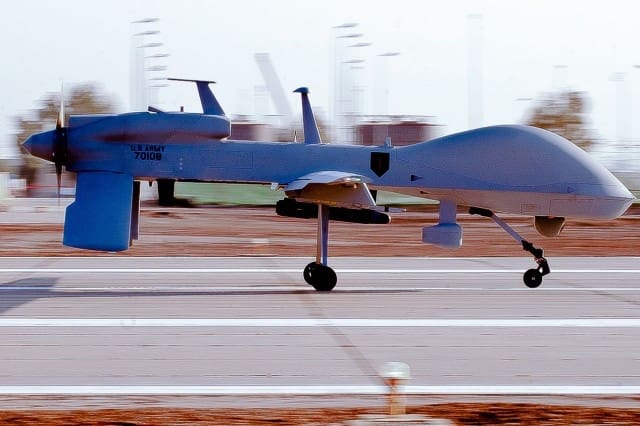
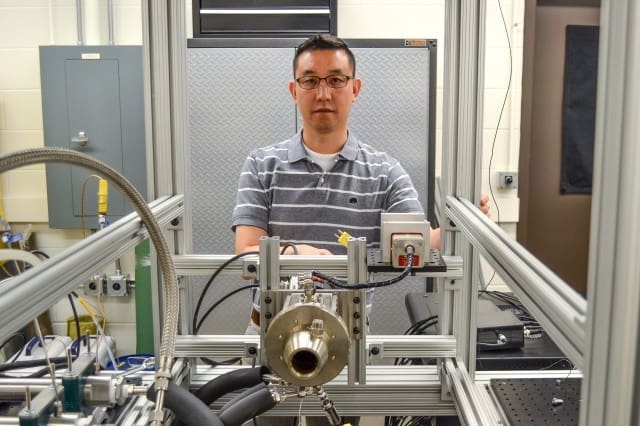
ABERDEEN PROVING GROUND, Md. — The U.S. Army recently awarded the University of Illinois-Urbana Champaign an $8 million, four-year cooperative agreement to develop key technologies that may allow the Army’s unmanned air and ground vehicles to run on any type of fuel.

Researchers at the U.S. Army’s Combat Capabilities Development Command Army Research Laboratory expect new technologies to increase unmanned vehicle performance and reliability and increase drone efficiencies.

“The Army’s fleet of unmanned aircraft systems often experiences performance and reliability issues due to fuel property variations and their effects on the ignition,” said Dr. Mike Kweon, program manager for the lab’s Versatile Tactical Power and Propulsion Essential Research Program.

The university will research comprehensive multi-fuel chemistry and ignition assistant technologies, which add energy to engines for reliable ignition.

Engines require a mixture of air and fuel, and an ignition source–either spark or compression ignition–to operate. For compression-ignition engines, thermal energy generated by compression is insufficient when low ignition quality fuels are used especially at high altitudes and cold conditions.

To address this, University of Illinois-Urbana Champaign researchers will investigate the ignition chemistry of fuels using machine learning algorithms, develop materials for novel ignition assistant technologies for flexible fuel UAVs, and investigate advanced propulsion technologies for high speed air launch effects in collaboration with Army scientists and researchers.

“We are thrilled to be taking part in development of new technologies that will be integrated into new UAV propulsion systems in the future for the Army. Equally important is training the next generation of engineers who can serve our nation in this field of science,” said Prof. Tonghun Lee, University of Illinois-Urbana Champaign. “This partnership is very exciting. The laboratory set out on a mission to operationalize science for transformational overmatch.”

Part of effort will expand the team to include experts in academia, small businesses and industry to push concepts and ideas into future capabilities for the Army, Lee said.

“The University of Illinois-Urbana Champaign has expertise and capability to perform research in multi-fuel chemistry and ignition assistance in a partnership with the Army to advance these technologies and to provide future capabilities for the warfighter,” he said.

This university-led research project is one of 11 funded this summer by the Army’s corporate laboratory as a part of Center for UAS Propulsion efforts to develop technologies for multi-fuel capable hybrid-electric engines. Each university partner is helping the Army address the energy demand required to power future unmanned vehicles. The Army awarded additional funding for similar research at the University of Minnesota; University of Michigan; University of Wisconsin-Madison; University of Illinois at Chicago; Iowa State University; University of Delaware; University of North Texas; Texas A&M University; University of Missouri and University of Tennessee-Knoxville.

The research, slated to begin this fall, is part of a larger research portfolio of multi-fuel capabilities technologies led by the laboratory that supports the Army Modernization Priority for Future Vertical Lift. Most recently, the laboratory announced the development of a new, advanced scientific model that will allow vehicle maintenance specialists to turn to bio-derived fuels in austere locations, as well as efforts to convert a home-based generator into a power source for autonomous ground and air vehicles.

By US Army CCDC Army Research Laboratory Public Affairs

Medevac Officer Looks to Help Army One Invention at a Time

Tuesday, September 29th, 2020

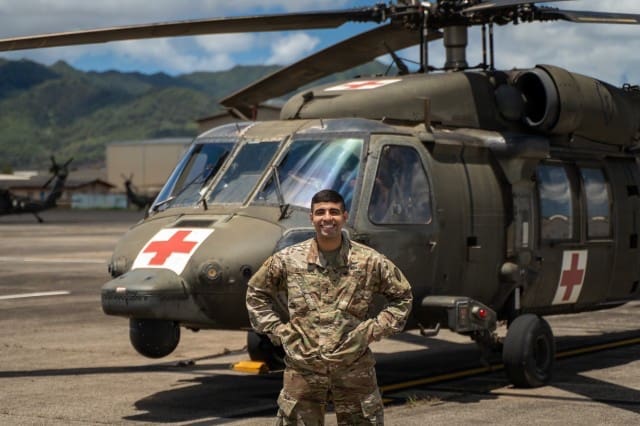
WHEELER ARMY AIRFIELD, Hawaii — Mahdi Al-Husseini had his whole career figured out as he enrolled in Georgia Institute of Technology back in 2013. He knew he would graduate with a joint degree in biomedical engineering and public policy before attending graduate school for computer science.

From there, he planned to pursue a job in the defense and space industry.

The idea of joining the Army never once crossed his mind, he said. He knew nothing of his school’s Reserve Officer Training Corps, or ROTC, and the vast opportunities in the Army.

Now a first lieutenant, Al-Husseini serves as an active-duty aeromedical evacuations officer with 3rd Battalion, 25th Aviation Regiment at Wheeler Army Airfield, Hawaii.

He is also an engineer currently developing an aerial hoist stabilization system that could help save lives during an in-air medical extraction.

“There is something unique about the medevac mission,” he said. “We ensure that America’s sons and daughters — individuals that have experienced great tragedy — have an opportunity to return home.”

Best-laid plans

While Al-Husseini’s passion for engineering never wavered during college, he did find a deeper calling to support something greater than himself.

The Army quickly soared to the top of his list, as he joined ROTC during his junior year. He was determined to give back to the people and institutions that helped him succeed.

“After I joined, I was deciding between a few different Army branches: medical services, engineering, or cyber,” Al-Husseini said. “That same year, I interned at the U.S. Army Aeromedical Research Lab.”

The USAARL looks to deliver scientific solutions to help save lives, according to lab officials. Research efforts target biomedical, physiological, and psychological issues, as the Army aims to increase the performance of aviation, airborne, and ground personnel.

As an intern, Al-Husseini assisted the lab’s experimental testing efforts tied to various aviation helmets. He eventually crossed paths with two medevac pilots working on a separate project. The three became friends as they started to exchange ideas.

“This was the first time I talked in depth about the medical evacuation mission,” Al-Husseini said. “We are responsible for bringing home America’s wounded warriors. In my opinion, this is truly one of theArmy’s no-fail mission sets.”

Influenced by his peers’ passion and drive, Al-Husseini’s outlook on engineering and his future career decisions started to shift.

“My experience [with USAARL] cemented my interest in the aeromedical mission. I decided to request medical services as my first choice of branch,” he said.

“I [now] look at engineering and computer science as tools in my toolbox,” he added. “I love engineering and computer science … but as an engineer, you have to decide what to do with those tools.”
Training, engineering, competing

Shortly after college, Al-Husseini found himself at Fort Rucker, Alabama, for flight training. It was around the same time that he started building his own company, a combined team of Army aviators and engineers, to develop their Stabilizing Aerial Loads Utility System.

“When we perform a medical evacuation on a real mission, usually it is the worst day of a patient’s life,” he said. “I wanted to use my skills and tool in a way that supports these Soldiers.”

During an in-air medevac mission, pilots are trained to control the aircraft as the hoist-line sways from the downward force of air created by the vehicle’s rotor system. Commonly known as downwash, this aerodynamic force can cause the hoist line to spin or oscillate, putting a patient or operator at risk.

“There have been fatalities connected to the spin, sway, or oscillation of the hoist line,” Al-Husseini said. “There have been a lot of folks that are negatively affected, either through asphyxiation, fatigue, or nausea. These real problems are impacting our patients, which are already in a compromised state.”

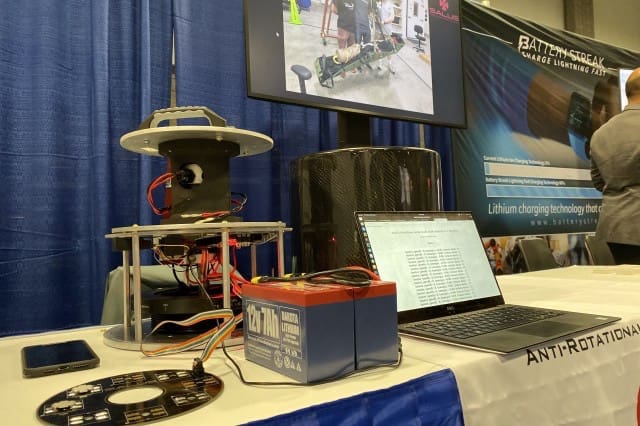
The new hoist-line system is designed to connect between a patient’s litter and the line’s base. The device’s internal control system will help stabilize the patient through a series of automatic spinning reaction wheels to counter the hoisted load movement.
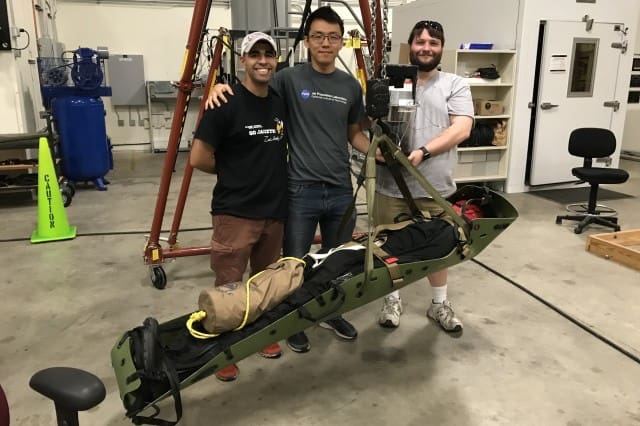
As Al-Husseini continued through flight training, he split himself between two worlds. He spent most of his time learning to be an aeromedical evacuation officer, and then his free time on his invention.

He credits much of his success to the overwhelming support he received from leadership and colleagues during training and his career, including Capt. Kimberly Smith.

“It is amazing to see everything that he’s done and accomplished, all while learning how to fly,” said Smith, commander of Company D, 1st Bn., 145th Avn. Rgt. at the Army Aviation Center of Excellence.

Al-Husseini remained committed to his team as they entered their new aerial load system into several competitions, including the Army’s xTechSearch.

“The xTechSearch program is incredibly well run,” he said. “It is so important to the many small businesses that are working to develop technology” that might aid in the Army’s future.

The Army’s acquisition process can be confusing and overwhelming for a smaller business, he added. Through the competition, small business owners develop connections and can earn possible funding for a specific program.

“It is an exciting time to be in the Army right now and be an engineer,” Al-Husseini said. “The Army is working to improve on a technical level, and the xTechSearch program is a model blueprint” for the way ahead.

To attend these competitions, Al-Husseini had to request a delay in training, Smith said. Pausing a Soldier’s education could negatively impact their career, and is typically granted on a case-by-case basis.

“When you are on the flight line, it can definitely become very challenging. Your purpose is to learn how to fly,” Smith said. “I always preach to the students: you have to find balance.

“I am impressed that [Al-Husseini] managed all of flight school and graduated, all while designing a device that could be beneficial for the Army,” she added.

Currently, the device from Al-Husseini’s team is being evaluated by USAARL. If selected, it could become a vital tool in support of the medevac mission, he said.

Seeing the device on an Army aircraft, “would be a dream come true,” he added. “Not for myself and the success of my team, and not for any financial gain. Just knowing that each Soldier will be better off because of what we developed … is more than I could possibly ask for.”

Alternatively, if his device does not meet the Army’s final selection process, Al-Husseini would applaud the decision.

“I do not want my device to be selected if there is a better device that exists,” he added. “I want whatever is best for our Soldiers in the field. That is what it means to be an engineer. You have to continue to scrap your designs or refine to pivot and to create new ideas.”

Overall, Al-Husseini said, the Army is a diverse force full of incredibly inventive and resourceful people.

“Identify a problem and find a way to solve it,” he added. “You will be amazed at how supportive the Army can be. I think this is one of the things that makes our Army the greatest in the world.

“I want to encourage Soldiers to think outside the box and continue to push their limits to find ways to improve their organization. Because at the end of the day — no one knows their mission set better than they do.”

By Devon Suits, Army News Service

US Army, Estonia Sign Historic Agreement for Collaborative Research in Cyber Defense

Friday, September 25th, 2020

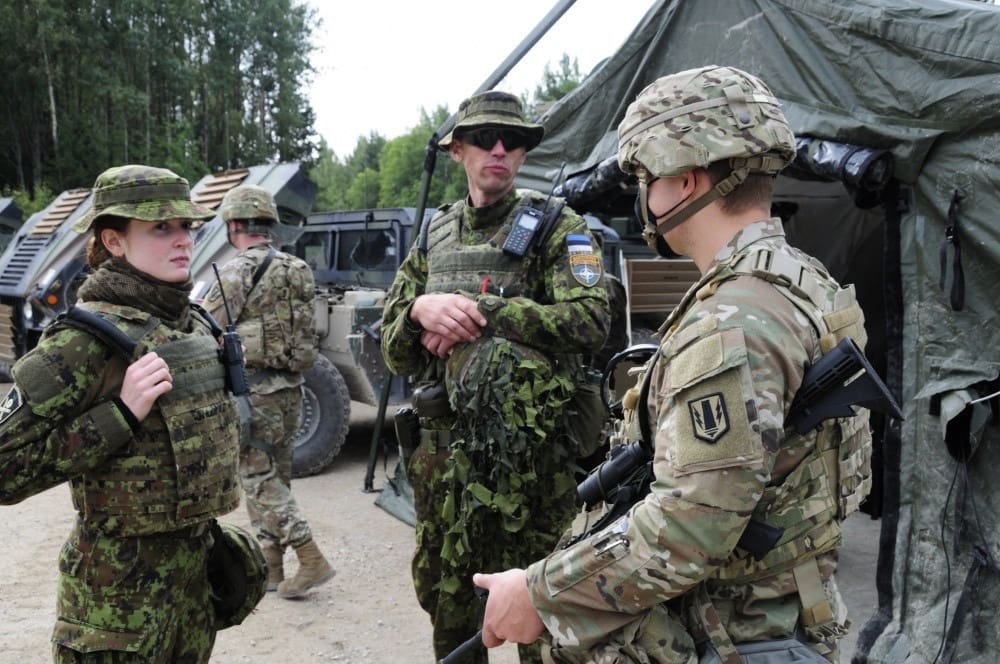
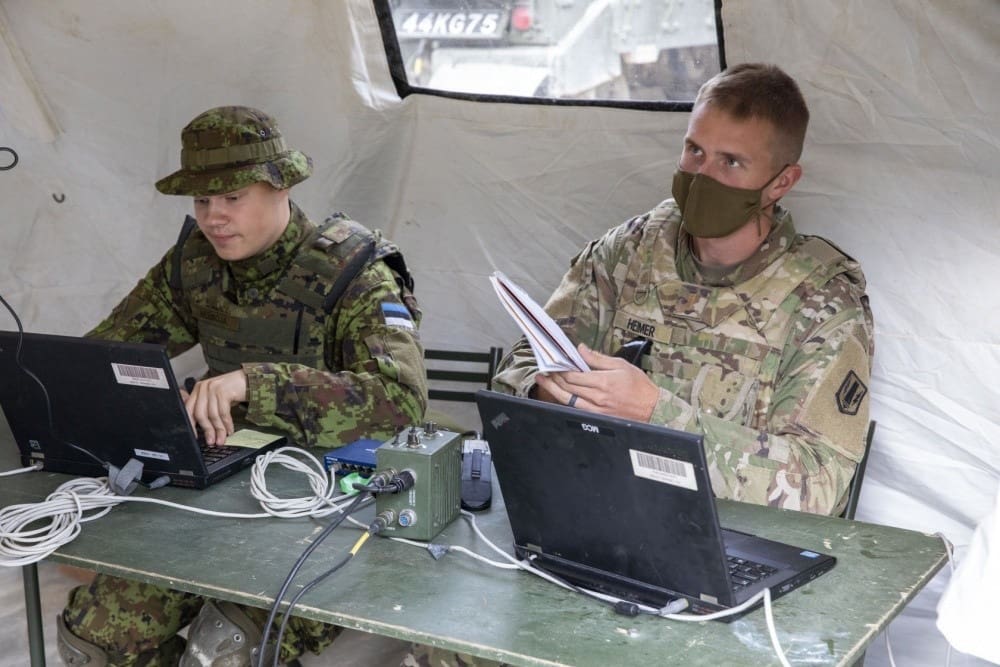
ABERDEEN PROVING GROUND, Md. – The U.S. Army and the Republic of Estonia’s Ministry of Defence signed an agreement today that will enable the two countries to conduct future collaborative science and technology efforts in cyber defense.

The Command, Control, Communications, Computers, Cyber, Intelligence, Surveillance and Reconnaissance (C5ISR) Center – a component of Army Futures Command’s Combat Capabilities Development Command – and the Estonian Ministry of Defence will establish a multi-domain operations, cyber domain working group to identify opportunities for interoperability experimentation and demonstrations.

The working group will provide a forum to exchange information on the research of defensive cyber capabilities for multi-domain operations and improved coalition interoperability. Specific collaborative activities identified by the working group may be carried out under future agreements involving projects, equipment and material, and information exchanges.

“This historic agreement provides the opportunity for two nations with substantial defensive cyber capabilities to leverage their respective cyber experience to drive new research and development to reduce cyber threats across the spectrum of conflict,” said Director of the C5ISR Center Patrick J. O’Neill.

The effort – which falls under a 2016 U.S. Department of Defense Research, Development, Test and Evaluation memorandum of understanding – is the first of its kind between the U.S. Army and the Estonian Ministry of Defence. It supports a “Vision for Security Cooperation” document between the countries to develop capabilities that will deter and defend against malicious cyber intrusions and attacks.

“The Estonian Ministry of Defence is very pleased to establish formal cooperation with the U.S. Army’s C5ISR Center, adding another partner with increased knowledge and capabilities. Our countries are close NATO allies who share fundamental values. Our collaboration in the cyber domain will advance our common security,” said Director of the Estonian Ministry of Defence’s Cyber Policy Department Andri Rebane.

“We hope that the knowledge generated from this bilateral relationship will not only be useful for the U.S. and Estonia but also our other allies. With that, I am pleased to sign the terms of reference to begin this important work,” said Rebane.

Prior to the event, Deputy Assistant Secretary of the Army for Defense Exports and Cooperation Elizabeth Wilson noted her office played an integral role in bringing together key personnel from U.S. Army headquarters, the C5ISR Center and counterparts at the Estonian Embassy to reach this milestone event.

“Exchanging information and optimizing our research and development efforts to modernize our militaries will help deter great power competitors and regional state adversaries. The U.S. Army is proud to partner with our Estonian counterparts in this unique opportunity,” said Wilson.

The complementary research will explore tactical and strategic challenges to enable standardization, rationalization and interoperability while improving the mutual defenses of both countries, said Robert Kimball, the C5ISR Center’s senior research scientist for cyber security.

“Estonia is a cyber country of excellence with a robust cyber defensive system in terms of technology and people. Given their deep expertise, I believe they will have substantial lessons to share, which will be enormously helpful in finding efficiencies in our science and technology efforts while understanding how best to defend against cyber warfare,” said Kimball, who noted Estonia is home to the NATO Cyber Defense Center and Cyber Range.

The agreement is slated to last until Sept. 30, 2023, at which point it may be extended.

“I am honored to have signed this agreement with Mr. Rebane today,” said O’Neill. “This is more than just a document that governs science and technology efforts; it affirms our two countries’ mutual commitment to work side by side to proactively address global security challenges. The C5ISR Center looks forward to this collaborative effort as we continue to explore the realm of the possible for cyber security. I am extremely pleased that the efforts on both sides have come to fruition.”

By Edric Thompson, CCDC C5ISR Center Public Affairs

Army to Host Tactical Assault Kit Virtual Workshop for Industry, Federal Agencies

Thursday, September 24th, 2020

ABERDEEN PROVING GROUND, Md. (Sept. 23, 2020) — The U.S. Army is hosting a virtual workshop to expedite the development and integration of situational awareness tools Sept. 29 – Oct. 2.

The Tactical Assault Kit (TAK) is a map-based software application that enables coordination among thousands of users with features such as a position data, chat, mission planning and shared overlays. It is compatible with Android, Apple iOS and Windows.

The Tactical Assault Kit virtual offsite will offer stakeholders from across the Department of Defense (DoD), federal agencies and industry an opportunity to exchange information and identify critical needs. The event will offer tracks for software development, programmatic updates and training on TAK platforms.

“The intent of these sessions is to learn from issues that may have arisen in the past year, produce innovative capabilities and reduce duplicative efforts,” said Josh Sterling, director of the TAK Product Center at the The Command, Control, Communications, Computers, Cyber, Intelligence, Surveillance and Reconnaissance (C5ISR) Center – a component of Army Futures Command’s Combat Capabilities Development Command.

“Any time we can get more feedback and lessons learned, it’s a data point we can use to improve the platform. I think this is a great way to generate cross-team collaboration that will spur both the development cycle and integration as we continue to push and facilitate a more universal type TAK operation.”

As the central software development hub for all TAK efforts, including 15 DoD programs of record, the C5ISR Center’s TAK Product Center provides software updates and testing for an enhanced user experience.

To foster innovation, the TAK Product Center approved the public release of a non-military variant for federal and government agencies – known as the Android Team Awareness Kit-Civilian (ATAK-CIV) application – on Google Play and the open-source Standard ATAK Software Development Kit on TAKmaps.com.

“TAK is an extensible platform, meaning that we give you a baseline and based on your mission requirements you can build on that baseline to bridge capability gaps,” said Mark Roberts, deputy director for the TAK Product Center.

“Anyone who has a job requirement to display point location information – the military, DoD and federal agencies, state and local authorities, firefighters and emergency responders – will benefit from these sessions. This is a great opportunity to give them a peek at what’s being done around the TAK community,” he said.

Registration for the offsite is available at tak.gov/offsite until Sept. 28.

By CCDC C5ISR Center Public Affairs

Tobyhanna Army Depot Expands NETT Warrior Support, Improves Soldier Experience

Monday, September 14th, 2020

Tobyhanna Army Depot, PA —

Tobyhanna Army Depot now fabricates a new type of cable that furthers its support of a critical Soldier communication system.

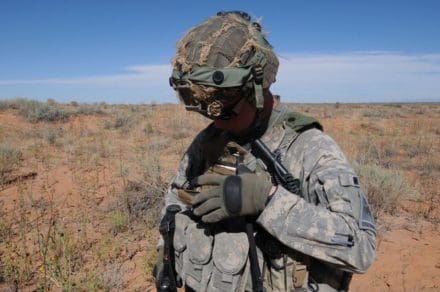
The depot recently stood up capability for production of flat cables for the Nett Warrior program. Nett Warrior is a smartphone-based system that provides situational awareness to dismounted Soldiers during combat operations. The program arrived at the depot in 2012 and, since then, engineers have designed more than 70 cables to support the system. Because the system is worn by Soldiers in the battlefield, ergonomics is key.

“The flat design of this cable will make the system more comfortable for Soldiers when they use Nett Warrior,” said Stanley Czock, lead engineer for the program. “The new cables also eliminate the likelihood of snagging in the field by holding more tightly to the vest. Both of these improvements directly benefit Soldiers.”

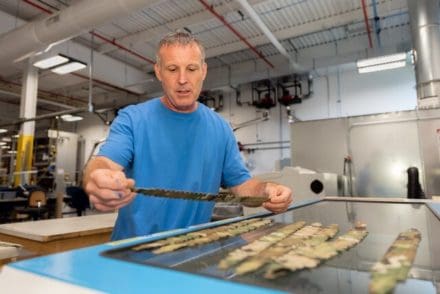
Production of the flat cables is aided by two new machines, a computer numerical control (CNC) sewing machine and a laser cutting machine. The machines allow for tighter stitching and the fabrication of scalloped tabs, which slide into the MOLLE system on the system’s Modular Scalable Vest and allow for a 90 degree bend in the cable without performance problems – another significant improvement for the end user. The equipment also allows for fabrication of conformal battery pouches and antenna mast holders, items used extensively by Soldiers when wearing Nett Warrior.

Acquisition of the new equipment is part of a larger effort to expand capability in the depot’s Systems Integration and Support directorate. The effort stems from Tobyhanna’s long-range strategic initiative, Toby 2028.

“Modernizing the shops with newer technology allows us to explore previously unreachable opportunities for customer and product support with the added benefit of remaining competitive.  Anywhere there is an opportunity to improve our capabilities, we have a Toby 2028 team looking into it and how it will shape our future,” said Michael Vivlemore, Lead for the Toby 2028 line of effort focused on technology impacts.

Depot personnel also worked closely with engineers from the U.S Army Sustainment Command’s Packaging, Storage and Containerization Center to perform extensive testing on the new cable prior to launch. They say this proactive approach is crucial to ensuring project success.

“Upfront testing allows us to ensure our product will meet warfighter requirements. It also allows us to address any potential defects before the product reaches the battlefield,” Czock said. “All in all, we’re thrilled to support a project that helps make life easier for the warfighter.”

Personnel from the Production Management directorate’s Sustainment Planning Division (SPD) say this new capability may also lead to additional workload for the depot.

“The addition of the CNC and laser-cutting machine greatly enhance the depot’s ability to adapt and support evolving Soldier requirements. We have seen interest from customers for new workload as a direct result of this new capability,” said Tracy Kraftchisin, a Logistics Management Specialist (LMS) in SPD. Fellow LMS Michelle Reese agreed.

“Right now, we are working on a Public Private Partnership (P3) with Microsoft in support of the Integrated Visual Augmentation System (IVAS). Under this P3, we have the potential to fabricate different types of cables for IVAS, a workload that falls under the Army Futures Command and represents an exciting opportunity for Team Tobyhanna.”

Depot personnel say the Nett Warrior program is planned through 2025 and will result in more than 200,000 cables for service members.

Tobyhanna Army Depot is a recognized leader in providing world-class logistics support for command, control, communications, computers, cyber, intelligence, surveillance and reconnaissance (C5ISR) systems across the Department of Defense. Tobyhanna’s Corporate Philosophy, dedicated work force and electronics expertise ensure the depot is the Joint C5ISR provider of choice for all branches of the Armed Forces and industry partners.

Tobyhanna’s unparalleled capabilities include full-spectrum logistics support for sustainment, overhaul and repair, fabrication and manufacturing, engineering design and development, systems integration, post production software support, technology insertion, modification, foreign military sales and global field support to our joint warfighters.

About 4,000 personnel are employed at Tobyhanna, which is located in the Pocono Mountains of northeastern Pennsylvania. Tobyhanna Army Depot is part of the U.S. Army Communications-Electronics Command. Headquartered at Aberdeen Proving Ground, Maryland, the command’s mission is to empower the Soldier with winning C5ISR capabilities.

Story by Ms. Danielle E. Weinschenk

Photos by Thomas Robbins

US Army Fields New Chemical Detection Technology

Wednesday, September 9th, 2020

RESEARCH TRIANGLE PARK, N.C. — Chemical weapons pose a serious threat to civilian and warfighter lives, but technology from the U.S. Army Small Business Technology Transfer program reduces those risks. Researchers developed a product to detect chemical weapons accurately at low concentration levels.

Active Army, Reserve and National Guard units started to receive the Chemical Agent Disclosure Spray and the Contamination Indicator/Decontamination Assurance System, known as CIDAS. The Army is fielding it to all units in areas where there is a threat of chemical agents.

The Chemical Agent Disclosure Spray, purchased by FLIR Systems, Inc., has transitioned into the CIDAS Program of Record within the Joint Program Executive Office for CBRN Defense. The research, which began 20 years ago with a business first spun out of the University of Pittsburgh and later acquired by FLIR, as part of a Small Business Technology Transfer contract managed by the Army Research Office.

ARO is an element of the U.S. Army Combat Capabilities Development Command’s Army Research Laboratory.

The Army funded the basic research behind this technology at the University of Pittsburgh led by Dr. Alan Russell. Russell worked to identify ways to incorporate enzymes into polymers that would be stabilized for use outside the cell and then ultimately used in realistic battlefield environments.

Typically enzymes are not stable outside the living organism, but Russell’s fundamental polymer and enzyme chemistry research identified a way to maintain high activity of the enzymes for sensing chemicals in realistic battlefield conditions. He then started a small business based on those findings, which FLIR purchased.

“Our ability to respond to chemical warfare is a national security challenge that is vital to protecting both civilian and military lives,” said Dr. Stephen Lee, senior scientist at the ARO. “This technology is highly sensitive, providing accurate results on only trace amounts of material, even at concentrations below levels that represent an immediate danger to life and health.”

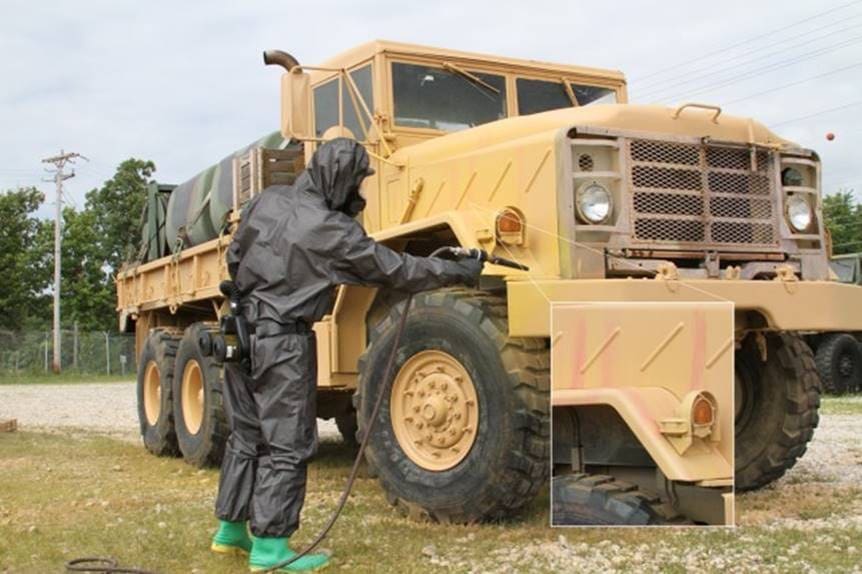
The new technology uses enzymes (complex proteins naturally produced by living organisms that act as a catalyst for specific biochemical reactions) to drive rapid, color-based reactions with chemical warfare agents. Once applied to a surface as a liquid solution, a vivid color change indicates the exact location of contamination by a specific chemical warfare agent.

Because the underlying chemistry uses enzymes to drive specific biochemical reactions, the technology is highly resistant to potential forms of chemical and environmental interference that might be problematic for conventional detection equipment.

The product’s sensitivity also provides the ability to determine whether decontamination was effective.

“Our Agentase C2 spray technology offers unprecedented performance, enabling rapid detection of highly toxic substances while reducing the lifecycle cost of decontamination operations,” said David Cullin, vice president of business development-Detection for FLIR Systems.

Products previously available for the detection of nerve and blister chemical agents range from simple units that use colorimetric techniques, wherein the presence of a chemical substance is indicated by a specific color change, to more complex systems that use special equipment.

Unfortunately, most colorimetric-based products such as paper detection products or gas detection tubes, can be highly susceptible to chemical interference, which can result in false positive and false negative results, as well as poor sensitivity.

“Through the Army’s Small Business Technology Transfer program, a small business has changed our nation’s ability to respond to chemical attacks,” Lee said. “The Army is taking advantage of the latest breakthroughs in synthetic biology to field new capability and protect national security. Without that program, we’d never have the ability to field this capability.”

The STTR program funds research and technology development with small businesses working in partnership with research institutions, most often colleges or universities. In contrast to the basic research programs managed by ARO, the STTR program focuses primarily on feasibility studies leading to prototype demonstration of technology for specific applications.

The Defense Threat Reduction Agency, the DOD agency responsible for countering weapons of mass destruction, provided additional funding to bridge the technology from development to capability delivery.

JPEO-CBRND, the DOD entity that manages the nation’s investments in chemical, biological, radiological and nuclear defense equipment, adopted the technology as part of the Domestic Response Capability Kit.

The kit packages the chemical components into a simple, pen-like construct, an easy-to-use point-and-touch detection as well as a spray-based formulation of the same technology. The kits have been fielded to all 57 Army National Guard Weapons of Mass Destruction Civil Support Teams across the country.

Now, National Guard units throughout every state maintain the capability to provide for detection, personal protection, decontamination and medical monitoring against chemical agents.

Additionally, JPEO-CBRND recently awarded FLIR an indefinite-delivery/indefinite-quantity five-year contract worth up to $21.8 million to support the Army’s Contamination Indicator/Decontamination Assurance System program.

This award initiates the full-rate production phase to field the product to units throughout the Army.

Shipments are expected to begin in the fourth quarter of 2020.

By U.S. Army CCDC Army Research Laboratory Public Affairs

US Army Ranger to Receive Medal of Honor for Hostage Rescue Mission

Monday, September 7th, 2020

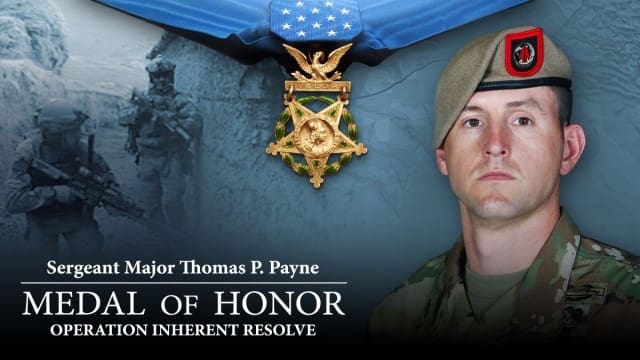
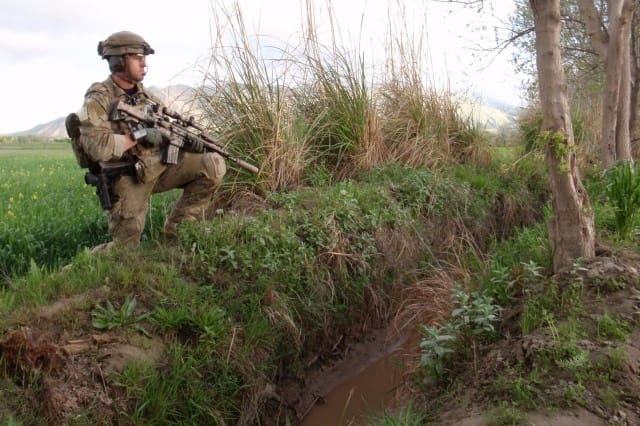
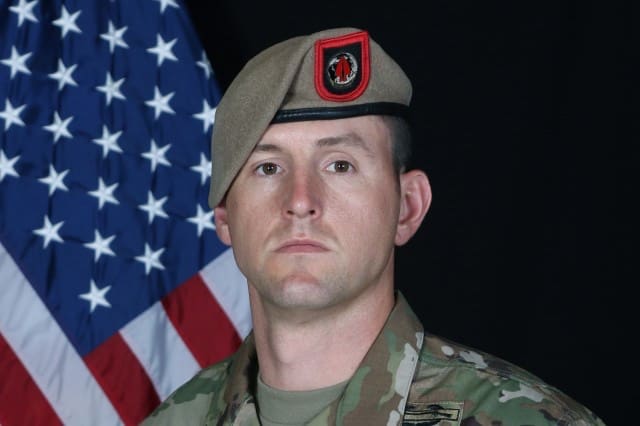
WASHINGTON — An Army Ranger who risked his life to save dozens of hostages facing imminent execution by ISIS fighters will be awarded the Medal of Honor, the White House announced Thursday.

Sgt. Maj. Thomas “Patrick” Payne, who is assigned to the U.S. Army Special Operations Command, was part of a joint task force that assisted Iraqi security forces Oct. 22, 2015, in raiding an ISIS prison near Hawija in northern Iraq.

Payne and his teammates liberated 70 hostages — many of whom were captured Iraqi security forces personnel — after a request by the Kurdistan Regional Government.

Soldiers had to quickly rescue the hostages amid heavy enemy gunfire and suicide-vest detonations during the contested nighttime operation, which left one U.S. Soldier and at least 20 insurgents dead.

“Time was of the essence,” Payne said in an interview. “There were freshly dug graves. If we didn’t action this raid, then the hostages were likely to be executed.”

After being infilled by CH-47 Chinook helicopters, Payne and members of the task force climbed over a wall into the prison compound. Payne, an assistant team leader at the time, helped lead his team as it cleared one of the two buildings known to house hostages.

Once inside the building after light resistance from the enemy, Payne said his team used bolt cutters to pierce through the locks of a prison door, freeing nearly 40 hostages.

Payne and others then heard an urgent call for help over the radio from other task force members engaged in an intense firefight at the second building.

Payne and his team maneuvered about 30 yards to the heavily-fortified building, which was partially on fire.

Once there, he and others scaled a ladder onto the roof of the one-story building as a sustained rate of enemy machine-gun fire shot out from below. From a vantage point on the roof, they engaged the enemy with hand grenades and small arms fire.

At that point, enemy fighters began to detonate their suicide vests, causing the roof to shake. Payne and others then moved off the roof to an initial breach point on the ground level.

With barricaded enemies firing rounds toward him, Payne entered the structure to open another fortified door. After he managed to cut the first lock, he had to run out due to the heavy smoke and handed off the bolt cutters to an Iraqi partner. After the partner came out for fresh air, Payne took the tool again to sheer off the last lock and kicked open the door.

Still being engaged by the enemy, Payne and others escorted about 30 more hostages out of the burning building, which was about to collapse.

“We had to use speed to our advantage,” he said.

With disregard for his own safety, Payne then reentered the building two more times to ensure every hostage was out. One of those times he had to forcibly remove one of the hostages who had been too frightened to move during the chaotic scene, he said.

For his actions, Payne was initially given the Army’s second-highest award, the Distinguished Service Cross, which was later upgraded to a Medal of Honor.

President Donald Trump will present the medal to Payne on Sept. 11.

Originally from Batesburg-Leesville and Lugoff, South Carolina, Payne joined the Army in 2002 as an infantryman with hopes of becoming an Army Ranger.

Since then, he has deployed several times to combat zones as a member of the 75th Ranger Regiment and in various positions with the U.S. Army Special Operations Command.

He earned a Purple Heart medal after being wounded in a separate 2010 mission in Afghanistan. And as a sergeant first class in 2012, Payne won the Army’s Best Ranger Competition, representing USASOC.

He is married with three children and is currently stationed at Fort Bragg, North Carolina.

For more information about Sgt. Maj. Thomas P. Payne’s heroic actions, visit Medal of Honor: Sgt. Maj. Thomas Payne.

By Sean Kimmons, Army News Service

Army Tests Versatile Unmanned Aircraft at Yuma Proving Ground

Sunday, August 23rd, 2020

YUMA PROVING GROUND, Ariz.– The United States military has used unmanned aerial systems (UAS) for decades, and increasingly counts on them to perform dangerous missions that save Soldiers’ lives.

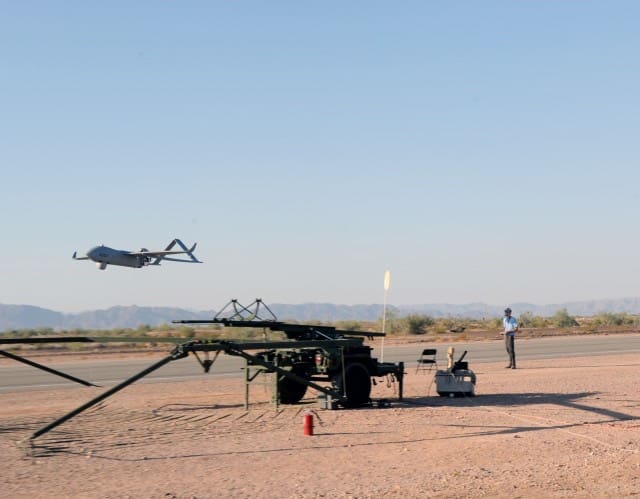
Among these flying wonders is the Aerosonde, a catapult-launched and net recovered aircraft used primarily for surveillance and reconnaissance.

Capable of 15 hours of flight time, the Aerosonde is highly portable and boasts outstanding optics at high altitudes. The system has undergone extensive testing at U.S. Army Yuma Proving Ground (YPG) for most of its existence.

“We test here whenever we have changes to the system,” said Kyle Petesch, Aerosonde site lead. “The YPG personnel are very attentive to what we ask for and easy to work with.”

“Aerosonde has been testing here for more than 12 years,” added Matthew O’Donald, test officer. “It’s a well-proven machine, and there have been numerous upgrades over the years.”

The sheer volume of commercial air traffic in the United States means that conducting developmental testing of even the smallest UAS in a safe, sustained manner within the national airspace is highly problematical. However, such constraints do not exist at YPG—the proving ground controls nearly 2,000 square miles of restricted airspace in addition to boasting clear, stable air and an extremely dry climate where inclement weather is a rarity.


“We have perfect flying weather, well over 300 clear days per year,” said O’Donald. “We have such a wide flight area of restricted airspace that’s perfect for customers to get what they need.”

“We like the nice, clear weather without a lot of clouds or rain delays, and definitely like the range space we can get here,” added Petesch. “The flat desert is good for emplacing ground stations and measuring farther distances without trees or line-of-sight issues.”

Aerosonde is typically deployed in a system with multiple aircraft and ground control stations, all of which can be accommodated in a realistic manner at YPG. The vast range and air space here means the testers can easily evaluate things like fuel consumption and the ability to smoothly hand-off control of the craft between controllers located in multiple ground control stations.

“We test not only to integrate products our customers want, but also to improve our own system’s reliability,” said James Ruthven, senior engineering support manger. “In the end, that helps our country’s mission overseas by having a quiet, reliable aircraft that provides good optics and other sensors.”

The Aerosonde is a relatively quiet aircraft, as is necessary for its surveillance mission.

“Our end user—a platoon out in the field—doesn’t want their targets to know they’re being watched,” said Ruthven. “Our engine and aircraft has to be quiet, so coming here affords us the opportunity to put people out in the desert and do acoustic measurements. We can tailor how we operate in the real world based on the findings we have here.”

The proving ground’s extensive experience with testing UAS and associated sensors is another attraction, as is the ability to control a large swath of the radio frequency (RF) spectrum. YPG has more than 500 permanent radio frequencies, and several thousand temporary ones in a given month.

“This is the easiest place for us to operate, and we get the most complete and comprehensive coverage in support of what we’re doing,” said Ruthven. “The heat and density altitudes that we find in this local environment are very similar to a lot of the places we’re operating in overseas.”

The Aerosonde will continue coming to YPG for testing well into the future, Ruthven added.

“We’re looking at our technology roadmap and trying to grow what our system can do for the customer to meet their needs for the next decade to come,” he said. “Utilizing the test ranges, frequencies, and facilities here is crucial to us getting to that point. The work we were able to do at YPG got us to this point.”

By Mark Schauer