XC3 Weaponlight

Archive for the ‘Army’ Category

US Army Soldier Wins Three Gold Medals in 300-meter Rifle Nationals

Wednesday, June 14th, 2023

ELK RIVER, Minn. — U.S. Army Sgt. Tim Sherry won three Gold Medals at the USA Shooting 300-Meter Nationals May 23 -27.

The Evergreen, Colorado native, who is a marksmanship instructor/competitive shooter with the U.S. Army Marksmanship Unit International Rifle Team, claimed the wins in Men’s 300-Meter Prone Rifle, Open 300-Meter Standard Rifle and Men’s 300-Meter Three-Position Rifle against top marksmen from across the United States.

To win each National Champion title, competitors were required to shoot each match’s course of fire twice on separate days. The Prone Match course of fire consisted of 60-shots in 50 minutes. Sherry fired a two-day aggregate score of 1187-57x, beating second place by eight points and 20 Xs. The Standard Rifle Match course of fire consisted of 60 shots in 120 minutes. In Day 2 of the match, Sherry shot a notable 588-21x that brought his winning aggregate score to 1171-39x. This impressive score beat the second place competitor by 58 points and 17 Xs. Then, the Three-Position Rifle Match course of fire consisted of 60 shots in 90 minutes. Sherry completed Day 2 of this match with a personal best score of 589-26x, which brought his winning aggregate score to 1168-45x. This win beat the next competitor by 46 points and 19 Xs. By the end of the matches, each competitor had fired a total of 360 rounds.

Competing at the 300-meter matches are a good test of our shooting positions and fundamentals, said Sherry, who was the only USAMU Soldier at the event.

“It was great to get validation on my training as I won all three events at the competition!”

In addition to adding three new medals to his collection, the Soldier’s performance also earned him a spot on the U.S. 300-Meter Rifle Team and will represent the United States, and Army, at the International Shooting Sport Federation World Championships in Baku, Azerbaijan starting in mid August, which is something Sherry said he is excited about.

“I am happy to have qualified for the team in all 300-meter events and am looking forward to Worlds later this summer.”

By LTC Michelle Lunato

Enhancing Lethality: US Army Marksmanship Unit’s Instructor Training Group Empowers Soldiers

Tuesday, June 13th, 2023

EWA BEACH, Hawaii- The U.S. Army Marksmanship Unit’s Instructor Training Group taught advanced marksmanship training to Soldiers from 2nd Battalion, 35th Infantry Regiment May 8-19 2023. The training built upon the foundation of basic marksmanship skills.

The Instructor Training Group is comprised of experienced combat veterans who provide tailorable marksmanship training courses to operational units globally. They provide training to Soldiers of all ability levels that meet the commander’s operational needs, while also supporting the USAMU’s mission to improve small arms lethality.

“I’ve learned a ton, a lot of this week refined our basic marksmanship skills,” said Sgt. Joe Calkin, an Orlando native and sniper team leader assigned to Headquarters and Headquarters Company, 2-35IN. “Everything we’ve learned will be able to translate to our Soldiers and increase our organization’s lethality.”

The training focused on both pistol and rifle marksmanship, refining the shooter’s form, grip, stance, trigger control, draw speed and accuracy.

“One of the most beneficial things for me was adjusting my shooting stance, with just a small change I was able to exponentially increase my stability and increase my accuracy. Small changes I learned here made me a better shooter,” said Calkin.

Emphasis was placed on consistency and eliminating any unnecessary movements that can affect accuracy. Practicing these fundamentals in a controlled environment lays the groundwork for more complex and demanding shooting scenarios.

“Developing my shooting skills with subject matter experts is a great experience and I would highly recommend it to any Soldier out there,” said Calkin. “If you get a chance to take a course from USAMU, do it.”

In 2022, the USAMU conducted 33 MTTs (Mobile Training Teams) at military installations, including four events training 50 drill sergeants. Each MTT is 5 to 10 days and includes an initial marksmanship assessment, classroom instruction, practical exercises, and a final evaluation to measure improvements in shooting metrics and knowledge. Training is tailored to the unit’s needs, focusing on basic rifle marksmanship with the M-4 carbine and the M-17 pistol. The average cost is $50 per Soldier to conduct world-class instruction, a cost that cannot be replicated in the DoD. MTTs are a force multiplier for partner units, institutional organizations, and division-level marksmanship assets to build the Army’s lethality program through spreading expertise and relevant knowledge with emerging technologies.

Instructor Training Group Soldiers conducted 76 lethality missions in 2022, improving over 2,340 Soldiers’ lethal hit rates by 40 percent in support of the unit’s mission to enhance lethality to enable the Army to win on a complex, competitive battlefield.

By SFC Kulani Lakanaria

Iowa National Guard Trains in Wyoming’s Higher Elevation

Wednesday, June 7th, 2023

CAMP GUERNSEY, Wyo. – Iowa National Guard infantry and aviation units traveled west by ground convoy and air to conduct annual training at the Camp Guernsey Joint Training Center in Wyoming at the end of May.

Wyoming’s elevation and expansive landscape offered a different training environment for the Midwest Soldiers.

“We’re spoiled in Iowa,” said Chief Warrant Officer 2 Ryan Hill, a training officer and UH-60 Black Hawk pilot with Company C, 2nd Battalion, 147th Assault Helicopter Battalion. The state sits about 1,100 feet above sea level. “We have power for days. Whereas [in Wyoming], you’re starting at about 5,000 feet, which is going to change aircraft performance. That’ll be good training for aircrew members when they go to high altitude.”

Several aircraft crew chiefs qualified on door gunnery skills, shooting an M240 machine gun out of the window of a Black Hawk as it flew over targets.

“My favorite part was definitely going up high and then seeing the tracers hit the little buildings and all the humvees,” said Spc. Julia Adkins, a Black Hawk mechanic with the 2-147th AHB. “It was a great experience because I’m brand new to flying.”

The 1st Battalion, 168th Infantry Regiment (“Lethal Battalion”), took advantage of the expansive weapon qualification ranges and rugged terrain to practice squad-level maneuvers. Soldiers spent several days in tents in the field.

“It’s just a massive training area,” said Capt. Jeremy White, executive officer with the 1-168th Infantry. “You can drive it for hours one side to the other. If you think you can put all your gear on and run around conducting operations like normal, you’re wrong. You can’t dodge higher elevation and this is a completely different terrain.”

White described it as collective training to test how well Soldiers move as a team toward objectives using communication and hand signals. Companies took turns rotating through physically taxing live-fire exercises, moving swiftly up and down steep slopes through tall grass and dodging environmental obstacles.

“We grow as a team as we’re out there,” said Spc. Valery Gonzalez, with the 1-168th Infantry. “We obviously have to trust each other so nobody gets hurt.”

In addition to completing unit-level tasks, the two infantry and aviation elements joined together to conduct realistic operational training. Ground force commanders with the 1-168th Infantry sent up orders to the 2-147th AHB, imitating what would happen if infantry Soldiers needed aircraft assistance in a real-world scenario – whether they needed people, supplies or equipment transported.

“One of the big takeaways for us is that we’re a customer-based service,” said Hill. “We have a lot of young aviators who have been focused on getting good at flying the aircraft. Now, they’re going to be able to execute planning processes, and they’ll have passengers that need things with real-life factors playing into it.”

The training is also valuable for Soldiers in the 1-168th Infantry. White said many Soldiers in the Iowa Guard train with real aircraft only a few times in their careers. The 2-147th AHB offered familiarization with aircraft safety procedures, air assault movements, supply drops and sling load operations.

The 1-168th Infantry trained on their new M3A1 Carl Gustaf Multi-roll, Anti-Armor, Anti-Personnel Weapons System (MAAWS). The recoilless rifle is capable of firing numerous types of rounds suited for targets that range from humvees to armored tanks. It can also illuminate the battlefield and provide smokescreens.

Staff Sgt. Chris Nieman, an infantryman assigned to Company A, said the weapon’s improved optics system eliminates much of the guesswork in aiming at targets.

“I really enjoy being in the field and training Soldiers,” said Nieman. “It’s loud, it blows up. Soldiers enjoy that. On a tactical level, it just increases our lethality. It’s a force multiplier on its own.”

Members of the 1-168th Infantry also broke in some new M110 A1 squad-designated marksman rifles with scopes, ambidextrous controls and suppressors. Even with all the new features, it wasn’t much heavier than the traditional M4 carbine rifle most Army Soldiers use.

“It’s a dream to shoot,” said Staff Sgt. Gabriel Morey, an infantryman with Company C. “I’ve seen nothing but smiles coming off of our range here at Camp Guernsey, so we have pretty positive rave reviews so far.”

By SSG Tawny Kruse, Joint Force Headquarters – Iowa National Guard

75th Innovation Command Brings Unique Skills to EDGE 23

Friday, June 2nd, 2023

The 75th Innovation Command (IC), based in Houston, Texas, employs reservist Soldiers who have been recruited from the civilian world because of their sought-after technical skills and expertise.

The 75th IC team also bring decades of combined military experience with countless deployments under their belts.

“We are here because we are engineers, we are scientists, we all have STEM degrees and backgrounds, so it’s easy for us to talk the talk with these developers and innovators,” explained Chief Warrant Officer 3 Steven Dixon, an innovation technician with the 75th IC.

“I can see where these technologies could be applied on the battlefield, because we have been there. All of us,” added Dixon, who has been deployed six times.

Lt. Col. Martin Plumlee, officer in charge for 75th IC from the Huntsville Innovation Detachment said, “That’s sort of the beauty and secret sauce of the 75th. We are looking for those people who have those unique skills and abilities who can help the Army when they are wearing this suit [Army uniform] and still help the Army when they are wearing a different suit.”

So, who better to provide Soldier feedback during the aviation-centric Experimentation Demonstration Gateway Event, better known as EDGE, that took place at Yuma Proving Ground (YPG) in late April through mid-May than the 75th IC?

The three-week event brought Army Futures Command’s Future Vertical Lift (FVL) Cross-Functional Team and industry and international partners to the Yuma desert to work through network connectivity, frequency communication and flying maneuvers. The event culminated with a live capabilities demonstration for senior leaders and members of Congress.

“Our job here is to integrate and to be embedded with FVL to support all levels of their mission,” Plumlee explained.

That meant boots on the ground at YPG for the duration of the exercise to assess the technology and provide feedback. The 75th IC Soldier feedback in some instances provided the missing link to get a system just right.

Capt. Eric McClure, an Innovation Officer with the 75th and UH-60 Blackhawk pilot by trade, said there were several moments with technology creators where the collaboration led them to think, “Oh, I never really thought about this” or “The feedback you just provided will help us go back and fix a software error or bug we saw, or potentially help improve a system to make it more user friendly.”

EDGE provided the unique ability to gather creators, engineers and software developers with Soldiers for their instant assessment and recommendations.

“Failure is a gift” is a term McClure said someone coined during EDGE. He went on to explain, “It’s a great learning moment, so they can take that back and improve their system. You can see there is care in the eyes of these industry partners to fix those problems, and some have been doing that rapidly on the fly. They have their engineers and their software coders on site. They experience a problem one day, they immediately go back and try to fix it.”

EDGE’s location in the hot Arizona desert made for a perfect training ground. Yuma Test Center at YPG provides unrestricted airspace to allow for air and ground testing.

“You can design something, but if you don’t know how it’s integrated, if the person who is putting in the equipment, or the crew members landing, don’t interact on true missions, or mock missions where they are actually flying the aircraft in the dust with sweaty hands using the equipment, it makes a huge difference,” explained Chief Warrant Officer 4 Gerrit Jenniskens, a tech scout with the 75th IC.

“You see where the failure points are here in a test experimental environment. So, when they get out in the desert or mountain or wherever they are going to be operational, those variable points are reduced. Let’s get it right in the experimental phase,” Jenniskens added.

And that’s ultimately the goal of EDGE — looking to see if the presented systems will be effective solutions and useful for the Army of the future.

“We want to win and bring all our men and women home,” remarked Plumlee.

By Ana Henderson

How Agile is Changing the Way PEO EIS Develops Software

Saturday, May 27th, 2023

Combining 28 disparate Soldier and civilian training systems into one cohesive system requires more than extensive planning. It demands collaboration, prioritizing people over processes, and a willingness to respond to change in increments over time — otherwise known as an iterative approach.

PEO EIS’ Army Training Information System (ATIS), managed by Army Data and Analytics Platforms (ARDAP), is being developed with two priorities in mind: getting all the Army’s training data in compliance with the Army Data Plan; and building a system around the user’s experience through human-centered design. For ATIS, the users are Soldiers and civilians seeking training and educational opportunities, anywhere they are in the world. For Army leaders, ATIS’ biggest return on investment is time. ATIS will consolidate multiple cumbersome and outdated legacy systems, and will automate all training management, development, scheduling and resourcing. This will allow leaders to focus on training execution and readiness assessment throughout the Army.

The ATIS team has implemented a Scaled Agile Framework® (SAFe) workflow across all aspects of the development process by leaning into SAFe’s 10 Agile principles. As part of the process, the ATIS team incorporates Soldier, civilian and Army leaders’ feedback at every step along the way.

“Agile allows programs to pivot,” said Capt. James Oliver, ATIS’ assistant project manager. “Agile programs emphasize collaboration and communication between team members, customers and all stakeholders.”

With this Agile framework in place, the ATIS team has worked in program increments (PI) by breaking up the development work into smaller, manageable chunks, each 10 weeks long. Within each PI are a set of two-week sprints, which serve as short-term goals where the team plans, develops, tests and delivers a working set of features. Each sprint builds on the next, and each PI does the same — with iterations along the way as needed, when goals and objectives change. This process allows for flexibility, which is key to adapting to changes in priorities and user needs during the development process.

“The sprints are synchronized across all the teams working on the PI, and they are designed to ensure that the teams are aligned and working toward a common goal,” Oliver said.

Working in increments makes it easier and more efficient to change plans. For example, if the ATIS team spent 10 weeks working toward an objective — an entire PI — only then to find out a feature needed modification, it would require a significant effort to undo the last 10 weeks of development work. With shorter, two-week sprints, making feature or program modifications is significantly quicker and more efficient.

Unlike in a waterfall approach, where all requirements are established up front, Agile goes about software development differently by using a process called progressive elaboration. In progressive elaboration, each sprint and PI serve as building blocks for the next phase of development by further refining project requirements during the process — progressively.

“The hard part about this process when you’re dealing with software is that everything changes so fast,” said Melissa Lee, ATIS’ release train engineer. “That’s one of the reasons why Agile is really good for software.”

Tim Hale, ATIS’ product manager, echoed Lee’s thoughts. “When you’re building software, you need flexibility,” he said. “You also need to create an environment that allows for incremental deployments while iteratively getting finished software into capability support and a Continuous Improvement/Continuous Development pipeline. This [Agile] process allows that.”

Staying on track in an ever-changing environment is a challenge for the ATIS team — which is where a 15-minute daily stand-up meeting helps. The purpose of the stand-up is to ensure each team member is moving forward with their objectives and to work out any issues that may arise. It is one of the ways the ATIS team continues to improve as PEO EIS progresses toward becoming a fully Agile organization.

“It’s a very big deal in the Army in this digital transformation,” said Aric Sherwood of PEO EIS’ journey to becoming an Agile organization. Sherwood is the director of PEO EIS’ Acquisition Innovation Directorate. “Specifically for PEO EIS, which does a lot of the Army’s heavy lifting when it comes to software development.”

Adopting Agile across the Defense Acquisition System in its entirety poses its own challenges, which makes PEO EIS’ efforts especially innovative.

“I find that the Defense Acquisition System and Agile aren’t always compatible,” Hale said to this point. “Further regulatory changes would help with future digital adaption.”

As of May 2023, the ATIS team has entered the fourth PI in the development process. It is still early, but the team is thriving in its adoption of Agile.

“We’re doing great,” Lee said of the ATIS team’s progress. “People are starting to understand Agile and how it works. We’re building momentum.”

For PEO EIS, the success on ATIS is just the beginning in the organization’s Agile transformation journey.

By Dan Lawton

AirLand Battle Emerges: Field Manual 100—5 Operations, 1982 and 1986 Editions: TRADOC 50th Anniversary Series

Thursday, May 25th, 2023

U.S. Army Training and Doctrine Command’s 50th anniversary is July 1, 2023. In celebration, the TRADOC Communication Directorate in collaboration with the TRADOC Military History and Heritage Office, is sharing an article series highlighting key moments in TRADOC’s history to include the evolution of training, AirLand Battle, and gender integration.

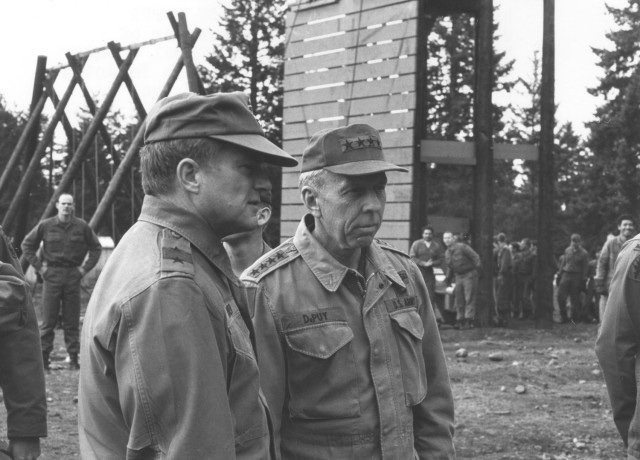
JOINT BASE LANGLEY-EUSTIS, Va. – In 1976, TRADOC distributed 176,000 copies of the new Field Manual 100—5 Operations. This massive publication and dissemination effort marked but one of Gen. William E. DePuy’s, TRADOC’s first commanding general, purposes for the manual—to drive rapid change throughout an Army confronting an upgraded Soviet threat in Europe and contending with the aftermath of the long Vietnam War. Fresh doctrine, Depuy reasoned, would serve as a guidon for the Army, shaping everything it did, from training and education, to developing leaders and new equipment. Another no less significant purpose was to provide Soldiers with clear and practical guidance on how to fight and win on the modern battlefield against a peer opponent.

However, significant criticisms of Depuy’s brainchild emerged almost as soon as the last manual left the presses. First, many assessed that it prioritized defensive operations; the chapter on defense was indeed more robust than the one tackling the offense. Consequently, the term Active Defense quickly emerged as a shorthand reference for the manual. Second, the manual stressed the science of the application of modern firepower and force ratios, ignoring, some argued, the fundamental human element in warfare. Third, others contended the doctrine focused too narrowly on the Western European battlefield to the detriment of other forms of conflict across the spectrum of war. Finally, operational commanders worried that, in concentrating on tactical combat at the forward edge of the battle area, the manual neglected a key element of Soviet doctrine—that of echeloning forces in depth to maintain the momentum of any attack. This emphasis might commit U.S. Army ground forces to an attritional fight they could not win. Whatever their specific objections, all critics agreed with Depuy that future success started with 100—5, the Army’s capstone field manual, and that 100—5 should direct the force in all that it did.

A series of TRADOC commanders—Gen. Donn A. Starry (1977-1981), Gen. Glenn K. Otis (1981-1983), and Gen. William R. Richardson (1983-1986)—took up the challenge and led the effort to revise the 1976 document, culminating in two new Operations manuals that appeared in 1982 and 1986 respectively. Their sustained, consistent, and collective efforts saw not just revised doctrine, but the development of training and the fielding of equipment to make the doctrine work in practice.

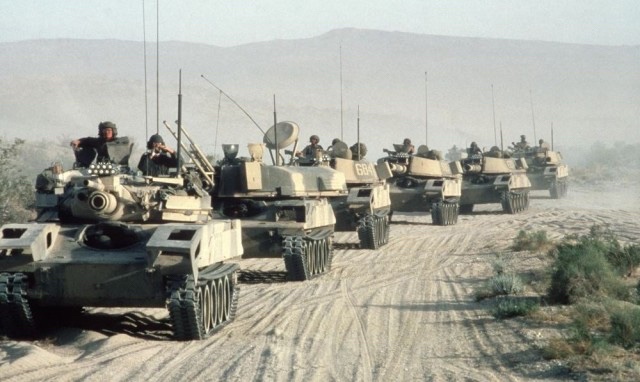
Taken together, the 1982 and 1986 editions of FM 100—5 addressed the perceived weaknesses of the earlier manual. For example, they introduced a concept, dubbed AirLand Battle, that dealt with the problem of Soviet offensive doctrine by emphasizing attacking throughout the depth of the battlespace through synchronized effort across the joint force. While the Army primarily managed the frontline fight, the Air Force (mainly) as well as Army attack aviation and long-range fires would attrite and disrupt second echelon Soviet forces. Furthermore, the new doctrine highlighted the value of maneuver and aggressive action with both local and deep counterattacks serving to shock adversaries and enhance the morale of Soldiers, who would now hit back as well as defend.

Although thankfully never tested in Western Europe, the TRADOC-led effort to transform Army doctrine and the force in tandem with it contributed directly to success in the Gulf War of 1990-1991. Echoes may also be heard today in the Army’s current multidomain operations concept.

By Courtesy, TRADOC Military History and Heritage Office

New Rotary Wing Advanced Tactical Helmet for Nightstalkers

Tuesday, May 23rd, 2023

The Nightstalkers of the famed 160th Special Operations Aviation Regiment (Airborne) have adopted a new lightweight flight helmet called the Rotary Wing Advanced Tactical Helmet or RATH (pronounced Wrath).

Recently on display at the AAAA Summit in Nashville, the new helmet will replace HGU-56/P Rotary Wing Aircrew Ballistic Helmet (ABH) Systems which have been in service for decades. In fact, the 160th was one of the first adopters of the HGU-56/P in the 1990s.

The quest for a lightweight flight helmet which would reduce aircrew neck strain began five years ago and has taken the combined efforts of the US Army Aeromedical Research Lab, Air Force Research Lab, SOFWERX, USSOCOM and the 160th. The effort has culminated with this fielding.

Features:

• Meets / exceeds all US Army FNS / PD 96-18 Safety Requirements & Specifications

• 6 unique helmet shell sizes – does not put extra liner padding in larger sizes to create smaller sizes

• 24% average weight reduction across all sizes when compared to legacy HGU-56P helmet

• 9% increase in side-to-side field of view when compared to legacy HGU-56P helmet

• Optional ballistic applique to provide protection from small arms fire & fragments

• Ventilated carbon fiber shell with “penetration proof” Dyneema™ ballistic liner

• Koroyd™ damage control honeycomb liner with up to 18% more compression than EPS foam

• Lightweight adjustable dial suspension and retention liner assembly

• Hot swap ballistic visor can be changed in less than 30 seconds without tools

• Clear & tinted ballistic Class 1 visor

• Side mounting rails for lights & accessories

• Easy snap / release chinstrap buckle

• Quick-release ANVIS NVG shroud

• Headset can be worn independently from helmet

• Hearing pass-thru with dynamic sound suppression and volume control

• UmeCobra™ boom microphone offers an average of 10 dB improvement of legacy M-87 mic

• Gel earseals and adjustable nape pad for custom sizing and compression adjustment

Next Generation Family of Army Medium-Size Vehicles Tested at Ft Bliss

Tuesday, May 23rd, 2023

FORT BLISS, Texas — Under the heat of the desert sun, a convoy of military vehicles roll down a dirt trail, kicking up dust and sand as they reach speeds of 45 miles per hour.

The vehicles look familiar but are a little different from what Soldiers are used to seeing.

The vehicle driving down the dirt trails is the Family of Medium Tactical Vehicles, or FMTVA2. The FMTVA2 is being tested here with hopes it will replace its predecessor, the Light Medium Tactical Vehicle, or LMTV, allowing Soldiers across the Army to have access to a modernized vehicle.

“Driving the FMTV has been a complete game changer from the old LMTV,” said Spc. Salvador Castillo, a horizontal engineer with Alpha Company, 16th Brigade Engineer Battalion, 1st Armored Brigade Combat Team, 1st Armored Division.

Castillo and his unit tested the FMTVA2 for about 4 weeks and praised the improvements from the previous model.

Castillo expressed appreciation of the user-friendly enhancements, such as improved suspension, and the Drive Display Unit — a digital vehicle monitoring system that informs the driver of vehicle faults in real time.

Feedback from the Soldiers are integral to the equipment testing process. Input from Soldiers testing the equipment is collected and used to inform the U.S. Army Operational Test Command how the FMTVA2 performs.

David Rogers, a civilian employee of OTC and assistant test officer for the FMTVA2 follow-on operational test, said all the data requirements are captured, and testing criteria are met to ensure that they can coordinate with their sister unit, the U.S. Army Evaluation Center, to produce an evaluation report to inform Army senior leaders of the FMTVA2’s suitability and reliability.

“Our mission is to collect the data,” Rogers said. “We provide the data to the evaluators so they can inform decision makers within the Army.”

Rogers explained the evaluator’s role as vital to ensuring the test exercise conducted over the course of the follow-on operational test meets data requirements and gives an overall scope of the FMTVA2’s capabilities and its readiness to roll out to the Army and its Soldiers.

As training wrapped up, the Soldiers testing the FMTVA2 are confident in the vehicle’s performance and their ability to operate them.

“It’s a lot easier for our unit to use, and we’re already comfortable using it. It will make it easier for all of us across the board,” said Castillo.

Three Fort Bliss 1st Armored Division units took part in the operational test: Companies A and B, 501st Brigade Support Battalion, 1st Armored Combat Brigade Team; the 16th Brigade Engineer Battalion; with the 528th Hospital Center, 1st Medical Brigade also joining in.

Story by SSG Jacob Lang, 24th Theater Public Affairs Support Element, Fort Bliss, Texas


Photos by Mr. Tad Browning, OTC Lead Audiovisual Production Specialist