XC3 Weaponlight

Archive for the ‘C5ISR’ Category

Anduril Awarded Contract to Redefine the Future of Mixed Reality

Tuesday, September 9th, 2025

“Military operations are inherently human endeavors, characterized by violence and continuous adaptation by all participants. Successful execution requires Army forces to make and implement effective decisions faster than enemy forces.”

-Army Doctrinal Publication 6-0, Mission Command

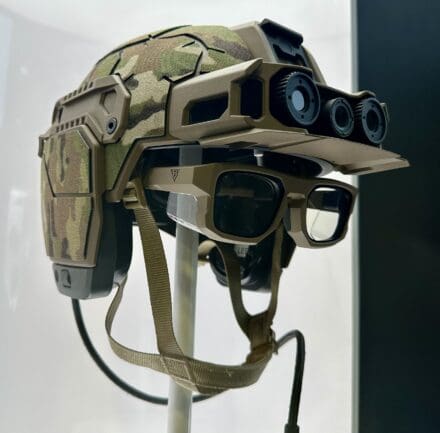
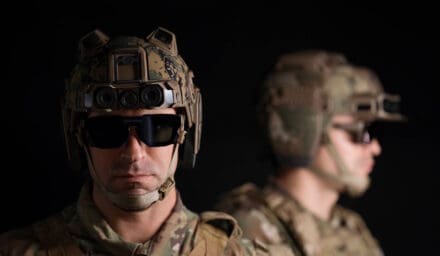
Anduril Industries announced today that it has been awarded a $159 million contract by the U.S. Army for an initial prototyping period to develop a night vision and mixed reality system as part of the Soldier Borne Mission Command (formerly IVAS Next) program. This award represents the largest effort of its kind to equip every soldier with superhuman perception and decision-making capabilities—fusing the best of night vision, augmented reality, and AI into a single system.

Today’s warfighters benefit from decades of steady improvements in night vision technology, but even the best NVGs remain fundamentally limited: they provide sight, not perception. They don’t fuse multiple spectral bands, integrate battlefield data, or enable soldiers to command robotic teammates directly from their display. At the same time, command systems remain largely designed for static command posts, not for soldiers in contested, communication-degraded environments.

In a forward-deployed environment, a squad leader must stitch together maps, radios, and ad hoc apps just to know where their team is, what the threat looks like, and how higher headquarters wants them to move. Intelligence gets trapped in silos, updates arrive too late, and every new piece of gear adds complexity instead of clarity. The result: warfighters lose precious seconds just trying to get a common picture of the fight. In a world where success depends on making and implementing decisions faster than the enemy, that’s an unacceptable disadvantage.

The Solution

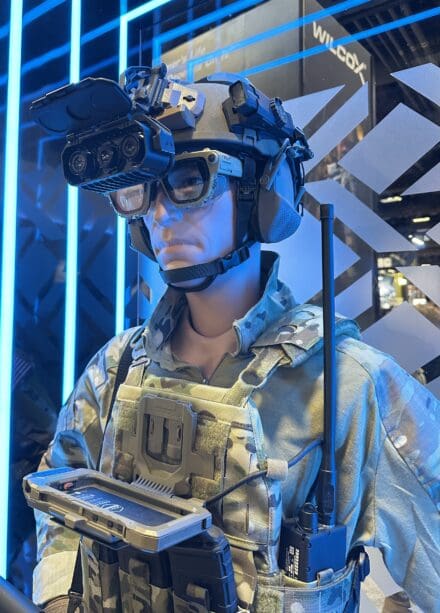
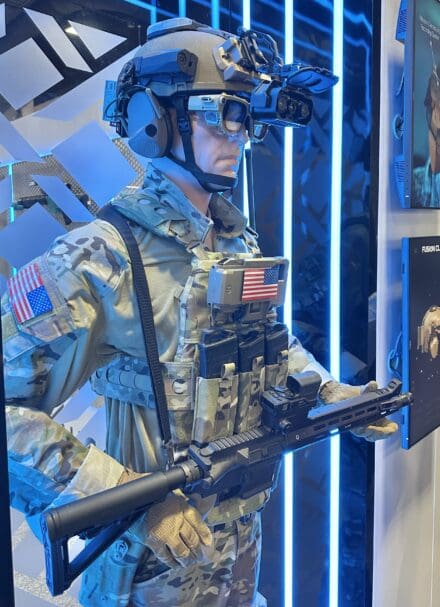
Anduril’s solution reimagines the battlefield interface giving soldiers superhero-like abilities. In collaboration with leading technology partners—including Meta; OSI; Qualcomm Technologies, Inc.; and Gentex Corporation—Anduril is developing a helmet-mounted mixed reality system that unites advanced night vision with augmented reality overlays. This creates a single perceptual layer that fuses day, night, and thermal imagery with real-time battlefield intelligence. Soldiers will see farther, across more spectral bands, through an intuitive, real-time display. Instead of toggling between devices, warfighters will perceive a unified picture of their environment—accelerating understanding and enabling faster, better decisions.

The competitively awarded SBMC contract provides Anduril with the opportunity to deliver a generational leap in both capability and hardware ergonomics. Anduril and its partners are developing a modular component framework, enabling soldiers to select the most effective loadout for their specific mission needs.

Soldier Borne Mission Command Architecture

Originally launched as the Integrated Visual Augmentation System (IVAS), Soldier Borne Mission Command-Architecture (SBMC-A) is the software backbone for the Army’s new mission systems. While the broader SBMC program delivers new helmet-mounted displays and edge compute hardware, SBMC-A provides the open software platform that integrates them into a fielded, soldier-ready capability, continuously iterated with Army combat units. Built on Anduril’s Lattice platform, SBMC-A is led by Anduril in partnership with Palantir Technologies, L3Harris Technologies; Persistent Systems, LLC; Sierra Nevada Company; DTC; Maxar Intelligence; Kägwerks; and others, all working together to advance integrated capabilities across the Soldier Borne Mission Command ecosystem.

Working with its partners and leveraging over 260,000 hours of soldier input from the IVAS program, Anduril has integrated IVAS 1.2 headsets as surrogates with Lattice, completing multiple field tests with the Army to advance SBMC-A as the foundation for future helmet-mounted mixed reality systems. SBMC-A has undergone four soldier exercises and been tested in combat training scenarios using a mesh of heads-up displays, and body- and vehicle-borne edge compute devices. Through Anduril’s SBMC-A, drones were directly tasked from over three kilometers away via a line-of-sight radio connection to a Lattice-integrated IVAS 1.2 headset, allowing individual soldiers to command and control drones from their HUD without a dedicated drone pilot.

Fourteen industry partners are actively engaged in the SBMC-A program, with third-party developers already onboarded to the Lattice Partner Ecosystem via the Lattice Software Development Kit (SDK) to expand capabilities inside the Lattice Mesh. Most notably, Anduril has reduced over-the-air software update timelines by 99 percent—cutting the process from two days to just 15 minutes—enabled by Lattice’s optimized test and fleet management tools. With daily updates pushing to the field, Anduril is accelerating delivery timelines, reducing costs, and continuously improving SBMC-A through real-world soldier feedback and operational testing.

Together, SBMC and SMBC-A are about human perceptual augmentation: giving soldiers the ability to see beyond the limits of human senses and act with speed and clarity across every domain of the fight. SBMC will allow every soldier to see farther, know more, and act faster than ever before, redefining what it means to fight and win in the 21st century.

Army Announces Additional Competitive Award for Next Generation Command and Control (NGC2) Prototyping Efforts

Wednesday, September 3rd, 2025

ABERDEEN PROVING GROUND, Md. — The U.S. Army has awarded a new Other Transaction Authority (OTA) agreement to Lockheed Martin Rotary and Mission Systems and their team of non-traditional innovators and commercial technology providers. This agreement aims to advance the Army’s Next Generation Command and Control division-level prototyping and experimentation by delivering an integrated data layer capability to the 25th Infantry Division.

Next Generation Command and Control, or NGC2, is the Army’s new, innovative approach to equipping commanders with the data they need to make better, faster decisions than the enemy amid rapid technological change.

The OTA was awarded through the NGC2 competitive Commercial Solutions Offering (CSO) on behalf of Program Executive Office Command, Control, Communications, and Network (PEO C3N) for $26 million with a not to exceed period of performance of 16 months.

The new OTA builds on the Army’s recently extended NGC2 OTA agreement to Team Anduril, which also includes several teamed industry partners. Vendor teams participating in NGC2 are flexible, allowing the Army to collaborate with the team leads to adjust capabilities and participants based on prototyping outcomes. Additionally, the Army is accepting proposals on the CSO for potential future team lead or component integration into the NGC2 technology stack.

“This isn’t the end of competition, this is the beginning. Through these two industry team lead agreements, we’ll evaluate different models for shared responsibility and aligned incentives during the NGC2 prototyping phase. We don’t want to have great capabilities simply at the start — we want a durable partnership model that keeps pace with an ever-evolving American tech sector and creates continual opportunity to find and insert the best technology solutions,” said Joseph Welch, deputy to the commanding general, Army Futures Command. “By encouraging companies to self-organize and team with each other and enabling them to integrate and solve these problems directly with the operational force, we will be able to rapidly and continuously improve the command and control capabilities we deliver to Soldiers.”

In July, the Army continued an OTA agreement to Team Anduril to maintain NGC2 momentum from Project Convergence experimentation. The agreement will deliver a NGC2 prototype architecture to the 4th Infantry Division, which is conducting prototyping across applications, data, infrastructure, and transport within a full “technology stack.” The Team Lockheed Martin OTA will focus on the integrated data layer, allowing the Army to assess NGC2 software options. These options will be supported by the C2 Fix transport and infrastructure capabilities already fielded to the 25th Infantry Division. The OTA also supports the Army’s goal of increasing competition and creating multiple opportunities for vendors to contribute technology to the NGC2 ecosystem.

“Next Generation Command and Control is about accelerating transformation and optimizing the innovation of both industry and our warfighters to deliver critical Warfighting capabilities at speed,” said Jesse Tolleson, acting assistant secretary of the Army for Acquisition, Logistics and Technology. “This is not business as usual and reflects exactly what we are trying to achieve through transformation across the Army and the acquisition community.”

Lessons learned by the 4th Infantry Division and 25th Infantry Division will provide insights into how heavy and light units will apply NGC2 differently. These efforts will also examine how NGC2 elements function across the technology stack, with a focus on the data layer’s ability to ingest, transport, and organize data from multiple warfighting systems. Additionally, they will inform future fielding considerations for the broader Army.

“The pace at which we are moving with NGC2, both in terms of contracting and getting the equipment into the hands of Soldiers, is exceptional and laser focused on making our formations faster and more lethal,” said Brig. Gen. Shane Taylor, PEO C3N. “The NGC2 CSO is one way we are transforming our acquisition approaches to drive continuous competition and equip Soldiers with technologies that will win in the future fight.”

Previously fielded with the Army’s C2 Fix capabilities — which provided a “fight tonight” division communications architecture with a mix of military and commercial off-the-shelf capabilities as a down payment on NGC2 transformation — the 25th Infantry Division is postured to demonstrate how NGC2 software capabilities operate with C2 Fix hardware.

“At the 25th Infantry Division, we are humbled to play a role in bringing Next Generation Command and Control into the hands of Soldiers,” said Lt. Col. Eugene Miranda, spokesperson for 25th Infantry Division. “This effort is about giving our leaders and formations the ability to sense, decide, and act faster together than any adversary. By working alongside our industry partners and allies, we are learning in real time how human skill, disciplined processes, and emerging technologies can come together to strengthen deterrence and win in the Indo-Pacific. We are proud to contribute to this Army-wide transformation, knowing that every lesson we learn here helps drive the change our Army needs at the speed of need.”

Through NGC2, the Army is transforming not only technology, but also processes in requirements, resourcing, acquisition and contracting. The NGC2 competitive CSO enables continuous open solicitation with specific “decision windows,” allowing vendors to support rapid integration of new capabilities. During the most recent CSO opportunity for NGC2 prototyping with 25th Infantry Division, more than 80 vendors submitted team lead or component provider proposals.

“Contracting for NGC2 is not just about buying a product; it’s about investing in strategic partnerships with vendors,” said Danielle Moyer, executive director, Army Contracting Command – Aberdeen Proving Ground. “By continuing to embrace open dialogue and collaboration with industry and offering an environment that continues to leverage competition across all aspects of the NGC2 ecosystem, we can better equip our Soldiers with the most agile and innovative technology available.”

By PEO C3N Public Communications Directorate

US Army Applications Lab Seeks Commercial Autonomous Systems for Extended Experimentation with 4ID

Friday, August 22nd, 2025

Army Futures Command is seeking innovative, readily available solutions for use by the 4th Infantry Division (4ID) based in Fort Carson, Colorado beginning in early calendar year 2026. These solutions should be capable of extended experimentation with soldiers in the field and focused on at least one of the eight capability focused areas listed below. They should also be open to integration with the Next Generation Command and Control (NGC2) prototype ecosystem that Program Executive Office Command, Control, Communications, and Network (PEO-C3N) is developing over the next 18th months with 4ID.

The goal is for companies to not just demonstrate their technology’s capabilities to operate in the space between the ground to a few thousand feet above it, the Air-Ground Littoral, but also its potential interoperability with the prototype NGC2 data layer/technology stack.

Capability Focus Areas

Movement & Maneuver: Unmanned (or improved safety and security) of operations including route/mine clearance, breaching, bunker/trench clearing, emplacement/detonation of charges or mines. Obscuration of friendly formations.

Mission Command: Tools that process data and recommend COAs. Nodes or relays that extend communication capabilities. Auto-generating tools for common operating pictures.

Intelligence: Loitering capabilities and sensor networks. Real-time targeting recognition analysis/assistance. Synthesis and predictive analysis of intelligence streams.

Reconnaissance & Target Acquisition: Low signature/early warning systems. Reconnaissance capabilities forward of maneuver elements.

Fires: Drone swarm or sensor-to-soldier systems that aid in target acquisition, fire adjustment, massing of fires, and attack capabilities. Loitering systems that engage autonomously with predefined rules of engagement. Autonomous tank or infantry support platforms that provide direct fire.

Sustainment: Autonomous CASEVAC, convoy, & aerial/ground resupply capabilities. Predictive maintenance & fleet (equipment) health tools. Automation of warehouse/port operations.

Protection: Systems that augment security/defense operations, screen (hide) troop movements. Automated/Augmented tools for Counter-UAS (identification, classification, jamming, intercept, neutralization). Chemical, biological, radiological, and nuclear (CBRN) sensor/alert systems.

Information: Tools that scan for and detect network vulnerabilities. Penetration testing. Automated monitoring of disinformation and counter-narrative generation.

Responses are due 5 September 2025 by email to opencallsolutions@aal.army

Learn more at sam.gov.

NGA and XVIII Airborne Corps Successfully Tests New AI Tool

Tuesday, July 29th, 2025

Members of the National Geospatial-Intelligence Agency’s Warfighter Support Office, the U.S. Army’s XVIII Airborne Corps, a national lab and a technology company tested artificial intelligence capabilities near Fort Bragg, North Carolina, May 5-8.

The team tested a prototype capability known as the GEOINT AI/ML Based Light-Edge Resilient system, or GAMBLER. It is a set of mission-focused AI capabilities aimed at directly supporting warfighters in the field. The system uses unclassified video and still images from tactical sources and rapidly identifies, locates and catalogues detected objects. GAMBLER can then disseminate the data to handheld devices and to upper networks for situational awareness.  

“One of those problems we are working on is moving the ability to make AI models in the field that are integrated into the warfighters collection, processing and dissemination paths … especially in communication challenged environments,” said NGA’s Warfighter Support Office director.

During the testing, the team performed multiple test objectives, including data and scenario collection, real time model construction, processing of detections and distribution to multiple systems.

“GAMBLER is designed be operated by the warfighter,” said the office’s chief engineer. “It’s about pairing the capabilities of GEOINT, machine learning, AI and mesh networks to reduce the amount of time it takes to identify important objects and quickly pass that tactical situational awareness along to where a decision can be made or action taken.”

It enhances the warfighters use of AI and GEOINT at the tactical edge to support any number of military missions, he added.

Also, the team designed scenarios in which personnel were moving around a village training area and tunnel system with backpacks, weapons and bags to determine illegal or illicit activity by individuals, for potential use for security missions.

GAMBLER is designed to support users in denied, degraded, intermittent and latent environments. To do this, GAMBLER supports multiple communications paths.

The agency’s Warfighter Support Office team tested this capability during the exercise. 

With support from service members at Fort Bragg and Fort Huachuca, Arizona, the team tested new software that allows detections and image tiles to be sent over different frequencies for long distances.

The team successfully distributed image detections via portable radios to locations across the United States.

Another significant objective was to test the performance of the GAMBLER software on low-cost, small-form-factor hardware.

Without adapting the software or models, the smaller system performed very well compared to the larger original system. These modifications drastically reduce the GAMBLER footprint, and uses much less power.

The lessons learned, test measurements and improvements are already being designed and implemented for the next version of GAMBLER.

Via Geospatial-Intelligence Agency’s Warfighter Support Office

Anduril Awarded $99.6M for U.S. Army Next Generation Command and Control Prototype

Friday, July 18th, 2025

As an Allied combined arms formation rolls quickly through a heavily fortified enemy area, the dangers they face are unknown. Enemy adversaries could be dug in, difficult to identify, and ready to open fire. A soldier launches a drone to perform reconnaissance of the area, spotting a series of dangerous enemy positions. But there are only minutes to convey that critical information to the Battalion and Brigade commanders and adjust tactics before large groups of soldiers advance. With the right software tools, commanders are able to receive and process this information from miles away on a mobile device, and then transmit new orders to their subordinates that integrates real-time intelligence before they engage the enemy. In a matter of seconds, the lethality and effectiveness of the advancing unit is significantly upgraded.

The information age is transforming the battlefield. Soldiers must be equipped to go into battle with the best technology American industry can muster, with connectivity from the outer edge to the operations center. As the battlespace becomes digitized — and timely data, information processing, and decision-making decide success or failure — a transformed, modernized Army will need transformed, modernized software, networking, and communications equipment.

Next Generation Command and Control (NGC2) is the Army’s answer to this challenge. It’s the principal Army initiative to modernize the service’s communications and networking technologies, equipping the warfighter with seamless and resilient connectivity at the edge while simultaneously supplying commanders with the best decision-making information available — all through a modular, extensible, and open architecture software platform.

Anduril Industries today announced that it was awarded a $99.6 million Other Transaction Authority (OTA) agreement by Program Executive Office Command, Control, Communications, and Network (PEO C3N) to lead the delivery of an NGC2 prototype, integrating partner capabilities from other technology-first companies like Palantir, Striveworks, Govini, Instant Connect Enterprise (ICE), Research Innovations, Inc. (RII), and Microsoft.

For NGC2, Anduril and its partners will create an ecosystem that can rapidly integrate a range of technologies into a singular architecture so that soldiers can access various kinds of compute, communications, and information processing capabilities all at once. Time-sensitive decisions will be faster, and soldiers will be more connected across Corps to Company. Critical data might include enemy locations, logistics and sustainment information, terrain mapping, tactical control measures, and weapons statuses. In turn, Lattice Mesh will enable machine-to-machine interfaces that deliver effects in a fraction of the time compared to legacy systems and networks.

Lattice Mesh is already the foundational edge platform that underpins several Joint and Service initiatives, including the DoD’s Chief Digital and Artificial Intelligence Office Edge Data Mesh. In the same fashion, Lattice will create immediate Joint interoperability for the Army’s Command and Control ecosystem. As a result, NGC2 will connect digital assets, remote sensors, command posts, and soldiers on the ground with real-time intelligence and systems. This solution is in stark contrast to the siloing of data and intelligence across classified and unclassified stovepiped systems that currently exists.

The announcement of OTA continuation follows an 18-month competitive experimentation process, which Anduril entered in late 2023. From the ground up, Army Futures Command has reimagined a new construct for command-and-control in just two years, considering multiple proposals from industry with the intent of standing up NGC2 at rapid speed. Contrasted with a typical five to seven year timeline, the Army moved from proof-of-concept to capability validation in just one year, a pace which Army CTO Alex Miller called “astronomically fast.” The Army established NGC2 as a program office in April 2025.

Anduril and its partners will deliver the NGC2 prototype to the 4th Infantry Division immediately upon award, working through a series of Soldier touchpoints and exercises to stress the performance of the software solution in operational environments at scale. The capability will be integrated onto compute nodes aboard multiple different types of mechanized vehicles throughout the 4th Infantry Division. Throughout the process, we will continue to evaluate new products, partners, and technologies that could strengthen the NGC2 ecosystem, contributing to continued improvement and evolution of NGC2. This prototype will serve as a proof-of-concept that with Anduril software, tactical units are better connected, informed, and more agile as they conduct real-time operations — precisely aligned with the Connected Warfare mission at Anduril as it works with customers across the Department of Defense.

This latest announcement from the Army is a reflection of Anduril’s commitment to delivering every conceivable battlefield advantage to the United States military — starting with the information they use and ending with the weapons they carry. And we’re still just getting started.

www.anduril.com

Army Researchers Turn Battlefield Data into Decision Dominance Tool for NGC2

Friday, July 11th, 2025

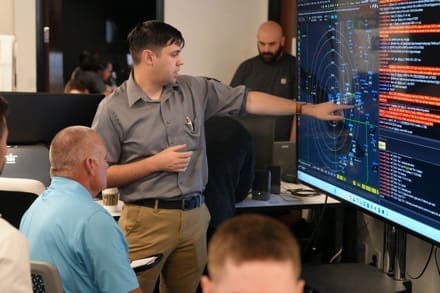
FORT BELVOIR, Va. (July 8, 2025) — Soldiers must quickly decipher an increasingly large amount of real-time battlefield data as they build and execute their mission plans. To enable better and faster battlefield decisions, U.S. Army researchers are developing a set of applications to analyze battlefield data to provide decision dominance and greater lethality.

These new applications, known collectively as Project Odin, monitor live data feeds, unit locations, sensor coverage, fuel, maintenance and ammunition status, weather, terrain, and more. They synthesize all this real-time information to understand and predict adversary actions, and enable commanders and staff to outpace their adversaries’ maneuvers and decisions.

The Army’s Command, Control, Communications, Computers, Cyber, Intelligence, Surveillance and Reconnaissance (C5ISR) Center leverages advances in artificial intelligence and real-time sensor data processing, according to Odin’s Project Lead Ben Rosen. C5ISR Center received feedback in July 2022 — the Army needed a Commanders decision tool to enable warfighting concepts and facilitate synchronization, lethality and flexibility.

“We developed a proof of concept within a year and immediately began an aggressive experimentation campaign to inform our development cycles from then on out. Being focused on capability gaps, the plan was to insert ourselves and live directly in the problem space,” Rosen said. “The burden on staffs to process all this battlefield data can slow down decisions. Project Odin speeds up the process to a fraction of the time.

“The program ingests battlefield information, analyzes it, and provides knowledge for Commanders to apply judgment, then decide and act faster than the adversary.”

Senior Army leaders are recognizing the benefits of emerging AI tech in expanding the possibilities of next-generation battlefield command and control tools. Gen. James Rainey, Army Futures Command commanding general, said during an AI summit last year: “The real potential for military application of artificial intelligence is to empower our commanders — the men and women who lead our formations. And how do we bring the power of AI to bear to let them do three things: make more decisions, make better decisions and make faster decisions?”

For the Army to accelerate Project Odin’s transition from R&D to a capability ready for Soldiers, C5ISR Center subject-matter experts are working directly with multiple units during experimentation events, such as Project Convergence and Transformation in Contact rotations.

“The Center’s S&T expertise is essential to delivering these tools to units. We combine technical experience, ability to interact with Soldiers in the field, partner with other Army R&D organizations, and quickly incorporate operational feedback for further improvements,” Rosen said.

Teaming the S&T community with units for persistent experimentation has been successful, as the Secretary of the Army wrote in the Army’s Posture Statement to Congress in May: “Feedback from TiC participants validated that our formations can evolve quickly when we pair the skill of developers with the warfighting ingenuity of soldiers. By adjusting how they organized and employed equipment, TiC units were able to more effectively see the battlespace, strike, and maneuver against opponent forces in training.”

Project Odin capabilities are hosted as applications on mission-command platforms such as the Android Tactical Assault Kit, commonly known as ATAK. By leveraging existing infrastructure and the Next Generation Command and Control data layer, the need for standalone single-use software across the force is eliminated.

“Odin is helping inform the Operational Modeling Tool annex to NGC2,” Rosen said. “We’re rapidly developing and experimenting to with NGC2 in mind, asking ourselves how we can leverage the NGC2 data layer to better understand the battlespace with a set of applications and services that work in concert with the overall NGC2 ecosystem.”

C5ISR Center has partnered with Army Research Laboratory and Army Corps of Engineers to take advantage of their areas of expertise in artificial intelligence, terrain data and digital modeling. The Army team has transitioned the capabilities from a concept to a fielded system in the hands of units in two years.

Experimentation with active-duty units continues to inform the program’s concepts and identify gaps.

“Project Odin quickens tactical decision cycles by removing the cognitive burden of monitoring highly synchronized plans and increasingly complex battlefields,” said Maj. Aaron Phillips, who used Odin during a recent Joint Readiness Training Center rotation. “This allows Commanders and their staffs to focus on selecting their next action, rather than tracking their current and past actions.”

Odin’s individual software components are at different levels of technical maturity, according to Steve Webster, the project’s technical lead at C5ISR Center. Some features are ready for Soldiers to use today during experimentation events like Project Convergence or Transformation in Contact rotations.

“We also have more advanced software under development earlier in the technology readiness pipeline that needs more development but is actively being informed by the experimentation we’re doing with the more mature services,” Webster said. “All of these efforts help us both in delivering capability and informing the needs for NGC2’s Operational Modeling Tools.”

One such capability in the R&D phase is Course of Action Generation, which continuously compares planned actions to real-time data — such as environmental conditions, available combat power and enemy position — to create new recommendations that guide staff to the best decisions. These Course of Action generation tools analyze information much faster than is possible for humans.

“Project Odin delivers on the Army’s need for a more data-centric command and control platform during a time of rapid technology advancements. Smarter, faster decision-making delivers lethality for Soldiers,” Webster said.

By Dan Lafontaine, C5ISR Center Public Affairs

Air Force DASH Pioneers Human-Machine Teaming for Faster Battle Management Decisions

Monday, June 23rd, 2025

LAS VEGAS (AFNS) —  

The Department of the Air Force took a bold step toward future command and control capabilities with the successful completion of its first Decision Advantage Sprint for Human-Machine Teaming, or DASH, experiment, recently held at the Howard Hughes Operations Center, or H2O, in Las Vegas, Nevada.

“The DASH experiment showed how machine support can dramatically reduce decision time and improve decision quality for air battle managers working in complex operational environments,” said Col. Christopher Cannon, Advanced Battle Management Cross-Functional Team lead. “Battle management teams were exercising command and control decision advantage.”

This two-week event brought together operational U.S. and Canadian warfighters, industry and Shadow Operations Center-Nellis software developers, to prototype microservices aimed at accelerating and improving decision-making in high-tempo battle management scenarios framed by the Transformational Model for Decision Advantage developed by the ABMS CFT.

“To deliver meaningful capability to the joint force, we must co-develop with industry partners who can iterate rapidly and help us operationalize software to meet urgent warfighter needs for today’s challenges and tomorrow’s fights. DASH experiments accelerate delivery of C2 and intelligence microservices that go beyond user interfaces and dashboards to directly address the (Combined Joint All-Domain Command and Control) imperative for decision advantage,” said Col. Jonathan Zall, ABMS Capability Integration chief.

Led by the ABMS CFT in partnership with the 711th Human Performance Wing, the Air Force Research Laboratory, the Integrated Capabilities Command and the 805th Combat Training Squadron, also known as the ShOC-N, the event focused on a critical subfunction of the Transformational Model – Battle Management: Perceive Actionable Entity.

“This is not just about accelerating data,” Cannon said. “It’s about accelerating decisions. DASH lets us move beyond buzzwords and into real-world prototyping, software built around the actual decisions our warfighters must make under pressure.”

The Transformational Model – Battle Management: Perceive Actionable Entity function determines which actions are possible, permissible and desirable against an operational entity, from targeting to rescue to resupply. Four selected industry teams and a ShOC-N coding team partnered with Total Force and Royal Canadian Air Force air battle managers in a simulated, high-pressure combat environment, building and testing code designed to help warfighters make faster and more effective decisions.

“Our C2 systems are still putting the burden of complex decision-making entirely on the human; this sprint starts to change that by giving our Airmen digital teammates that help them perceive, decide and act faster,” said Lt. Col. Shawn Finney, 805th CTS/ShOC-N commander, Nellis Air Force Base, Nevada. “The ShOC’s H2O center serves as an unclassified software development and vendor engagement hub allowing the DASH teams to rapidly code.”

From concept to capability: DASH in action
DASH participants were challenged to develop working software that output “Battle Effects,” battlefield-changing recommendations bounded by operational constraints like rules of engagement and time sensitivity. The tools were not pre-prescribed in format or interface, allowing developers flexibility in how their software performed decision-making and delivered information.

“What set the DASH experiment apart was its deliberate depth, driven by a focus on the end-user’s specific challenge. Instead of a generalized showcase, concentrating intensely on the PAE function allowed a rigorous evaluation of how advanced tools integrate into the operator’s critical workflow. This targeted, user-centric approach is key to genuinely operationalize agentic AI where it matters most, yielding concrete insights for the warfighter,” said an industry participant.

To measure the impact of human-machine teaming, the experiment was conducted in two phases. First, battle managers executed a combat scenario using only their existing tools and training—without any machine assistance. This established a performance baseline. In the second phase, they faced similar but not identical scenarios, this time with prototype decision-support tools developed during the sprint. By comparing performance across both scenarios, the assessment team measured how much the software improved decision speed and accuracy.

“The DASH experiment isn’t just a coding sprint—it’s a learning environment. Industry teams bring diverse perspectives and technical approaches that push us to think differently about C2. That collaboration accelerates our ability to deliver functional software and refine requirements for the entire enterprise,” said Lt. Col. Wesley Schultz, 805th CTS/ShOC-N director of operations.

The TM-BM DASH approach allowed for rapid development of machine teammates with clear, testable goals.

“DASH is the start of a new model for C2 software acquisition — one that begins with the decision, not the platform,” Cannon said. “We’re not buying software to display more data. Coders are building software that actively helps operators transform that data into measurably better battle management.”

Battle managers participating in the experiment responded positively, with anecdotal evidence suggesting the tools helped them process information more effectively and improve confidence in their decisions. Importantly, the tools required minimal training, reflecting the DASH experiment’s emphasis on lightweight, adaptable integration. Operators engaged directly with developers to refine the tools in real time, offering interface feedback that improved usability during the sprint itself.

“It was an incredible opportunity to be part of the inaugural DASH human-machine interface effort in battle management. I’m always looking for new ways to help make our force more expeditionary, more precise, and ultimately, more lethal,” said 1st Lt. Bennie Crawford, Georgia Air National Guard, 116th Air Control Wing, Robins AFB, Georgia.

ShOC-N: The engine behind DASH
The ShOC-N staff and facility played a critical role in the DASH by crafting the combat-representative scenario, using modeling and simulation technology presenting this simulated battlespace using an unclassified environment, reducing the barrier to entry for industry.

“At ShOC-N, we don’t just simulate conflict, we simulate decision pressure. The DASH experiment gave us a chance to immerse software developers in the reality our warfighters face, so the tools they build are operational from day one,” Finney said.

ShOC faculty also provided operator instruction and facilitated final outbriefs to senior stakeholders from Advanced Battle Management System Cross-Functional Team, Air Force Research Laboratory, Integrated Capabilities Command and 711th HPW.

“Our initial analysis illustrates that when the software developers’ tools were applied, not only did the human-machine team’s average decision-making time decrease seven-fold, but software ‘machines’ responded to more than twice as many dilemmas as the humans alone, and microservices generated three times the number of valid solutions, what we call ‘Battle Effects’,” Cannon said. “Machine answer errors were on par with human error, not bad for a week’s worth of coding. We demonstrated that machines absolutely helped, software services helped, but we also demonstrated that we can in fact build a software microservice that allows this to happen and gives us a more capable human-machine team.”

Each DASH enriches valuable software requirements that will find their way into future C2 requirements and gives participating industry early insight and practice in crafting their answers to those requirements. The experiment validated a repeatable, scalable methodology: design, develop, deploy and evaluate. This approach will guide future sprints across a growing catalog of decision functions. All findings, including technical and functional requirements, will inform future C2 software strategies and investments across the DAF’s C2 enterprise.

Beyond the sprint: The future of human-machine teaming
The DASH experiments translate abstract concepts like “decision advantage” into tangible, testable software capabilities. It marks a shift in Air Force capability development culture, developing functional and technical requirements alongside warfighters, with code in hand.

“Decision advantage is the capability gap that underwrites all others,” Finney said. “With DASH, we’re not just closing that gap, we’re coding directly into it.”

The ABMS CFT, in partnership with the 711th HPW, AFRL Information Directorate, ICC, and the 805th Combat Training Squadron, will host two additional DASH events later this year, each focusing on a different decision function within the TM-BM model.

“This is where theory meets execution,” Zall said. “We’ve spent years defining what decision advantage looks like. DASH is about delivering it by building software that helps our operators act faster and smarter than our adversaries. As the Air Force continues to iterate, experiment and evolve, the human-machine team will remain at the heart of the Department’s push for decision advantage.”

By Deb Henley

505th Command and Control Wing Public Affairs

Soldiers Experiment with Next-Generation C2 at Project Convergence

Thursday, March 20th, 2025

FORT IRWIN, Calif. (March 11, 2025) – The Army’s Next Generation Command and Control effort is reaching a critical milestone at Project Convergence Capstone 5, where commanders and Soldiers are employing new capabilities in realistic mission scenarios and conditions.

Next Generation Command and Control, known as NGC2, aims to provide the integrated information framework that commanders need to make rapid decisions across warfighting functions, giving them an edge over adversaries. NGC2 will also enable Army tactical units to operate faster and more dispersed by providing lighter, more mobile and survivable network and C2 equipment.

“What we’re trying to do is take these emerging technologies where we can get this data better and faster to execute,” said Lt. Col. Tad Coleman, commander of the 2-37 Armor Battalion, 1st Brigade, 1st Armored Division (1/1 AD). “The technology in Next Generation C2 is the stuff a majority of people are seeing and already doing (in their daily lives). It’s just that now, it’s at the fingertips of the commander.”

After a year of NGC2 technical experimentation in lab and field environments, the Project Convergence Capstone 5 (PCC5) experiment taking place within the operational rigors of the National Training Center is serving as a “proof of principle” for the Army to assess progress with the approach before transitioning to prototyping.

NGC2 is focused at the 3-star headquarters and below to provide a “full stack” of capabilities from applications to edge compute and tactical communications links. At PCC5, the 1/1AD, 82nd Airborne Division, and 18th Airborne Corps are utilizing elements of NGC2 experimental capabilities to execute offensive and defensive operations at speed, scale, and distance, attempting to achieve shared understanding of the battlefield and improve decision-making at all echelons.

Although early in the experiment, Soldiers and leaders at PCC5 said they saw the value of NGC2 in providing faster communications, smaller form factors, more complete data across warfighting functions, and ease of training and use as compared with legacy systems.

“It is really good information that is passed a lot faster,” said Staff Sgt. Paul Johnson, a section sergeant in Alpha Company, 2-37 Armor Battalion.

At PCC5, NGC2 experimental technology – including applications, data infrastructure, software, and hardware such as tablets, end user devices, and mobile communications equipment – has been integrated onto the armor battalion’s tactical vehicles, as well as brigade, division, and corps nodes. However, Army officials emphasized that the equipment at PCC5 is not a final product, and solutions will continue to evolve based on upcoming prototype contract awards and continuous iteration of requirements and user input.

The ability to avoid vendor lock, and flexibility to make quick changes to functionality based on Soldier needs, are key Army priorities in developing the NGC2 approach. Even ahead of PCC5, Army Futures Command made updates based on Soldier feedback received from 1/1 AD at a touchpoint in January.

“We were able to generate more Soldier feedback, and since we’ve been out here (at Project Convergence) we’ve actually seen a lot of that integrated and incorporated,” said Capt. Nathan Kraemer, brigade AS3 (operations officer), 1/1 AD. “It’s very intuitive, the functionality of it. That really opened our eyes, and everyone was excited to use this. Now, we are just seeing how it can contribute, take effect, and change the way we fight.”

Breaking down information siloes and stovepipes across warfighting functions, locations, and echelons for a common understanding of the battlefield has the potential to significantly change operations, users said.

“I fully believe that you cannot win any war without communications,” said Sfc. Victor Norman-Morris, a communications section chief in 2-37 Armor Battalion. “I don’t care if it’s bullets, logistics – if you can’t talk to whoever you’re trying to, to get whatever you need, you’re not going to be able to do it. At every echelon, everybody (must be) able to talk and sync and be on the same page so we can continue moving forward and completing our missions successfully.”

For example, Sfc. Joshua Holland, a platoon sergeant in Alpha Company, 2-37 Armor Battalion, said using NGC2 at PCC5 enabled him to gather more real-time data to “paint a picture” of the battlefield that provided greater situational awareness to his platoon leader.

“She can control everything that she has to control, and I can continue to paint that picture, and the system I’m [using] right now is making it a lot easier to do that in a quicker time,” Holland said. “You can get a visual image of something and simultaneously share that with your counterparts. Even if it’s something simple like sending a message saying, ‘Hey, can you see this?’ and you share it and it’s an immediate response back and forth.”

Project Convergence is the Army’s premier experimentation event that brings operational units and industry teams together in a complex real world operational environment to test ideas, concepts, and promising technology. The lessons and observations captured during PCC5 will directly inform Army decisions to refine requirements documents, prioritize funding, and invest to accelerate promising technologies.

For NGC2, the operational feedback received through PCC5 will inform updates to requirements including the Capability Characteristics of Need (CoN) document, which is consistently updated to reflect the evolving needs of the warfighter and technology progress.

NGC2 is executed in partnership by the Army Futures Command (AFC) and the Assistant Secretary of the Army for Acquisition, Logistics and Technology (ASA(ALT)). The AFC product owner and ASA(ALT) program manager will work together to plan and rapidly execute capability drops in concert with the operational force.

By Claire Heininger, U.S. Army Futures Command C2 CFT