Streamlight TLR VIR II

Archive for the ‘Contracts’ Category

USMC Seeking Modular Armor System

Monday, November 21st, 2011

The Marine Corps posted a Sources Sought Notice late last week for a new “Modular Armor System” to replace both Plate Carrier and Improved Modular Tactical Vest which hasn’t even been fielded yet.

Marine Corps Systems Command (MARCORSYSCOM) is conducting market research, and identifying potential sources and best practice information towards designing, developing, and procuring a Modular Armor System. The system will allow the individual Marine to configure and tailor the armor level based on mission requirements.

The United States Marine Corps (USMC) envisions at this time a single system that will be capable of providing the area of coverage of the current USMC Plate Carrier and expanding to a soft armor area of coverage equal to the USMC Improved Modular Tactical Vest (IMTV) with the Pelvic Protective System Protective Overgarment (POG). The system will be able to provide supplemental armor protection to the extremities.

The envisioned system will either integrate with current hard armor ballistic plates or a new hard armor plate design. There are no constraints on symmetry or materiel for soft and hard armor. Hard Armor threat defeat capability equal to that of the XSAPI is required with a desired maximum allowable areal density of 7.0 pounds per square foot. The soft armor performance within the torso and extremity regions is required to possess performance equal to the OTV CO-PD-00-2G with a desired maximum allowable areal density of .85 pounds per square foot. The carrier will possess the Pouch Attachment Ladder System (PALS) webbing for the mounting of modular pouches, have a single pull emergency release located on the center of the vest below the neckline and integrate with the USMC Chest Rig without impeding the quick release of the carrier.

The desired system will not exceed the cumulative weight of the IMTV with torso and flank plates. This suite will enable the individual Marine to configure components to best meet specific mission requirements by optimizing/balancing human factors engineering (e.g. comfort and usability), integration with fielded Load Carriage Equipment (LCE) and cost (production and maintenance).

It is important to note that the RFI states that “Modular Armor System’s attributes have not yet been finalized” so this is your chance to help influence the writing of the final requirement.

Potential sources of supply have until 30 December, 2011 to notify the Marines of their concept. Additionally, the Program Management Office (PMO) will have representatives attending the January 2012 Shooting, Hunting and Outdoor Trade (SHOT) Show in Las Veagas. Look for a separate posting on FedBizOpps with details on how to arrange a visit.

US Army Camouflage Improvement Effort Update

Friday, November 18th, 2011

According to PEO Soldier spokesperson Ms Debra Dawson, the current planned award date for 15 December 2011, a full three months after the initially planned date of 15 September. The latest word on the street is that the Army will most likely down select to four commercial and one Government families of patterns rather than the three and two originally planned.

After the camo industry day we published a comprehensive explanation of the Army’s plan and methodology. If you are unfamiliar with the plan we suggest you review that article. Naturally, the original, aggressive timeline has slipped significantly.

We will continue to update you as we receive additional information. Thanks to PEO Soldier for their assistance.

US Purchasing UK Harrier Fleet

Wednesday, November 16th, 2011

According to a story in the UK Guardian, the US Department of the Navy is purchasing the entire fleet of 74 UK Harriers removed from service as part of their controversial Strategic Defence and Security Review.

The USMC plans on keeping the Harrier in service through 2025 so this is an excellent opportunity to take advantage of available aircraft. In an interview with Navy Times, Chief of the US Navy Supply Corps, Rear Admiral Mark Heinrich said, “We’re taking advantage of all the money the Brits have spent on them. It’s like we’re buying a car with maybe 15,000 miles on it. These are very good platforms. And we’ve already got trained pilots.”

This is a good use of resources.

Canada Adopts TenCate FR Fabrics

Wednesday, November 16th, 2011

While not a wholesale of TenCate’s fabric solutions, or of FR in general, two recent Canadian procurements will result in the use of TenCate fabrics by Canadian troops.

First, the Advance Combat Ensemble (ACE) used by the Canadian Air Force will be manufactured with Nomex FR fabric from TenCate’s Brigade product portfolio. Additionally, new tents will incorprate the Nomex-based TenCate Campshield FR liner fabric.

www.tencate.com

Australia Purchases Additional OCUs

Wednesday, November 16th, 2011

Australia is purchasing an additional 10,000 Operational Combat Uniforms. These “test” items will be manufactured from TenCate’s 6.5 oz Defender M fabric. This is the improved fabric used by the US Army and Marine Corps rather than than the earlier fabric used in the first run of ODUs. The ODU is essentially a Crye Precision combat uniform. Apparently, someone at Department of Defence has determined that there is a need for FR protection for the Australian Soldier.

Photo: ABIS Jo Dilorenzo, 1st Joint Public Affairs Unit, Australia DoD

RFI Issued for USMC Corpsman Assault Pack

Thursday, November 10th, 2011

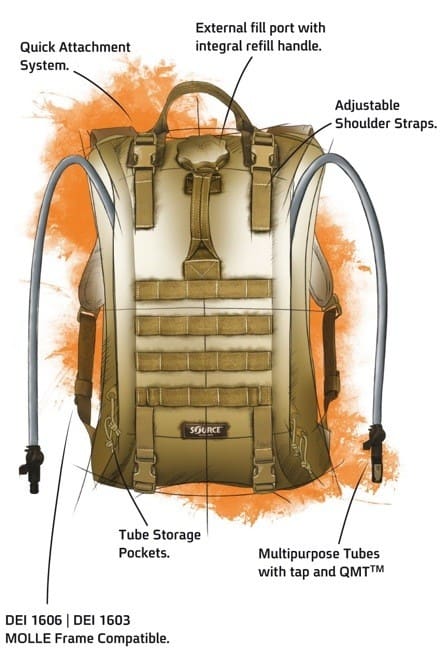
The Marine Corps has issued a Request for Information from industry for a USMC Corpsman Assault Pack to possible be manufactured sometime in 2012-2013.

Like all contracts Marine, the timeline is aggressive. A total of 10,000 complete USMC Corpsman Assault Systems at a rate of 1,000 complete USMC Corpsman Assault Systems delivered NLT 60 calendar days post First Article Test (FAT) approval and a sustained rate of 2,500 complete USMC Corpsman Assault Systems per month with delivery beginning NLT 90 day calendar days post FAT approval.

According to the RFI, the USMC Corpsman Assault System includes the following:

Qty Item

(1) Corpsman Assault Pack (22″ x 14″ x 4″) similar to the USMC Assault Pack

(18) Medical Inserts of varying dimensions to be mounted inside of the Corpsman Assault Pack

(1) Sustainment bag (20″ x 14″ x 4″)

(1) Trauma pouch similar to USMC combat trauma bag, NSN 8465-01-571-5231

(1) Thigh rig similar to the Advanced Life Support (ALS) leg kit, NSN 6515-01-531-6535

Like the new Marine Corps Pack System (originally called FILBE), it looks to be a Government owned design. They aren’t looking for industry’s good ideas. They’ve already seen those at trade shows and site visits. Instead, they’re looking for companies to tell them how they’ll build them and for how much.

Bravo to the Marines for updating the Corpsman pack. However, RFIs like this don’t make much sense, at least for their intended purpose. They’re still building Marine Corps Pack System and know what is out there manufacturing-wise and what it costs. All it serves to do is to cost a company money to answer the RFI. And, the RFI even admits:

“THE SUBMISSION OF THIS INFORMATION IS FOR PLANNING PURPOSES ONLY AND IS NOT TO BE CONSTRUED AS A COMMITMENT BY THE GOVERNMENT TO PROCURE ANY ITEMS/SERVICES, NOR FOR THE GOVERNMENT TO PAY FOR THE INFORMATION RECEIVED. NO SOLICITATION DOCUMENT EXISTS.”

Rather, look at this as a warning order that something is coming down the pipe. Interested companies have until 1 December. Good luck!

USSOCOM Precision Sniper Rifle

Saturday, November 5th, 2011

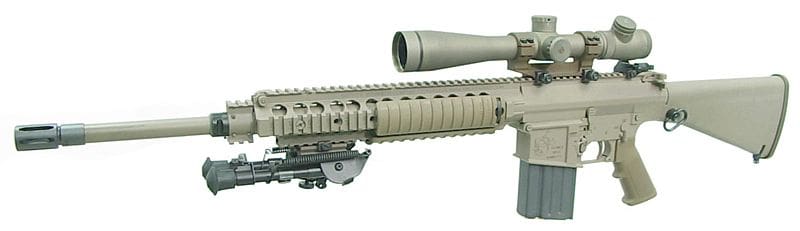
Yesterday, USSOCOM finally released the solicitation for the Precision Sniper Rifle.

The PSR system is designed to address the operational effectiveness and SOF sniper survivability over the current inventory of sniper weapons. The major components of the PSR system are: rifle, ammunition, magazines, sound suppressor including a mirage mitigating device, operator manual, sling, cleaning kit, bipod, drag bag, and hard carrying case. These items have been determined to be a commercial item and are intended to fulfill the approved USSOCOM requirement for a PSR.

In order to see the actual requirements you have to have explicit access meaning you have to be registered on the Central Contractor Registration (CCR) and be registered with a North American Industry Classification System (NAICS) code of 332994 for small arms manufacturing and/or 332992 small arms ammunition manufacturing.

The previous entry on FBO will no longer be used for this solicitation.

www.fbo.gov

Canadian Innovation Commercialization Program

Wednesday, October 26th, 2011

Sponsored by the Department of Public Works, the Canadian Innovation Commercialization Program is designed to allow companies to present new technologies to the Government without a requirement. While the program is open to solutions for use by all of Government, there are areas that can also find defense applications. Take for example the company Inversa. They have developed a system using the Deep Backscatter Tomography (DBT) technique that scans culverts and tunnels for maintenance problems so that waste water personnel won’t have to excavate pipes. It’s basically non-destructive inspection for sewers. Now, imagine using such technology to inspect culverts for IEDs.

Innovation often comes from small companies. Unfortunately, they often lack the expertise or staff to present their capabilities to the Government. Oftentimes, they are preyed upon by those who take their money, promising to open doors and grant Government access. In most cases, such access is readily accessible without the cost of a “consultant.” Another issue is that the Government’s procurement system is requirements based. If those writing requirements don’t know a capability exists, they can’t ask for it and may continue to do things the same old way.

It’s good to see the Canadian Government cut some of the red tape so that they can see the latest in technology and open opportunities to small business. It can be a win-win situation.