Wilcox Ind

Archive for the ‘Contracts’ Category

Saab Receives Order for RBS 70 NG from Finland

Monday, August 31st, 2026

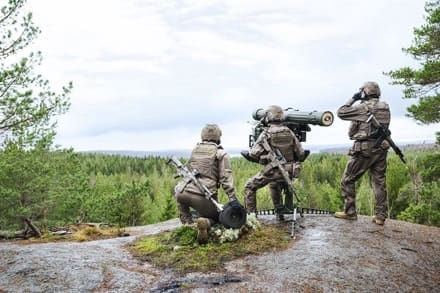
Saab has signed a contract and received an initial order from The Finnish Defence Forces Logistics Command for deliveries of the RBS 70 NG air defence solution. The order value is SEK 1.2 billion.

The new contract also enables Finland to place additional future orders for the RBS 70 NG as well as training, spare parts and maintenance equipment.

“We are proud to continue supporting Finland’s Defence Forces and contributing to keeping the nation’s skies safe. With RBS 70 NG, Finland will receive a state-of-the art short-range air defence capability to effectively meet evolving aerial threats,” says Görgen Johansson, head of Saab’s business area Dynamics.

The Finnish Defence Forces has been a user of the previous version of RBS 70 since 2008. The latest generation, RBS 70 NG, features the unjammable laser-guided missile while also adding a range of new capabilities, such as an automatic target tracker and built-in night capability which further increase hit probability and enhance operational use. 

Army Reaches Agreement with Private Industry for Nuclear Micro-Reactors

Monday, August 31st, 2026

WASHINGTON — The Department of the Army is announcing today that the Janus Program has selected five nuclear energy vendors, and five initial locations.

In partnership with the Department of War Innovation Unit (DIU), the Army is awarding up to a combined $2.2 billion to own, construct, and operate nuclear microreactors on military installations.  These vendors will deliver safe, secure, and reliable nuclear power, strengthening the Army’s ability to project power globally, while supporting the revitalization of American industrial capacity and technological leadership. With the private sector funding expected along with these government dollars, the Army expects more than 20 total nuclear microreactors will be built and operated across Department of War installations.

The five selected vendors and installations are as follows:

Antares Nuclear, Inc. – Fort Bragg, North Carolina

BWXT Advanced Technologies, LLC – Fort Campbell, Kentucky

General Atomics Electromagnetic Systems – Fort Hood, Texas

Radiant Industries, Inc. – Fort Benning, Georgia

Westinghouse Government Services – Fort Drum, New York

“Since launching the Janus Program, our mandate from President Trump and Secretary Hegseth has been clear: secure the power our warfighters need to train, deploy and win,” said Dan Driscoll, Secretary of the Army. “Awarding these contracts accelerates our ability to deliver safe, reliable baseload power directly to our installations. We are building the energy resilience necessary to project combat power globally, without relying on potentially vulnerable external grids.”

“The Janus Program is grabbing the baton from Project Pele and the [Department of Energy’s] Reactor Pilot Program,” said Dr. Jeff Waksman, principal deputy assistant secretary of the Army for Installations, Energy and Environment. “We are seeking not just reactors capable of turning on for a brief demonstration, but rather systems able to deliver power with high-capacity factors for years of operation. The Janus Program will be a complete success when and only when we have assisted multiple nuclear companies in developing truly reliable and affordable nuclear microreactors which they can sell to other buyers beyond just the military.”

After gathering technical and operational information from industry via an Area of Interest released by DIU, the Army down-selected potential industry awardees for negotiation of Other Transactions Authority-based agreements. A decision board and panel of top nuclear and technical experts from the Department of Energy, national laboratories and representatives across the services provided deeply rigorous input on the technical risks, financial situation, and management capabilities of the solutions. The close collaboration with technical experts and service representatives ensured selected vendors would provide solutions to enhance energy resilience for specific operational needs at military installations.

“When DOE created an authorization pathway for the demonstration of advanced reactor designs, we quickly began to realize how valuable these technologies could be for fortifying our national defense infrastructure,” said Assistant Secretary of Nuclear Energy Ted Garrish. “We are honored to work in lockstep with the Army to leverage nuclear energy innovation in support of our country’s military operations at home and abroad.”

The alignment of these vendors with Army installations represents the culmination of a year-long effort to evaluate and prioritize installations based on a multitude of factors from energy needs to seismic and hydrological considerations, all with a primary focus on safety. As the Janus Program moves forward, it is intended that these vendors will also site nuclear technologies on other service installations for continued energy resilience across the entire DOW. Additional Army and other Service sites will be announced at a later date. The Army continues to drive towards the September 2028 target outlined in President Trump’s Executive Order 14299 for operation of a first reactor, regulated by the Army, on a military installation.

“The Army is leading the nation in its return to nuclear preeminence via the Janus Program,” said Jason Craft, Janus Program manager. “Our selected industry awardees represent the most viable technologies to achieve this capability, setting conditions for both installation energy resilience and operational energy solutions.”

Using a milestone-based payment model, vendors will receive government funding only after successfully hitting specific technical goals. This investment model brings together approximately $2.2 billion across FY2027-2031 along with significant capital investment from each vendor. This technology development model will speed up the delivery of next-generation energy solutions to the warfighter and promote innovation while ensuring accountability. The prototype reactors will be contractor-owned and operated.

“We need more power. We need it delivered faster and cheaper, and we need it to be more reliable,” said Owen West, director, DIU. “With Janus, DIU is assisting the Army’s micro reactor build — speeding military energy production to protect the nation.”

Collaboration with utility providers is essential to the success of Army’s nuclear power strategy and the Janus Program. The Army will work closely with serving utilities and privatized utility providers on the Janus Program to ensure the best possible outcomes. The Army also invites continued collaboration with utilities both now and in the future on utility-scale, grid-facing power generation opportunities sited on Army installations.

“The Army’s Janus Program has my full support, said Emil Michael, the War Department’s Chief Technology Officer. “The War Department is acting swiftly to implement President Trump’s Executive Order, Deploying Advanced Nuclear Reactor Technologies for National Security, to deploy a nuclear reactor on a military installation by September 2028. We are unleashing America’s domestic nuclear industrial base to ensure a more resilient and secure energy supply for the joint force.”

Reliable energy underpins national defense. The down-selection to these five vendors represents a critical step forward in securing the operational readiness of our forces. The Army is committed to fortifying the defense and strength of the nation now and for future generations.

U.S. Army Communication and Outreach Office

Rheinmetall Receives First Order for a Modular Camp Under the German Armed Forces Contractor Augmentation Program II – Static Accommodation in Lithuania

Thursday, August 27th, 2026

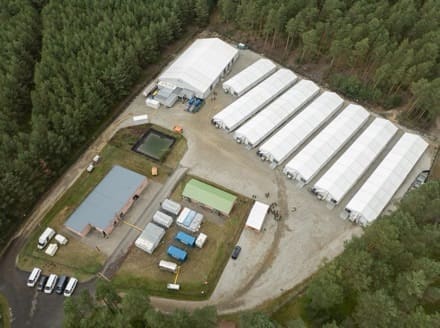
Rheinmetall has received an initial call-off from the Federal Office of Bundeswehr Infrastructure, Environmental Protection and Services (BAIUDBw) under the German Armed Forces Contractor Augmentation Program II – Static Accommodation (G-CAP II SU). In Lithuania, the group will now, as the main contractor, build a modular camp for up to 2,000 soldiers, which is due to become operational from mid-August 2027. Following commissioning, Rheinmetall will be responsible for facility management, including laundry, as well as catering. The order value for the construction of the modular facility amounts to €250 million, while the subsequent operation is valued at €40 million annually. The order was booked in Q3/2026.

The G-CAP II SU programme provides static accommodation for soldiers during deployment and standby commitments in the context of international crisis management and national and collective defence, irrespective of the climatic, geographical and geological conditions in the country of deployment. Pre-planned modular infrastructure covered by the framework agreement, from manufacture through transport, construction and operation to dismantling, forms the core of G-CAP II SU. Since these steps are standardised and can be called off from a single contractor, the entire process is accelerated. In this case, the contract was used to support the Bundeswehr in fulfilling its mission in Lithuania.

The G-CAP II SU project, initiated by BAIUDBw, aims to enable private-sector service providers to provide static accommodation during deployment. By enabling the private sector to establish such infrastructure, the Bundeswehr can conserve its own resources and keep them available for high-threat situations.

Rheinmetall is responsible for the planning, manufacturing and delivery of camps worldwide – by sea, land or air as required – as well as their construction, multi-year autonomous operation and subsequent dismantling. 

Saab Signs Long-Term Agreement for Camouflage Systems with the Netherlands

Thursday, August 27th, 2026

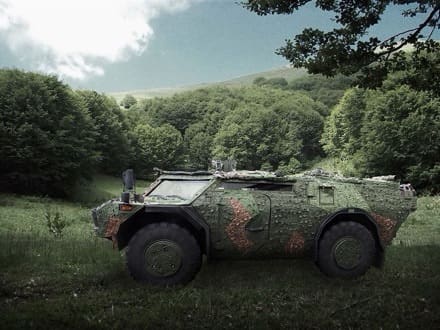
Saab has signed a long-term agreement with the Netherlands Ministry of Defence for the Barracuda Mobile Camouflage System. Saab has also received a first order within the agreement, with deliveries in the coming years.


The agreement, which runs over multiple years, enables the Netherlands to place orders and equip their vehicles with Saab’s Barracuda Mobile Camouflage System. 

“We are proud to support the Royal Netherlands Army with our advanced multispectral camouflage solutions, helping to protect its vehicle fleet from detection across the modern sensor spectrum, strengthening survivability and mobility on the battlefield,” says Henning Robach, head of Saab’s business unit Barracuda.

The initial order is for the Royal Netherlands Army’s existing Fennek and Panzerhaubitz vehicles. The agreement also includes options to equip additional vehicle types in the future. 

Saab’s Barracuda Mobile Camouflage System is tailor-made for a perfect fit for any vehicle, with woodland, urban or arctic camouflage patterns and can be deployed in any environment. 

AV Receives $51 Million US Army Order for Switchblade 600 Loitering Munitions

Wednesday, August 26th, 2026

Award under Lethal Unmanned Systems IDIQ reflects growing demand for AV’s next-generation, long-range precision loitering munitions and proven Switchblade 600 performance. 

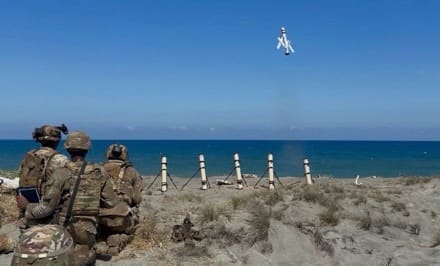
ARLINGTON, Va., August 26, 2026 – AeroVironment, Inc. (“AV”) (NASDAQ: AVAV), a global leader in defense technology, autonomous systems and precision strike solutions, today announced receipt of a $51 million delivery order from the United States Army for additional Switchblade® 600 Block 2 loitering munition systems. The order also includes Switchblade 600 Block 1 systems in support of a Foreign Military Sale to a key United States ally. 

The order was awarded under the Army’s existing five-year, $990 million Indefinite Delivery, Indefinite Quantity (IDIQ) contract for Lethal Unmanned Systems (LUS), originally issued in August 2024.  

This latest award represents a follow-on procurement to the Army’s initial order for the next-generation Switchblade product line and underscores the strong, sustained demand for AV’s battle-proven long-range, precision loitering munitions. 

“Continued investment by the U.S. Army in Switchblade 600 Block 2 reflects both the growing demand for long-range, precision loitering munitions and the proven reliability of the Switchblade family in demanding operational environments,” said Brian Young, Senior Vice President of Loitering Munitions at AV. “Building on the success of Switchblade 600 Block 1, Block 2 continues to deliver the meaningful upgrades in autonomy, resilience, and lethality tailored to the Army’s needs in contested, multi-domain operations.” 

This order also reflects AV’s expanding production capacity and performance on prior Switchblade 600 deliveries.  


“This new delivery order under the LUS IDIQ further validates Switchblade 600 Block 2 as a next-generation, scalable fires solution for the Army,” said Young. “As we expand our manufacturing capacity and accelerate delivery timelines, we’re ensuring that U.S. soldiers have reliable, combat-proven loitering munitions that deliver precision effects at range while keeping them out of harm’s way.” 

Since 2025, Switchblade 600 has been fielded across more than 20 brigade combat teams while hundreds of U.S. soldiers have been trained on the system’s operation and employment. 

Switchblade 600 Block 2 is designed for multi-domain operations and ruggedized for maritime and highly contested environments. Developed in collaboration with United States Special Operations Command (SOCOM), the system incorporates upgraded avionics and advanced automatic target recognition including SPOTR AiTR, to enable faster detection, identification, and engagement of threats.  

Integrated resilient communications, including Silvus MANET radios, support distributed operations and extended handoff ranges, while improved navigation and mission resilience allow effective employment in GPS-challenged environments. These enhancements provide commanders with increased reach, flexibility, and confidence against armored and other high-value targets. 

Kongsberg to Deliver Remote Weapon Systems to Canada

Monday, August 24th, 2026

KONGSBERG, NORWAY – Aug. 20, 2026 – Kongsberg has signed a contract with General Dynamics Land Systems–Canada (‘GDLS-Canada’) valued at NOK 1.1 billion for the delivery of Protector RS4 Remote Weapon Systems. These systems will be integrated onto the Canadian Army’s Armoured Combat Support Vehicle (ACSV). 

The contract represents a continuation of the established partnership between Kongsberg and GDLS-Canada. This order is a follow-on procurement of RS4 systems for the ACSV program, building on previous deliveries to the same platform.

“This contract confirms our customer’s confidence in the Protector systems and further strengthens our long-term partnership with GDLS-Canada. We are proud that the RS4 continues to be selected as a key capability for the Canadian Armed Forces’ modern vehicle fleet,” said Kjetil Reiten Myhra, Executive Vice President, Kongsberg and President of the Defence Systems division.

Kongsberg has previously delivered RS4 systems to GDLS-Canada for integration on ACSV vehicles. The new deliveries will further enhance and expand the operational capabilities of the Canadian Army.

The RS4 is part of Kongsberg’s Protector family of Remote Weapon Systems, providing high levels of protection, flexibility, and situational awareness for vehicle crews.

The Protector RS4 is an advanced Remote Weapon System designed to enhance survivability, precision, and operational flexibility for modern military vehicles. The system is in service with defence customers worldwide and can be integrated onto a wide range of vehicle platforms.

US Marine Corps Awards Accrete Sole-Source Contract for Argus for Cognitive Advantage

Saturday, August 22nd, 2026

NEW YORK, Aug. 21, 2026 — Accrete, the cognitive infrastructure company building Knowledge Engines for autonomous work, today announced that it has been awarded a sole-source contract by the U.S. Marine Corps to deliver Argus for Cognitive Advantage.

The award was made on a sole-source basis. Under the award, Accrete will license its Expert AI Agents to the U.S. Marine Corps to help achieve cognitive advantage, enabling more informed, confident decisions.

Adversaries increasingly compete below the threshold of armed conflict, using coordinated narratives, synthetic media, and inauthentic amplification to shape perceptions faster than human analysts can track. Rather than treating open-source data as a search problem, Argus for Cognitive Advantage tracks, analyzes, and visualizes narrative development across the complete information environment — OSINT, open web, social media, broadcast media, messaging platforms, and foreign-language outlets. Accrete’s Knowledge Engine platform, which powers the Expert AI Agent Argus for Cognitive Advantage, converts the institutional knowledge of experienced practitioners into expert AI agents that surface the most relevant, use-case-specific signals across every accessible network. This significantly reduces analytic time and produces the detailed reporting required for timely decision-making.

In a world driven by visual media, rapid analysis is paramount — and this is where Argus for Cognitive Advantage’s video vision stands out. It reduces hours of video content to analysis in minutes, transcribing and translating speech, detecting objects and scene content, and inferring location cues — turning clips that once had to be watched end to end into searchable, attributable evidence, including video posted in languages the analyst does not read.

Additional product capabilities include:

Narrative intelligence. Narrative engines, stance detection, and predictive simulation track how conversations evolve and resonate.

Audience simulation. The Audience Simulation Agent segments an audience and simulates how each segment will react to a message before it is released, compressing a weeks-long analytic task into a single workflow.

Measures of effectiveness. Automated assessments quantify mission outcomes.

Global reach. Real-time translation and transcription across 243 languages, spanning sources including Facebook, Instagram, TikTok, X, YouTube, Reddit, Telegram, Weibo, and VKontakte.

Argus Chat. Analysts query the data in plain language.

Trusted AI by design. Every inference is traceable to its source, within auditable, accreditation-ready boundaries.

“Cognitive advantage is a warfighting requirement, not a support function, and this award reflects the Marine Corps’ clear recognition of that,” said Bill Wall, CEO of Accrete AI Government. “Furthermore, this sole-source award demonstrates the trust Accrete has built across the Department of War services. Accrete is proud to expand its reach within the Department of War by supporting the U.S. Marine Corps.”

Accrete first deployed Argus with the Department of War in 2022, followed by a multi-million dollar U.S. Army contract in 2024 to advance the capability for Army information operations. Argus for Cognitive Advantage was selected for a 2025 AFWERX STRATFI award to transition its technology from prototype to operational use.

“Knowledge Engines are dynamic context recorders, and the advantage begins the moment an organization presses record. The most valuable context in any institution is the know-how trapped in the heads of its best people. Organizations that never capture it are ceding compounding advantage to adversaries and competitors that do. Argus for Cognitive Advantage is one of the most sophisticated applications of the Knowledge Engine platform, and Accrete is proud to extend it to the Marine Corps as it counters adversaries operating against the United States every day through digital channels,” said Prashant Bhuyan, Founder, CEO, and Chairman of Accrete, Inc.

Denmark Selects Terma to Deliver Nationwide Counter-Drone Defense System

Thursday, August 20th, 2026

Terma will deliver a sovereign, integrated counter-drone defense system that connects existing and future sensors into one shared drone situational picture. With AI-supported processing of sensor data, the system will give the Danish Armed Forces and other authorities a stronger foundation to detect, understand and act on drone threats in real time.


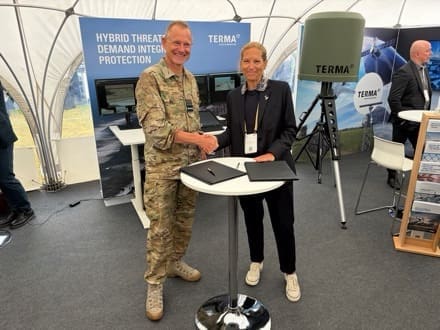
Per Pugholm Olsen, Head of DALO (Left) and Terma CEO Henriette Hallberg (Right)

Lystrup, Denmark – 19 August 2026 – The Danish Ministry of Defence Acquisition and Logistics Organisation (DALO) has entered into an agreement with Terma for the delivery of a new, integrated command-and-control system for counter-drone defense. The system will create a shared drone situational picture for the Danish Armed Forces and other authorities.

“I am pleased to sign this agreement, which will strengthen Denmark’s ability to maintain an up-to date drone situational picture. This new agreement with Terma is an important cornerstone in the ongoing effort to build a strong counter-drone capability, both within the Danish Armed Forces and Danish industry,” says Lieutenant General Per Pugholm Olsen, Chief of DALO.

From individual sensors to a shared drone situational picture

Denmark already operates sensors across the Armed Forces, civilian authorities and critical infrastructure, but today the information remains in separate systems and at different locations. The solution is built on Terma Helion, Terma’s sovereign multi-domain data backbone. Helion connects existing and future sensors and brings their data together into one shared drone situational picture. The platform integrates distributed systems and transforms large volumes of data into information that supports tactical decision-making at both local and central levels.

“In a security environment where drones represent a persistent and growing threat, the ability to detect, classify and act on threats across domains is fundamental to national security,” says Henriette H. Thygesen, CEO of Terma. “The ability to connect sensors, process data and turn information into timely decision support is essential to effective counter-drone defense. By creating a shared drone situational picture, we give the Danish Armed Forces and other authorities a strong foundation to act faster and with greater confidence. We are proud of the trust Denmark has placed in Terma. It confirms our ability to deliver mission-critical defense solutions that strengthen security in Denmark and across Europe.”

The solution also integrates OSL Technology’s FACE® platform for command and control and data fusion. OSL Technology became part of Terma in 2025. FACE brings together and processes data from Terma’s radar and surveillance technologies as well as third-party sensors and countermeasures. AI supports the processing, classification and prioritization of sensor data, enabling operators to rapidly identify and act on relevant incidents.

The solution builds on OSL Technology’s operational experience from complex civilian and military environments. Since 2019, OSL has been the prime contractor and system integrator for Heathrow Airport’s counter-drone system and also delivers counter-drone systems to the Ørland and Evenes air bases under a multi-year framework agreement with the Norwegian Defence Materiel Agency (FMA). Combined with Terma’s radar, surveillance and multi-domain capabilities, this creates a market-leading, open and modular counter-drone solution.

National control and flexibility for future threats

The solution will ensure national control over operational sensor data while enabling technologies from multiple suppliers to be integrated. It will be delivered in cooperation with other Danish industry partners and draw on expertise from across the Danish defense industry.

The scalable architecture allows sensors, sites, countermeasures and other capabilities to be continuously added over time. The solution can therefore support the management of drone incidents at military installations, airports, ports, energy facilities, government buildings and other critical infrastructure.

Facts

Together, the technologies enable authorities to:

  • Detect, classify and track drone activity
  • Fuse and prioritize sensor data using AI
  • Maintain a shared drone situational picture
  • Coordinate decisions and actions at Danish Armed Forces locations
  • Integrate new sensors and countermeasures as threats evolve