Wilcox Ind VIPR

Archive for the ‘Gadgets’ Category

Mobile Video Surveillance System

Sunday, August 22nd, 2010

At the recent TREXPO, we ran across a new technology that makes mobile video surveillance affordable to most any department of military organization. The one thing that struck as the adaptability of the system. It can be fitted to any vehicle with a standard trailer hitch and is powered through a simple cigarette lighter adapter. This means you don’t have to purchase an entirely new vehicle, but rather can adapt different vehicles for use as a surveillance system. For example, a van could be used during urban ops or a 4-wheel drive vehicle for use in rural areas and these same vehicles can be used for other purposes when the system is not in use. Additionally, it doesn’t require any long-term institutional training but can rather be learned on the job.
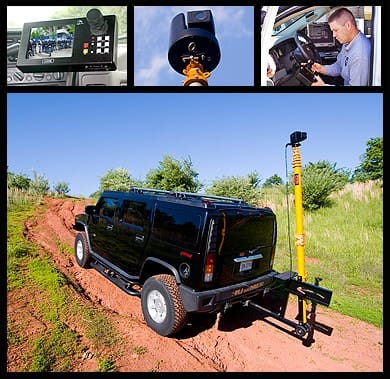
Both Luke and Holloman AFB have recently obtained a Mobile Video Surveillance (MVS) systems from Venture Tec LLC. The system is unique in that it incorporates an adjustable, telescopic mast hitch, which allows users to position the mast vertically at any location, including uneven or sloping terrain. The unit weighs approximately 85 pounds and unlike a trailer-mounted system, this surveillance system can be used anywhere the vehicle can go
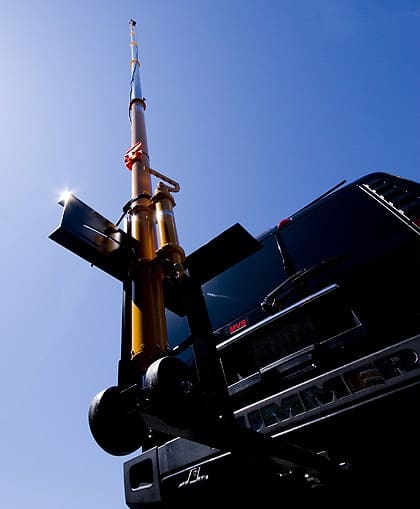
The MVS system attaches to any vehicle with a standard 2” x 2” Class III receiver, requiring no vehicle modification and it pneumatically telescopes to elevations up to 32 feet. It’s simple to use, takes only a minute to raise or lower, and can operate day or night in all weather conditions. The MVS system can be equipped with a long range visible light camera and a thermal camera for complete darkness. All surveillance is done from inside the safety and comfort of the vehicle or command center, and all video is recorded with a date/time stamp. To operate the system, users simply tilt the mast to find vertical, lock it in place, and raise the mast to the desired height. The PTZ controller and video display provide an unparalleled view from above in all directions. When ready to relocate, users simply open the air release valve to lower the mast.
For more information, please visit www.mobilevideosurveillance.com.

Disruptive Technologies

Friday, August 20th, 2010

You may have heard the term but what it is it? And what does it mean to me? If you are reading SSD then you are most likely a member or student of the profession of arms. Pay attention here dear reader because pretty soon we are going to introduce you to what we consider a disruptive technology that may very well challenge our primacy in a particular facet of warfighting.


“Disruptive innovation is a term used in business and technology literature to describe innovations that improve a product or service in ways that the market does not expect, typically by lowering price or designing for a different set of consumers.”
-Wikipedia

The concept of Disruptive Technologies was coined by Clayton M. Christensen in his 1995 article Disruptive Technologies: Catching the Wave where he defines a disruptive innovation as a product or service designed for a new a set of customers.

“Generally, disruptive innovations were technologically straightforward, consisting of off-the-shelf components put together in a product architecture that was often simpler than prior approaches. They offered less of what customers in established markets wanted and so could rarely be initially employed there. They offered a different package of attributes valued only in emerging markets remote from, and unimportant to, the mainstream.”

While the idea was applied to how technology affects markets, it can just as easily be applied to warfighting. Wired’s “Danger Room” blog wrote a piece awhile back talking about how enemy belligerents can outsource or improvise their way into being a niche competitor with the US. Check out this PowerPoint briefing by Booz Allen Hamilton that illustrates this point. Commercial access to satellite imagery could be considered disruptive simply because an entirely new set of players have access to what was once the sole purview of the most advanced nation states.

As Moore’s Law makes high power computing more accessible to the masses, it becomes more difficult to maintain a technological edge. As commercial technologies are adapted for military and intelligence purposes, it becomes even more troublesome for the United States who has long maintained a distinct advantage.

Stuff We Didn’t Write About

Sunday, August 15th, 2010

Arms Merchants of South Central

Pentax K-x now available in Tan and OD

Why is there a hole in the center of a parachute?

Nano ‘tea bag’ purifies water

New gel could speed wound healing

S.O.D. Shorts Review by MM

Stuff We Didn’t Write About

Saturday, August 7th, 2010

Bushnell Redesigns Popular BackTrack Line

More camo news! US Navy Working Uniform III

This It How It Feels to Be Under a Nuclear Attack

Making Money During A Recession

DARPA’s Inhaled Drugs to Boost Troops at Extreme Altitudes

Fluid defences

Topeak Alien III

Monday, August 2nd, 2010

Sure it’s designed for cycling, but the Topeak Alien III’s 25 tool can fill the void when a tool box isn’t handy. The two halves of the pressed metal frame come apart revealing tool heads crafted from Chrome Moly and Stainless Steel. Included is everything from Allen, Box, Spoke, and Torx Wrenches to Tire Levers and a Chain Tool. There’s even a Knife Blade and a Bottle Opener.

So whether riding a mountain bike on your time off, or just looking for a handy emergency tool kit, consider the Alien III from Topeak.

Stuff We Didn’t Write About

Sunday, August 1st, 2010

The Invention of the Leatherman: Patent Gallery

New A-TACS Images

New Wound Care Zaps Cuts Closed

DIY Wearable Computer Turns You Into a Cyborg

Are 3D-Printed Fabrics the Future of Sustainable Textiles?

EMFX Pouches from NEMO Equipment

Friday, July 30th, 2010

At the recent Warrior Expo – East NEMO Equipment had quite a few new wares on display. In addition to the ZIRO 2P SE Shelter, they also displayed the EMFX pouch. Sure, it looks like a mild mannered pouch made from 210D Ripstiop Nylon with a tough Hypalon belt loop. But don’t judge this pouch by its looks. The real power is inside. Using a conductive textile the EMFX pouch blocks all electromagnetic signals from reaching your cell phone. This means your phone won’t be tracked or attacked by adversaries. In addition to cell phones and other personal electronics, the EMFX pouch will also keep prying signals from interrogating your passport with RF chip. Measuring 4″ by 5.5″ it features a roll top to keep the duct and other debris out.

For more information visit www.nemoequipment.com

Unit orders can be processed by ADS.

Soldier Portable Charger

Saturday, July 10th, 2010

According to a news release from the British Ministry of Defence, a team of energy experts at Defence Equipment and Support (DE&S) and the Integrated Soldier Systems Executive (ISSE) at Abbey Wood have developed a portable energy solution dubbed the Solider Portable Charger. Based on a Urgent Operational Requirement from field commanders in Afghanistan, the system consists of lithium ion power source (LIPS) 11 & 12 batteries, a solar charging mat, and a plug n play battery charger that can be carried by a quad.

The requirement was based on weight. Currently, an eight-man section taking part in a 40-hour patrol currently has to contend with a hefty 60kg burden in batteries alone:

“A major factor in developing this UOR was the weight in batteries required during that 40-hour mission,” explained project manager Peter Flowers. “That’s a ridiculous amount to be added just for power supplies, so we sat down last autumn and worked out how we could do something about it.

“One of the things we discovered was that [the batteries] were saying they were empty even though they may have had between ten and 20 per cent power remaining.

“The SPC takes that energy out and transfers it to another type of battery. That means that if you take rechargeable batteries, you only need one on the radio and one on charge and you can then take four of each type off the patrol.”

Additionally, the new LIPS 11 & 12 batteries were developed based on the 3.75kg LIPS 10. They weigh 1.5kg and 2.25kg and provide enough power for two and four hours respectively:

“We have effectively taken the LIPS 10 and chopped it into thirds,” explained Mr Flowers.

“You can now take the lower-power battery if you need it. We’re not dictating to commanders on the ground what they should use, we’re just putting the right clubs in their bag.”

A total of 4,556 units are being deployed to Op HERRICK, with the first 1,000 arriving in theater this month and the remainder being delivered in batches in August and September 2010.