Colt

Archive for the ‘Guest Post’ Category

Top Army Generals for Cyber, Space and Special Ops Convene

Tuesday, February 13th, 2024

PETERSON SPACE FORCE BASE, Colo. — The U.S. Army’s top generals for cyber, space and special operations forces met to discuss the Triad partnership and how they can further develop, operationalize and institutionalize the collaboration.

Commanding Generals Lt. Gen. Maria B. Barrett, U.S. Army Cyber Command; Lt. Gen. Jonathon P. Braga, U.S. Army Special Operations Command; and Lt. Gen. Sean A. Gainey, U.S. Army Space and Missile Defense Command, met Jan. 31, 2024, for the third Triad 3-Star General Officer Steering Committee at USASMDC headquarters at Peterson Space Force Base.

Members of the committee emphasized the importance of the Triad due to the ever-changing character of warfare. Along with this evolution, the threats and the nature of deterrence are changing for the United States. The Triad looks to develop innovative and comprehensive solutions.

“The Cyber-Space-SOF Triad provides one of these solutions,” Braga said. “It is a ‘Modern-Day Triad’ designed to converge unique accesses, capabilities, authorities, understanding and effects in many of the same ways we have implemented combined arms operations. Additionally, the Triad provides operational and strategic advantage during active campaigning, crisis and conflict, while presenting options to senior leaders that are less escalatory than current strategic deterrence options.”

Gainey said that they must continue building upon the significant progress the Triad has already made in the development of concepts, capabilities and formations that enable exquisite operational preparation of the environment. The commands have already developed a unified exercise, experimentation and engagement plan for fiscal year 2024 and fiscal year 2025.

“We are working with the Theater Special Operations Command to ensure they know the space and high-altitude capabilities we can provide and to develop the operational concepts of employment,” said Gainey.

“(The Triad) is developing real-world employment concepts designed to enable Army and joint force objectives anywhere in the world at a time and place of our choosing,” Gainey said. “Additionally, the Triad will enable ‘Left of Launch’ trans-regional missile defeat and active campaigning to ensure the ability of our nation’s adversaries to strike the United States, as well as its partners and allies is prevented.”

The Triad is a major way we can contribute to multi-domain operations and for us, the potential it provides our Missile Defeat efforts, as well as the access, understanding, and effects it can enable for the Joint Force are undeniable, Gainey said.

“As such, the Triad provides flexible deterrent options that can shape the threat environment in ways our adversaries are unaware of and can provide flexible response options if they choose to break international norms and escalate tensions into conflict,” he said.

Braga said the Triad has an outsized impact against the adversary’s capabilities as it relates to SOF, space and cyber.

“That is why it is inherent we work together, experiment together and learn together,” Braga said.

Barrett said the Triad is coming up with solutions and tools together as a team.

“Triad operations disrupt adversary actions, demonstrate resolve, shape the adversary’s perceptions and gain advantage for warfighters when deterrence fails,” Barrett said. “ARCYBER has a track record of integrating cyber, electronic warfare and influence operations and can now deliver that to triad partners.”

By Dottie White, USASMDC

Soldier Wins Gold Medal at Event in Egypt

Sunday, February 11th, 2024

CAIRO — U.S. Army Sgt. Samantha Simonton won the Gold Medal in Women’s Skeet at the International Shooting Sports Federation World Cup in Cairo, Egypt, January 29, 2024.

The Soldier with the U.S. Army Marksmanship Unit Shotgun Team earned her place in the Final with a qualification score of 121 out of a possible 125, which beat 31 other competitors from around the globe and tied one from France.

In the final against five other international competitors, the Gainesville, Georgia native strongly represented Team USA in the cold and windy conditions. Simonton won the Gold with a score of 50 while Italy’s Martina Maruzzo earned the Silver with a 47 and Reem Al Sharshani from Qatar took the Bronze Medal with a 37.

With part two of USA Shooting’s Shotgun Olympic Trials coming up in March, the USAMU Soldier said a gold medal win in challenging conditions helps her prepare for the highly competitive match that determines which athletes will represent the United States at the Paris Games.

“I am just trying to use it as a training tool and move forward onto better scores like I have been training,” Simonton.

This gold medal win brings Simonton’s ISSF medal count to five. Her past medals are:

Bronze from the 2022 ISSF World Championships

Bronze from the 2022 President’s Cup

Silver from 2023 ISSF World Cup-Italy

Silver from the 2023 ISSF World Cup-Qatar

The Bronze World Championships Medal also came with a coveted Olympic quota for the United States in women’s skeet.

Though Simonton won one of the two possible Olympic Quotas for the Women’s Skeet event, that does not qualify her personally for the Games. It just ensures that an American athlete a ticket to the Games. Therefore, the U.S. Army Soldier will compete for a seat on Team USA at USA Shooting’s Shotgun Olympic Trials in Tucson, Arizona March 11-17. Until then, every match is training for her path to Paris.

Story by LTC Michelle Lunato

Photos by Andrea Caroppo

Next Generation Squad Weapons Undergo Arctic Testing

Saturday, February 10th, 2024

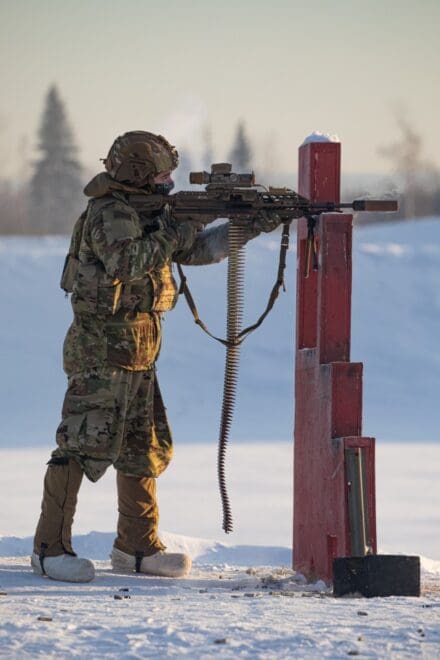
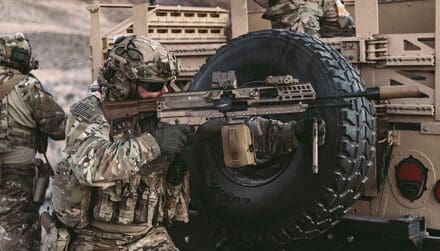
Soldiers from 1st Squadron – Airborne, 40th Cavalry Regiment, based out of Alaska, are supporting Project Manager Soldier Lethality with cold weather testing of the Next Generation Squad Weapons. Extreme environmental testing is critical to ensuring reliable systems. In addition to Arctic testing, the weapons, ammo, and fire controls will be subjected to jungle and hot weather testing.

Col. Jason Bohannon, PM SL, visited the testing site and shared his thoughts: “The Arctic environment is extreme and unforgiving to both the Soldiers and weapons. Our intent is for the weapons to perform in conditional ranges that exceed those which Soldiers would have to endure. I have been impressed with both Soldiers and weapon performance.”

Rite in the Rain Announces Expansion of Brand Collaboration with Battle Board in

Saturday, February 10th, 2024

www.riteintherain.com

Airborne Test Force Tests Field Radio Ruck to Survive Airborne Combat Missions

Saturday, February 10th, 2024

The U.S. Army Airborne Test Force (ATF) located at Yuma Test Center, Yuma Proving Ground, recently tested program of record Manpack radios, the AN/PRC-158 and AN/PRC-162, managed by the Product Manager Handheld, Manpack, Small Form Fit (HMS) inside the Army’s newest Radio Carrier Rucksack (RCR) solution. The RCR, developed and produced by the Natick Soldier Systems Center, was stressed in combat-realistic scenarios by the center to determine if the RCRs could safely support parachute operations without damage to radios or the ruck.

Soldier feedback using the legacy radio rucksack over several years of test events indicated that a solution with better weight balance, comfort, and heat dissipation was required for the user. PdM HMS initiated a competitive market research strategy, which brought a variety of industry and government rucksack solutions to Soldiers during 2022 and 2023 that led to the selection of the currently tested RCR solution.

“The competitive process really drove industry innovation, challenging the community to develop a best all-around rucksack solution in support of Army combat operations while carrying our modernized communications equipment,” said Derek Harberts, deputy PdM HMS.

“What we saw during this test are the results of a successful competitive process providing the all-around best-value to the Soldier and the taxpayers.”

The current design leverages modifications to the existing design of the Modular Lightweight Load-carrying Equipment assault pack currently fielded across the Army. Compared to the legacy RCR, the improvements allow securing the radio to the pack frame for better weight, balancing, and cooling. Modifications to the ruck allow better access if the radio needs to be carried and operated inside the bag as well as improved stowage and access for radio ancillary and mission equipment.

“The radio harness allows the radio to be connected to the existing assault frame, while the side pouches allow for individualized space to store antennas away from other equipment and gear,” explained Bob Cohen, HMS Manpack Lead Test Engineer.

“There’s additional space in the bottom compartment that can be used to individually store spare batteries and other ancillary equipment for ease of access.”

In all, the RCR will carry the radio, a battery, an antenna, and the Soldier’s basic load of individual equipment.

Leading up to the test, Soldiers with the ATF team started by packing the rucks as they would operationally under the direction of ATF Soldier Sgt. 1st Class Cody Lavalla.

“The configuration of these rucks is slightly different then the currently issued rucks,” tells Lavalla, “We are going through the process of figuring out how to rig the harness single point release to the ruck so all the equipment will survive the jump and is safe for the jumpers.”

The harness single point release is the equipment that secures the ruck close to the jumper’s body during most of the jump and is designed to be lowered on a release line away from the jumper by pulling a release handle just prior to landing.

When the Soldiers were about 150 feet from the ground, they lowered the rucksack carrying the radio using the lowering line, making it about 15 feet below them when they landed.

“We don’t want the ruck still attached to us when we prepare to land on the ground, or we risk injuries as we do our Parachute Landing Falls,” explained Lavalla. “We pull on the release handle and the ruck falls away from our body but is still attached to us via the lowering line so the equipment is out of the way when we are ready to land. It is nearby to have access to the equipment quickly if needed once we are on the ground.”

ATF Soldiers performed several jumps throughout the week for the safety confirmation tests. A team met them on the ground to ensure their safety and monitored the jumps.

Afterwards, Air Delivery Test Officer Faith Harbolt, ATF and members of the HMS team inspected the radios to see how they held up to the test.

“The test went well. The results of the test demonstrated that the rucksacks successfully secure and protect the radios during airborne operations. There was no damage to the rucks or radios observed during the inspection that occurred after the test was complete,” said Lavalla.

The improved rucksack will be fielded to units receiving Manpack radios starting early next calendar year. When fielded, these items will be used by units such as the 82nd Airborne during combat operations.

Story by Ana Henderson, U.S. Army Yuma Proving Ground

Battlefield Technology Focus: Featuring OKSI, KAGWERKS, Firebird Electro-Optics & ONYX Industries

Friday, February 9th, 2024

During SHOT Show 2024, leading tech experts curated a parlor space to showcase pushing the boundaries of innovation with elite technologies. They all share the same goal; to bring the warfighter technical solutions required to overcome challenges faced on the ever-evolving battlefield.

Let’s cover down on Tech:

OKSI – Their Autonomous Precisions Weapon Systems includes Passive Ranging, Sentry Remote Weapon System, EO/IR Seeker for APKWS, and an 81mm Precision Guidance Kit. Additionally, they have Unmanned Autonomous Systems & Networks portfolio, which includes Autonomous Vehicle Kits, GPS-denied Navigation, Coordinated Drone Teaming & Swarming, and ATD/ATR.

KÄGWERKS – Their chest mounted radio systems featuring Silvus Technologies MN MiMo tech was on display, along with the Dock Ultra body worn compute system. The system enables operators to do real time processing of map data, image recognition, along with other AI/ML capabilities.

Firebird Electro-Optics – Their weapon mounted and handheld LED & LEP illuminators, along with their MAID MFAL dual beam single aperture laser, focusable VCSEL illuminator was on display. They also showcased their SWIR and LWIR solutions, with active and passive range finding and designation.

Onyx Industries – The Sentry Remote Weapon System was on display in the parlor and show floor in partnership with Persistent Systems, LLC, showcasing its multifunctional ATD/ATR human in the loop capabilities, in both its kinetic and ISR variants, ready to be deployed in overwatch or terrain denial positions.

FirstSpear Friday Focus – New Stratton Flannel Patterns

Friday, February 9th, 2024

One of the most anticipated drops of the new year, FirstSpear 9oz Stratton Flannels have been re-stocked in new patterns, Brown/Black & Navy/Red/White.

Backed by popular demand after launching our new Field Flannels, we developed Stratton varients to satisfy the masses.

Don’t sit on it for too long! Although these are freshly stocked in the warehouse, they will not last long in the most popular sizes.

Visit FirstSpear to find American Made kit and accessories, Built For The X.

Marine Corps and Army Assess South Korean UGV, Eyeing Future Capabilities

Friday, February 9th, 2024

Marine Corps Training Area Bellows, Hawaii —

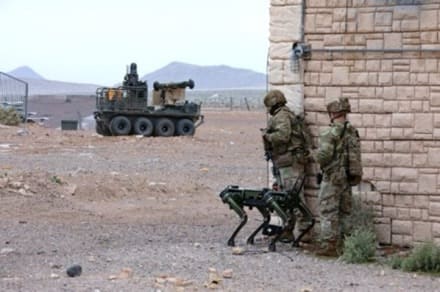
In a strategic move meant to advance Force Design’s shift to the INDOPACOM Area of Responsibility, the Marine Corps partnered with partners from the U.S. Army and the Ministry of National Defense of the Republic of Korea to test cutting-edge autonomous vehicle technology—taking a significant step towards modernizing its advanced logistics capabilities.

In mid-December, against the picturesque backdrop of Honolulu, Hawaii, Marines from the 3d Littoral Logistics Battalion, or LLB, engaged in a pivotal Foreign Comparative Test, or FCT, of a South Korean Unmanned Ground Vehicle, or UGV, prototype—marking a critical juncture in the Corps’ exploration of advanced unmanned technologies.

This two-week test, the culmination of a collaborative partnership between Marine Corps Systems Command, III MEF, the Army’s Ground Vehicle Systems Center and its South Korean allies, demonstrated the commitment to advancing military capabilities.

Key to advancing military capabilities, FTC programs allow the acquisition community to evaluate high-readiness technologies from foreign allies to quickly and economically meet defense needs. FCT stands out by offering substantial savings, bypassing research and development expenses, reducing procurement costs, and accelerating the deployment of critical equipment. This approach not only minimizes risk but also enhances the operational readiness and safety of U.S. forces.

The FCT of the South Korean UGV prototype in Honolulu is a significant milestone in the Marine Corps’ journey towards embracing unmanned technologies. This test, rooted in the principles of Force Design, and the ever-evolving realities of contested logistics, has the potential to shape the future of Marine Corps logistics operations.

“The use of autonomy directly supports Force Design, as the emphasis on smaller operational units means personnel have to do more,” David Keeler, MARCORSYSCOM’s advanced technology integrator for the Logistics Combat Element Systems portfolio and project lead for the effort. “UGVs can supplement tactical vehicle operations since they are highly transportable, can be moved to points of need quickly and don’t require licensed operators.”

As modern warfare continues to evolve, the need for efficient, autonomous logistics solutions becomes increasingly vital—especially as the warfighter is called upon to operate within contested environments. Here, the UGV’s potential to operate effectively in such scenarios stand to revolutionize how the Marine Corps approaches logistics, a critical component of warfare.

“If you look at the war between Russia and Ukraine, you see each side is going after each other’s logistics support. That’s contested logistics,” explained MARCORSYSCOM’s International Affairs Specialist Steve Duong. “What you don’t want is a big platform with a big signature transporting something like a tire or ammo back and forth because it can easily be identified by enemy sensors. A capability like this can help Marines with their logistics while operating in dangerous environments.”

Foreign Technology as a Force Multiplier

The test’s primary goal was to evaluate the UGV’s artificial intelligence and machine learning capabilities. The selection of the South Korean UGV prototype represents a leap in technological advancement, attributed to its maturity in utilizing artificial intelligence and machine learning to complete its mission.

“When we first started planning this effort, this was the most mature vehicle that uses artificial intelligence and machine learning to complete its mission,” noted Durgadath Nanan, III MEF science advisor, emphasizing the importance of these capabilities in current and future military operations. “This is an opportunity to get access to foreign expertise. Because, you know, we have great scientists, engineers and companies in the States, but that doesn’t mean we have the most advanced capabilities in all areas.”

This FCT is more than just an evaluation of a new vehicle; it’s a foray into a future where unmanned systems play a crucial role in military operations. The success of this test could lead to a transformative shift in how the Marine Corps conducts logistics, particularly in contested environments.

“Allied technology can provide tremendous benefits for not only the Marines and the DoD, but also to the vendors,” said Keeler. “Our vendors and allies get insight to our requirements and how their technology may be employed. Most importantly, it gives the vendors direct feedback and input from our warfighters so they can further refine and mature their technology.”

Joint Collaborative Effort

Keeler repeatedly emphasized the project’s foundation on innovative military technology and collaboration between Joint Forces and Allies. He acknowledged USMC’s International Programs Office for securing funding for the FCT from the Office of the Secretary of Defense and providing program support during the test cycle in Hawaii.

Nanan, a science advisor for the Office of Naval Research stationed at III MEF, played a crucial role as the liaison, ensuring ONR’s research align with Fleet requirements.

“We make sure that the R&D at ONR is working on requirements of the Fleet, not only short-term but longer-term,” Nanan said.

In Detroit, Michigan, DEVCOM’s Ground Vehicle Systems Center (GVSC) was instrumental in planning and executing the testing for the UGV project.

Jason Bagnall, GVSC electrical engineer and UGV FCT test lead, described GVSC’s involvement, saying, “GVSC’s robotics group has expertise in UGVs design, integration, and testing, leading the USMC to seek our independent evaluation of the South Korean UGV prototype.” He added, “GVSC developed the test plan, coordinated onsite activities, and will publish a report on the platform’s suitability.”


Ultimately, the project highlights the Corps’ commitment to international collaboration and innovation. As Keeler noted, “The FCT has been a great tool for LCES. It’s given us the opportunity to generate data to inform requirements, make procurement considerations, and build relations with allied governments and businesses.”


Feedback from the Fleet

The collaboration with 3d LLB Marines in testing and operating the UGV was a pivotal aspect of the project. Their direct, hands-on experience with the vehicle provided invaluable real-world data, shedding light on the vehicle’s performance, especially its sophisticated AI and machine learning capabilities. This practical insight from those with frontline experience was critical to understand the real-world applications of the technology.

Bagnall emphasized the importance of this partnership, further highlighting the importance of obtaining feedback from the fleet.

“Our in-house engineers and commercial/academic partners are some of the best in the business,” he said. “That said, most of our engineers have never served in uniform, have never experienced combat. When a mission is completely understood, and the doctrine well-established, it’s often possible for the user community to deliver really good requirement sets for tech developers to work from.”

Defining Future Requirements

Another critical aspect of this test is the defining of requirements for future unmanned ground vehicles. As Duong pointed out, “It is the major function of this test to help define requirements for unmanned ground vehicles, for which we currently don’t have a program of record.”

This endeavor aligns with the broader goals of the Corps to integrate more unmanned systems into their operations, as envisioned in Force Design.

“I have conducted a few different FCTs, each evaluating different technologies–from medical, to mine clearance, and now autonomy and UGVs,” said Keeler. “In each case we were evaluating an allied technology that either could close a capability gap, enhance existing capabilities, or provide a new capability.”

Keeler noted, if the FCT has good results, further evaluation in operational environments may be considered, followed by a decision to procure the technology.

The Broader Perspective and International Collaboration

The test also highlighted the significance of international collaboration, particularly with South Korea, a key ally in the Indo-Pacific region.

“This program is important as it falls under the security cooperation umbrella,” Duong said, acknowledging the 70th anniversary of the U.S.-ROK mutual defense treaty and its impact on such collaborations.

Nanan encapsulated the transformative potential of testing such advanced technologies, saying, “In testing this vehicle, we’re pushing the boundaries of what’s possible and confirming our commitment to be technologically advanced. This can change the way we operate and fight, adapting to the evolving nature of warfare as seen in current global conflicts.”

Ultimately, the successful testing of the UGV prototype marks a pivotal advancement in military logistics and unmanned technologies. This collaboration not only showcases the potential of international partnerships in enhancing military capabilities but also sets a new standard for the future of autonomous operations in contested environments.

By Ashley Calingo, MCSC Office of Public Affairs and Communication | Marine Corps Systems Command