Phantom Lights

Archive for the ‘Guest Post’ Category

Purdue Receives $5 million Lilly Endowment grant to support Military Family Research Institute

Sunday, May 28th, 2023

WEST LAFAYETTE, Ind. – A $5 million grant from Lilly Endowment Inc. will provide continued support during the next three years for the work Purdue University’s Military Family Research Institute (MFRI) does to improve the lives of military families and veterans.

This grant, which includes $3.5 million in outright funding and $1.5 million in matching funds, will help MFRI enhance its robust support networks. The grant period is from March 1, 2023, to June 30, 2026. 

“We at MFRI are honored and humbled by this funding,” said Shelley MacDermid Wadsworth, MFRI director and Distinguished Professor in the Department of Human Development and Family Science in Purdue’s College of Health and Human Sciences. “Over the past 16 years, support from Lilly Endowment has made it possible for MFRI to deeply understand the vulnerabilities – and the resilience – of military and veteran families and to quickly develop and test new ways to help them confront the challenges and barriers placed in their way. We are excited about the opportunities ahead and look forward to expanding our work with partners at Purdue, across Indiana and around the country.”

Specifically, the grant will assist military and veteran families by:

• Supporting their military communities by cultivating continuity between military and civilian organizations, building and sustaining linkages among the systems surrounding military families, and promoting synergy in their efforts.

• Strengthening the motivation and capacity of their civilian communities to support military and veteran families through improved preparedness and coordination.

• Generating important new knowledge about their needs and circumstances.

• Assisting veterans as they transition to civilian life.

• Influencing pertinent programs, policies and practices by initiating, building and sustaining productive working relationships with existing and potential partners, while also raising awareness and shaping the thoughts and actions of the broader community.

• Growing and sustaining vibrant learning across all focus areas, with the goal of enhancing professional opportunities for veterans and military families.

“MFRI has demonstrated scholarly excellence for more than two decades, conducting groundbreaking studies that influence programs, practices and policies,” said Mung Chiang, Purdue University president. “Shelley MacDermid Wadsworth has earned an international reputation as a scholar who has led MFRI in developing innovative research and programs that have received numerous awards at Purdue and nationally. We are proud to serve as such an important resource for supporting the quality of life for military and veteran families.”

With guidance from MacDermid Wadsworth, MFRI was created at Purdue in 2000. The organization works to expand opportunities for military members, veterans and their families by providing research to help mental health providers, public policymakers, employers and leaders in higher education better understand the issues affecting the military community. This includes helping civilian leaders see the value of bringing military and veteran families into community leadership roles. 

MFRI uses support from Lilly Endowment and other funders to strengthen the capacity of community organizations and systems to promote and build the resilience of military and veteran families. Innovations created by MFRI and its partners are operating across the country in several key areas: 

• Policy: The Measuring Communities program provides stakeholders in cities, towns and rural areas across the U.S. with data that supports good decision-making about how best to support military and veteran families.

• Behavioral health: The Star Behavioral Health Providers program makes it easier for military and veteran families to connect with well-trained therapists in their local communities. The Reaching Rural Veterans program brings community organizations together to address food and housing insecurity among high-need veterans in rural areas.

• Higher education: The Focus Forward Fellowship program promotes academic and career achievements among female student veterans nationwide. MFRI collaborates with faculty and provides learning opportunities for students in diverse disciplines ranging from computer graphics technology and data science to counseling and human development and family science.


• Programming: In communities across Indiana, MFRI brings together clinicians, community leaders and legal experts at the annual Battlemind to Home Summit to educate them about the newest scientific evidence, programs and policies that will help them address needs in the military and veteran communities. Through the annual Barbara Thompson Excellence Award competition, MFRI brings researchers and practitioners together to “narrow the gap between the laboratory and the living room.”

• Collaboration: MFRI partners extensively with military and government organizations as well as national, state and local nonprofits to help them do their work better through improved preparedness and coordination, with strong attention to relevant scientific evidence and data.

“Veterans and military families have done so much for the benefit of our country,” said N. Clay Robbins, Lilly Endowment’s chairman and CEO. “Their challenges and aspirations are much better understood because of MFRI’s outstanding research and analysis, which helps government and military leaders and concerned citizens know how to help veterans and their families lead more satisfying lives. Lilly Endowment is pleased that its support will help MFRI continue and enhance its important research efforts as well as the programs it has developed for the benefit of veterans and military families.”

Individuals or organizations interested in doubling the impact of their gifts in support of MFRI’s efforts to assist veterans and military families should contact Jim Priest, director of foundation relations at Purdue for Life Foundation, at jcpriest@purdueforlife.org to learn about matching opportunities through Lilly Endowment’s grant. 

509th Weapons Squadron Supports SOF exercise, Prepares for WSINT

Sunday, May 28th, 2023

Airmen from the 509th Weapons Squadron integrated with the 14th Weapons Squadron providing air refueling for a special operations forces exercise at Hurlburt Field, Florida, May 7-10.

The purpose of the training for the 509th WPS was to expose its students to the Special Operations mission set and to prepare its students for their large-scale Weapons School Integration capstone exercise where all weapons schools come together and perform peer-to-peer combat to perfect their skills.

“The tanker’s mission means that it’s always an asset that is integrated with other operations,” said Lt. Col. Ian Shelley, 509 WPS commander. “This exercise allows our students to integrate with the special operations mission set. They develop tanker tactics to best support air players who are providing air support to ground units. They integrate not only with air players, but with Army and Navy ground units.”

The exercise also provided the 509th WPS Airmen a chance to integrate with other weapons squadrons and their weapons systems to execute the mission. Some units that also participated in the training include the 14th WPS AC-130J Ghostriders, MC-130J Commando IIs, U-28 Dracos, and CV-22 Ospreys.

“SOF operates in a unique manner, one that most of our students haven’t experienced before,” Shelley said. “The integration opportunity provides tanker and SOF units with a broader set of tools preparing them for future combat operations.”

One of the key points of the training included the students having to work together to create an effective mission plan in order to meet the objective of the exercise.

“Not only did the students plan air refueling and fly the KC-135, we also had students who planned and witness tilt rotor air refueling on board an MC-130 and we had others who were heavily integrated in forward arming and refueling point operations whereby the lessons learned can be applied to future agile combat employment operations,” Shelly said.

The 509th WPS is one of 21 weapons squadrons and is the only weapons school for the KC-135 Stratotanker, with a mission of providing the world’s most advanced training and tactics to pilots, navigators and inflight refueling specialists.

“We develop aviators who are steeped not only in peer threats and tanker tactics, but also critical thought and problem solving,” Shelley said. “Their expertise in other platforms and mission sets makes them experts in employment operations.”

Training for the 509th WPS is designed to prepare Airmen to analyze and apply appropriate tactics to possible pacing threats, and ensure they are ready for tomorrow’s fight anytime, anywhere.

Story by SSgt Lawrence Sena, 92nd Air Refueling Wing Public Affairs

How Agile is Changing the Way PEO EIS Develops Software

Saturday, May 27th, 2023

Combining 28 disparate Soldier and civilian training systems into one cohesive system requires more than extensive planning. It demands collaboration, prioritizing people over processes, and a willingness to respond to change in increments over time — otherwise known as an iterative approach.

PEO EIS’ Army Training Information System (ATIS), managed by Army Data and Analytics Platforms (ARDAP), is being developed with two priorities in mind: getting all the Army’s training data in compliance with the Army Data Plan; and building a system around the user’s experience through human-centered design. For ATIS, the users are Soldiers and civilians seeking training and educational opportunities, anywhere they are in the world. For Army leaders, ATIS’ biggest return on investment is time. ATIS will consolidate multiple cumbersome and outdated legacy systems, and will automate all training management, development, scheduling and resourcing. This will allow leaders to focus on training execution and readiness assessment throughout the Army.

The ATIS team has implemented a Scaled Agile Framework® (SAFe) workflow across all aspects of the development process by leaning into SAFe’s 10 Agile principles. As part of the process, the ATIS team incorporates Soldier, civilian and Army leaders’ feedback at every step along the way.

“Agile allows programs to pivot,” said Capt. James Oliver, ATIS’ assistant project manager. “Agile programs emphasize collaboration and communication between team members, customers and all stakeholders.”

With this Agile framework in place, the ATIS team has worked in program increments (PI) by breaking up the development work into smaller, manageable chunks, each 10 weeks long. Within each PI are a set of two-week sprints, which serve as short-term goals where the team plans, develops, tests and delivers a working set of features. Each sprint builds on the next, and each PI does the same — with iterations along the way as needed, when goals and objectives change. This process allows for flexibility, which is key to adapting to changes in priorities and user needs during the development process.

“The sprints are synchronized across all the teams working on the PI, and they are designed to ensure that the teams are aligned and working toward a common goal,” Oliver said.

Working in increments makes it easier and more efficient to change plans. For example, if the ATIS team spent 10 weeks working toward an objective — an entire PI — only then to find out a feature needed modification, it would require a significant effort to undo the last 10 weeks of development work. With shorter, two-week sprints, making feature or program modifications is significantly quicker and more efficient.

Unlike in a waterfall approach, where all requirements are established up front, Agile goes about software development differently by using a process called progressive elaboration. In progressive elaboration, each sprint and PI serve as building blocks for the next phase of development by further refining project requirements during the process — progressively.

“The hard part about this process when you’re dealing with software is that everything changes so fast,” said Melissa Lee, ATIS’ release train engineer. “That’s one of the reasons why Agile is really good for software.”

Tim Hale, ATIS’ product manager, echoed Lee’s thoughts. “When you’re building software, you need flexibility,” he said. “You also need to create an environment that allows for incremental deployments while iteratively getting finished software into capability support and a Continuous Improvement/Continuous Development pipeline. This [Agile] process allows that.”

Staying on track in an ever-changing environment is a challenge for the ATIS team — which is where a 15-minute daily stand-up meeting helps. The purpose of the stand-up is to ensure each team member is moving forward with their objectives and to work out any issues that may arise. It is one of the ways the ATIS team continues to improve as PEO EIS progresses toward becoming a fully Agile organization.

“It’s a very big deal in the Army in this digital transformation,” said Aric Sherwood of PEO EIS’ journey to becoming an Agile organization. Sherwood is the director of PEO EIS’ Acquisition Innovation Directorate. “Specifically for PEO EIS, which does a lot of the Army’s heavy lifting when it comes to software development.”

Adopting Agile across the Defense Acquisition System in its entirety poses its own challenges, which makes PEO EIS’ efforts especially innovative.

“I find that the Defense Acquisition System and Agile aren’t always compatible,” Hale said to this point. “Further regulatory changes would help with future digital adaption.”

As of May 2023, the ATIS team has entered the fourth PI in the development process. It is still early, but the team is thriving in its adoption of Agile.

“We’re doing great,” Lee said of the ATIS team’s progress. “People are starting to understand Agile and how it works. We’re building momentum.”

For PEO EIS, the success on ATIS is just the beginning in the organization’s Agile transformation journey.

By Dan Lawton

FirstSpear Friday Focus: Memorial Day 2023

Friday, May 26th, 2023

“Freedom is a fragile thing and is never more than one generation away from extinction. It is not ours by inheritance, it must be fought for and defended constantly by each generation…”

— President Ronald Reagan

28 IS Fusion Cell Support Grand Slam for Full Spectrum SOF at Emerald Warrior 2023

Friday, May 26th, 2023

HURLBURT FIELD, Florida —  

Air Force Special Operations Command (AFSOC) wrapped up its 16th annual Emerald Warrior exercise May 6, 2023. The exercise provided realistic and relevant, high-end pre-deployment training, encompassing multiple joint operating areas to ensure preparedness of Special Operations Forces, Conventional Force enablers, Partner Forces and Interagency elements. This year’s exercise locations included Hurlburt Field, Homestead Air Reserve Base and Puerto Rico.

Five Reserve Citizen Airmen from the 28th Intelligence Squadron were key players in the event. The Airmen were critical to the success of the Intelligence (J2) Fusion Cell’s work. The Fusion Cell pushed out multiple “articles, tweets, and social media posts” regarding a massive earthquake destroying key infrastructure in Puerto Rico. This event became the first of many injects requiring the deployed Joint Special Operations Task Group (SOTG) and units to make decisive decisions on behalf of the nation and partner nations.

“Synchronizing Information Related Capabilities across Intelligence, Information Operations, Cyber, Space, and Public Affairs SMEs (subject matter experts) allowed us to further educate our SOTG and SOTU (Special Operations Task Unit) commanders on the capabilities they can provide when down range, said Maj Jessica Vogle, the 28 IS’s assistant director of operations, who served as the Emerald Warrior J2 and Fusion Cell lead.

Vogle went on to say, “Whether it be the utilization of cyber effects to create complex dilemmas for our adversaries, space capabilities to get a site picture of the operation area or using Information Operations and/or Public Affairs to get strategic messaging out into the public, fusion cells create operational effects in the information environment and strategic advantage for AFSOF, our allies and partners through unique access and placement.”

In Emerald Warrior 23, the Fusion Cell led and processed 90 Requests for Information, 498 Red Cell injects, 11 Publicly Available Information roll ups, four spot reports, seven tear lines and eight additional J2 products.

The 21st Special Tactics Squadron completed pre-deployment qualifications for Air Force Force Generation model readiness posture. Four missions were executed during the course of the event: Humanitarian Assistance/Disaster Relief, Integrated Deterrence, Information Operations/Cyber.

445th Airlift Wing Public Affairs

AirLand Battle Emerges: Field Manual 100—5 Operations, 1982 and 1986 Editions: TRADOC 50th Anniversary Series

Thursday, May 25th, 2023

U.S. Army Training and Doctrine Command’s 50th anniversary is July 1, 2023. In celebration, the TRADOC Communication Directorate in collaboration with the TRADOC Military History and Heritage Office, is sharing an article series highlighting key moments in TRADOC’s history to include the evolution of training, AirLand Battle, and gender integration.

JOINT BASE LANGLEY-EUSTIS, Va. – In 1976, TRADOC distributed 176,000 copies of the new Field Manual 100—5 Operations. This massive publication and dissemination effort marked but one of Gen. William E. DePuy’s, TRADOC’s first commanding general, purposes for the manual—to drive rapid change throughout an Army confronting an upgraded Soviet threat in Europe and contending with the aftermath of the long Vietnam War. Fresh doctrine, Depuy reasoned, would serve as a guidon for the Army, shaping everything it did, from training and education, to developing leaders and new equipment. Another no less significant purpose was to provide Soldiers with clear and practical guidance on how to fight and win on the modern battlefield against a peer opponent.

However, significant criticisms of Depuy’s brainchild emerged almost as soon as the last manual left the presses. First, many assessed that it prioritized defensive operations; the chapter on defense was indeed more robust than the one tackling the offense. Consequently, the term Active Defense quickly emerged as a shorthand reference for the manual. Second, the manual stressed the science of the application of modern firepower and force ratios, ignoring, some argued, the fundamental human element in warfare. Third, others contended the doctrine focused too narrowly on the Western European battlefield to the detriment of other forms of conflict across the spectrum of war. Finally, operational commanders worried that, in concentrating on tactical combat at the forward edge of the battle area, the manual neglected a key element of Soviet doctrine—that of echeloning forces in depth to maintain the momentum of any attack. This emphasis might commit U.S. Army ground forces to an attritional fight they could not win. Whatever their specific objections, all critics agreed with Depuy that future success started with 100—5, the Army’s capstone field manual, and that 100—5 should direct the force in all that it did.

A series of TRADOC commanders—Gen. Donn A. Starry (1977-1981), Gen. Glenn K. Otis (1981-1983), and Gen. William R. Richardson (1983-1986)—took up the challenge and led the effort to revise the 1976 document, culminating in two new Operations manuals that appeared in 1982 and 1986 respectively. Their sustained, consistent, and collective efforts saw not just revised doctrine, but the development of training and the fielding of equipment to make the doctrine work in practice.

Taken together, the 1982 and 1986 editions of FM 100—5 addressed the perceived weaknesses of the earlier manual. For example, they introduced a concept, dubbed AirLand Battle, that dealt with the problem of Soviet offensive doctrine by emphasizing attacking throughout the depth of the battlespace through synchronized effort across the joint force. While the Army primarily managed the frontline fight, the Air Force (mainly) as well as Army attack aviation and long-range fires would attrite and disrupt second echelon Soviet forces. Furthermore, the new doctrine highlighted the value of maneuver and aggressive action with both local and deep counterattacks serving to shock adversaries and enhance the morale of Soldiers, who would now hit back as well as defend.

Although thankfully never tested in Western Europe, the TRADOC-led effort to transform Army doctrine and the force in tandem with it contributed directly to success in the Gulf War of 1990-1991. Echoes may also be heard today in the Army’s current multidomain operations concept.

By Courtesy, TRADOC Military History and Heritage Office

AFSOC Conducts First-Ever Command Chief Change of Responsibility Ceremony

Wednesday, May 24th, 2023

HURLBURT FIELD, Fla. —  

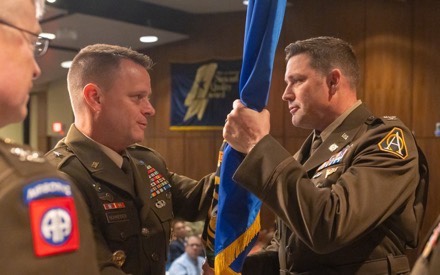
During a first-ever Air Force Major Command Change of Responsibility ceremony, Chief Master Sgt. Anthony Green assumed Command Chief responsibilities for Air Force Special Operations Command at Hurlburt Field, Fla., May 19.

Taking the colors from Chief Master Sgt. Cory Olson, Green became the 11th command chief of AFSOC which boasts approximately 22,000 total force and civilian Air Commandos worldwide.
AFSOC commander, Lt. Gen. Tony Bauernfeind presided over the ceremony.

“Command Chief Olson’s warfighting mindset, his sound guidance and his wisdom advanced this command for the future,” said Bauernfeind. “Command Chief Green is absolutely the right leader to manage and accelerate the change necessary to evolve Air Force Special Operations Command for the future.”

Change of Responsibility ceremonies are a standard within the joint community, but this was the first for an Air Force Major Command. Bauernfeind directed the holding of the ceremony to highlight the critical role of the senior enlisted leader in mission success.

Green spoke on the meaning of the title worn by the Airmen of AFSOC, “Air Commandos.”

“[The meaning of Air Commando] is not the planes. It’s not the cool kits,” said Green. “It’s what we’re called to do. It’s the mission. It’s the people. It’s the team.”

Among the attendance of roughly 250 individuals were notable guests such as Deputy Chief for Operations, Headquarters U.S. Air Force Lt. Gen. Jim Slife, Chief Master Sergeant of the Air Force Joanne Bass, and U.S. Special Operations Command Senior Enlisted Leader, Army Command Sergeant Major Shane Shorter.

Green entered the Air Force in September 1995. His background includes positions as an instructor and maintenance technician on the C-130 and various other non-standard aircraft. Throughout his career he has filled numerous roles including Flying Crew Chief, Combat Aviation Advisor, Maintenance Superintendent, and Senior Enlisted Advisor. 

By SSgt Caleb Pavao

Next Generation Family of Army Medium-Size Vehicles Tested at Ft Bliss

Tuesday, May 23rd, 2023

FORT BLISS, Texas — Under the heat of the desert sun, a convoy of military vehicles roll down a dirt trail, kicking up dust and sand as they reach speeds of 45 miles per hour.

The vehicles look familiar but are a little different from what Soldiers are used to seeing.

The vehicle driving down the dirt trails is the Family of Medium Tactical Vehicles, or FMTVA2. The FMTVA2 is being tested here with hopes it will replace its predecessor, the Light Medium Tactical Vehicle, or LMTV, allowing Soldiers across the Army to have access to a modernized vehicle.

“Driving the FMTV has been a complete game changer from the old LMTV,” said Spc. Salvador Castillo, a horizontal engineer with Alpha Company, 16th Brigade Engineer Battalion, 1st Armored Brigade Combat Team, 1st Armored Division.

Castillo and his unit tested the FMTVA2 for about 4 weeks and praised the improvements from the previous model.

Castillo expressed appreciation of the user-friendly enhancements, such as improved suspension, and the Drive Display Unit — a digital vehicle monitoring system that informs the driver of vehicle faults in real time.

Feedback from the Soldiers are integral to the equipment testing process. Input from Soldiers testing the equipment is collected and used to inform the U.S. Army Operational Test Command how the FMTVA2 performs.

David Rogers, a civilian employee of OTC and assistant test officer for the FMTVA2 follow-on operational test, said all the data requirements are captured, and testing criteria are met to ensure that they can coordinate with their sister unit, the U.S. Army Evaluation Center, to produce an evaluation report to inform Army senior leaders of the FMTVA2’s suitability and reliability.

“Our mission is to collect the data,” Rogers said. “We provide the data to the evaluators so they can inform decision makers within the Army.”

Rogers explained the evaluator’s role as vital to ensuring the test exercise conducted over the course of the follow-on operational test meets data requirements and gives an overall scope of the FMTVA2’s capabilities and its readiness to roll out to the Army and its Soldiers.

As training wrapped up, the Soldiers testing the FMTVA2 are confident in the vehicle’s performance and their ability to operate them.

“It’s a lot easier for our unit to use, and we’re already comfortable using it. It will make it easier for all of us across the board,” said Castillo.

Three Fort Bliss 1st Armored Division units took part in the operational test: Companies A and B, 501st Brigade Support Battalion, 1st Armored Combat Brigade Team; the 16th Brigade Engineer Battalion; with the 528th Hospital Center, 1st Medical Brigade also joining in.

Story by SSG Jacob Lang, 24th Theater Public Affairs Support Element, Fort Bliss, Texas

Photos by Mr. Tad Browning, OTC Lead Audiovisual Production Specialist