Register Now for SOF Week

Archive for the ‘Guest Post’ Category

“Force Plate Vertical Jump Scans are Not a Valid Proxy for Physical Fitness in US Special Warfare Trainees”

Sunday, November 27th, 2022

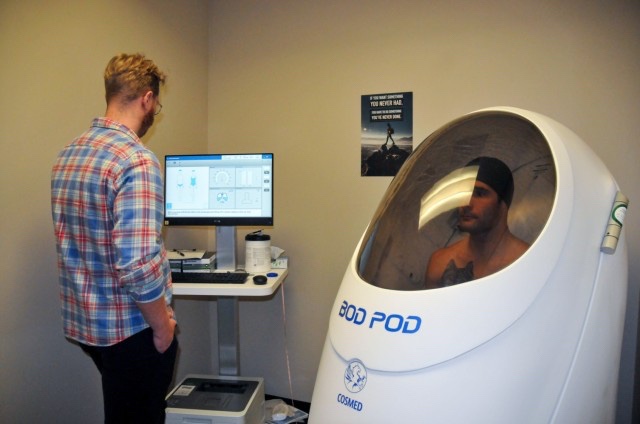
Members of the Air Force Special Warfare Human Performance Support Group’s Research Flight recently published an article in a peer-reviewed journal, “Force plate vertical jump scans are not a valid proxy for physical fitness in US special warfare trainees.”

The Research Flight is the only embedded research team in the DoD, tasked with supporting the Special Warfare Training Wing with data driven decisions to identify trends, maximize the effectiveness and reduce injuries within the pipeline.

Read the full article here.

Unit Profile – US Army Indian Scouts

Saturday, November 26th, 2022

During the nation’s westward expansion after the Civil War, the U.S. Army fought a series of Indian Wars against the Native American Nations with whom white settlers had come into conflict.

Instrumental to Army success in the post-bellum Indian Wars were the Indian Scouts, an enlisted cadre of Native American scouts often drawn from Nations with longstanding antagonisms toward the Nations at war with the United States.

First formed in 1866, the Indian Scouts were a force of up to 1,000 men (although this slowly declined as the years passed) whose members were be compensated the same as a white cavalryman.

The Indian Scouts supplied desperately needed knowledge of the terrain and enemy belligerents to an Army short on expertise and struggling to accomplish its mission. Indian Scouts were essential to Army’s efforts across the greater frontier and played crucial roles in iconic conflicts like the Great Sioux War and the Apache Wars.

The settlement of the frontier by the close of the 19th century spelled the end for the Indian Scouts and their unique place in Army history; the service slowly declined until coming to a practical end by the beginning of World War One.

During their time in Army service, Indian Scouts earned 16 Medals of Honor; a small part of their legacy has been carried into the present day by U.S. Army Special Forces, whose crossed arrows insignia was originally designated for use by the Indian Scouts in 1890.

US Army Center of Military History

FirstSpear Friday Focus: NSNS Carrier Systems

Friday, November 25th, 2022

This week, we’re showcasing our best selling Non-Stocking Non-Standard (NSNS) carrier systems.

Taking its name from an old Norse Viking term for a lightning raid, Strandhögg was one of the first formalized battle tactics to use covert infiltrators in advance of an actual raiding operation. Strandhögg was a tactical game changer in its time, just like the technological advances FirstSpear brings forward in this line of plate carriers.

Cut edge-to-edge to specifically fit SAPI / ESAPI / SPEAR plate sizes, the Strandhögg can be worn with or without soft armor panels, depending on ballistic requirements, threat conditions and type of plates used. Maximizing lightweight 6/12 technology and rapid Tubes® Closure Systems, this carrier can be rapidly donned and doffed. The Strandhögg is a streamlined fit and is easily tailored for comfort and ventilation.

Named for the intrepid explorer and cunning warrior Ragnar Lodbrok, the Ragnar Vest and its accessories are suited for a wide variety of roles and circumstances. The Ragnar Vest is covered in loop fabric and can be altered with different cummerbunds. Four special built-in pockets with retention tabs allow for storage of accessories based on situational requirements. This is a multi-mission vest with the flexibility to cover a variety of profiles.

The Sloucher combines many of the most desirable features of both the Siege-R and the Sleeper. Stretch panels on the cummerbund and Tubes closures keep the fit tight and allow for quick donning and doffing. The 6/12 Pocket Attachment System provides a low profile. This carrier accepts front, back and side plates SPEAR / BALCS cut soft armor (not included), MASS accessories and pockets using 6/12, 6/9 and MOLLE / PALS. The sloucher provides state of the art capability to support a full spectrum of operations.

The Sleeper is a stay behind asset and a less visible alternative to more overt style tactical vests. This carrier is designed to be worn over or under garments, as a stand alone vest or in conjunction with other FirstSpear carrier systems. The Sleeper fits US SOCOM SPEAR / BALCS soft armor and SAPI / ESAPI / SPEAR plates, including swimmer cut.

Visit FirstSpear to find other NSNS deals and all of our gear and apparel.

Airmen Innovate, Ensure HH-60W’s First Deployment

Friday, November 25th, 2022

MOODY AIR FORCE BASE, Ga. (AFNS) —

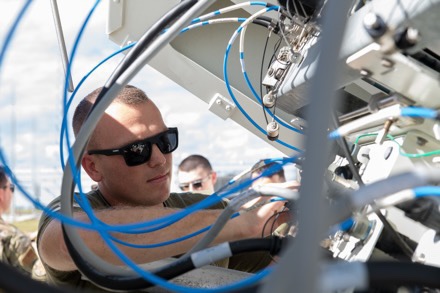
In preparation for the Air Force’s newest rescue platform’s first deployment, Airmen from the 41st Rescue and Rescue Generation Squadrons conducted extensive training to learn the intricacies of the new HH-60W Jolly Green II.

As a result of the increase in training, the 41st RQS expended more of the aircraft’s hoist cables than anticipated, lending to a potential shortfall. A team of 41st RGS maintenance Airmen, however, quickly recognized the need to replace these cables and jumped at the chance to accelerate change and make an Air Force-wide impact.

“Our maintenance Airmen have a won’t-fail mentality and are constantly working to make things better not only for the 23rd Maintenance Group but for the entire Air Force,” said Col. Jason Purdy, 23rd MXG commander.

These hoists are critical to the success of combat search and rescue operations. They are used in high-stakes scenarios to rescue individuals in dangerous or remote areas that aren’t accessible by ground transportation, or if the victim is trapped by fire or water.

Recognizing the need to adapt, the Airmen came together and discovered they could circumvent the supply shortage by using the HH-60G Pave Hawk cables in the HH-60W with only slight modifications.

“We used our subject matter expertise to troubleshoot the issue,” said Staff Sgt. Nicholas Cellini, 41st RGS flying crew chief. “We improvised and adapted to overcome the supply shortage, by using a cable that we know is reliable and the Air Force has plenty of.”

Cellini and his counterparts went to the field training detachment hoist trainer to test and write the operating procedures for converting the HH-60G cables for use in the HH-60W. The process ensured the safe use of the hoist cables by synchronizing the speed in which they extend at the appropriate points of the cable.

The 41st RGS submitted an engineer request and engineers from Warner Robins Air Force Base came to Moody AFB to provide safety checks and approve the process.

With the process approved and implemented, the rescue Airmen ensured the HH-60W was fully mission-capable and ready to deploy by Air Combat Command’s initial operational capability deadline.

“Finding and testing this information and realizing it can work for us is going to make a huge difference knowing there will never be a shortage of cables,” said Master Sgt. Jonathan Holford, 41st RGS production superintendent.

Discovering innovative solutions for unpredictable circumstances is a testament to the Airmen who feel empowered to do so. The Airmen with the 41st RGS said they feel confident in providing creative solutions to these shortfalls thanks to their leadership.

“People say aircraft maintenance is pretty black and white, but some of it’s not,” Cellini said. “Our leadership is open to ideas; as long as it’s safe and we can effectively and efficiently accomplish it, our whole chain of command will back us.”

Holford attributed the success of the organization to this leadership philosophy and the teamwork mentality fostered within the unit.

“We encourage Airmen to solve problems,” Holford said. “We always want to afford them the opportunity to fail, but we fail together; we learn from it and continue to grow on what we learned.”

The mission relies on Airmen’s ingenuity and initiative to succeed, and Moody AFB Airmen have exemplified these traits throughout the transition to the HH-60W.

“I’m very proud of our maintainers for leading the way on the HH-60W fleet,” Purdy said. “Whether it’s been a hoist, a gun system, or a lapse in technical data, our Airmen developed ways to make the entire program better.”

Story Airman 1st Class Deanna Muir, 23rd Wing Public Affairs

Photos by Staff Sergeant Devin Boyer

FROG.PRO Capsule Collection #1 – FUSION

Thursday, November 24th, 2022

The Italian reference brand for tactical tailoring FROG.PRO® introduces FUSION, its first Capsule Collection.

With these limited edition products, FROG.PRO makes the customer participate in the creative process, choosing his own combination of colors to create a personalized and exclusive look. In fact, the product page allows the user to choose Color #1 and Color #2 from 5 different colors (Black, Coyote 498, Ranger Green, MultiCam and MultiCam Black) resulting in 20 unique combinations. The Capsule Collection #1 – FUSION gives the one time, unrepeatable chance, to have a customized, one-of-a-kind piece of equipment.

The collection includes the popular COBRA Operator Belt provided together with the COBRA Trousers Inner Belt, two magazine pouches for short and long weapons from the “EOT” (Elastic Open TOP) series, two pouches with flap closure from the “VF” series (Velcro fastener Flap) and the newly born Chiron Mini IFAK, younger sister of the Orthos Med Pouch which is already enjoying great success among users.

The Capsule Collection #1 – FUSION will be available on www.frogpro.eu and official distributors who have joined the project from Friday 25th November to Saturday 31st December 2022.

AFSOC Spark Tank Finalists to Compete at Air Force-Level

Wednesday, November 23rd, 2022

HURLBURT FIELD, Fla. —  

Since the inception of Air Force Special Operations Command, Air Commandos have been pathfinders, breaking new ground and laying the foundation for others to find innovative ways to solve problems, some not yet considered.

Spark Tank, an annual, Air Force-wide program that solicits solutions to operational problems, allows Air Commandos to use their innovative and pathfinding spirit to get after Air Force and AFSOC-wide problems. The program is focused on empowering Airmen at all levels by providing a platform to pitch innovative solutions.

Of AFSOC’s 31 submissions, six semi-finalists were selected to compete at the major command level.

The six finalists presented their ideas to a panel of AFSOC senior leaders who selected two to compete at the Air Force level.

“The innovative spirit of our Air Commandos is part of what makes AFSOC so unique, so it’s no surprise to see such a large turnout of great ideas,” said Mr. Donald Plater, AFSOC executive director. “This competition is about recognizing our Airmen and making the Air Force better, so let’s give them our full attention.”

The Advanced Maintenance and Troubleshooting Suite (A-MATS), submitted by Master Sgt. Aaron Cordroch, wing avionics manager for the 1st Special Operations Maintenance Group, and Project OREGON TRAIL created by Staff Sgt. Michael Sturtevant, air transportation and aerial delivery supervisor for the 353rd Special Operations Support Squadron, were the two finalists.

Cordroch’s A-MATS proposes the development of an information database which will provide access to aircraft data using cyber security monitoring tools. These tools currently provide access to previously unavailable data. This data can be used to significantly reduce maintenance costs associated with replacing parts that are still serviceable and predicting future potential maintenance issues.

“A-MATS will offer more accurate fail data to maintenance technicians, saving thousands of hours in aircraft downtime currently being used to troubleshoot maintenance problems,” said Cordroch. “It will offer more detailed and accurate aircraft historical data, while also providing current system health statuses to allow for enhanced maintenance scheduling and forecasting.”

Sturtevant’s Project OREGON TRAIL aims to create a quick and space-reducing solution for moving pallets and equipment in austere environments in lieu of a forklift.

“Fork-lifts can take 95-man hours to disassemble and reassemble and can also take up five pallet positions plus a pallet needed for fuel,” said Sturtevant.

“The goal is to deliver more mission critical equipment for those down-range who are getting the mission done and to also ensure their safety. If a forklift is down and a mission must go, our people must carry that heavy equipment themselves, and this eliminates that problem.”

“Without our Airmen, we are nothing and this is a stark reminder of how important it is to invest in our human capital,” said Plater. “I appreciate all who submitted their ideas and am truly impressed with the bright and innovative Airmen we have in this command.”

From here, the two finalists will go on to compete at the Air Force level, where a board of innovation and functional experts from Deputy Under Secretary of the Air Force, Management, and AFWERX, a Technology Directorate of the Air Force Research Laboratory (AFRL), will select the best submissions and compile a slate of Semi-Finalists for presentation to the Semi-Finals board.

If selected, the Semi-Finals board, co-chaired by the Vice Chief of Staff of the Air Force, and consisting of Vice Chief of Space and Department of the Air Force Executive subject-matter experts, will select up to six to be pitched at the Spark Tank Finals, which are planned to be held in conjunction with the Air and Space Forces Association’s Warfare Symposium in Aurora, Colo., in March. 

By Capt Alicia Premo, Air Force Special Operations Command

AFSOC Hosts Mission Command Summit

Tuesday, November 22nd, 2022

HURLBURT FIELD, Fla. —  

Air Force Special Operations Command hosted leaders from the LeMay Center for Doctrine Development and Education, the Army Mission Command Center of Excellence, Air War College, Air Command and Staff College, the Barnes Center, and Squadron Officer School at a Mission Command Summit last week to better understand the Air Force’s concept of Mission Command and how it applies to AFSOC.

The summit was co-hosted by Col. Stewart Parker, 492d Special Operations Wing vice commander, AFSOC’s lead wing for education and training, and Col. Eries Mentzer, director of AFSOC Force Development. Lt Gen Jim Slife, AFSOC commander, kicked off the summit explaining why understanding mission command is so critical at this time.

“To deliver the Air Force Special Operations Command we need in today’s increasingly complex and uncertain environments, we must decentralize and empower Special Operations Task Units (SOTU) and Special Operations Task Groups (SOTG) with mission command,” said Slife.

Today’s challenges demand multi-capable Airmen deployed through a sustainable Force Generation model, empowered to take on current and emerging threats. Integrating the culture of mission command makes that model possible.

U.S. Air Force Chief of Staff, Gen. Charles Q. Brown, Jr., discussed mission command as one of the Air Force’s five cultural focus areas at the Air Force Association’s Air, Space and Cyberspace Conference in September 2022. Brown identified mission command, force generation, agile combat employment, multi-capable Airmen, and the wing A-staff construct as key cultural shifts essential to deliver the Air Force we need in today’s dynamic operating environment. 

The Mission Command Summit hosted at the U.S. Air Force Special Operations School, reviewed the definition of mission command to ensure a shared understanding and discussed ways to promote mission command throughout AFSOC. Attendees also discussed barriers the command may face including culture, key behaviors and value systems that must evolve. Additionally, attendees discussed resources needed to deliver a mission command culture aligned with AFSOC’s warfighting functions and competencies, both in garrison and deployed.

Recommendations from the three-day summit were briefed to Maj. Gen. Wolfe Davidson, deputy commander of AFSOC, to deliver at the upcoming Force Development Council hosted by Headquarters Air Force.

“To be survivable in the fight and adaptive in garrison, we must execute mission command’ said Davidson, “To make this possible, AFSOC is committed to delivering the necessary resources. We need command teams at every level to deliver this command culture.”

Col. Mentzer and Col. Parker will reconvene the Mission Command Summit in Spring 2023 to receive feedback from the first Airmen to deploy under the newly fielded SOTG and SOTU Command Teams and review progress on shifting AFSOC’s culture to support and facilitate mission command.

“Pride is the fuel of human accomplishment,” said Slife. “We want to give our Airmen missions—and not simply tasks or functions—for which they can be accountable and proud of succeeding in accomplishing.”

By TSgt Jonathan McCallum, 492d Special Operations Wing

PC22 Experiments with New Medical Technology for the Battlefield

Monday, November 21st, 2022

FORT IRWIN, Calif. — A buzz could be heard as a medical supply drone known as Project Crimson flew overhead to drop off packages of crucial medical field supplies to medics assisting wounded warriors. As the supplies hit the ground, a medic rushed to retrieve the packages, as many of the other medical warriors kept applying field aid to their Soldier counterparts.

The mass casualty scenario, part of Project Convergence 22, brought together medical personnel from the U.S. Army’s 1st Battalion, 7th Cavalry Regiment, and the Australian Army’s 2nd Health Battalion, to experiment with advanced field care technologies, including those enabled by artificial intelligence.

“Project Crimson is a project to take a common unmanned air system and adapt it to support a medical mission,” said Nathan Fisher, Medical Robotics and Autonomous Systems division chief at the U.S. Army’s Telemedicine & Advanced Technology Research Center.

“This drone supports medical field care when casualty evacuation isn’t an option. It can keep whole blood and other crucial items refrigerated in the autonomous portable refrigeration unit and take it to medics in the field with wounded warriors.”

Fisher explained how the drone is a vertical landing and take-off aircraft, therefore doesn’t need a catapult launch or runway to perform a lifesaving mission. This allows military personnel to preserve life in the critical phase of injury and facilitate rapid transport to an Army hospital for further treatment.

While Project Crimson sustained the medical field from the air, military medics used Medical Hands-free Unified Broadcast, or MedHUB, and Battlefield Assisted Trauma Distributed Observation Kit, or BATDOK, systems strapped to their arms and chests to input medical treatments digitally from the ground.

“MedHUB is used to enhance medical situational awareness,” said Philip Featherston, an Air-ground Interoperability and Integration Lab systems engineer. “At the point of injury, we can start hands-free documentation. All we do is place a sensor to the patient that will apply a broadcast to the treatment facility and control center.”

“The facility can see the patient’s status real-time using BATDOK, while the medics on ground can update treatments and medications for the patients as well. This allows the facility to be alerted, rally and prepare to treat the patient once they are transported,” explained Michael Sedillo, an integrated cockpit sensing program airman systems director with the Air Force Research Laboratory.

During the experiment, litters carrying casualties were taken from medical evacuation vehicles, while Army field hospital medics rushed to apply advanced medical care. As casualties were taken into tents, medics with BATDOK and MedHUB systems traded patient information with the previous medical personnel with the near field communication card.

“The ability to have these technologies on hand has enhanced medical field care tremendously,” said Capt. Morgan Plowman, a nurse with the 15th Brigade Support Battalion, 1st Cavalry Division. “To take a tablet or phone to input personnel data has increased the communication down the line and accuracy of field care. So much so that the rate of patient care has increased to the point that caring for a casualty start to finish has sped up drastically.”

The mass casualty experiment also highlighted the potential for allied nations to work together more closely on future battlefields in the area of emergency medical care.

“This is an excellent opportunity to come over here and work with multinational partners,” said Capt. Michael Harley, an Australian Army medical officer, of Project Convergence 22 experimentation. “It is eye-opening to see the initiative between everyone and see the interoperability between the nations.”

“I just came from [advanced individual training], so I didn’t know what to expect coming out here during this event,” said Pfc. Tyler Swanson, a 15th Brigade Support Battalion, 1st Cavalry Division field medic. “When I used this medical technology, it was easy to pick up and learn, even in a fast-paced field environment.”

“I am excited to see what the future of medical technology will look like a decade down the road,” Swanson added.

By SGT Trinity Carter, 14th Public Affairs Detachment