Phantom Lights

Archive for the ‘Guest Post’ Category

SureFire Field Notes Ep. 68: How to Draw a Handgun with Robert Vogel

Friday, March 25th, 2022

SureFire Field Notes is a multi-segment informational video series with tips and techniques from subject matter experts of all backgrounds. In this episode, Robert Vogel of Vogel Dynamics discusses how to properly draw a handgun. This video references a previous video on grip: youtu.be/688tyvWxaYg

Robert Vogel is a professional marksman, competition shooter, and National/World champion. He is the only Law Enforcement Officer ever to win World and National Championships in the Practical Pistol Disciplines of IPSC, IDPA and USPSA.

www.vogeldynamics.com

www.surefire.com

FirstSpear Friday Focus: Operator Glove

Friday, March 25th, 2022

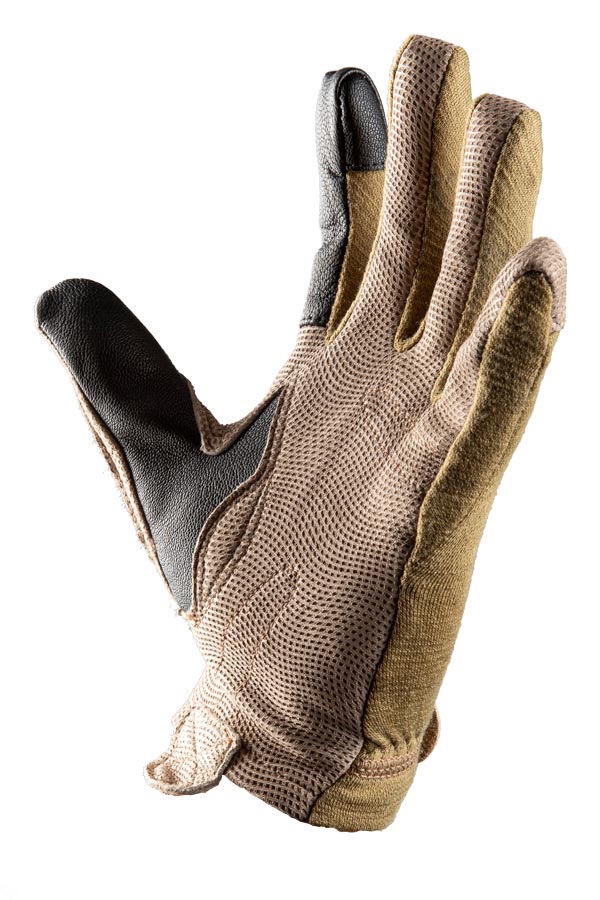
This Friday we are focusing on an FS classic the Operator Glove. When maximum manipulation and tactility are required while protecting your digits consider the Operator Glove (OG) first!

• Patent pending design creates a “no glove” feel
• Touch screen friendly thumb and index finger
• Super high dexterity leather palm (FS-HDLTM)
• Ultra lightweight and breathable
• No Melt No Drip construction
• 100% USA Berry Compliant materials with Core-Spun USA Merino Wool

When maximum manipulation and tactility are required while protecting your digits consider the Operator Glove (OG) first! Comprised of the most technologically advanced materials and modern construction details no corner is cut in this design. The trigger finger of the OG has an advanced patent pending design that will still give excellent transmission of trigger feel, magazine release and other key weapons functions.

The OG can work as a stand-alone capability or when higher durability and toughness is required it can be utilized in conjunction with the Operator Outer Glove (OOG). In order to achieve this amazing level of peak performance, the OG utilizes extremely light, thin materials which by their very nature will not stand up to extremely long periods of hard abuse but will perform through several mission-focused cycles.

Available in commando, sand, and manatee in small through 2XL sizes.

For more information check out www.first-spear.com/operator-glove

SecAF Kendall Details ‘Seven Operational Imperatives’ & How They Forge the Future Force

Thursday, March 24th, 2022

ORLANDO, Fla. (AFNS) —  

Secretary of the Air Force Frank Kendall outlined his increasingly urgent roadmap March 3 for successfully bringing about the new technologies, thinking, and cultures the Air and Space Forces must have to deter and, if necessary, defeat modern day adversaries.

The particulars of Kendall’s 30-minute keynote to Air Force Association’s Warfare Symposium weren’t necessarily new since they echoed main themes he’s voiced since becoming the Department’s highest ranking civilian leader. But the circumstances surrounding his appearance before an influential crowd of Airmen, Guardians, and industry officials were dramatically different, coming days after Russia invaded Ukraine.
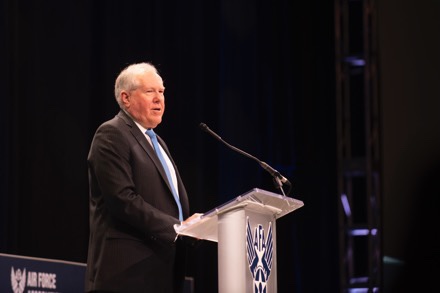
Kendall used the invasion to buttress his larger assertion that the Air and Space Forces must modernize to meet new and emerging threats and challenges. The path to achieving those goals are embodied in what Kendall has dubbed the Department of the Air Force’s “seven operational imperatives.”

“My highest personal goal as Secretary has been to instill a sense of urgency about our efforts to modernize and to ensure that we improve our operational posture relative to our pacing challenge; China, China, China,” he said. “The most important thing we owe our Airmen and Guardians are the resources they need, and the systems and equipment they need, to perform their missions.”

“To achieve this goal, I’ve commissioned work on seven operational imperatives. These imperatives are just that; if we don’t get them right, we will have unacceptable operational risk,” he said.

Kendall spent the balance of his address discussing each of the seven imperatives. But he also noted that, given recent events, the threats are not abstract.

“In my view President Putin made a very, very, serious miscalculation. He severely underestimated the global reaction the invasion of Ukraine would provoke, he severely underestimated the will and courage of the Ukrainian people, and he overestimated the capability of his own military,” Kendall said.

“Perhaps most of all, he severely underestimated the reaction from both the U.S. and from our friends and allies,” he said.

The world’s mostly united response to Ukraine should not divert attention from the distance the Air and Space Forces must cover to adequately upgrade and change to face current threats.

“We’re stretched thin as we meet Combatant Commanders’ needs around the globe,” Kendall said, repeating a frequent refrain. “We have an aging and costly-to-maintain capital structure with average aircraft ages of approximately 30 years and operational availability rates that are lower than we desire.”

Kendall added, “While I applaud the assistance the Congress has provided this year, we are still limited in our ability to shift resources away from legacy platforms we need to retire to free up funds for modernization. … We have a Space Force that inherited a set of systems designed for an era when we could operate in space with impunity.”

Those realities, he said, triggered establishing the Department’s seven operational imperatives. They are:

1. Defining Resilient and Effective Space Order of Battle and Architectures;
2. Achieving Operationally Optimized Advanced Battle Management Systems (ABMS) / Air Force Joint All-Domain Command & Control (AF JADC2);
3. Defining the Next Generation Air Dominance (NGAD) System-of-Systems;
4. Achieving Moving Target Engagement at Scale in a Challenging Operational Environment;
5. Defining optimized resilient basing, sustainment, and communications in a contested environment;
6. Defining the B-21 Long Range Strike Family-of-Systems;
7. Readiness of the Department of the Air Force to transition to a wartime posture against a peer competitor.

The first imperative, he said, is aimed at ensuring capabilities in space. “Of all the imperatives, this is perhaps the broadest and the one with the most potential impact,” he said.

“The simple fact is that the U.S. cannot project power successfully unless our space-based services are resilient enough to endure while under attack,” he said. “Equally true, our terrestrial forces, Joint and Combined, cannot survive and perform their missions if our adversary’s space-based operational support systems, especially targeting systems, are allowed to operate with impunity.”

The second of Kendall’s seven imperatives is to modernize command and control, speed decision-making and linking seamlessly multi-domain forces. In short he wants continued development of defense-wide effort known as Joint All-Domain Command and Control (JADC2) and the Air Force component of that effort known as ABMS or Advanced Battle Management System.

“This imperative is the Department of the Air Force component of Joint All Domain Command and Control. It is intended to better define and focus DAF efforts to improve how we collect, analyze, and share information and make operational decisions more effectively than our potential adversaries,” Kendall said.

At the same time, that effort demands discipline. In this regard, Kendall was blunt, saying “we can’t invest in everything and we shouldn’t invest in improvements that don’t have clear operational benefit. We must be more focused on specific improvements with measurable value and operational impact.”

Another imperative is Defining the Next Generation Air Dominance (or NGAD) System of Systems. 

“NGAD must be more than just the next crewed fighter jet. It’s a program that will include a crewed platform teamed with much less expensive autonomous un-crewed combat aircraft, employing a distributed, tailorable mix of sensors, weapons, and other mission equipment operating as a team or formation,” he said.

Kendall’s next imperative is “Achieving Moving Target Engagement at Scale in a Challenging Operational Environment.”

The effort, he said, has direct connection to the JADC2/ABMS initiatives but tightens the focus.

“What enables our aforementioned ABMS investments to be successful starts with the ability to acquire targets using sensors and systems in a way that allows targeting data to be passed to an operator for engagement,” he said, adding, “for the scenarios of interest it all starts with these sensors. They must be both effective against the targets of interest and survivable.”

The next imperative is a pragmatic throwback to a concept that has long been important – defining optimized resilient basing, sustainment, and communications in a contested environment.

But as in other efforts, Kendall says the concept needs new thinking. In addition to relying on large, fixed bases as the Air Force has done for generations, Kendall said there needs to be a new “hub-and-spoke” arrangement that includes smaller, more mobile bases. That concept is known as Agile Combat Employment (ACE).

“It’s the idea that you don’t just operate from that one fixed base. You have satellite bases dispersed in a hub-and-spoke concept, where you can operate from numerous locations and make your forces less easily targetable because of their disbursement,” he said.

The sixth imperative has a heavy focus on hardware. The effort will define the B-21 Long Range Strike “family of systems,” he said.

As in other imperatives, this one has echoes to others in the list. “This initiative, similar to NGAD, identifies all of the components of the B-21 family of systems, including the potential use of more affordable un-crewed autonomous combat aircraft,” he said.

“The technologies are there now to introduce un-crewed platforms in this system-of-systems context, but the most cost effective approach and the operational concepts for this complement to crewed global strike capabilities have to be analyzed and defined.”

As a former senior weapons buyer for the Department of Defense, Kendall has a keen understanding of the tension between equipment and cost. That understanding explains, in part, this imperative.

“We’re looking for systems that cost nominally on the order of at least half as much as the manned systems that we’re talking about for both NGAD and for B-21” while adding capability, he said. “ … They could deliver a range of sensors, other mission payloads, and weapons, or other mission equipment and they can also be attritable or even sacrificed if doing so conferred a major operational advantage – something we would never do with a crewed platform.”

The seventh and final imperative is both ageless and essential – readiness.

“To go from a standstill to mobilizing forces, moving them into theater, and then supporting them takes the collective success of a large number of information systems and supporting logistical and industrial infrastructure. We have never had to mobilize forces against the cyber, or even the kinetic, threats we might face in a conflict with a modern peer competitor,” he said.

While achieving the imperatives is challenging, Kendall said he’s optimistic.

Kendall said industry, with its “intellectual capital” will have a critical role in finding solutions and compressing the often decades-long development time. So will allies and, of course, Airmen and Guardians.

“I’ve gotten to meet a lot of Airmen and Guardians. Nothing is more inspiring to me than to have informal conversations with the men and women who wear the Air or Space Force uniform. The dedication, commitment, professionalism, and passion these people bring to their service and to the nation is simply awesome,” he said.

“As I’ve traveled to places like Alaska, Montana, North Dakota, and Thule, Greenland, the positive attitudes, drive, and commitment our men and women serving far from home, and in sometimes challenging circumstances, is just exceptional.”

By Charles Pope, Secretary of the Air Force Public Affairs

Secretary Approves Implementation of Revised Army Combat Fitness Test

Wednesday, March 23rd, 2022

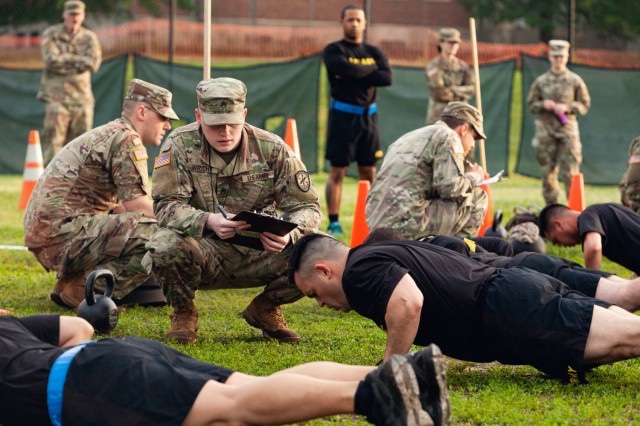
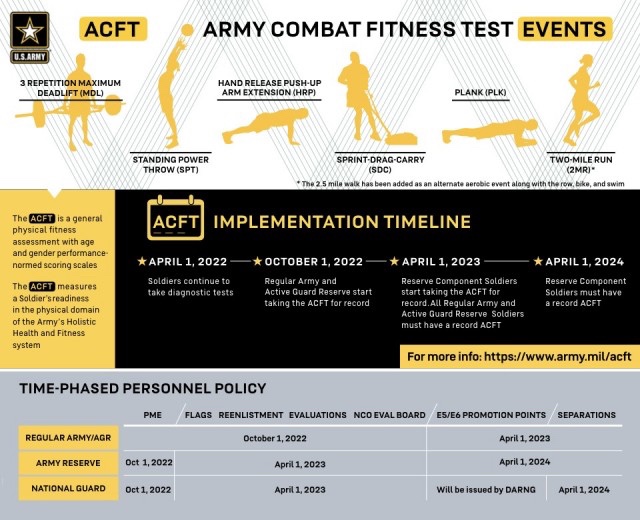
WASHINGTON – Secretary of the Army Christine E. Wormuth issued an Army Directive today outlining a time-phased implementation of a revised ACFT as the Army’s general physical fitness test.

Changes made to the ACFT incorporate feedback from Soldiers and independent analysis of test performance.

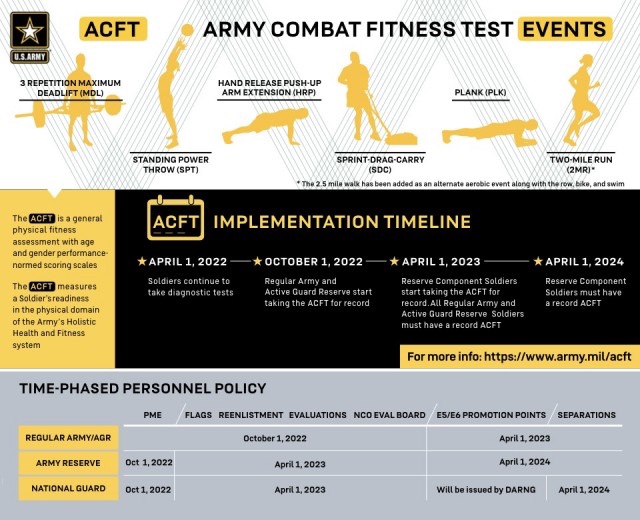
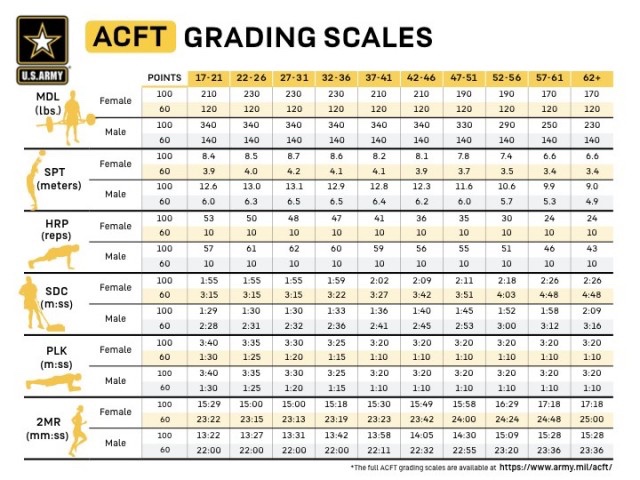
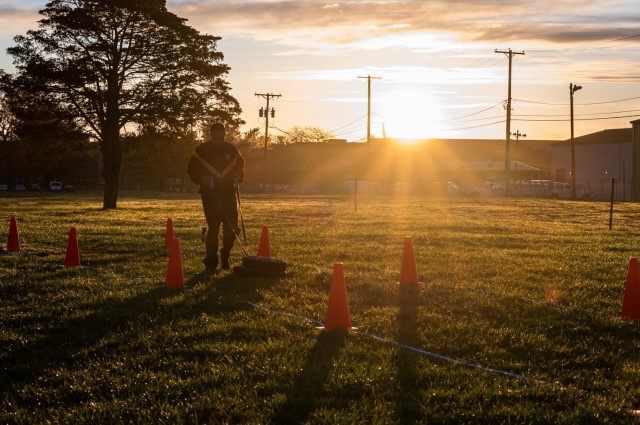
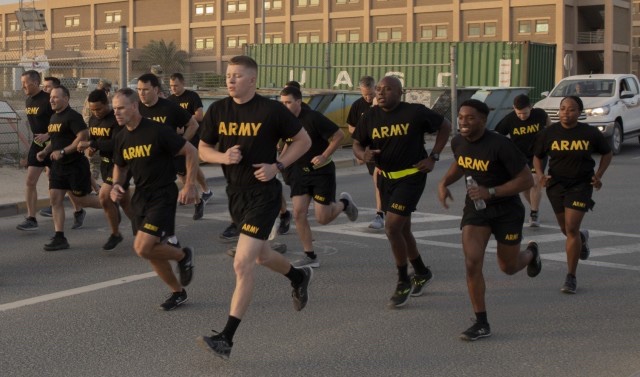
Among the key changes announced by the Army are new age-and-gender-performance normed scoring scales; the replacement of the leg tuck with the plank for the core-strength assessment; and the addition of the 2.5-mile walk as an alternate aerobic event.

“The ACFT is an essential part of maintaining the readiness of the Army as we transform into the Army of 2030,” Wormuth said.

“The revisions to the ACFT are based on data and analysis, including an independent assessment required by Congress. We will continue to assess our implementation of the test to ensure it is fair and achieves our goal of strengthening the Army’s fitness culture.”

A common concern identified by the Army’s independent analysis and the RAND study was that a gender-neutral test might not accurately measure all Soldiers’ general physical fitness levels. One example was using the leg tuck as the assessment of core strength.

RAND concluded that Soldiers might have the core strength that is not accurately measured if they lack the upper body strength required to perform a leg tuck. Now, the plank will be the sole exercise to assess core strength, using recognized standards from sister services as a baseline, and modifying the scales based on Army requirements.

The revised ACFT will utilize scoring scales that are age and gender normed, similar to the APFT. The Army designed the new scoring scales from nearly 630,000 ACFT performance scores, historical performance rates from the APFT, and scoring scales used by other military services.

The Army will continue to assess performance data and has established an ACFT governance body to provide oversight of the full implementation of the new test. This structure will assess ACFT scores, pass rates, injuries and environmental considerations, and report those findings along with any recommended changes to Army Senior Leaders. The first comprehensive assessment will be in April 2023.

Unlike the APFT, which went largely unchanged for 40 years, Army leaders believe the ACFT must be adaptable.

“Since 2018 we’ve said this test would evolve, and it has,” said Sgt. Maj. of the Army Michael Grinston.

Grinston noted the governance structure will continue to advance the ACFT to maximize the physical fitness of the force.

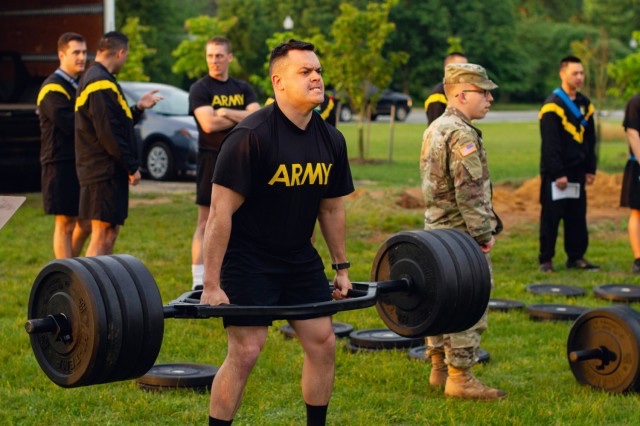
The six-event ACFT now provides commanders and Soldiers an accurate assessment of a Soldier’s physical fitness level and sustains the Army’s efforts to maintain a physically fit force capable of a wide range of missions.

Implementing the ACFT

Beginning April 1, units will start diagnostic testing under the new structure. Record testing begins for Regular Army and Active Guard Reserve Soldiers on October 1, 2022, to allow Soldiers six-months to train. Also on October 1, a passing ACFT score will be used for retention, graduation of initial military training, professional military education, and evaluation reports for Regular Army and Active Guard Reserve Soldiers. Implementation of separation actions may begin in April 2023 for Regular Army and Active Guard Reserve Soldiers.

The Army also approved similar, but longer, timelines for Army Reserve and Army National Guard Soldiers, with April 2023 marking the start point for most personnel policies, and the implementation of separation actions beginning in April 2024.

“During this transition, we want to make sure all Soldiers have the proper time to succeed,” Grinston explained. “Put the test on the calendar and make sure your Soldiers have a solid training plan.”

Grinston said while Regular Army Soldiers can be flagged beginning October 1, 2022 for failing the ACFT, no Regular Army Soldier will be separated solely for ACFT failure until April 2023.

The policy also directed a change to extend retesting periods from 90 days under the APFT to 180 days for Regular Army and Active Guard Reserve Soldiers, and 240 days for Reserve Soldiers for the ACFT. Grinston noted that the extended reconditioning timelines will guarantee that Soldiers who are willing to put in the time and training are provided an opportunity to pass the test.

Chain Teach throughout the Force

To help inform the force of all the policies and procedures of the test, the Sergeant Major of the Army is initiating a chain teach throughout the force – and personally gave Army Command, Army Service Component Command, and direct reporting unit command sergeants major a class on changes to the ACFT.

“They will turn around and give that class to the NCOs who report to them as well as the [command sergeants major] for their subordinate units,” Grinston said.

The chain teach will continue throughout the Army to ensure all noncommissioned officers and Soldiers are directly informed of the policy.

“This is an opportunity for leaders to get engaged and understand their Soldiers’ questions and concerns about the test,” Grinston said. “Know where they are struggling and develop a plan to help them succeed. Leaders need to address more than just physical training and focus on the Soldier’s overall fitness.”

To ensure Soldiers throughout the Total Army have comparable training opportunities, the Army procured and distributed more than 40,000 sets of equipment, 60% of which were designated for Soldiers in the Army Reserve and National Guard.

Grinston encouraged Leaders to use their equipment for physical readiness training, including on drill weekends for the Reserve Component, to help Soldiers familiarize themselves with the events before testing.

There are also a number of resources available on the ACFT website to help Soldiers train, including workout program examples and videos of exercises – many of which require no equipment.

Holistic Approach

Army leaders expect units to incorporate principles of all the Holistic Health and Fitness (H2F) System domains into their training. In addition to the physical domain, Leaders should include proper nutrition, sleep, and spiritual and mental fitness to improve overall Soldier readiness. Unit master fitness trainers are the subject-matter experts and are trained to advise in all domains of fitness.

“H2F is an incredible system that looks at training in ways the Army has never done before,” said Brig. Gen. John Kline, commanding general of the Center for Initial Military Training – the Army’s lead proponent for the H2F system.

“Incorporating things like mindfulness training, proper nutrition counseling, and better sleep techniques are proven methods to improve mental and physical readiness,” Kline said.

“If you really want to improve your ACFT score,” Grinston agreed, “start with those other four domains of fitness.”

For the full details on the implementation of the ACFT, visit www.army.mil/acft.

By SFC Will Reinier

DEVCOM Tests Airdrop System for Rapid Deployment in the Field

Wednesday, March 23rd, 2022

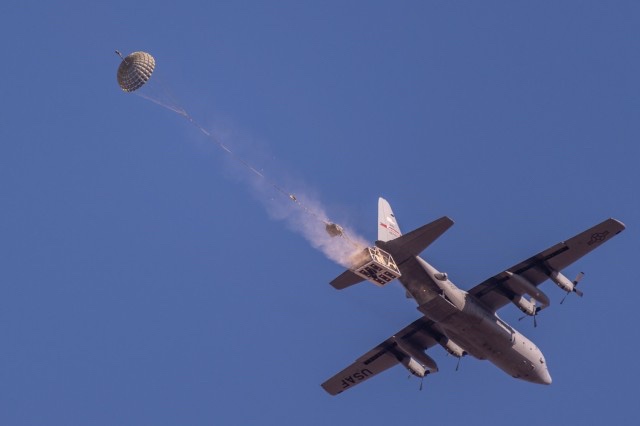
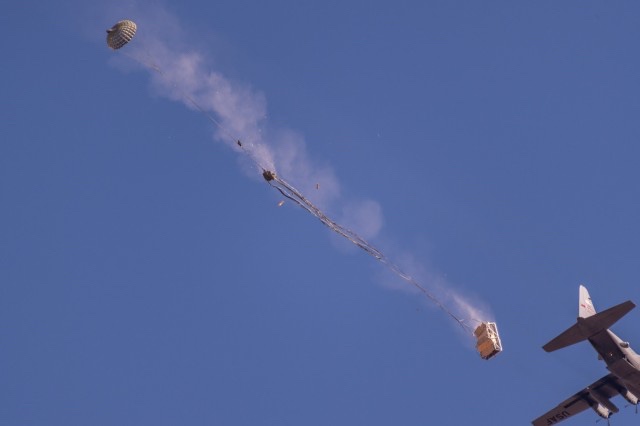
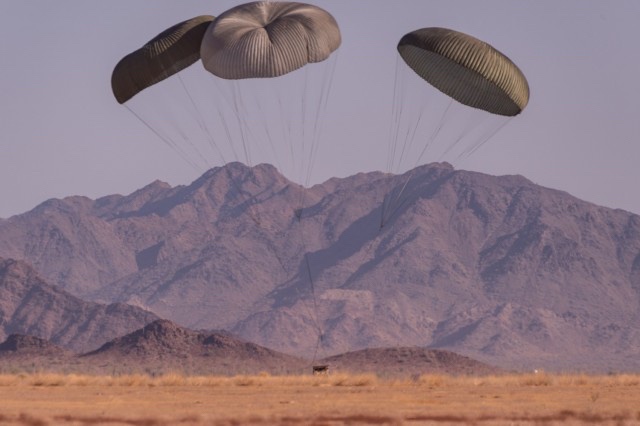
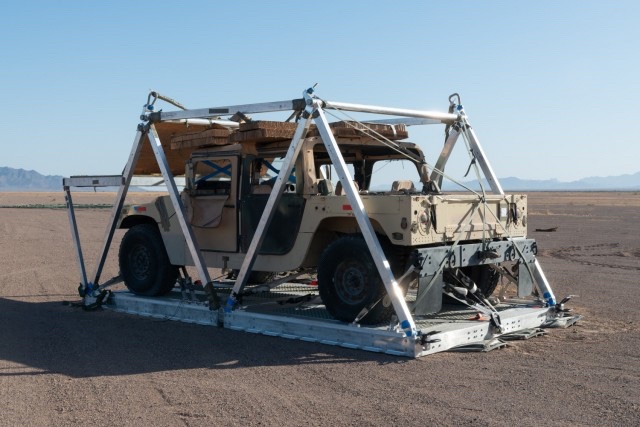
YUMA PROVING GROUND, Ariz. — For U.S. Army Soldiers on the move, getting a vehicle in the field increases their survivability and mobility. Safely airdropping the vehicle and quickly de-rigging it is important to reduce Soldiers’ exposure to threats. As a measure to increase operational readiness, the Army recently tested the ATAX land airdrop system, an off-the shelf prototype.

The Foreign Technology Assessment Support program provided funding that enabled the U.S. Army Combat Capabilities Development Command, or DEVCOM, Soldier Center to test the ATAX system, manufactured by United Kingdom-based IrvinGQ. The system was originally designed for British and NATO standards, which are similar to the U.S. but not identical.

The funding enabled the DEVCOM team to ensure it meets U.S. airdrop and air transportation specifications and to address any issues gathered during the testing. A follow-on Foreign Comparative Testing program, sponsored by the Office of the Secretary of Defense Comparative Technology Office, enabled detailed integration, prototype fabrication and additional airdrop flight testing.

The U.S. Army Yuma Test Center conducted four live airdrop tests between November 2020 and May 2021. The team used ballast weight for the first three airdrop tests and a High-Mobility Multipurpose Wheeled Vehicle for the fourth and last airdrop test, which they drove off the ATAX platform at the conclusion of the test.

“Overall, the project was a success. At the final demonstration, we derigged the HMMWV and drove it off the platform without any issues,” said Sean Wellman, DEVCOM SC engineer and ATAX project lead.

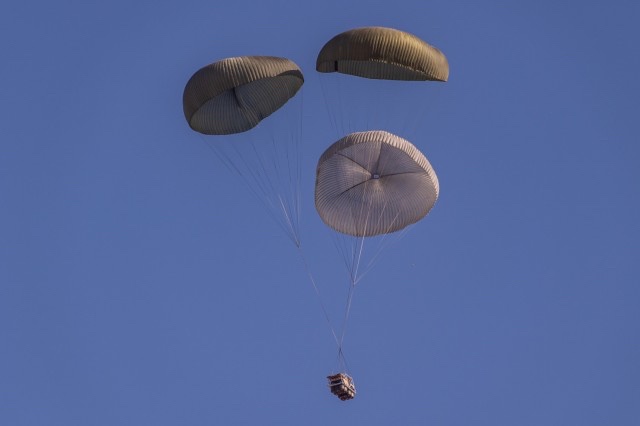
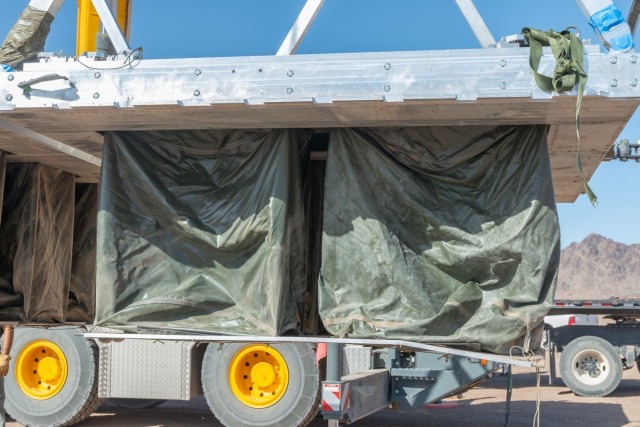
The ATAX airdrop system is modular and consists of eight-foot platforms connected by hinges. It can be adapted to different lengths, typically between 8 and 32 feet, and it is surrounded by a self-contained structure where the parachutes are mounted and attached. The vehicle is loaded onto the ATAX platform with an under-mounted airbag system. In a typical low altitude airdrop, it takes between two to three minutes for the vehicle to drop from a height of 1,500-2,000 feet. Airdrop systems can weigh up to 42,000 pounds including the payload and airdrop equipment.

The ATAX airdrop system has significant advantages over traditional systems because it uses reusable airbags to soften the impact when the vehicle lands. Traditional airdrop systems use multiple layers of stacked paper honeycomb that is three inches thick to soften the landing. The paper honeycomb, which is crushed by the impact, is left in the field and can take up to an hour or more for Soldiers to free the vehicle from the paper honeycomb. One of the goals of the project is to reduce de-rigging time by 75 to 80 percent, which will reduce the amount of time that Soldiers are in the drop zone.

“Airbags minimize or avoid the need for paper honeycomb, saving time during preparation and recovery. The risk of becoming stuck in a stack of honeycomb is eliminated when airbags are used. Basically, when the vehicle is dropped, everything comes off, and the vehicle is ready to execute the mission,” Wellman said.

DEVCOM SC teamed with Product Manager Force Sustainment Systems on the FTAS and FCT project. PM FSS is executing the Rapid Rigging and Derigging Airdrop System Program of Record, which will enable wheeled vehicles to drive on and off the aerial delivery platform, decreasing the amount of time Soldiers are in the drop zone. Funding provided by the FCT program enabled the Army to maintain competition that would otherwise have not been possible. The FCT program provides funding to acquire, test and evaluate mature products from foreign industry that might fill a capability gap or satisfy an urgent need.

DEVCOM SC established a Cooperative Research and Development Agreement with IrvinGQ in 2018, to share information about the ATAX system and other aerial delivery technology. DEVCOM is leveraging the CRADA for other projects that support its mission. According to IrvinGQ, numerous European forces are using the ATAX system.

“Ultimately, the ATAX system was not selected for further development but it was a key enabler for modernization efforts in aerial delivery. The ATAX is still available as a test bed for future science and technology projects, if needed,” said Andrew Meloni, lead of the DEVCOM SC Airdrop Research, Capabilities & Systems team.

By Argie Sarantinos, DEVCOM Public Affairs

TMS Tuesday – The M.A.R.C.H Algorithm – Circulation

Tuesday, March 22nd, 2022

The MARCH algorithm is laid out differently from Advanced Trauma Life Support (ATLS) which uses Airway, Breathing, and Circulation (ABC’s) as the order of treatment to instead use Massive Hemorrhage, Airway, Respiration, Circulation, Hypothermia/Head Injury for prioritizing lifesaving treatments.

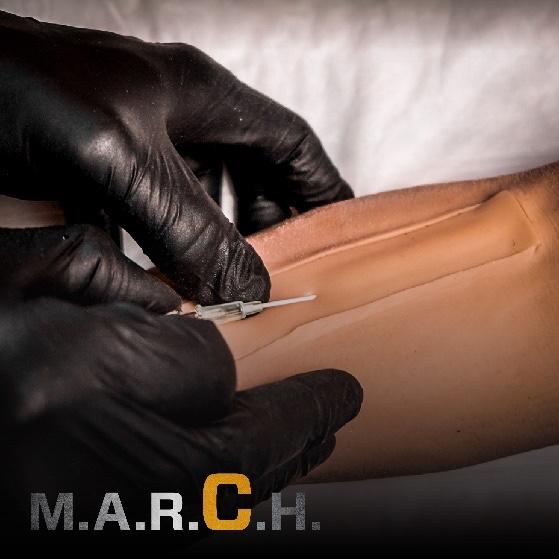
The “C” portion of the MARCH acronym refers to the broad topic of Circulation. In the context of MARCH, circulation covers a wide gamut of responsibilities, from assessing for hemorrhagic shock to administering blood transfusions to non-blood-based fluid replacements like Tranexamic Acid (TXA). However, the “C” phase is also an opportunity to “SEE”, i.e. Not just LOOK at our patient, but to really SEE our patient.

In TCCC, we use the “C” phase to expose and reassess the need and effectiveness of our previous efforts and “SEE” the overall view of our patient’s status. In the “C” (or “See”) portion, we use a discriminate eye to determine and answer the following:

1. Does the method of injury indicate that we should stabilize the pelvis?

2. If we used a tourniquet, did the injury need it?

3. How is our tourniquet placement? If you performed a hasty tourniquet application in a care under fire circumstance, can we apply a new device now two to three inches above the wound directly on the skin?

4. Can we safely perform a tourniquet conversion to a pressure dressing if the situation warrants it?

5. Have we marked times of application on the tourniquet(s) we applied or converted?

6. Do we see signs of hemorrhagic shock such as altered mental status in the absence of brain injury?

7. Do we need to gain IV access?

8. Is fluid replacement or TXA applicable?

9. Field blood transfusion?

10. Blood product administration?

11. Is blood loss even the culprit behind the symptoms we are observing with our patient?

The circulation phase is where these deeper dive questions get answered, and we must use the “C” phase to “See” the answers.

Tools to Aid in Circulation

TacMed Solutions™ offers a variety of products built to help with this circulatory emergencies including the TacMed™ Vascular Access Kit (VAK), the Compact Syringe Kit, the Field Blood Transfusion Kit, the Saline Lock Kit (SLK), the IV Evaporative Cooling System (IVECS™), and more. To stock your kit with these essential tools, check out TacMed Solutions™ at tacmedsolutions.com/collections/m-a-r-c-h-tccc/circulation.

Air Commandos Earn ACA Honors

Tuesday, March 22nd, 2022

HURLBURT FIELD, Fla. —  

Past and present Air Force Special Operations Command Airmen were recognized for their dedication and hard work by the Air Commando Association.

Due to COVID-19, the Air Commando Association’s Heritage Seminar Breakfast and the Awards Banquet were not held.

The following Airmen were recognized for receiving Commander’s Leadership Awards:

Technical Sgt. Andrew T. Flynn, 23rd Special Operations Weather Squadron, Det 1

First Lt. Brittany K. Brown, 4th Special Operations Squadron

Technical Sgt. Adam C. Long, 720th Operational Support Squadron

First Lt. Erik A. Lolland, 720th Operational Support Squadron

Technical Sgt. Arthur W. Mapp, 27th Special Operations Group

Captain Jonathan C. Edwards, 27th Special Operations Aircraft Maintenance Squadron

Staff Sgt. James R. Evans, 58th Aircraft Maintenance Squadron

Major Jacob L. Wiseman, 58th Special Operations Wing

Master Sgt. Robert T. LeMay, 352nd Special Operations Squadron

First Lt. Ryan M. Laube, 352nd Special Operations Support Squadron

Technical Sgt. Jeremy D. Morlock, 353rd Special Operations Support Squadron

Captain Zachary R. Maginnis, 1st Special Operations Squadron

Staff Sgt. Trevor L. Rohrer, 524th Special Operations Squadron

Captain Riley A. Feeney, 492nd Special Operations Training Support Squadron

Technical Sgt. Keith A. Proze Jr., 2nd Special Operations Squadron

Captain Jason M. Morris, HQ AFSOC/A3

Technical Sgt. Brett E. Rush, Data Masked

Major Michael J. Lintz, Data Masked

The following awards were presented:

Chief Hap Lutz AFSOC Commando Medic of the Year – Tech. Sgt. Stephen M. Sauer, Data Masked

Senior Airman Julian Sholten Intelligence, Surveillance, and Reconnaissance Operator of the Year – Tech. Sgt. Nicholas A. Lord, 25th Intelligence Squadron, RAF Mildenhall, U.K.

Operational Squadron of the Year – 7th Special Operations Squadron, RAF Mildenhall, U.K.

Deployed Aircraft Ground Response Element Member of the Year – Staff Sgt. Ethan C. Pierce, 352nd Special Operation Support Squadron, RAF Mildenhall, U.K.

Special Tactics Operator of the Year (Enlisted Category 2020) – Tech. Sgt. Adam Anderson, 17th Special Tactics Squadron, 24th Special Operations Wing, Ft. Benning, Georgia

Special Tactics Operator of the Year (Operator Category 2020) – Capt. Brandon Farrell, 320th Special Tactics Squadron, 353rd Special Operations Wing, Kadena Air Base, Japan

Special Tactics Heart of the Team Member of the Year – Master Sgt. James A. Olk, 720th Operational Support Squadron

The following recipients were inducted into the ACA Hall of Fame:

Colonel (ret.) Timothy Hale – Hale excelled as an MC-130E/H crew commander and instructor/evaluator and an AC/MC-130J instructor. From his first combat mission as an MC-130E pilot in the lead aircraft over Point Salinas, Grenada, Hale led from the front with professionalism, courage, a keen sense of humor, and respect. He commanded an Expeditionary Group and Wing, flying missions and riding resupply convoys during Operation IRAQI FREEDOM. Upon retirement, he continued to serve Air Commandos as an aircrew accession instructor with the 58th Special Operations Wing.

Lieutenant Col. Bill Schroeder (posthumously) – As an officer-in-charge and then commander of the Special Operations Weather detachment at Ft. Bragg, North Carolina, his steadfast leadership of low-density, high-demand Special Operations Weather Team (SOWT) operators was critical in ensuring premier weather support to the 3rd and 7th Special Forces Groups as they deployed during Operations ENDURING and IRAQI FREEDOM. He later led the effort to modernize the Battlefield Airman training program and played a role in establishing the Special Warfare Training Wing. Schroeder laid down his life after confronting an armed assailant determined to inflict harm to the men and women under his charge. He was posthumously awarded the Airman’s Medal and honored by the Air Force Portraits in Courage for his valor and selfless sacrifice.

Major (ret.) Dan Turney – Turney was an MH-60 initial cadre pilot in the 55th Special Operations Squadron, the first H-60 unit in the U.S. Air Force. He was the first MH-60G special mission planner for the 1st SOW and Joint Special Operations Command (JSOC). He deployed as an MH-60G Combat Search and Rescue mission manager during Operations JUST CAUSE and DESERT STORM, coordinating over 40 combat missions. After retirement, Turney served as an AFSOC operations analyst and developed the first formal Aviation Foreign Internal Defense Concept of Operations and Roadmap for the 2006 and 2009 Quadrennial Defense Reviews.

Chief Master Sgt. (ret.) William C. Markham – Markham served as the senior enlisted leader of the Joint Special Operations Air Detachment and Combined Joint Special Operations Air Component in combat. He was the first U.S. Airman on the ground in Afghanistan a mere five weeks after September 11, 2001. Then-Sergeant Markham controlled close air support that decimated the ranks of the Taliban, and ultimately liberated Bagram Air Base and Kabul International Airport, and returned the U.S. Embassy to American control. For gallantry in action, he received the Silver Star. As an AFSOC Command Chief, he led the growth and re-missioning of the 352nd Special Operations Group integrating the MC-130J Commando II and CV-22B Osprey weapons systems. Markham personally enabled hundreds of thousands of dollars in scholarship funding and pro-bono legal support to American service members and their families.

Senior Master Sgt. James Lackey (posthumously) – Lackey’s outstanding professionalism and personal leadership were vital to building the readiness of the 8th Special Operations Squadron, AFSOC’s first operational CV-22B squadron, and prosecuting the squadron’s mission during the global war on terrorism. From 1992-2006, Lackey served with distinction as an Instructor and Flight Examiner for the MH-53 Pave Low Models J/M. His leadership, courage, and superior airmanship were evident during Operations PROVIDE PROMISE, UPHOLD DEMOCRACY, BEVEL EDGE, ALLIED FORCE, ENDURING FREEDOM, and IRAQI FREEDOM. He was awarded the Distinguished Flying Cross for heroism as well as the Meritorious Service Medal and Air Medal. He excelled as a CV-22 flight engineer during combat deployments supporting OIF and OEF. Lackey gave his last full measure on April 9, 2010 during a combat mission in Afghanistan.

The ACA recognizes retired and active duty Special Operations Forces Airmen by honoring their achievements as well as providing support to Air Commandos and their families.

By SSgt Brandon Esau, Air Force Special Operations Command Public Affairs

Airman Survives Parachute Accident, Still Going Strong

Monday, March 21st, 2022

POPE ARMY AIRFIELD, North Carolina —  

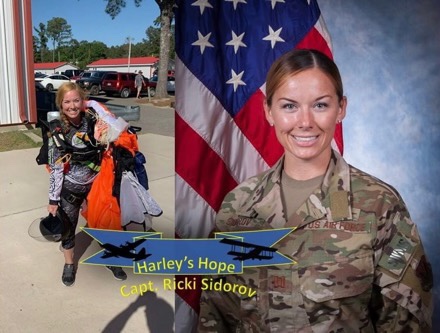
Women’s History Month is in March and there is nobody reflective of being a role model for other women than U.S. Air Force Capt. Ricki Sidorov.

First impressions aren’t always accurate, but when meeting her, there is a bubbly, positive, go-getter attitude who can, and will, get things done. Hardly what you’d expect from someone who nearly lost her life in a skydiving accident in less than two years ago. In this case, though, what you see is what you get.


The San Bernardino, California, native is the Special Warfare Mission Support flight commander for the 818th Operations Support Squadron, primarily responsible for, well, pretty much everything: projects, building maintenance, combat arms, supply, and vehicle maintenance, just to name a few. She also leads 11 Airmen, one civilian, and four contractors.

Prior to joining the Air Force, Sidorov spent six years in the U.S. Army in expeditionary communications. After returning from a deployment in Afghanistan, she decided to leave the military and devote time to working towards a college degree. In typical fashion, she not only earned a bachelor’s degree, but kept going for a master’s.


It was then that she realized how much she missed serving her country and opted to join the Air Force. Sidorov’s job isn’t much different from her position in the Army, but the Air Force has allowed her to have more unique assignments, such as serving in the Combined Air and Space Operations Center in Qatar and the Expeditionary Communications Squadron.

She finds her job humbling and rewarding. “I work with many talented individuals who passionately serve their country, and I continually learn from them,” Sidorov said. That attitude keeps her going, as she plans to remain in the Air Force, traveling the world while continuing to learn and grow.

Someone with these traits isn’t just born with them. She has drawn most from U.S. Air Force Col. Michelle Carns. “She is the epitome of a strong and caring leader. While in Qatar, our team in the Combat Plans Division was a family. It didn’t matter that everyone was from different career fields or branches of service. We were united in our mission and every month we had a team night to relax, eat and highlight the member of the month. Magical things happen when you bring people and food together.”

Sidorov is always the planner. The doer. Constantly trying to learn from others and lead with professionalism and class. That was all paused – and almost stopped completely – during her 2020 skydiving malfunction. As one of her favorite hobbies, she had made over 50 successful jumps without incident and had just finished her Class B license course a few months before.

On this day, she experienced a high-speed parachute malfunction, falling between 70-90 mph – spinning so fast that she blacked out. At 900 feet, the automatic activation device was triggered, releasing her reserve parachute. Within seconds, her main canopy partially collapsed her reserve parachute. If there was a positive, besides the fact she survived, she landed in someone’s back yard with ground that had been freshly tilled and was the softest it had ever been.

She sustained two collapsed lungs, a fractured scapula, knee ligament tears, and internal swelling that required surgery while spending 11 days in the hospital. Not surprisingly, she returned to work just a month after being released from the hospital.   

While most would swear off skydiving after that, Sidorov was back at it six months later. “We all face challenges in life,” she said. “You can’t prevent it, but you can have a positive mindset as you overcome those challenges. It doesn’t matter how hard you fall, as long as you get up and keep going.”

There isn’t a better example of that than Capt. Ricki Sidorov.

By Lori Dean