TYR Tactical

Archive for the ‘Guest Post’ Category

Sergeant Major of the Army Announces Inaugural Best Squad Competition

Saturday, February 19th, 2022

The Army’s Best Warrior Competition is getting an upgrade.

FORT BENNING, Ga. — During his remarks Tuesday to the Maneuver Warfighter Conference at Fort Benning, Georgia, Sgt. Maj. of the Army Michael Grinston announced that groups of Soldiers will compete together in the inaugural U.S. Army Best Squad Competition.

“For over two years I’ve talked about the importance of building a cohesive team that is highly trained, disciplined, and fit,” Grinston said. “Now it’s time to measure ourselves against that standard.”

For purposes of the competition, a “squad” will consist of five Soldiers:

One Squad Leader – Sergeant First Class or Staff Sergeant

One Team Leader – Sergeant or Corporal

Three Squad Members – Specialist and below

The inclusion of a sergeant first class was authorized to account for staff sections not typically led by a staff sergeant.

Specific details on how the squads will be assembled have not been finalized; the Army execution order is expected to be published before the end of the month. Grinston said his intent is for the teams to come from the lowest echelons of command possible.

“We don’t want divisions assembling super-squads,” he said. “But we have to figure out how that looks because each competing command is operated a little differently.”

For example, he said he would be open to allowing Soldiers from across a garrison headquarters and headquarters battalion to compete together even if those Soldiers aren’t in an organic squad.

“I want units to really think about what makes up a squad,” Grinston explained. “’This is My Squad’ isn’t just about the traditional infantry squad. It’s about those small groups of Soldiers who really know and care about each other and hold each other to a high standard of proficiency, discipline, and fitness.”

As the Army continues to modernize and train for large-scale combat operations in a multi-domain environment, Chief of Staff of the Army Gen. James C. McConville said that begins with the squad.

“The foundation of readiness is the individual Soldier and the small unit – from the team and squad levels,” he said. “The best units in the world ensure their individuals and small units are masters of their craft. If you don’t have a solid foundation of readiness, you won’t have agility. You’ll never be able to execute graduate-level operations.”

Grinston said his goal is to assess squads not just on their technical and tactical proficiency, but also on their cohesiveness and ability to work together as a team.

“By the time the squads get to the Army level, we know they’re tactically sound,” Grinston said. “So we’re going to challenge them in ways maybe they haven’t been challenged before, see how they respond when they’re stressed in other ways.”

The Army-level competition doesn’t begin until the end of September, but units will begin assembling and assessing squads now to earn the right to represent their assigned competing commands. In all, 12 teams, including one each from the Army National Guard and Army Reserve, will compete.

Sgt. Maj. of the Army Grinston also plans to select the NCO and Soldier of the Year from among the 60 competitors, but said they won’t necessarily come from the winning squad.

They, along with the best squad, will be announced at the AUSA Annual Convention in October.

By SFC Will Reinier

FirstSpear Friday Focus – Squadron Smock Now Available in Multicam Arid

Friday, February 18th, 2022

Now available in Multicam Arid— check out the Squadron Smock, an exceptionally popular garment from FS which has maintained its classic design matched with modern high performance materials. The dual layer MID 400 merino package is used throughout the hood, back and shoulders as well as two zippered hand pockets.

With over 18 total pockets this smock serves a load bearing vest style capability many outer garments could not support. An oversized hood works great over the top of a bump lid or helmet.

FirstSpear has also used a low profile padding through the elbow and forearm finished with extra large adjustable cuffs. Webbing attachment points on the back and hood can be used to secure a pack like the ECP or even add foliage for concealment. Like most FirstSpear products the Squadron Smock is 100% American made and Berry Compliant. 

Additionally, we offer our popular Wind Cheater in Multicam Arid as well.

For more information, check out www.first-spear.com/squadron-smock or www.first-spear.com/wind-cheater

ACC’s Agile Combat Employment Just Got More AGILE

Friday, February 18th, 2022

JOINT BASE LANGLEY – EUSTIS, Va. (AFNS) —

Air Combat Command has made significant progress on a number of Agile Combat Employment initiatives, including the creation of an agile battle lab.

As the command continues to anticipate changes and adapt to ACE concepts, innovation and integration has never been more important to members of the staff here.

Lt. Col. Adam Chitwood, ACC’s Agile Battle Lab commander, launched his unit into the ideology of accelerating change and influencing the necessity of ACE Airmen. The ABL mission is to accelerate technology, tactics and unit design to further ACE in ACC and around the Air Force.

More than 22 years ago, under Air Education and Training Command, ABL, then called Squadron Next, began with tests and experiments. Now, after transitioning to ACC in 2020, the ABL collaborates with many organizations, including ACC’s A6 communications directorate (cyber) units outside of ACC to find and solve problems, giving organizations effective ways to operate and train Airmen.

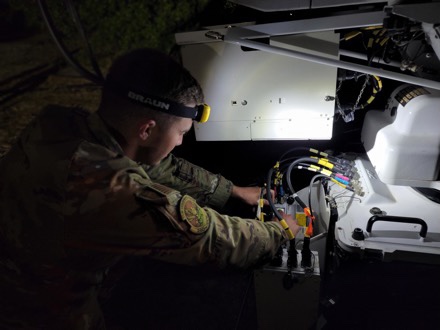
An Airman assigned to the 52nd Combat Communications Squadron from Robins Air Force Base, Ga. sets up a satellite in a simulated austere environment in Sunglow City during Exercise Bushwhacker 21-07 at Davis-Monthan Air Force Base, Ariz., Oct. 4, 2021. Bushwhacker allowed DM to execute and test Agile Combat Employment processes and timelines to pack up, load and re-establish wing facilities and command and control structures at newly established locations. Air Combat Command has made significant progress on several Agile Combat Employment initiatives, including the creation of an agile battle lab. (U.S. Air Force photo by Staff Sgt. Kristine Legate)

 “One unit cannot solve all of the problems of the Air Force,” Chitwood said. “That’s why collaborating and adapting is so vital.”

The difference between the ABL and traditional ACC units is its unique mission. ABL’s ultimate goal is to reshape the way Airmen think, work and incorporate processes that elevate the capabilities of the Air Force in preparation for the future fight.

We are not focused on everyday problems. We’re focused on strategic and more operational level issues,” said Master Sgt. Andrea Murray, ABL’s intelligence integration manager. “We’re making changes in 18 to 20 months. Unlike traditional labs and units, we can’t wait 10 years. We need things to change now, and that’s what we’re doing.”

A major part of ACE is the creation of a multi-capable Airmen mindset. MCA is an initiative where a small group of Airmen will be trained to accomplish tasks outside their core Air Force specialty. They will train in a cross-functional team to provide combat support to aviation force elements conducting dispersed and dynamic operations. MCA will recover, refuel, reload, launch and defend mission generation force elements.

As MCA concepts expand across the Air Force, the need for immediate, effective change and improvements grows. According to Chitwood, with ACE being ABL’s primary effort, integrating MCA will become essential to the Air Force as a whole. ABL’s goal is to equip the force with more than capable Airmen.

“We, as Airmen, have to practice like we fight,” said Senior Master Sgt. Reid Beveridge, ABL superintendent. “War is not an additional duty. We need to practice MCA jobs and we need to identify failure gaps before we are called on to use [tactics, techniques and procedures] in combat.”

In December 2021, ABL led an ACE command control and communications operations rehearsal for ACC and joint partners. The success of the rehearsal resulted in a way ahead to plan and identify what future challenges adversaries might present Airmen.

“Developing and testing ACE concepts through the lab and other venues will ultimately give our Airmen decisional advantage in tomorrow’s fight,” Chitwood said.

By SSgt Jaylen Molden

Air Combat Command Public Affairs

Air Force to Phase Out 13O Career Field, Strengthen All Airmen Joint Capabilities

Friday, February 18th, 2022

WASHINGTON (AFNS) —  

The Department of the Air Force announced Feb. 17, the Multi-Domain Warfare Officer (13O) career field will be phased out while emphasizing that multi-domain capabilities will become fundamental across the Air Force.

This phase out impacts 136 currently-assigned Total Force Airmen in the active component, Air National Guard and Air Force Reserve.

“We must be prepared to face future conflicts with our joint and combined partners, and the knowledge Multi-Domain Warfare Officers bring to the fight is too critical to confine to a single career field,” said Air Force Chief of Staff Gen. CQ Brown, Jr. “To continue outpacing near-peer adversaries, we must reinforce all Air Force members’ multi-domain expertise.”


The Air Force will continue to evolve its professional education and force structure to ensure all Airmen can apply operational concepts and contribute to Joint All-Domain Operations, versus limiting it to one core AFSC.

The transition will begin after eligible officers meet the LAF-X Colonel central selection board March 29 – April 14, 2022. Commanders will guide Multi-Domain Warfare Officers through the reassignment process. Officers trained in multi-domain warfare gained valuable experience in all-domain and joint planning capabilities which will be leveraged at all levels of training and professional military education to strengthen enterprise-wide capabilities.


“We want to utilize the depth of knowledge and experience that our Multi-Domain Warfare Officers bring to the fight and to the maximum extent possible need their help to train and educate Airmen to fight and win against a peer threat in all domains,” said Maj. Gen. Albert G. Miller, director of Training and Readiness, Deputy Chief of Staff for Operations at Headquarters U.S. Air Force.

Air Education and Training Command, the lead for Professional Military Education, plans to implement principles of the current Multi-Domain Warfare Initial Skills Training into Air Force-wide developmental education. This will increase the operational knowledge and expertise required to produce joint-capable and credible Airmen.

The Multi-Domain Warfare Officer (13O) career field was established June 25, 2018, as a result of the Multi-Domain Command and Control Implementation Plan to train operational-level C2 personnel specialized in executing command and control of multi-domain operations.

The Agilite Pincer Placard 5.56 is Live

Thursday, February 17th, 2022

The Patented Agilite Pincer Placard™ uses revolutionary funneled magwells and other features that solve some major mag pouch issues-check out the video to see how it works:

www.agilitegear.com

Simplified Human/Machine Interfaces Top List of Critical DOD Technologies

Thursday, February 17th, 2022

WASHINGTON — A modern-day cell phone packs quite a wallop when it comes to computing technology and capability. But most cell phones barely come with a “quick start guide,” let alone an instruction manual that spells out how to use all the features.

Cell phone companies have mastered the interface between humans and technology, making their use entirely intuitive and rendering thick instruction manuals a thing of the past.

The same thing should be happening for weapons systems used by servicemembers, Heidi Shyu, who serves as the undersecretary of defense for research and engineering, said. During a virtual discussion today with the Potomac Officers Club near Washington, D.C., she said intuitive, easy-to-use human/machine interfaces is something that’s a priority for her and the Defense Department.

“When I [served as an executive for the] Army before, one of the experiences I learned is with a lot of our weapons system, you really have to have a manual and go through weeks of training, if not months and years to be proficient, which is ridiculous,” she said. “[Weapons systems] ought to be designed with the appropriate ease-of-use human/machine interface, so it will become much more intuitive.”

As the Defense Department’s chief technology officer, Shyu said she’s interested in developing better ways to simplify the way service members use the technology they are given in order to reduce the training burden and learning curve.

“I really would like to see how we can change our weapons systems’ human/machine interface to be a lot more intuitive, to ease the amount of training that’s required,” she said.

For most service members, combat means use of a weapon such as a rifle, an aircraft that can drop a bomb or launch a missile, or a ship or tank that fires a large gun that requires a round to be loaded. All of these kinetic weapons systems fire solid projectiles which need to be carried along with warfighters, and which may eventually run out. But a new generation of weapons systems, which uses directed energy rather than expendable ammunition or ordnance, is on the horizon, Shyu said.

“In the area of directed energy, we’re … finally at the cusp of developing laser technology,” she said. “After 30 years, we’re finally getting to the point of fielding the prototypes. So I’m thrilled. Army and Navy are [both] fielding laser systems. I’m really happy to see that. We’re also developing high-power microwave systems as well.”

The Optical Dazzling Interdictor, Navy program, or ODIN for short, is a nonlethal weapons system used to confuse and perhaps render harmless an enemy drone — rather than shooting it down.

The ODIN system is already installed on multiple Arleigh Burke-class guided-missile destroyers within the Navy’s fleet, and there are plans to install additional systems as well.

The Army is also developing several directed energy systems. One of those is the Directed Energy Maneuver-Short Range Air Defense, or DE M-SHORAD system, which involves a 50kW-class laser to protect divisions and brigade combat teams from unmanned aerial systems, rotary-wing aircraft, and threats from rockets, artillery and mortars.

The department is also interested in the development of advanced materials, Shyu said.

“I’m certainly interested in materials that can handle higher heat, higher temperature, next-generation hypersonic materials,” she said. “I’m interested in material that’s stronger, but lighter weight. It certainly can help us reduce the logistics burden; and also materials that can have higher efficiency — materials that can potentially change properties. [There are] a lot of different areas within advanced materials we need to continue to push the research in.”

The department is also doing its part to bring the manufacture of microelectronics back to the U.S. to improve supply chain reliability, Shyu said.

“You guys have all heard about the situation that we’re in with the supply chain, where 70% of our chips are coming from Asia,” she said. “That poses a supply chain risk. You can see there’s a lot of interest on the Hill in terms of helping out the microelectronics foundries to try to onshore some of the capabilities.”

Shyu said the Defense Department is working closely with the Department of Commerce and with foundry companies to make that happen.

“We also work very closely with intelligence communities to make sure we understand all the needs and figure out how we can leverage commercial processes which can evolve at a much faster rate than just the defense-unique foundry,” she said.

Finally, Shyu said, the department is interested in having the U.S. take the lead on the development of 5G technologies — and the advancement of the next-generation of radio communications as well.

“I call it the ‘next G’,” she said. “Namely, beyond 5G. What I don’t want to happen is for us to take our eyes off the ball and play catch-up. I’m interested in making sure we’re developing technologies on 6G and 7G, so we, the U.S., can shape the standards, as opposed to some other country shaping the standard and us playing catch-up.”

By C. Todd Lopez

SITKA Arrowhead MLX Hoody- MDWi in MultiCam

Wednesday, February 16th, 2022

SITKA Arrowhead announces a limited sale opportunity on an exclusive colorway of the MLX Hoody- MDWi.

The initial release of the MultiCam version of this Polartec® Alpha® active insulated Hoody is offered exclusively within the US through O P Tactical and in Canada via Millbrook.

Exceptionally lightweight, breathable, and compressible the MLX Hoody-MDWi performs equally well as a standalone piece or as a midlayer in conjunction with a Wet Weather Protective solution.

Utilizing Polartec® Alpha® Direct insulation for optimal temperature regulation during the start-stop conditions of combat, and Brookwood AREOLITE H600 30d Nylon Ripstop face fabric for enhanced breathability, SITKA Arrowhead has produced a high performing, lightweight piece you will find yourself never deploying without.

Find your size today at O P Tactical or Millbrook.

Troop Support Takes Over Fielding of Army Green Service Uniform for New Recruits, Soldiers

Wednesday, February 16th, 2022

PHILADELPHIA  –  

After years of planning, the Defense Logistics Agency Troop Support is now providing Army green service uniform items to recruits, and soon soldiers shopping at Army & Air Force Exchange Service stores.

While the Army initially fielded the Army green service uniforms in 2020, the Troop Support Clothing and Textiles supply chain’s planning efforts with the Army dates to 2017, said Cheryl Reynolds, C&T chief of the Plans & Integrations’ Recruit Clothing Division.

“Planning, both materiel and demand, plays an integral part in each and every new item introduction,” Reynolds said. “For the AGSU program, our discussions with the Army started over four years ago and they have been conducted regularly ever since.”

Within the last two years, C&T has been working to transition AGSU support from Army contracts to DLA-provided contract support. This included converting existing DLA Army service uniform contracts or creating new acquisitions for fabrics and end-items, Reynolds said. The team then closely monitored vendor production, shipments, and stock levels ahead of customer roll-out timelines.

The AGSU ensemble is tailored by gender and includes 17 end-items, two fabrics and 270 insignia, Reynolds said. Uniform items include short- and long-sleeve shirts or blouses, trousers or slacks, coats, gloves, dress shoes, socks, belts, and neckties.

Troop Support provided nearly 8,000 AGSU sets in total to recruit training centers at Forts Benning, Leonard Wood, Sill and Jackson this month. In April, Troop Support will begin fielding to AAFES stores worldwide.

C&T collaborated with internal finance, contracting, planning, technical and customer support teams, and personnel from the Army Program Executive Office Soldier and Tank-automotive and Armaments Command to successfully field the uniforms.

“Our team’s successful roll-out of the AGSU at the four Army RTCs reflects a significant achievement between multiple agencies within the DLA enterprise and the Army,” said C&T Director Air Force Col. Matthew Harnly.

Reynolds described the process as a ‘massive undertaking’ due to the extensive network of coordination required, number of items and various sizes.

“With close to 1,000 sizes overall, it was crucial that we were buying the quantities per size,” Reynolds said. “Time-phased inventory plans were developed for each of the items to ensure that adequate safety levels would be received when DLA took over support of the program which is necessary for a successful roll-out.”

Army recruit training center team Supervisor Timothy Schmidt noted a nuanced challenge in planning quantities by size, based on physique differences between new recruits and seasoned soldiers.

“The challenge is going to be determining what the size tariff needs to be going forward under the DLA contract versus what the Army is buying because we incorporate AAFES support, which is a different targeted demographic than the RTC audience,” Schmidt said.

“Recruits at the RTCs are, generally speaking, an 18–24-year-old demographic,” he continued. “So, [physically], they tend to be different than for instance matured soldiers who are going to AAFES and buying their uniforms at their installations.”

C&T also overcame industry challenges and found opportunity in using new vendors to produce end-items, said Ashley Liddle, chief of the dress uniform integrated support team.

“We have a limited industrial base and adding a new uniform, the normal contractors that we work with were at capacity, so we were able to find new contractors that have never done business with us,” Liddle said. “So, the majority of contractors making the items are new to us.”

Learn more about the C&T supply chain, including customer and vendor support here.

By Mikia Muhammad, DLA Troop Support Public Affairs