Archive for the ‘Guest Post’ Category
SureFire Field Notes Ep 70: Driver Skills with Scott Brady
Thursday, June 9th, 2022Visual Information Service Members Compete for ‘Best Combat Camera’
Thursday, June 9th, 2022
FORT A.P. HILL, Va. — The Spc. Hilda I. Clayton Best Combat Camera Competition, now in its ninth year, is an event hosted annually by the 55th Signal Company (Combat Camera) to challenge combat camera personnel and honor the life of Clayton. This year’s competition was held at Fort A.P. Hill and concluded on May 24, 2022.
Clayton was assigned to the 55th Signal Company (Combat Camera), 114th Signal Battalion, 21st Signal Brigade, based at Fort Meade, Maryland. She deployed in support of Operation Enduring Freedom, Regional Command-East and Combined Joint Task Force-101. She was tasked as the unit’s combat camera covering the 4th Brigade Combat Team, 1st Cavalry Division, “Task Force Long Knife.”
Clayton was involved in a deadly mortar explosion in Jalalabad, Afghanistan while documenting an Afghan military exercise. Her final camera shot captured the explosion that led to her death and claimed the lives of four Afghan soldiers.
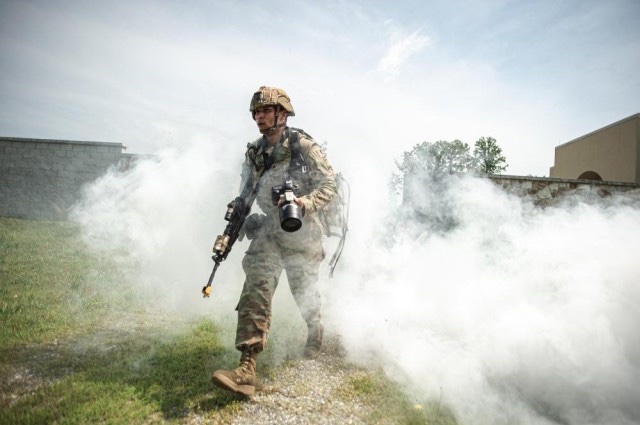
The competition is a joint, multi-national event consisting of visual information specialists, public affairs mass communication specialists and combat photographers. Competitors from across the DOD and participating multinational partners are tested on physical, tactical and technical proficiencies.
“This competition is truly special for the Department of Defenses’ visual information, public affairs specialists and international combat camera photographers,” said U.S. Army Maj. Octavia Blackwell, the commander of the 55th Signal Company (Combat Camera). “Our earnest hope is that this competition brings honor to the hard work, selfless dedication and sacrifice that service members in these career fields bring to fight, every single day. With the Army’s decision to merge the visual information and public affairs career fields, we look forward to the continued growth of the ‘Best COMCAM’ competition.”
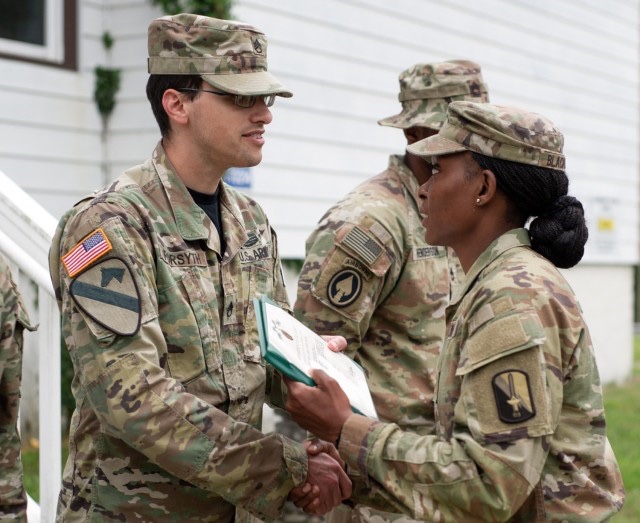
Similar to other military competitions, this event is composed of fitness trials and soldier tasks, with one major exception — the competitors are required to document each other. They must develop powerful, creative and informative visual information products to be submitted before the end of the five-day competition. Final products are then judged and graded by military and civilian personnel from visual information and public affairs career fields.
The Best Combat Camera Competition is a staple competition for DOD visual storytellers. Competitors assess their skills, strengths and weaknesses before the first event begins to ensure they’re ready for the challenge.
With the enduring effects of the COVID-19 pandemic and on-going unrest in Eastern Europe, military storytellers are far-flung and often find themselves supporting multi-faceted training rotations and deployments. Amidst this intensity of operations, 20 service members answered the call and applied to compete in the 2022 Best Combat Camera Competition.
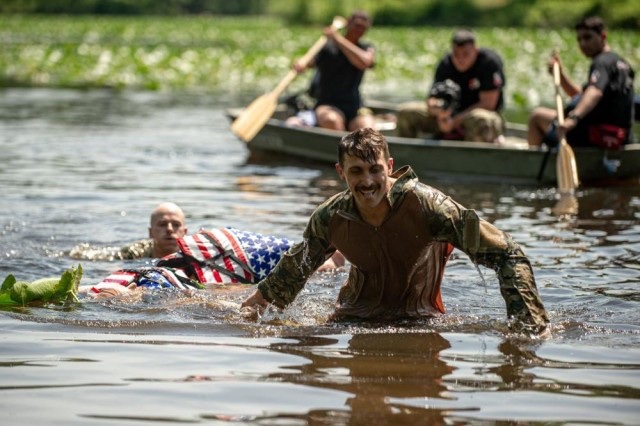
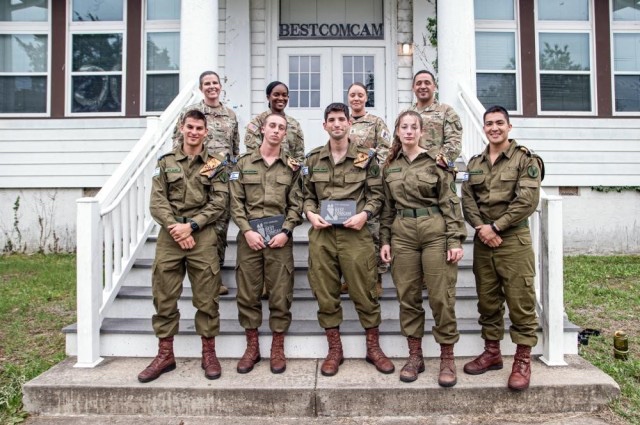
This year’s competition includes service members from the active and reserve components of the U.S. Army, the reserve component of the U.S. Air Force as well as service members of the Israeli Defense Forces Combat Camera Unit.
Army units represented included:
The 3rd Psychological Operations Battalion (Airborne), 8th Psychological Operations Group (Airborne) from Fort Bragg, North Carolina
The 22nd Mobile Public Affairs Detachment, 18th Airborne Corps from Fort Bragg, North Carolina
The 982nd Signal Company (Airborne) from Atlanta, Georgia
The 55th Signal Company (Combat Camera) from Fort George G. Meade, Maryland
The Air Force Reserves were represented by the 4th Combat Camera Squadron, 315 Airlift Wing from Charleston, South Carolina.
The Israel Defense Forces were represented by the Combat Camera Unit from Tel Aviv, Israel — regular participants in the annual event.
With 18 competitors and 21 events, this year’s competition was in its history.
Events included Hero workout of the day, capabilities briefings, day and light land navigation, a swim event, undisclosed distance ruck marches, a tactical lane, sensitive site exploitation and a variety of ranges including pistol challenges, marksmanship qualifications and stress shoots.
For some competitors, travel for this event marked their first trip to the U.S.
“It’s exciting to learn about the culture of the U.S.A., and the Army, and work together,” said Sgt. Lee Hershkovitz of the Israeli Defense Forces Combat Camera Unit. “I’m looking forward to meeting new people, because we are combat photographers and they are combat photographers in another country. It’s very interesting to know what they do because in Israel, in the U.S., it’s not the same thing.”
When asked how she felt about the competition, Hershkovitz responded, “I’m a little bit nervous, but it’s going to be fun and interesting.”

This competition brings out the very best of military creatives. The competition serves as a melting pot of talent, equipment, technical knowledge and experience. New competitors and veteran-teams alike earn the respect of their fellow competitors while establishing long-lasting partnerships across their career fields.
The 315 Airlift Wing’s 4th Combat Camera Squadron’s Tech. Sgt. Corban Lundborg and Senior Airman Joseph LeVeille, won first place at the 2022 Spc. Hilda I. Clayton Best Combat Camera Competition. Their victory marks the first year a team from the Air Force Reserve won the event.
“It was a fun competition this year and it was good training” Lundborg said. “There were a lot of great teams. It’s really about getting to meet everyone in this career field, building relationships and getting better at our job.”
“It was a privilege to compete with such talented professionals and an honor to tell my dad’s story,” said LeVeille. One of the winning team’s project submissions was a video telling about how LeVeille’s father, who lost his life while serving in the Army, inspired him to join the military.

“As one of the more senior competitors, I love the training opportunities that come with this competition,” Lundborg added. “The week isn’t all about beating the other teams, but putting your best foot forward and helping others along the way. We’re all able to learn from each other and give back to the community.”
The 55th Signal Company (Combat Camera) holds the proud distinction of being the U.S. Army’s only active duty COMCAM unit. Their mission is to provide still and video documentation of Army operations during peacetime, contingencies, and combat. Ready to deploy on a moment’s notice, the 55th employs state-of-the-art documentation equipment and is equipped with still and motion cameras, night vision equipment, and editing suites. The unit also has the distinction of an airborne capability requiring the unit to conduct monthly airborne operations to maintain the airborne qualified status of select members of the unit.
By Michael Meisberger
Editor’s Note: U.S. Air Force Michael Dukes, 315th Airlift Wing, Command Information Chief and U.S. Army Sgt. Henry Villarama, 55th Signal Company (Combat Camera) contributed to this article.
Predator Ghillie Spectralflage Blanket – Beez Combat Systems
Wednesday, June 8th, 2022Using VR Through VALOR to Improve Combat Casualty Care
Tuesday, June 7th, 2022HURLBURT FIELD, Fla. —
The 24th Special Operations Wing Surgeon General’s office has implemented the use of virtual reality training devices, in partnership with SimX, throughout special tactics to maintain the critical pararescueman’s skill in an ever-changing operational environment.
“The operational mission is going to continue to grow in complexity in the future fight,” said U.S. Air Force Col. John Dorsch, 24th SOW Surgeon General. “The PJs must be prepared to treat both injury and illness in austere environments for longer periods of time with limited reach-back.”
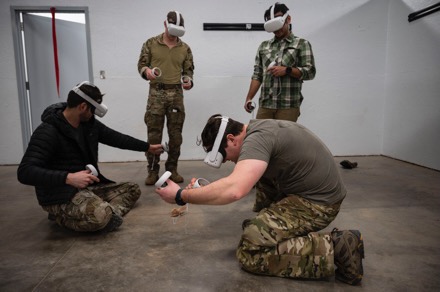
When looking at what the future operational environment may look like, the 24th SOW SG team must consider the implications to operational medicine. Scenarios PJs face could be in low-visibility areas where they have to keep patients alive for longer periods under possible chemical, biological, radiation or nuclear conditions.

“Preparing PJs medically for the future fight will require an advanced interoperable standard, optimized initial and sustainment training, deliberate tech development and integration, and enhanced performance tracking and feedback,” said Dorsch.
The virtual reality program objectives are to improve realism, increase flexibility and reduce cost. Through more than $10 million in Department of Defense Research and Development Funding and the Air Force Small Business Research Innovation Research program, SimX and the 24th SOW have been able to create more than 80 training scenarios including canine treatment and care, blast injuries, severe gas exposure, and more.
These training devices provide intricate and realistic training scenarios that other methods, such as medical dummies, cannot, and improves the effectiveness of the training.
“By using a flexible piece of equipment, we are able to deliberately and efficiently target specific desired learning objectives based on evolving mission requirements,” said Dorsch. “We now have the time and bandwidth to provide trainees with enhanced real-time feedback from the through the program, which grades the trainee on a point system through data analysis and a performance tracking system.”

Currently, there are 14 sites online using the PJ Tactical Combat Casualty Care curriculum, including Air Force Special Operations Command and Air Combat Command. In the future, they plan to expand access to the existing medical training portfolio across all SOF TCCC responder tiers, broaden capabilities and integrate partner force training.
“The VALOR program has increased the availability of efficient and effective medical training and has allowed us to develop complex decision-making, which will improve survival rates in U.S., coalition and partner force combat casualties in the future fight,” said Dorsch. “VR training is critical for ensuring that the highest level of combat trauma and austere medical care are provided by our special operations ground forces. We have only scratched the surface of its incredible potential.”
Story by Capt Savannah Stephens, 24 SOW Public Affairs
Photos by TSgt Carly Kavish
Kitanica heads to Outdoor Retailer for the first time
Monday, June 6th, 2022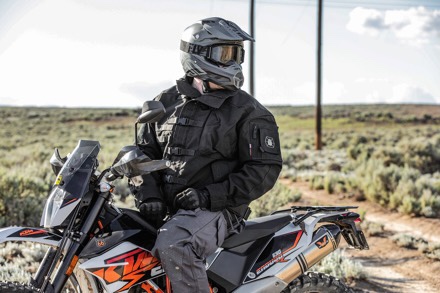
Kitanica is bringing its overbuilt line of gear to Outdoor Retailer in Denver June 9th-11th (Booth 35107 Upper Level). In these times of supply chain crisis, Kitanica has managed to pump up production and capabilities to support a new body of retailers and are launching a wholesale program of its U.S. Made and globally sourced products. For more information about becoming an authorized Kitanica retailer contact Chris Cronin at Chris@kitanica.net.
SCUBAPRO Sunday – Mulberry Harbors
Sunday, June 5th, 2022When you look at WWII, historians, and military people will say, this is what won the war, or that is the reason. Some people say it was the M2 .50 cal machine gun or the Jeep or the M1 Grand rifle. I think there is an excellent argument for all of those things and more. But there were also some fantastic feats of engineering. There were a couple of reasons that the Germans didn’t think that the Allies would land at Normandy. Some of it had to do with the deception plan the Allies used, like having Patton be in charge of a fake Army in the north of England. The other reasons was the fact that there was not a deep-water harbor close enough to make it worthwhile. But the Allies had a secret plan to build their own harbor. The Mulberry harbors were temporary mobile harbor developed during World War II for unloading troops and supplies during the Allied invasion of Normandy.
The British developed them from lessons learned during the ill-fated Dieppe raid two years prior. The Brits discovered that quickly capturing a well-defended port was impossible. They were formed in secret and sunk all over England so they wouldn’t be seen.
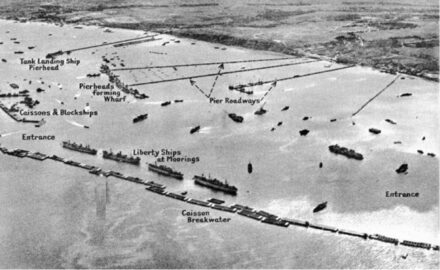
After the successful landing and the establishment of beachheads on D-Day, two Mulberry harbors’, previously constructed in secret at various sites across the UK, were taken in parts across the English Channel and reassembled off Omaha Beach and Gold Beach. Within 12 days of the invasion, the harbors were up and running. The Mulberry Harbor was broken down into three different areas, the Breakwater, the Pierheads, and the Roadways.
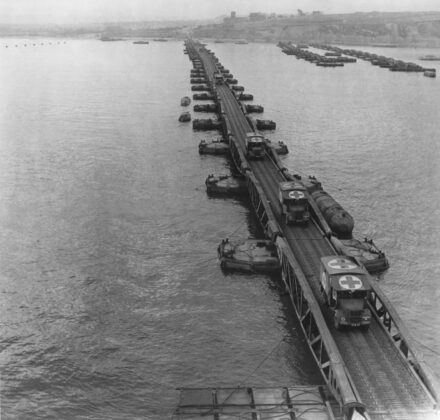
The Breakwaters were made from a combination of sinking 70 older merchant ships, steel, and concrete caissons, and concrete type crosses used to help keep it all in place. The breakwater was about 9.5 kilometers long(about 6 miles). In from that was the Pierhead that the ships could tie off to, the last part was the roadways that lead into the shore and was used for the offloading of the personal and supplies to the beach.
Along with the components of the mulberries, the harbors were protected from swell and waves by blockships deliberately sunk adjacent to the harbor. You can still see parts of the huge concrete blocks sitting on the sand, and more can be seen further out at sea. I have significantly simplified how they were made and what went into them. I am not an engineer and a hell of a lot more when into making the then I talked about.
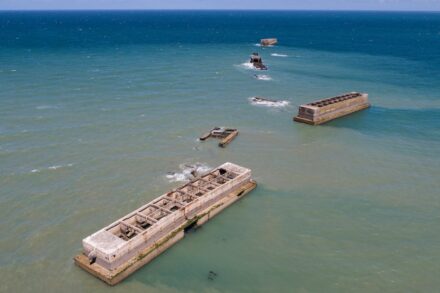
The Mulberry harbors were intended to be used until a French port could be captured. It was not until six months after D-Day that the port of Antwerp in Belgium was captured. The Mulberry harbor at Omaha Beach was abandoned after it was damaged in a storm on the 19th of June 1944, but the harbor at Gold Beach continued at nearly full capacity for ten months after the invasion. The British Mulberry supported the Allied armies for ten months. Two and a half million men, a half-million vehicles, and four million tons of supplies landed in Europe through the artificial harbors at Arromanches.
Army Modernizes Pacific Expeditionary Signal Battalion
Sunday, June 5th, 2022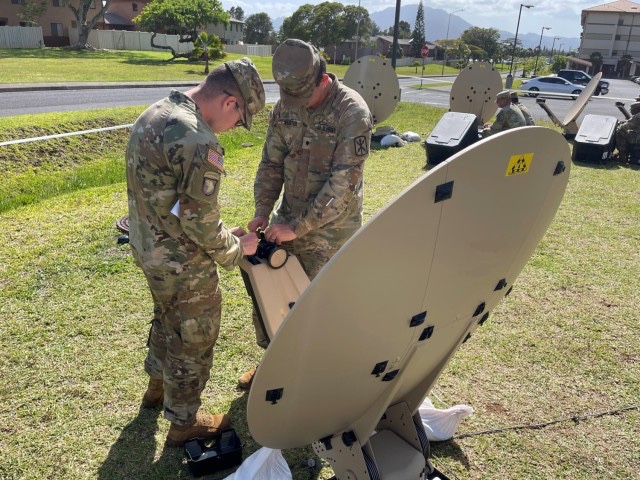
HELEMANO MILITARY RESERVATION, Hawaii — As the 307th Expeditionary Signal Battalion, or ESB, celebrated its 80th birthday on May 27, the Army is converting the unit to an ESB-Enhanced formation. With this conversion comes a smaller, lighter and faster network communications equipment tool suite that will better serve the unit’s unique and varied mission sets.
With companies in both Hawaii and Alaska, the battalion provides global network connectivity on short notice to U.S. Army Pacific and U.S. Army North units, often in harsh locations, from secluded island jungles thousands of miles across the ocean to ice-covered mountains in the Arctic Circle.
“We talk about the tyranny of distance, about the challenges created by the vast number of locations and extreme environments throughout the Pacific; this new expeditionary equipment set will help us to support those missions,” said Col. Lee Adams, commander of the 516th Theater Signal Brigade, to which 307th ESB-E is assigned. “We are always trying to improve and to provide foundational capabilities for the theater Army. This transition to an ESB-E does that for us; it gives us a better capability to enable the theater Army to fight successfully.”
The reduced size and system complexity of the equipment set enables ESB-E units to significantly increase their network support to other units with more nodes and less manpower, while reducing transportation requirements by over 60 percent. The tool suite includes various-sized expeditionary satellite dishes and baseband equipment, high-throughput backhaul radios, and wireless command post technologies. It replaces the unit’s much larger Tactical Network Transport At-The-Halt equipment, formally known as Warfighter Information Network-Tactical, which is often transported across the Pacific via cargo ships. The new equipment set can be transported via commercial airline if needed, in hours versus days or weeks.
Prior to his current position, Adams commanded the first unit to be converted to an ESB-E, the 50th ESB-E, during the planning and initial fielding of the unit’s pilot equipment. The 307th ESB-E conversion marks the sixth unit that the Army has fielded with the new equipment package. The Army’s Project Manager Tactical Network, assigned to the Program Executive Office for Command, Control, Communications-Tactical, began fielding the unit with the Scalable Network Node to the companies in both Hawaii and Alaska in March. Fielding the remainder of the initial baseline systems is expected to be complete by the end of the fiscal year.
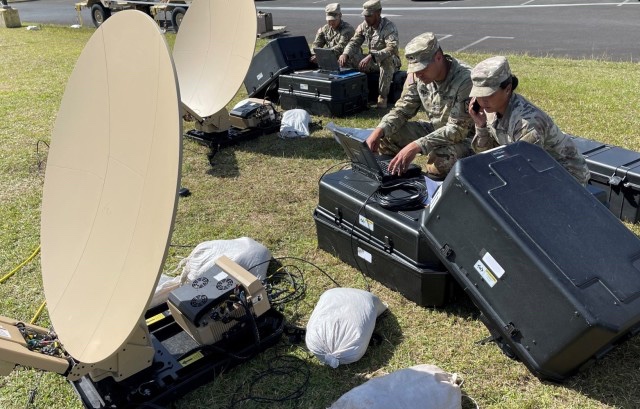
The Army’s agile ESB-E acquisition and fielding approach aligns with its two-year incremental Capability Set fielding process, which enables the service to enhance the ESB-E baseline capability in future capability sets if Soldier feedback warrants it, or when evolving commercial technologies become mature enough to be procured. On the current plan, the Army is fielding several ESB-Es per fiscal year until all of the ESBs have been upgraded to the new baseline capability.
“As I talk to the other ESB-E commanders, the [project manager], and its fielding team that is here now, and we get feedback from our Soldiers as they going through the training, I can see firsthand the accumulation of lessons learned and how the equipment set continues to improve,” said Lt. Col. Drew Chaffee, commander of the 307th ESB-E, who also once served as a company commander for the unit.
The ESB-E tool suite is a critical element of Capability Set 21, which delivers smaller, lighter and faster communications systems that are easier to operate and provide increased network communication Primary, Alternate, Contingency and Emergency, or PACE, plan options. The tool suite provides signal path diversity in congested and contested environments, leveraging numerous high-throughput line-of-sight and beyond-line-of-sight capabilities.
“It’s critical to have a good PACE plan, to be able to incorporate different transport that may be more survivable in a particular terrain. Every commander wants more options,” Adams said. “When we are fighting in a battle environment that is degraded, intermittent or just has delayed latency, I have to have different technologies, different pieces of kit that make me more survivable, make us a harder target to hit, yet allows us to stand still to support multi-domain operations at an assured level. And that is what having these different network transport capabilities provide us.”
To enable additional transport paths for improved network resiliency, the Army is working to deliver high-throughput and low latency satellite communications leveraging emerging commercial technologies and services in non-traditional orbits, such as Low Earth Orbit and Medium Earth Orbit. In April, the 307th ESB conducted a demonstration of commercial high-throughput and low latency satellite communications, at the Helemano Military Reservation on Oahu. The unit plans to further experiment with the capability during upcoming U.S. Army Pacific training exercises.
“The name of the game is operational flexibility,” Chaffee said. “This new kit is scalable and tailorable to the mission. We have the operational flexibility to tailor our teams, our equipment set, and our footprint to the requirements based on the mission and the environment that we find ourselves in. This smaller lighter ESB-E kit is going to get us there much more effectively and it highlights the United States’ ability to support and adapt in some of the most austere and remotely located environments in the world.”
By Amy Walker, Project Manager Tactical Network, PEO C3T, public affairs
KC Eusebio Wins Again!
Saturday, June 4th, 2022

Atlanta Arms congratulates our shooter, KC, on his recent Dragons Cup Championship victory
KC won 1st Place Open using Atlanta Arms’ very own .38 Super Comp Elite ammo. When asked how the day went, KC responded “This was one of the hardest matches of the year. Moving steel targets, sliding moving targets, and 107 degree weather made this competition so challenging. My Atlanta Arms Elite ammunition is the driving force in my marksmanship. Always consistent, always the best. Thank you so much to my Atlanta Arms family for always taking care of me.” Congratulations!