SIG SAUER - Never Settle

Archive for the ‘Guest Post’ Category

TacMed Tuesday – Customizations for Every Need

Tuesday, February 15th, 2022

Tactical Medical Solutions™ got it’s start by creating the original SOF® Tourniquet in 2003 and has created components and custom kits to meet customer specifications and mission needs ever since. With a primary focus on military and law enforcement applications, we have created custom kits for not only them, but also consumer organizations and small businesses in many other cross-over markets from the outdoor and overland markets to concealed carry and arborist communities.

TacMed Solutions holds an ISO 13485 certification and can provide medical devices and related services that consistently meet customer and applicable regulatory requirements. Our capabilities range from support in selecting products specific to your mission needs, designing your brand’s printed labels and packaging, creating custom nylon solutions, and more.

SwitchBack Outdoor Safety took advantage of the customization capabilities of TacMed™ Solutions. Aaron Paris, owner of SwitchBack Outdoor Safety, reached out wanting to build out custom emergency trauma kits for his company. His company aims to provide education and equipment for those who desire to take the road less traveled, so we were able to aid in customizing two medical kits that helped align with his goal.

“I really like working with TacMed because of the ease of being able to make kits adjustable to our needs and our customer’s needs,” Aaron said. Our partnership with SwitchBack Outdoor Safety, a key leader in the overlanding and off-road community, led to the creation of the SOS Trauma Kit and the SOS First Aid Kit and refill packs for each. “I have worked with other companies in this space and though they gave a custom kit, the attention to detail just wasn’t there and there was a lack of willingness to be as modular. For us, this was a 180 in some ways and it gave it a much more professional appearance.”

Solutions are part of our culture, not just part of the name.

To learn more about our capabilities in creating a custom kit for your specific needs, check out: tacmedsolutions.com/pages/customizations

To learn more about SwitchBack Outdoor Safety, check out: www.switchbacksafety.com/product-category/first-aid

PSA – MissionSpec Shows You How To Make A Paper Rose

Monday, February 14th, 2022

Did you forget to get something for Valentines Day? That’s ok. MissionSpec has got your back.

Benefits of making a paper rose are: 1) they never die.
2) you did it yourself so your significant other might appreciate that.
3) you can get your kids involved. Win. Win. Win.

SCUBAPRO Sunday – Desert Storm False Invasion

Sunday, February 13th, 2022

With four Republican Guard heavy divisions and the equivalent of a fifth, made up of commandos, Iraq invaded Kuwait on 02 August 1990. Then U.S. President George H. W. Bush quickly said that the United States didn’t condone Iraq’s actions.

During Operation Desert Shield, President Bush formed a coalition (“a collation of the willing” Chapelle) of 35 countries to protect Saudi Arabia and then free Kuwait. On 06 August, the U.S. sent troops to Saudi Arabia, the 82nd Airborne Division and Special Forces were some of the first on the ground (I am sorry if I missed other groups). This began a buildup of combat power in the region, which at its peak had about 600,000 U.S. troops there at one time.

During Desert Shield, some smaller operations took place, including Visit Board Search and Seizure (VBSS), Special Reconnaissance looking for SCUDS and Combat Search and Rescue (CSAR), and running around in Desert Patrol Vehicles (DPVs they would be the first forces into the city of Kuwait) but indeed General Schwarzkopf was not a fan of any Special Forces. He didn’t want to use them for anything. He even had operators from Delta guarding him. On 17 January 1991, Desert Shield turned into Desert Storm with the start of the air campaign. More than 18,000 air missions were flown and more than 116,000 combat air sorties by the U.S. and between 32-40 other countries, including several Arab countries. They dropped 88,500 tons of bombs on the enemy.

On 28 February 91, the ground war started again; a lot of groups played different roles in the invasion. Special Forces Groups conducted special reconnaissance, CSAR, and Direct-Action missions.

Naval Special Warfare (NSW) Group One had run NSW Task Group Center based out of Ras Al-Mishab. There were SEAL platoons from almost all west coast teams, including a Platoon for SEAL Team Five and a boat Det from Special Boat Unit 12.

One of the Platoons from SEAL Team Five and the High-Speed Boat (HSB/ HSAC )Det from SBU-12 was tasked with conducting an over the horizon beach attack to fool the Iraqis into thinking a full-scale amphibious landing was going to happen. To help with this, over the horizon, off the coast of Kuwait, was an armada of ships, each carrying approximately 17,000 Marines, all ready to land on the beaches. But, the only amphibious assault of Kuwait would be carried out by a half-dozen Navy SEALs. Lt. Tom Dietz (the only reason I am using his name as this is well documented) and five other SEALs would drive up the coast from Ras al-Mishab in a pair of Fountain-33 HSBC as the sunset on Saturday, 23 February, the day before the allies were scheduled to commence the ground campaign. The Fountains, propelled by 1,000-horsepower MerCruiser engines, sped up the Kuwaiti coastline at 40 miles per hour. This might sound fun, and at first, it is, but it is not the best on the knees. That night, the water temperature was a bone-chilling 50 degrees Fahrenheit in the gulf. It was even more concerning because it was plagued with mines. The SBU 12 boat guys sailed blindly, with their lights turned off, knowing that if their thin-shelled boats encountered a mine, it would not end well for them. When they entered the minefield, they traveled slowly at first; then, after some talking realized fast or slowed if they hit a mine, it would be not good, so travel fast was decided to be the best plan.

Dietz’s speedboat came to a halt 15 miles off the coast of Kuwait at approximately 10 p.m. His team was able to free the Zodiac rubber raiding boat attached to the bow. After swimming up to Kuwaiti beaches in stealth for a month, searching for prospective amphibious landing sites, the SEALs discovered that all of them were well fortified and mined, indicating that they would be difficult to reach. Dietz’s two motorized Zodiacs made their way gently to the coast, halting every few miles so the commandos could look and hear what was going on.

The F470 Zodiac stopped about five hundred yards from the beach, and the swimmer were launched. Each carried haversack with C4, which they would use to string buoys out along the swim to the beach. These buoys with a diameter of four feet would give the impression that the buoys were marking impending amphibious ships. The beach charges were set for 1 a.m. local time about 3 hours before the Collation forces began breaching the minefields along the Kuwait border on Sunday, 24 February. This would give the Iraqis time to move troops east to the coast, where the fake invasion was thought to be happening. The importance of time could not be overstated. For the Iraqis to respond effectively, they must be allowed to do so by moving forces east in response to the diversion rather than reinforcing soldiers in the west, where the actual attack would occur.

The SEALS kept an eye on the coast while swimming toward the beach together. Each swimmer had an MP5 with them, and SBU-12 HSP was slowly making their way towards the beach to help in an emergency and for a follow-on mission after the platoon was back to the F470s. The team would stop and look at the beach with a pocket night-vision scope every hundred yards. In the early 90s, items like that were not as waterproof as they are now, so it was stored in a good old plastic bag. They even made all black surfboards sent from Coronado to carry radios. Because of the smoke from the oil wells burning, the night seemed even more ominous. The sand on the beach was white and looked like it had just snowed out even though it was sand.

The crew split out on the shoreline and unloaded its haversacks in around a foot of water. The rest of the team followed suit. Dietz instructed the timers to be set by using hand signals. The SEALs exfilled keeping an eye on the beach. After closing in on the Zodiacs, the HSBC opened up on the shore with their .50-caliber machine guns for half an hour in an attempt to make the Iraqis think a more significant force was attacking the coastal fortifications. Two-pound charges were dropped off the sides of the boats and exploded every five minutes. Around the same time, the USS Missouri battleship opened up with her 16in guns, firing 2700lbs shells over the heads of the guys in the boats. They were firing at the Iraqi command bunkers near the Kuwaiti coastline, helping with the illusion that an American-led amphibious assault on occupied Kuwait would be on the horizon. At precisely 1 a.m., explosives on the beach went off. Dietz radioed back the code word “Pamela,” meaning “mission completed.”

After a brief pause, Missouri fired once more into Iraqi-occupied Kuwait. This time, the Marine Corps dispatched ten helicopters to mimic a landing force on the ground in Iraq. The Iraqis launched anti-ship missiles at Missouri, but a British ship intercepted and destroyed the lone missile that posed a severe threat to the warship. Coalition jets were able to locate and destroy the missile launch point quickly.

As a result of the bombardment’s effectiveness, Iraqi troops sought to surrender to the drone (from the USS Missouri) that flew back over the target area, waving little white flags. For the first time in history, troops would try and surrender to a drone.

Hundreds of lives were saved during Desert Storm due to this fictitious amphibious assault by Naval Special Warfare. After six weeks of air attacks, the ground campaign only took 100 hours before Kuwait was freed. On 28 February, a ceasefire was established, effectively putting an end to the hostilities until Iraqi dictator Saddam Hussein agreed to the peace agreement provisions. The coalition forces suffered a total of 300 casualties in the combat, which is significantly less than the number of deaths they would have suffered if the Iraqi troops had been permitted to concentrate on the actual threat.

Portable Servers Enhance Army Geospatial Intelligence Training

Saturday, February 12th, 2022

FORT KNOX, Ky. — The Army Geospatial Center has assisted in further modernizing the 412th Theater Engineer Command’s Engineer-Focused Intelligence Training, or ENFIT, geospatial intelligence procedures with two portable high speed imagery servers.

The OPTIA-produced “ammo can” and smaller-sized portable imagery server from TerraMaster provide Engineers with rapid access global map data without reliance on network speeds or bandwidth limitations. The unit connects a laptop to either device and pulls what they need directly from it, cutting down research and product development by as much as 50 percent.

Jorge Morales, Team Lead Geographer with the AGC Warfighter Support Directorate, stated that the AGC integrated both portable systems into the ENFIT program as of the third quarter of 2021, so the AGC anticipated units to send in results of their use shortly.

“The ‘ammo can’ has about 25 terabytes in storage,” he said. “That fits all of the geospatial maps with space to spare for more.”

Morales explained that the maps already on the devices varied depending on what engineers needed, but each were as detailed down to as much as half a meter. He said they provided a “hybrid solution” with both three dimensional and simulation capabilities.

Armed with comprehensive imagery of the entire world, regardless of depth or height, Army Engineers can precisely direct and reinforce U.S. military efforts for assured mission success. Further, at an estimated five pounds each, the servers prove an easy, more than acceptable burden for any unit.

ENFIT is a specialized course where Soldiers use updated geospatial analytic tools with rapid terrain analysis — geospatial data being facts about occurrences, objects and events that are associated with a particular location on Earth’s surface. These give engineer commanders proper foundational, geographical knowledge to make the right decisions as to where operations should take place.

Maj. Gen. Stephen Strand, 412th TEC Commander, emphasized that ENFIT provides new methods to improve top-tier planning for the Army Reserve.

“The ENFIT program significantly enhances the geospatial engineering capabilities of the [412th Theater Engineer Command],” said Strand. “It’s a great program to develop the bench needed to maintain proficiency for years to come.”

Col. Steven Hayden, 412th Theater Engineer Command Chief of Staff, concurred on Strand’s assessment, adding that ENFIT allows Soldiers to use geospatial analytic tools to provide commanders with terrain analysis that shape the battlefield and drive decision.

ENFIT continues in Alexandria, Virginia throughout 2022 with more classes that include these and more modernizing devices.

By MAJ William Allred and SFC Tony Foster, 412th Theater Engineer Command

Edgar Sherman Designs Glock Gen 5 Magwell

Friday, February 11th, 2022

Since the start of ESD Edgar has been working on perfecting the handgun reload. From hours of dryfire to numerous classes and observation of professionals he’s set out to achieve the sub second reload and increase his efficiency as a shooter. Through training and experience Edgar learned a lot about how users reload, the issues they encounter, and how we compensate for them. The primary lesson learned is that it comes down to efficiency and consistency as a shooter. Training both day and night in all weather conditions brought new experiences to the table.  Another lesson learned is that while skills are important, the equipment used can either optimize or detract from the experience. Shooters in icy and sandy environments struggled with stripping magazines when magwells were added, and we took note. We listened to shooters working in no light/low light conditions struggling to locate their pistol grip and properly align mags. We watched competition shooters fumble their mags after removing their index finger early to avoid hitting the magwell during reloads.

After years of shooting, observation and dryfire Edgar set out to solve the problems he observed and experienced first-hand. With the expertise of Patrick Law from BP Knives we began development of the first ESD Glock gen 5 magwell. This is the first pistol magwell that’s design understands human ergonomics and motion. A magwell in a class of its own that not only looks like a Ferrari but it performs like one too.

Every curve, every angle, every feature on the ESD magwell is intentional and aligns with our mission to enhance a shooter’s capabilities using human centered design. Featuring symmetrical side cut outs for stripping magazines, the ESD magwell allows for easy removal of flush fitting magazines as well as those that have an extension. Additionally, a third cut out is located on the front of the ESD magwell. This third cut out is especially useful in low light/ no light conditions and serves as a reference point for the shooter which allows them to focus on the task at hand rather than worrying about fumbling a magazine during a reload. The angles on the inside of the magwell allow for a greater margin of error when inserting mags and will “course correct” if they are ever inserted at an off angle.

The ESD Magwell is proudly manufactured with the help of our good friends at Parker Mountain Machine in New Hampshire. We want to support American manufacturing as well as our local community at every opportunity, so for us this partnership was a no brainer. For us, It’s important to not only source a quality product, but also work with a company we trust to maintain strict quality standards at every step of the manufacturing process. The magwell is made of high quality 6061-T6 aluminum and anodized black. The ESD Magwell is currently available for Glock Gen 5 double stack 9mm and .40cal pistols, with support for other handguns coming in the future.

We’re very excited for the launch of the ESD magwell, and hope you are as well. The ESD magwell launches Friday 02/11/2022 and will also be available with our dealers. We can’t wait to see them out there in the wild!

www.edgarshermandesign.com

The ESD Team

Contributed by Thomas Burton

Thomas@blacksidesolutions.com

Black Side Solutions LLC

FirstSpear Friday Focus – Cold Climate Glove

Friday, February 11th, 2022

Stay warm, don’t wait to order these Cold Climate Gloves. This is not your average winter glove. The Cold Climate glove from FS is built with a keratin leather palm patch, Primaloft Gold insulation, and a waterproof breathable insert.

Incredibly warm with excellent dexterity allowing basic trigger control. Additionally, we removed the insulation from the upper half of the trigger finger to increase basic trigger manipulation and make it easier when using a touchscreen. In fact, touchscreen sensitive index fingers and adjustable wrist cuffs come standard on this premium cold climate glove from FirstSpear.

Overall the glove is incredibly light weight compared to how warm it will keep your hands. Impressive dexterity including reduced insulation in the trigger finger to increase basic fire control manipulation. Touch screen capable index fingers and adjustable cuff with a perfect amount of stretch. Available and shipping now in fatigue green and black.

For more information check out: www.first-spear.com/technical-apparel/handwear/cold-climate-glove

24 SOW DET 1 Conducts First Readiness Exercise Under AFSOC

Friday, February 11th, 2022

MACDILL AIR FORCE BASE, Florida. —  

MACDILL AIR FORCE BASE, Florida. – Airmen from the 24th Special Operations Wing, Detachment 1, participated in their first joint deployment exercise since transitioning from United States Special Operations Command to Air Force Special Operations Command Jan. 31 – Feb. 1, 2022, at MacDill Air Force Base, Florida.

The 24th SOW, Det. 1 conducted the exercise to validate their ability to provide short-notice civil engineering, force protection and logistics support toward a wide variety of special operation missions across the globe.

During the exercise, Airmen secured their cargo, prepared it for loading, and ensured it was ready for safety inspection.

“This is our first deployment exercise under AFSOC,” said Tech. Sgt. Ismael Hayes, the noncommissioned officer in charge of Air Transportation for the 24th SOW, Det. 1. “We wanted to get an understanding of some of our new roles and how we would proceed with our missions from here on out.”

Hayes added that although the transition from SOCOM to AFSOC did not entirely change their mission, it would actually help them get it done faster.

“We’re all about time,” said Hayes, “Now that we’re working with AFSOC, we’re able to work seamlessly with other units across the 6th Air Refueling Wing.”

Alongside the 24th SOW, Det. 1, were Airmen from the 6th Logistics Readiness Squadron, conducting safety inspections and providing cargo loading support throughout the exercise.

“Working with the 24th SOW was definitely interesting,” said Staff Sgt. Nasya Didomenico, a passenger terminal representative with the 6th LRS. “We ensured that all the cargo was prepared for loading, conducted the safety inspections to prevent any hazardous situations, and exchanged feedback with the Airmen conducting the exercise.”

Didomenico added that the 24th SOW Airmen were extremely efficient during the exercise and the 6th LRS is looking forward to a higher operations tempo now that the 24 SOW, Det. 1 is under AFSOC.

“We definitely still have the same mentality when it comes to doing our job,” said Hayes. “However, we’re very much looking forward to what the future has in-store for us being able to work under AFSOC and with the support of the 6th ARW.”

By Airman 1st Class Hiram Martinez

6 Air Refueling Wing Public Affairs

Autonomous Vehicles Carrying Critical Supplies Could be Key to Reducing Risk to Life in Combat Zone

Thursday, February 10th, 2022

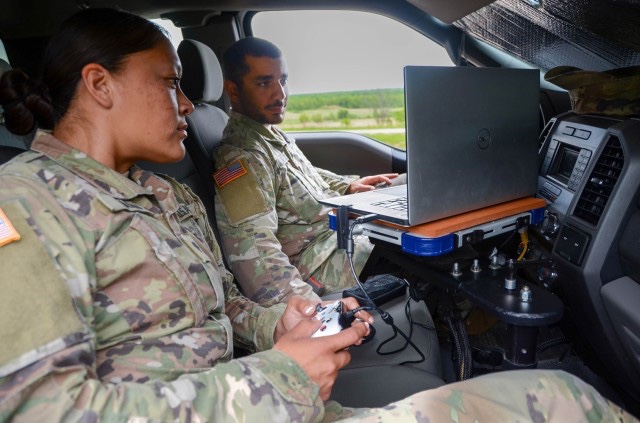
Three companies have won contracts worth £3 million each to accelerate autonomous capability that could be used to safely deliver mission-critical supplies to troops engaged in combat territory known as the ‘last mile’.

The British Army tasked the Future Capability Group (FCG) at Defence Equipment and Support (DE&S), the procurement arm of the MOD, with investigating potential solutions for autonomous ‘Last mile supply’ – the delivery of combat supplies crucial to operational success in combat zones.

This work followed a successful first stage investigation by the Defence and Security Accelerator (DASA) and Defence Science and Technology Laboratory (Dstl).

The FCG was set up by DE&S to pull through technology at pace and accelerate acquisition at value for money to ensure the UK Armed Forces are provided with the equipment needed to counter ever evolving threats.

Under Project Theseus, it is hoped the use of self-driving air or ground platforms to deliver supplies, including ammunition, clothes, food and fuel, will reduce the need for personnel to risk their life by entering into what are typically hostile environments.

As well as vehicles, FCG see the essential inclusion of dynamic autonomous processing, ordering and delivering fuels, foodstuff and other stores so that troops to have the ‘ease of an Amazon style delivery service’ where they need it most. 

Under a potentially ground-breaking commercial model, FCG were able to use a novel process to rigorously evaluate autonomous capabilities from more than 50 primes and SMEs before awarding three contracts totalling £9 million pounds to:   

• Horiba Mira (UK)

• Marlborough Comms Ltd (UK)

• Rafael (Israel)

The contracts will help the companies accelerate the development of their systems to try and meet further challenges set by FCG and the British Army.

James Gavin, Head FCG at DE&S, said:

“Our team used a dynamic commercial approach to stimulate industry and draw in over 50 companies who have key technologies in this area. They then worked with pace and agility to identify three suppliers offering potential solutions from a vast amount of industry specialists.


“This project is also a success for the MOD innovation ecosystem. Dstl and DASA stimulated the market and proved the first stages of this project, with Army HQ asking DE&S to explore and accelerate this promising capability area towards exploitation.”

Major Matt McGarvey-Miles, SO2C Robotic and Autonomous Systems, Future Force Development added:

“Robotic and Autonomous System capabilities will play an increasing role in delivering deployed sustainment in the near-future; doing so will increase combat power through increasing mass and tempo of resupply, as well as reducing risk-to-life for our people, leading to an increased probability of mission success.”

Project THESEUS, a two-year Defence Transformation Fund project, is also exploiting the innovation, findings and technology demonstrator investigations delivered by the Dstl Autonomous Last Mile Re-Supply (ALMRS) project. 

As reported last month, under Theseus the British Army are exploring using robotic dogs to support troops in dangerous and complex urban environments. The platforms would be used to navigate rough terrain, help deliver supplies in war zones and investigate bombs, significantly reducing the risk to personnel.

MoD DE&S