SIG SAUER - Never Settle

Archive for the ‘Guest Post’ Category

US Army Rolls Out New Medical-Training Mannequins

Sunday, March 22nd, 2020

CAMP BUEHRING, Kuwait — The U.S. Army is rolling out a new program for certified medical-personnel to borrow state-of-the-art medical-training equipment from the Training Aids Service Center on post, scheduled to be fully implemented by this summer.
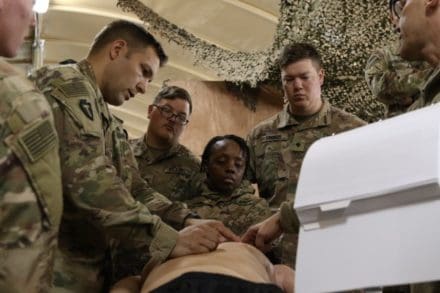
The medical-simulation unit is a mannequin that emulates many aspects of battlefield casualties to help commanders train their soldiers more effectively in Tactical Combat Casualty Care, in compliance with Department of Defense Initiative 1322.24: Medical Readiness Training (MRT).
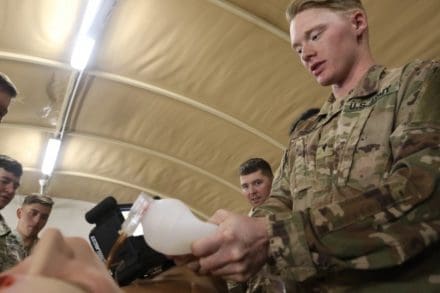
“The purpose of this device is for the commanders to employ collective training where a casualty is incurred, and the squad is supposed to react,” said Dr. Jerry P. Higman, Deputy Product Manager of Medical Simulation, U.S. Army Program Executive Office for Simulation, Training, and Instrumentation. “At present we have instruction to field 77 systems across 41 sites.”
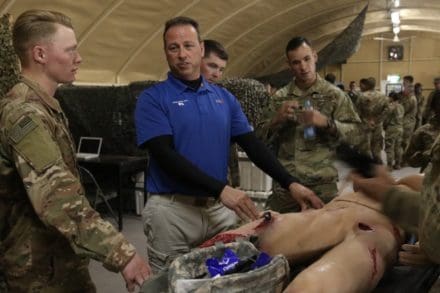
The mannequin, named the Tactical Combat Casualty Care Exportable, or TC3X, simulates the three main causes of death on the battlefield: airway obstruction, tension pneumothorax and blood hemorrhage, commonly referred to as the “ABC’s” — airway, breathing, and circulation. The TC3X is fully animatronic and effectively simulates the ABC’s through a heavily-monitored internal system, giving feedback to the soldiers through physical movements and vocalizations.
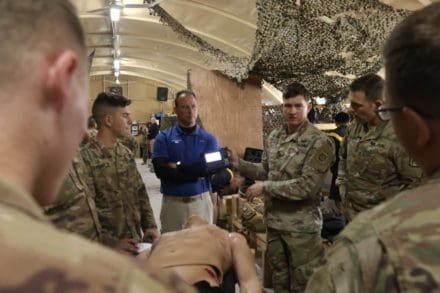
The movements and vocalizations can be set and controlled by an operator before the training takes place. The controller has a variety of scenarios built in with spaces for custom scenarios. Scenarios range from bullet wounds and shrapnel damage to head trauma and full amputations, requiring soldiers to act accordly in real time.
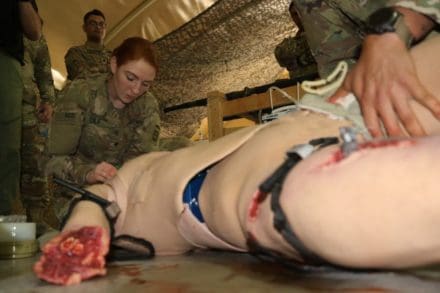
“You should definitely treat it like you would treat a human,” said Lt. Col. Rickardo Christopher, Product Manager of Medical Simulation, U.S. Army Program Executive Office for Simulation, Training, and Instrumentation. “If you don’t apply correct pressure to the wound, it’ll keep bleeding just like a real human being.”

The mannequin is built to withstand dust, dirt, mild moisture and variations in temperature, necessary for field-operations training.
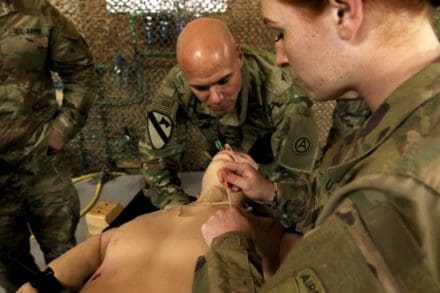
“You’re working with a high fidelity mannequin, but it is robust,” said Higman. “Do not be afraid to work with the mannequin, in terms of deploying it or taking it to the field. We do not want the medics to have any inhibitions on checking it out.”

“You have to use what you have to get better,” said Christopher. “This mannequin sets the condition for soldiers to increase their overall medical readiness.”

To check out a TC3X for use in training, see the TASC on post to see if and when they are available.

By PFC Andrew Zook

Army Scientists Create Innovative Quantum Sensor – Covers Entire RF Spectrum

Saturday, March 21st, 2020

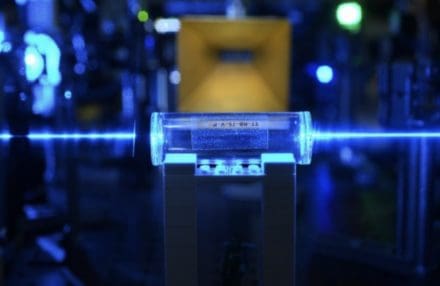
ADELPHI, Md. — A quantum sensor could give Soldiers a way to detect communication signals over the entire radio frequency spectrum, from 0 to 100 GHz, said researchers from the Army.

Such wide spectral coverage by a single antenna is impossible with a traditional receiver system, and would require multiple systems of individual antennas, amplifiers and other components.

In 2018, Army scientists were the first in the world to create a quantum receiver that uses highly excited, super-sensitive atoms–known as Rydberg atoms–to detect communications signals, said David Meyer, a scientist at the U.S. Army Combat Capabilities Development Command’s Army Research Laboratory. The researchers calculated the receiver’s channel capacity, or rate of data transmission, based on fundamental principles, and then achieved that performance experimentally in their lab–improving on other groups’ results by orders of magnitude, Meyer said.

“These new sensors can be very small and virtually undetectable, giving Soldiers a disruptive advantage,” Meyer said. “Rydberg-atom based sensors have only recently been considered for general electric field sensing applications, including as a communications receiver. While Rydberg atoms are known to be broadly sensitive, a quantitative description of the sensitivity over the entire operational range has never been done.”

To assess potential applications, Army scientists conducted an analysis of the Rydberg sensor’s sensitivity to oscillating electric fields over an enormous range of frequencies–from 0 to 10^12 Hertz. The results show that the Rydberg sensor can reliably detect signals over the entire spectrum and compare favorably with other established electric field sensor technologies, such as electro-optic crystals and dipole antenna-coupled passive electronics.

“Quantum mechanics allows us to know the sensor calibration and ultimate performance to a very high degree, and it’s identical for every sensor,” Meyer said. “This result is an important step in determining how this system could be used in the field.”This work supports the Army’s modernization priorities in next-generation computer networks and assured position, navigation and timing, as it could potentially influence novel communications concepts or approaches to detection of RF signals for geolocation.

In the future, Army scientists will investigate methods to continue to improve the sensitivity to detect even weaker signals and expand detection protocols for more complicated waveforms.

The Journal of Physics B published the research, “Assessment of Rydberg atoms for wideband electric field sensing,” in its special issue on interacting Rydberg atoms. Army scientists David H. Meyer, Kevin C. Cox and Paul D. Kunz led this research, as well as Zachary A. Castillo from the University of Maryland. This work was supported by the Defense Advanced Research Projects Agency.

By US Army CCDC Army Research Laboratory Public Affairs

Special Tactics Airman Involved In Fatal Swim Training Incident Identified

Saturday, March 21st, 2020

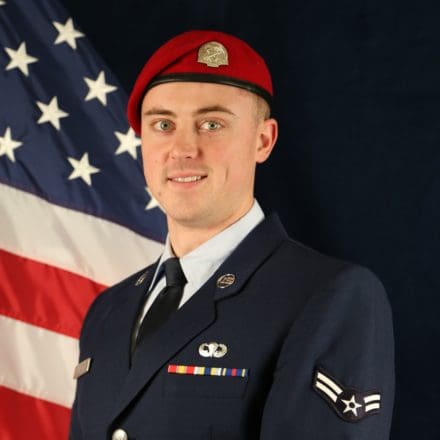
HURLBURT FIELD, Fla. – Airman First Class Keigan Baker, 24, an Air Force Special Tactics combat controller assigned to the Special Tactics Training Squadron, 24th Special Operations Wing, was found unresponsive after he went missing during a surface training swim at Naval Support Activity Panama City, Florida, Thursday.

Baker was taking part in the Air Force Combat Dive Course run by Air Education and Training Command’s Special Warfare Training Wing headquartered at Joint Base San Antonio-Lackland.

“This is devastating loss to the entire Special Tactics community,” said U.S. Air Force Col. Matthew Allen, commander of the 24th SOW. “We are very grateful for Keigan’s willingness to serve our nation and vow to honor his memory.”

The agencies that contributed to the search and recovery efforts include: The Naval Diving and Salvage Training Center, U.S. Coast Guard Station Panama City, Bay County Sheriff’s Office, The Florida Fish and Wildlife Conservation Commission and other sister service dive units.

Baker enlisted in the United States Air Force in June 2018 and was recognized as an Honor Graduate at Basic Military Training. After BMT, he immediately entered the two-year combat control training program. Shortly after being assigned to STTS he left to attend the Special Warfare Pre-Dive course at Joint Base San Antonio-Lackland, followed by the Air Force Combat Dive Course at Naval Support Activity Panama City, Florida.

The Air Force Combat Dive Course teaches students diving fundamentals through open circuit self-contained underwater breathing apparatus (SCUBA) training and closed circuit underwater breathing apparatus (UBA) training. Students learn basic diving, advanced rescue diving principles and advanced combat diving fundamentals. Upon completion of the course, students are certified Special Operations Command (SOCOM) combatant divers.

“Keigan’s loss is felt across the entire training wing, where the safety of our trainees is our top priority,” said U.S. Air Force Col. Parks Hughes, commander of the Special Warfare Training Wing. “We are grateful to all the agencies that assisted with the search and recovery effort.  Our thoughts and prayers are with Keigan’s family, friends and teammates.”

The Longview, Washington native was a graduate of Mark Morris High School. He then received his Bachelors of Arts Degree in Business Administration from Eastern Washington University. 

His awards and decorations include: Air Force Good Conduct Medal, Air Force Basic Military Training Honor Graduate Ribbon, The Air Force Training Ribbon and the Global War on Terrorism Service Medal.

As a Special Tactics combat controller apprentice, Baker was training to deploy into combat zones to conduct reconnaissance, global access, precision strike and personnel recovery operations.

The incident is currently under investigation. For further queries on the incident and training please reach out to the Special Warfare Training Wing at SWTW.Public.Affairs@us.af.mil

FirstSpear Friday Focus – Built For The X

Friday, March 20th, 2020

FirstSpear has just announced a promo code is now live on the website for 10% purchases until next Friday. Just enter B4TX at checkout!

First-spear.com

Tune In Each Monday For The MATBOCK Webinar

Thursday, March 19th, 2020

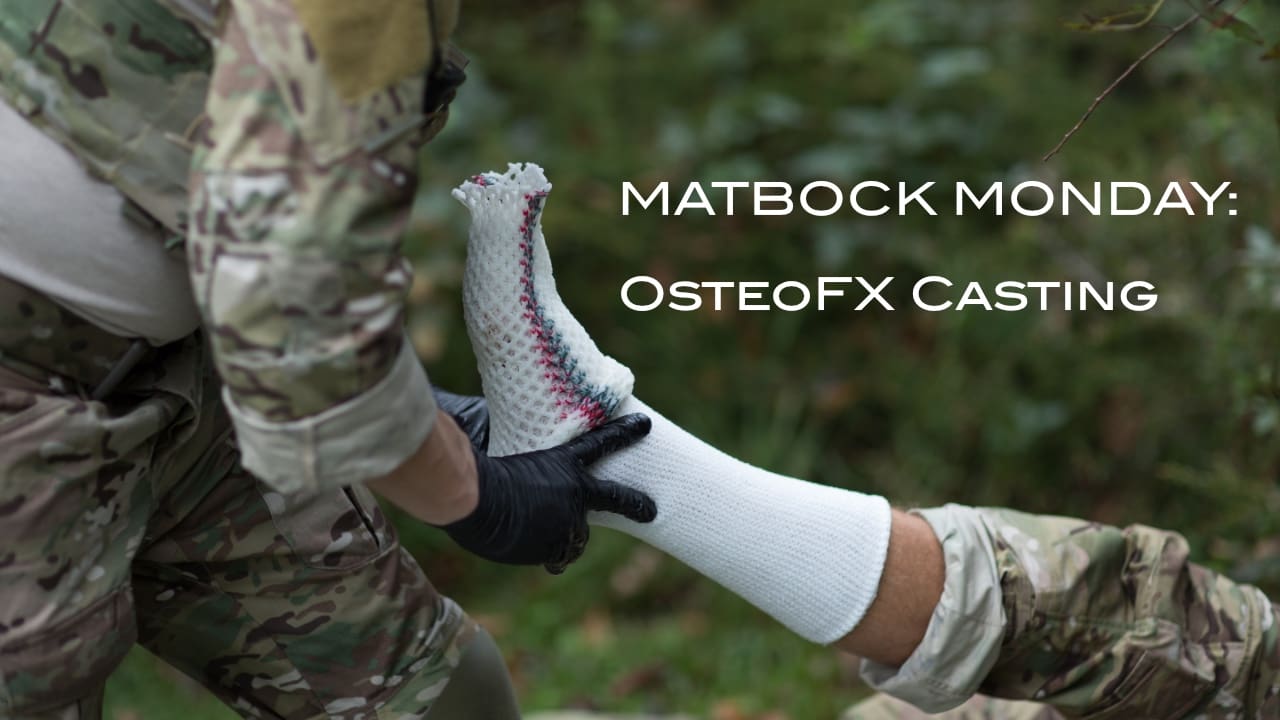
Starting Monday 23 March at 4:30pm Eastern Time, MATBOCK will be hosting a weekly webinar, which will also be live streamed on Facebook & YouTube. Each week they are going to cover one product,. Plus, there will be time for Q&A.

We hope you will join us:

When: Mar 23, 2020 04:30 PM Eastern Time (US and Canada)

This will repeat every Monday

Please download and import the following iCalendar (.ics) files to your calendar system.

Weekly: zoom.us

Topic: MATBOCK Monday: OsteoFX Casting

Please click the link below to join the webinar:

zoom.us/j/575186371

Or iPhone one-tap :

US: +16465588656,,575186371#  or +13126266799,,575186371#

Or Telephone:

Dial(for higher quality, dial a number based on your current location):

US: +1 646 558 8656 or +1 312 626 6799 or +1 301 715 8592 or +1 346 248 7799 or +1 669 900 9128 or +1 253 215 8782

Webinar ID: 575 186 371

    International numbers available: zoom.us/u/adxLgwySq1

This webinar will also be live on Facebook & YouTube. The webinars will also be published on various soical media channels to view later, if you miss one of the weekly webinars.



US Army G-2: Intel, Cyber Soldiers ‘Duking It Out’ Daily With Enemy

Thursday, March 19th, 2020

ARLINGTON, Va. — The Army’s senior intelligence officer likened intelligence and cyber Soldiers to those in the combat arms since they fight on networks everyday with adversaries.

“Our intelligence professionals and our cyber operators are duking it out,” Lt. Gen. Scott Berrier said. “I kind of think of ourselves, cyber and military intelligence, as sort of combat arms. I know it’s hard to get your head around that, but we’re the ones who are kind of doing that right now.”

Berrier spoke Wednesday as part of the Association of the U.S. Army’s breakfast series on threats the Army is facing in today’s era of great power competition.

RUSSIA

Since the end of the Cold War, the general said Russia has transformed its army to be smaller with new capabilities that it has been able to test in operations in nearby countries.

Using those lessons, he said Russia now uses those capabilities in Syria, which include air and air defense, precision targeting, special operations and contract forces, and intelligence, surveillance and reconnaissance, or ISR.

The capabilities have also created standoff for Russia as it presses back against NATO presence in Europe, he said.

“We’re watching that very, very closely,” Berrier said. “[We] don’t think [Russia] wants to get in a toe-to-toe fight with the U.S. [It] wants to be regionally dominant and to be a global player.”

CHINA

In the Pacific, he said China aims to be a global economic hegemony by 2049, and at same time gain military parity with the U.S. to push American forces out of the region.

“It really [wants] to establish a new world order,” Berrier said. “They are jealous of the economic system that we have.”

The general added that China would one day like to see its currency, the yuan, replace the U.S. dollar as the global currency.

To achieve its ends, China has started to militarize islands in the South China Sea, creating an effective defensive line.

China “would like to control everything out to the first and second island chain and just keep us out,” Berrier said.

Similar to Russia, China has reorganized its army to be smaller with new capabilities in air and air defense, space and ISR using intellectual property it illegally obtained.

“Much of the modernization that [its] been able to accomplish is with technology that [was] stolen from us and our partners,” Berrier said.

China has also carried out a reversal of the Marshall Plan, he said, by going into countries struggling financially and paying off their debt and building infrastructure. As a result, China then sort of owns that country and can place forces and capability inside of it, he said.

“We’ve seen this play out across Africa, we’ve seen it play with our Middle Eastern partners, we’ve seen it play in South America,” he said.

The general noted that by doing this China is also trying to connect markets to its own.

MODERNIZATION

The U.S. Army’s modernization priorities and multi-domain operations doctrine is currently tackling these near-peer threats, he said.

“The modernization that we’re doing for Russia and the modernization that we’re doing for China really will do the same thing for us in both theaters,” he said.

The Army is putting together multi-domain task forces that have I2CEWS — intelligence, information, cyber, electronic warfare and space capabilities — that will allow Soldiers to punch through enemy frontlines.

They “will help us in that boxer stance and be able to get inside, penetrate the ability that they have to keep us out,” he said.

Once complete, multi-domain operations will be backed up by “multi-domain intelligence.”

“So if you want to do MDO, you have to do MDI,” he said. “And in MDI in the future it’s all about the data and how we process and how we pull [artificial intelligence] into that.”

Army intelligence plans to have three layers of upgraded capabilities at the terrestrial, aerial and space levels.

At the terrestrial level, brigades will receive more capability that combines signal, intelligence, electronic warfare and cyber assets.

In the air, he noted, the Army will need a new platform that goes higher and can sense deeper.

And for space, the Army looks to work with its partners to take advantage of assets, whether they’re owned by the government or commercial satellites, to carry out long-range precision fires in coordination with aerial and terrestrial systems.

“Think of this sensor grid, from space to mud, that is connected through multi-domain intelligence using and fusing data at the speed of combat operations,” he said.

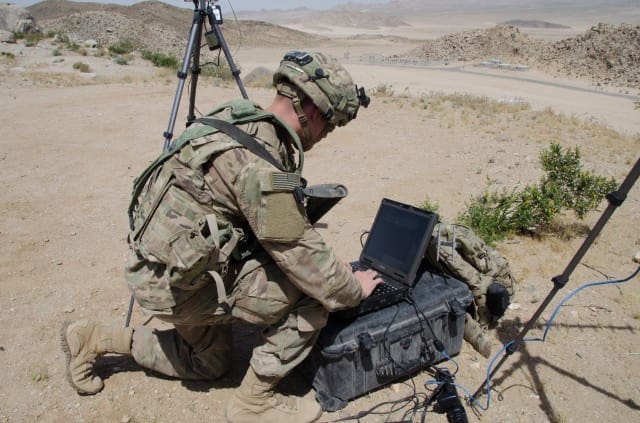
Known as TITAN, the Tactical Intelligence Targeting Access Node is a scalable and expeditionary intelligence ground station that leverages space, aerial and terrestrial sensors.

A TITAN space prototype, which is expected to be delivered by fiscal year 2022, is being developed to provide targetable data from these sensors to fire networks.

“TITAN is going to be the ground station that replaces a number of these systems that we have today [and] is central to all of it,” he said.

Story by Sean Kimmons, Army News Service

Photos by Bill Roche, US Army & Luc Dunn, AUSA


ADS Talks Pandemic Response Preparedness: COVID-19

Wednesday, March 18th, 2020

ADS Inc has posted an article detailing the products they have available. Here’s a little bit of the article:

Through thousands of long-standing supplier relationships, we quickly find and deliver the equipment you need to do your job—safely. ADS, Inc. has compiled the following list of products geared toward military and first responder pandemic responses. This is just a sampling of the tens of thousands of products we offer. If you don’t see what you’re looking for, just ask.

Because these products are in high demand, ADS will quote and source these products to the best of or ability. Due to the strain on the supply chain, orders may be canceled. We will do our best to find an alternative.

ADS provides operational equipment exclusively to the U.S. and allied Armed Forces, first responders, vetted government contractors, emergency responders and officers. We cannot sell to civilians.

Whether you have funding or need it, ADS is a prime on over 65 contracts and has the power to move your requirement forward.

Check out the full details, including the list of products at adsinc.com/pandemic-response-preparedness-covid-19.


New Error Correction Method Provides Key Step Toward Quantum Computing

Monday, March 16th, 2020

RESEARCH TRIANGLE PARK, N.C. — An Army project devised a novel approach for quantum error correction that could provide a key step toward practical quantum computers, sensors and distributed quantum information that would enable the military to potentially solve previously intractable problems or deploy sensors with higher magnetic and electric field sensitivities.

The approach, developed by researchers at Massachusetts Institute of Technology with Army funding, could mitigate certain types of the random fluctuations, or noise, that are a longstanding barrier to quantum computing. These random fluctuations can eradicate the data stored in such devices.

The Army-funded research, published in Physical Review Letters, involves identifying the kinds of noise that are the most likely, rather than casting a broad net to try to catch all possible sources of disturbance.

“The team learned that we can reduce the overhead for certain types of error correction on small scale quantum systems,” said Dr. Sara Gamble, program manager for the Army Research Office, an element of U.S. Army Combat Capabilities Development Command’s Army Research Laboratory. “This has the potential to enable increased capabilities in targeted quantum information science applications for the DOD.”

The specific quantum system the research team is working with consists of carbon nuclei near a particular kind of defect in a diamond crystal called a nitrogen vacancy center. These defects behave like single, isolated electrons, and their presence enables the control of the nearby carbon nuclei.

But the team found that the overwhelming majority of the noise affecting these nuclei came from one single source: random fluctuations in the nearby defects themselves. This noise source can be accurately modeled, and suppressing its effects could have a major impact, as other sources of noise are relatively insignificant.

The team determined that the noise comes from one central defect, or one central electron that has a tendency to hop around at random. It jitters. That jitter, in turn, is felt by all those nearby nuclei, in a predictable way that can be corrected. The ability to apply this targeted correction in a successful way is the central breakthrough of this research.

The work so far is theoretical, but the team is actively working on a lab demonstration of this principle in action.

If the demonstration works as expected, this research could make up an important component of near and far term future quantum-based technologies of various kinds, including quantum computers and sensors.

ARL is pursuing research in silicon vacancy quantum systems which share similarities with the nitrogen vacancy center quantum systems considered by the MIT team. While silicon vacancy and nitrogen vacancy centers have different optical properties and many basic research questions are open regarding which type(s) of application each may be ultimately best suited for, the error correction approach developed here has potential to impact both types of systems and as a result accelerate progress at the lab.

By U.S. Army CCDC Army Research Laboratory Public Affairs