FirstSpear

Archive for the ‘Guest Post’ Category

FirstSpear Friday Focus – FirstSpear Launches iPhone/ Android App

Friday, March 29th, 2019

FirstSpear has always stayed on the cutting edge of personal protective equipment technology and now they are enhancing ways customers can access new information on equipment all the way through the purchasing phase. Also included free in the application is quick access to FirstSpear TV entertainment content, all you do is click the Watch button in App. Download now in the apple store or get it on google play!

Download for Apple

Download for Android

See more content like this in the FirstSpear App!

Brigantes Presents – High Angled Solutions – The Nordic Pocket Saw

Wednesday, March 27th, 2019

An active outdoor lifestyle and enjoying all that the outdoors has to offer, requires products developed for harsh conditions.


New for 2019, The Nordic Pocket Saw has added the premium Edition to its saw repertoire, where its handles and case are hand made in Sweden and the leather is 100% Swedish and Organic.

It is low weight, high packability and raw power. That is what signifies Nordic Pocket Saw and makes it an essential companion for your outdoor adventures. It can be held in your fist and weighs in at just 132g. The chain is made from heat treated high carbon steel which is ideal for blades and specially developed for resilience under harsh conditions. This saw chain isn’t like a normal powered chainsaw chain, with all the teeth pointing in the same direction, this has teeth pointing both ways so that you cut in both directions, making this a tool that cuts and clears the material at the same time so the cut and saw stays clean.

If you are looking for a tool to stand the test of the rugged Nordic outdoors, the Nordic Pocket Saw is compact, lightweight, solidly made wood cutting tool, with straight forward design and function which makes it an ideal choice for military and woodsmen alike.

Marines Perform ‘Arduous’ Evaluation of New Grenade Launcher

Tuesday, March 26th, 2019

MARINE CORPS BASE QUANTICO, Va. —

The Marine Corps plans to introduce a new weapon intended to enhance the lethality of infantry Marines on the battlefield.

The M320A1 is a grenade launcher that can be employed as a stand-alone weapon or mounted onto another, such as the M27 Infantry Automatic Rifle. Scheduled to be fielded in fiscal year 2020, the system will give fleet Marines the ability to engage with enemies near and far, day or night.

“The M320A1 will provide good range and accuracy, making the infantry squad more lethal,” said Lt. Col. Tim Hough, program manager for Infantry Weapons in Marine Corps Systems Command’s Ground Combat Element Systems.

The functionality of the M320A1 makes it unique, said Hough. Its ability to be used as a stand-alone or in conjunction with a firearm should help warfighters combat enemy forces. The weapon will replace the M203 grenade launcher, currently employed by Marines.

“The mounted version of the M320A1 is a capability we’re currently working on so that Marines have that option should they want it,” added Hough.

Before the Marine Air-Ground Task Force receives the M320A1, the Corps must draft technical documents for the weapon. These publications provide Marines with further information about the system.

In early March, Ground Combat Elements Systems collaborated with fleet maintenance Marines and logisticians from Albany, Georgia, conducting various analyses to determine provisioning, sustainment and new equipment training requirements for the system.

The first evaluation was a Level of Repair Analysis, or LORA. A LORA determines when a system component will be replaced, repaired or discarded. This process provides information for helping operational forces quickly fix the weapon should it break.

The LORA establishes the tools required to perform a task, test equipment needed to fix the product and the facilities to house the operation.

“It’s important to do the LORA now in a deliberate fashion so that we don’t do our work in front of the customer,” explained Hough. “And it ensures the system they get is ready to go, helping them understand the maintenance that must be done.”

The second evaluation was a Job Training Analysis, which provides the operational forces with a training package that instructs them on proper use of the system to efficiently engage adversaries on the battlefield.

“This process helps us ensure this weapon is both sustainable and maintainable at the operator and Marine Corps-wide level,” said Capt. Nick Berger, project officer in Infantry Weapons at MCSC. “It sets conditions for us to field the weapon.”

Analyses supports sustainability

Sustainability is a key factor in any systems acquisition process. The goal of the LORA and Job Training Analysis is to ensure the operator and maintenance technical publications of a system are accurate, which reduces operational ambivalence and improves the grenade launcher’s sustainability.

The LORA is an ongoing process that continues throughout the lifecycle of the M320A1 to establish sustainability, said Hough. After fielding the M320A1, the Corps will monitor the system to ensure it is functioning properly.

During this time, the program office will make any adjustments and updates necessary.

“We’re looking to have the new equipment training and fielding complete prior to fourth quarter of FY19 to ensure they can be used and maintained properly once they hit the fleet,” said Berger.

The analyses, which occurred over the course of a week, were no easy task.

“This was an extensive and arduous process,” explained Hough. “We scheduled three days for the LORA—all day—so you’re looking at about 24 hours of work for the LORA. And that doesn’t include reviews, briefs and refinements to the package.”

However, at the end of the week, Hough expressed gratitude for all parties involved in the M320A1 analyses, which he called a success. He said the tasks could not have been completed without the help of several key individuals.

“I will tell you what’s noteworthy is working with our contract support, the outside agencies and the deliberate efforts by our team—specifically Capt. Nick Berger and Steve Fetherolf, who is a logistician,” said Hough. “Those two have made a significant effort to get this together and move forward.”

Berger also expressed pride about the accomplishments of the analyses.

“This week has been a success,” he said. “We got the system in Marines’ hands, worked out the kinks and began to understand how we’re going to use this moving forward.”

By Matt Gonzales, MCSC Office of Public Affairs and Communication | Marine Corps Systems Command
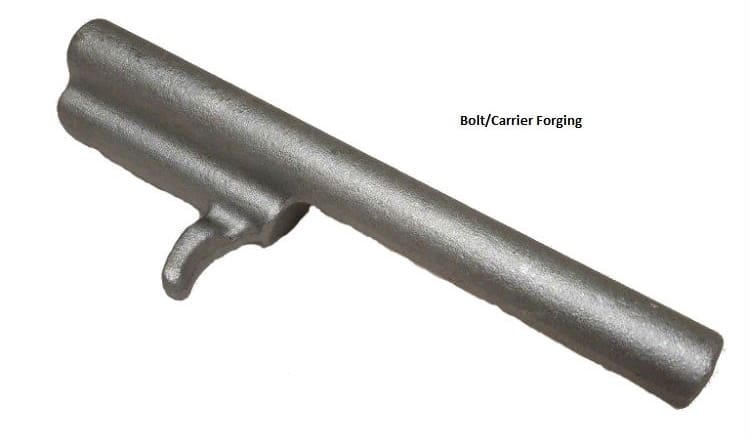
Photo of Marine firing M230A1 by LCpl Taylor W Cooper.

Max Talk Monday: Texas Class 2019 Break Contact Flank (Right) Team Drill

Monday, March 25th, 2019

This is the fifteenth installment of ‘Max Talk Monday’ which shares select episodes from a series of instructional videos. Max Velocity Tactical (MVT) has established a reputation on the leading edge of tactical live fire and force on force training. MVT is dedicated to developing and training tactical excellence at the individual and team level.

Break Contact Flank (Right) Team Drill is video footage of a team break contact drill conducted at the Texas Class 2019. This was a team level live fire training exercise with simulated enemy to the right side of the trail. As some are likely to point out, the team was moving on a trail, and a rolling (multi-target) contact is simulated from the right side, in order to keep the peel going for longer for training benefit. Utilizing a trail is an effective training aid because the route in is clearly markedly / recognizable; moving back along same is the drill for getting out of the contact – back along the route already traveled. The drill shown is the immediate action drill, which can be subsequently modified by leadership if required due to increased complexity of the situation. However, it is important to have a drilled, violent, effective immediate action drill to maximize the chances of surviving a contact such as this.

MVT Tactical Manual

Max is a tactical trainer and author, a lifelong professional soldier with extensive military experience. He served with British Special Operations Forces, both enlisted and as a commissioned officer; a graduate of the Royal Military Academy Sandhurst. Max served on numerous operational deployments, and also served as a recruit instructor. Max spent five years serving as a paramilitary contractor in both Iraq and Afghanistan; the latter two years working for the British Government in Helmand Province, Afghanistan. 

Website: Max Velocity Tactical

YouTube: Max Velocity Tactical

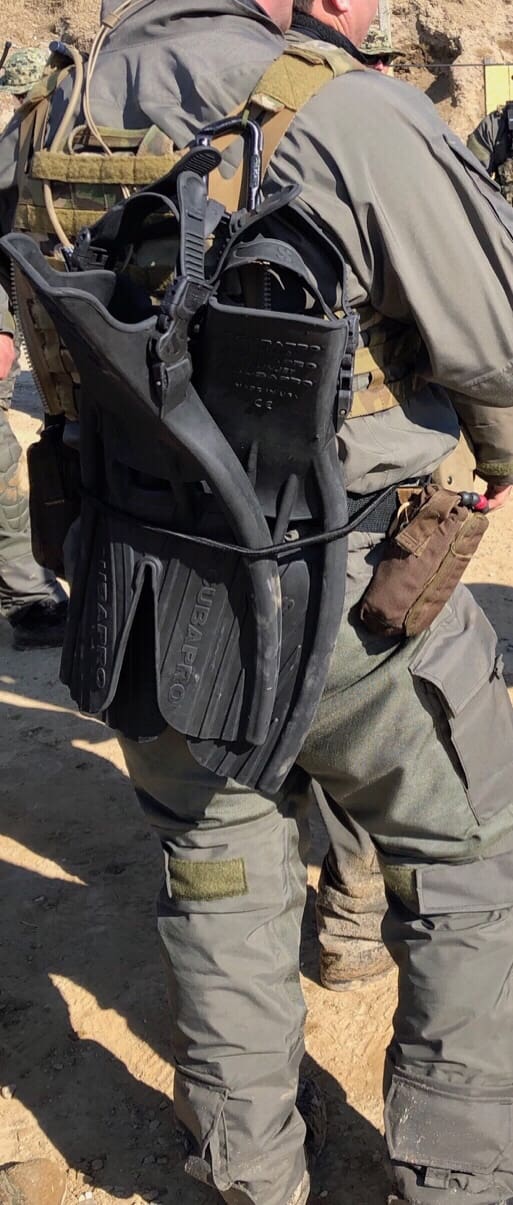
SCUBAPRO Sunday – Hand signals

Sunday, March 24th, 2019

Good communication is crucial when diving with someone you never have dove before with. You can always use Dräger talk, but sometimes that doesn’t work that well. There are universal hand signals very similar to the hand and arm signals when patrolling.  



There are a lot of different hand signals, used by divers especially in different fields of diving. However, with some basic hand signals, you can dive with anyone in the world.  


Going Up or Down

Use a thumbs up signal to indicate that you are going up, or a thumbs down to indicate the opposite.

I’m Okay

Place your thumb and forefinger together forming a circle and leave the other three fingers extended upright. This is the same as you would say OK as you would above water.

Stop

Signal your dive buddy to stop by holding up one hand; the same as you would in any other instance. You can also use a closed fist like being on patrol.

Changing Direction

Just like with up and down, point your thumb (or your index finger) to indicate which direction you’re heading. You can point again like on land

Turn Around

To let everyone know it’s time to turn around, put your index finger up and rotate in a circle. Similar to rally-up.

Slow Down

Place your hand in front of you with your palm facing down. Wave your hand up and down to indicate that you need everyone to slow down a bit.

Level Off

To indicate that you want to level off once you’ve reached a certain depth, put your hand out in front of you, palm down, and wave it back and forth.

Something’s Wrong

Place your hand out in front of you, fingers spread and palm down. Wave your hand back and forth in a rocking motion. It is similar to the hand signal maybe.  

Help!

Wave your entire arm from outstretched by your side to over your head. Repeat the motion as long as you need to.

I’m Low on Air

It takes practice to be able to make your air last. Clench your hand into a fist and pull it in toward your chest. Repeat as much as you need to indicate how urgently you need to resurface. When diving a rebreather, you should point at the pressure gauge. With some of the newer rebreathers, you can pull your gauge out and show it to your dive buddy if needed.  

I’m Out of Air

If something has gone wrong with your equipment, signal quickly and repeatedly. Place your hand, palm down in front of your throat and move back and forth in a cutting motion.

You can always pull on your buddy-line to get your buddies attention, and once you have dived a couple of times together, you will start to understand what each other wants and needs. Diving at night or in low-viability is way different than diving in the day time in clear water. Sometimes diving in real lousy visibility in the day time is worse than diving at night. So, knowing how to communicate is very important. Bottom line is as long as you and your dive buddy understand what you are saying to each other you should be good. So, make sure you at least talk to the person your diving with to have the basic’s down.


New Marksmanship Test Aims To Create More Realistic Environment

Sunday, March 24th, 2019

CAMP GUERNSEY, Wyo. — While it hasn’t received as much attention as the new Army physical fitness evaluation, the 40 targets on the rifle marksmanship range are also about to be engaged in a more combat-focused manner.

Soldiers from the Wyoming Army National Guard’s C Company, 1st Battalion, 297th Infantry Regiment (Forward) were the first to try out the new test at Camp Guernsey Joint Training Center as part of pre-deployment training that will require them to conduct the proposed analysis two more times this year.

The new marksmanship test has been undergoing evaluations and changes for about two years, primarily by the active duty’s airborne infantry units, and is slated to become the Army-wide standard for rifle marksmanship qualification in the fiscal year 2020.

“It’s a lot more functional and realistic, integrating more of a rifleman’s tasks,” said Staff Sgt. Zach Semmons, a squad leader with 1/297th. “You have to maintain situational awareness, keep a round count, and execute combat magazine changes, all while engaging the targets.”

According to an Army Times article from Jan. 17, 2018, Brig. Gen. Christopher Donahue, commandant of the U.S. Army Infantry School, said the proposed changes are all aimed at increasing Soldier lethality and presenting a more realistic shooting environment based on what the Army has seen in 16 years of combat.

As it sits now, the new weapons qualification will feature four shooting positions–prone unsupported, prone supported, kneeling supported, and standing supported. Soldiers are issued four 10-round magazines, to engage 40 pop-up targets from the four shooting positions. Some iterations will show three or four targets at a time, forcing Soldiers to be extremely focused.

Sgt. Sol Griffith, a fire team leader with the Afton-based infantry company, said the unit will conduct the qualification with its parent unit in Alaska soon, and again during mobilization training at Fort Bliss, before deploying overseas this year.

During the March 7 training day, Griffith demonstrated the test for his comrades before they conducted the current qualification for their annual records when they concluded that test, the rest of the unit tried out the future test.

Spc. Lance Pierce, a target systems repairer, assigned to Camp Guernsey’s Training Center Command, learned about the new standard last year while attending a course at Training Center University, and built a software program that would run the test and the targets at Camp Guernsey.

“This is the first unit to try it out,” he said before the demonstration. “No one had any use for the program until now.”

“Now you have three or four targets up at the same time, and you have to transition between them very thoughtfully,” said Griffith. “It’s not like it was with someone yelling what target is coming up. Plus, the tower doesn’t tell you when to do a (magazine) change. You have to know when to do it, and then, do it.”

The new standard is going to be difficult for a lot of shooters, even those who hold the rifleman occupational specialty. For instance, the range noncommissioned officer in charge announced from the tower’s public address system that Griffith hit 22 of the 40 targets during the demonstration. “Sgt. Griffith usually hits 40 out of 40,” the tower announcer added.

As for the rest of the unit, Semmons said about half the Soldiers met the minimum qualifying standard of 23 hits, and a 32 was the high score of the practice round.

“It was the first time trying it for most of them,” he said. “But, I think it went extremely well, and they were very receptive to it. They liked the mag change and engaging more targets.”

By Sgt. 1st Class James McGuire, Wyoming National Guard

Kit Badger – Pros and Cons of Security Contracting

Friday, March 22nd, 2019

Ivan from Kit Badger goes over the ups and down of working for a private security contractor.

Read all about it at kitbadger.com/pros-and-cons-of-security-contracting.

FirstSpear Friday Focus – Noveske Discreet Rifle Bag

Friday, March 22nd, 2019

This Friday we are taking a look at a popular low vis rifle bag from FirstSpear originally designed at the request of Noveske Rifleworks.

Utilizing varied colors and more commercial material applciations this backpack offers a very soft look with the design and strength to support and quickly deploy a short barreled rifle or sub gun.

Features an exterior beaver tail style pocket with adjustable straps to secure another bag or loose clothing. The bag also features a hidden pocket as well attachment points on the inside of the bag to secure pockets as well as the included accessories to secure the rifle inside the bag.

Dimensions: 28¼” x 13 ¼” x 5″

Made in the USA with USA Materials

www.first-spear.com/noveske-discreet-backpack