SIG SAUER - Never Settle

Archive for the ‘Guest Post’ Category

FirstSpear Friday Focus – OEM Partner Series, Triad Tactical Rifle Forend Wrap

Friday, April 5th, 2019

Today’s Friday Focus marks yet another installment in the FirstSpear OEM Partner series, where we take a look at one of FirstSpear’s Industry OEM partners and one of the products FirstSpear manufacturers for them. We revisit Triad Tactical and their Rifle Forend Wrap.

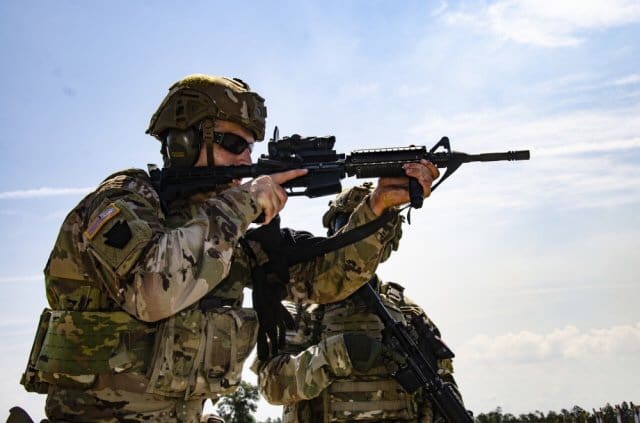
Constructed with a low profile loop bonded to a rubberized hypalon provides an exceptional amount of traction, friction, and padding on the foreend of any rifle. The RFW is non-slip, providing extra grip in your hand, even when wet. When held against a hard material like a barricade, wall, tree or rock, the RFW reduces movement when shooting, allowing for better shot placement and follow-up shots.

The RFW is made of a rubberized material that is bonded to the soft/loop side of Velcro. The wraps can be mounted using the strips of sticky backed Velcro (provided) or with the shoelace option(the small size is Velcro only, no shoelace option). The RFW can also be trimmed by the user to create cut-outs for bipod studs, pic rail etc.

Designed by Triad Tactical and Made in the USA with USA Materials by FirstSpear.

triadtactical.com/rifle-forend-wrap

To learn more about becoming a FirstSpear OEM Partner visit first-spear.tech.

Natick Engineer Has Dedicated Career to Improving Helmets for the Warfighter

Thursday, April 4th, 2019

NATICK, Mass. — Sometimes you need to put on your thinking cap to develop the best helmets for warfighters.

Scott Bennet has spent decades doing just that. Bennet has spent most of his nearly 30-year career improving helmets for the warfighter, and he is an expert in helmet design and capabilities.

Bennet is a project engineer in the Soldier Protection and Survivability Directorate at the Combat Capabilities Development Command Soldier Center. The CCDC SC supports the Soldier Lethality-Cross Functional Team, or SL-CFT, priorities. The center’s science and engineering expertise are combined with collaborations with industry, DOD, and academia to advance Soldier and squad performance optimization, readiness, and lethality — as well as synthetic training environments.

During his long career, Bennet has worked on the Personnel Armor System for Ground Troops combat helmet, or PASGT helmet, the Advanced Combat Helmet, or ACH, and the Enhanced Combat Helmet, or ECH. Bennet currently supports and is entirely funded by the Marine Corps System Command’s Program Manager Infantry Combat Equipment, or PM ICE, the organization for which he worked on the ECH. The CCDC SC provides technical support to these and several other PM offices.

The ECH is credited with playing a large role in saving the life of Staff Sgt. Steven “Bryan” McQueen, who was serving in Afghanistan. Officials from Program Executive Office Soldier returned the helmet to McQueen in a recent Personal Protective Equipment Return ceremony.

Bennet is proud of his role in the ECH, as well as other helmets.

“Part of my job is to write the performance requirements for the helmet specifications that the contractors build to,” said Bennet. “User requirements, what the helmet needs to do, come directly from the warfighters. The helmet performance specifications are designed to meet those needs. The helmets go through a variety of rigorous tests. It feels good to know that I’m involved with something worthwhile — something that saves lives.”

In addition to the Marine Corps, in the past, Bennet has supported Army Product Managers, including Product Manager Soldier Protective Equipment, or PM SPE, part of PEO Soldier.

Bennet worked on the ACH while supporting PM SPE.

“I was their helmet engineer,” said Bennet.

A few years ago, Staff Sgt. Ty Carter, a Medal of Honor recipient, visited Natick and spoke to the workforce. During his talk, Carter mentioned the ACH. Carter recounted how the ACH saved Sgt. Bradley D. Larson from sniper fire in Afghanistan. Because Larson survived, he was able to provide fire cover and give Carter direction. Carter credited Larson’s survival with his own.

Ever-modest, Bennet is quick to point out that he is just one of many folks at the CCDC SC working hard for the warfighter.

Nevertheless, Bennet’s long-term experience and knowledge of how helmet technologies have evolved make him invaluable. Because of his extensive background knowledge, he knows what realities drove requirement creation and how warfighter battlefield needs have changed over time.

“Scott Bennet has been supporting the Marine Corps ECH program since the beginning, and he played a central role in DOD helmet development long before that,” said Nick Pierce, Individual Armor team lead, Marine Corps Systems Command, headquartered in Quantico, Virginia. “His presence at Natick, where Army and Marine Corps technical support sit side-by-side, and his long-standing relationships throughout the helmet community have been critical to our progress. He is a big part of why some Marines and Soldiers are still alive today.”

Story by Ms. Jane Benson (CCDC SC). Photo by Mr. David Kamm (CCDC SC).

Brigantes Presents – High Angled solutions – Snigel Designs – Beast Pack Board

Wednesday, April 3rd, 2019

The Beast Pack Board solves countless carrying needs ranging from ammunition and weapons through containers and bulky items to oddly shaped burdens not easily fitted into a regular backpack.

Featuring the same proven and sturdy carrying harness as the classic Snigel 90/120 Litre Backpack, the Beast Pack Board will stand up to heavy loads while still being ergonomic, comfortable and fast to handle.

The Pack Board is developed with tactical considerations in mind and is excellent for burdens such as e.g. 84mm munition cases, 60mm and 81mm mortars. There is a dedicated bottom hole for wider barrel ends securing the burden centered and close to the carrier. The inside of the pack board flap is protected by Hypalon™ CSM, rendering a tough lining also resistant to chemicals, temperature extremes, and ultraviolet light.

Each Pack Board is delivered with a set of long, sturdy straps to cover almost any need conceivable. In addition there are PALS/MOLLE webbings all over the Pack Board and the belt, where straps, pouches and packs will further extend the versatility of this excellent carrier.

For sales contact international@brigantes.com

For UK sales contact warrior@brigantes.com


MCTSSA Personnel Help Strengthen Acquisition Workforce

Tuesday, April 2nd, 2019

CAMP PENDLETON, Calif.—On a rather secluded and undeveloped piece of southern California coastline lies a succession of nondescript buildings that seem unremarkable to the naked eye. Yet, inside these structures, sophisticated laboratories are housed with highly skilled engineers and technical experts testing the very limits of battlefield communications, and they need to train their replacements.

Building the future acquisition workforce is an important initiative within the Department of the Navy, which is why Marine Corps Tactical Systems Support Activity personnel provided technical demonstrations and briefings to approximately 80 Naval Acquisition Development Program entry-level employees from across the country Feb. 26, aboard Marine Corps Base Camp Pendleton.


Ric Gay (left), Marine Corps Tactical Systems Support Activity satellite communications laboratory engineer, recently discussed satellite communications and operations with Naval Acquisition Development Program entry-level employees during a tour of the command Feb. 26, aboard Marine Corps Base Camp Pendleton, California.

The NADP is a two- to three-year development program that recruits and trains future acquisition workforce members. New employees receive detailed training in contracting, finance, cost estimating, engineering, facilities engineering, IT, logistics, program management, and test and evaluation.

“NADP helps new employees in various career fields become future acquisition leaders for the Department of the Navy,” said Shelly Best, Naval Acquisition Career Center NADP career manager.

There are currently around 1,000 NADP participants across the continental United States, Hawaii and Guam.

“MCTSSA has been a beneficiary of this program for 15 years, and several of our co-workers are current or former NADP participants,” said David Yergensen, MCTSSA senior principal engineer.

During the most recent hiring season, NACC received 34,000 applicants. Among those, 15,000 were highly qualified for only 600 positions.

“It is our goal to introduce these new acquisition professionals to the Sailors and Marines at various activities and give them a chance to ‘see and touch’ some of the hardware used by the warfighter and acquired through their acquisition efforts,” said Ron Fevola, NACC career management division head.

Command customers heavily rely on NADP to assist with the replenishment and development of their future acquisition workforce members, said Fevola.

“Our goal is to hire the best of the best,” he said.

NADP is a great source for entry-level technical talent, said Yergensen.

“These are highly motivated and enthusiastic employees typically in their first professional position,” he said “Getting good employees into the government early increases the probability that they will stay with the government, even if they move on to other agencies.”

The one-day event at MCTSSA highlighted current technical objectives involved in supporting the command, control, computer and communications—or C4—systems used by expeditionary warfighters.

“I appreciate everyone’s patience and the knowledge they shared with not only me, but the whole NADP team,” said Christina Berenato, Naval Sea Systems Command NADP participant. “Exploring behind the scenes, and witnessing the hard work and dedication put into keeping our nation safe was extraordinary, truly a day I will never forget.”


U.S. Marine Corps Capt. Caleb Wu (left), Marine Corps Tactical Systems Support Activity naval systems integration officer, speaks to Naval Acquisition Development Program entry-level employees during a tour of the command’s Landing Force Operations Center laboratory environment Feb. 26, aboard Marine Corps Base Camp Pendleton, California.

Whether learning about combat operations centers, satellite communications, Networking On-the-Move, cybersecurity, networks, radars or amphibious vehicles, the participants saw a large breadth of systems and how they relate to warfighter support.

“MCTSSA is a great place to start a technical career in the Department of Defense,” said Yergensen. “We have a majority of the Marine Air-Ground Task Force C4 systems integrated into a realistic test environment.”

NADP employees at MCTSSA get to work with a variety of systems at multiple stages in the acquisition life cycle and perform hands-on experiments, trade studies, test and engineering assessments, installation, configuration and troubleshooting in a lab environment, said Yergensen.

“We also get them into field support to experience the operational environment firsthand,” he said. “Our NADP employees get to work closely with active-duty Marines, which helps them understand who and how the systems are used. This would be hard to find in any other C4 organization.”

Many of the NADP tour participants appreciated learning about the development of C4 equipment.

“It was interesting to see the advancement in technology benefitting COC operations and their forward-deployed elements as they maneuver through the battlespace,” said Jason Fraker, Naval Facilities Engineering Command NADP participant.

Berenato echoed similar sentiments.

“I learned about Networking On-the-Move,” she said. “It is reassuring to know the new technology no longer geographically tethers commanders to the COC.”

From viewing improvements in technology to getting a better understanding of the big picture as it relates to the acquisition workforce, participants walked away more prepared to support the warfighter.

“Any command could benefit from learning about both the research done at MCTSSA and the manner in which MCTSSA operates with precision,” said Brooke Didier, Naval Sea Systems Command NADP participant. “MCTSSA is a leading force for military research and development, and quite frankly, as an entity of the Marine Corps, MCTSSA runs like a well-oiled machine.”


Marine Corps Tactical Systems Support Activity hosted 80 Naval Acquisition Development Program entry-level-employees during a tour of the command Feb. 26, aboard Marine Corps Base Camp Pendleton, California.

Tucked away at this inconspicuous beachside facility, MCTSSA has over 40,000 square feet of engineering and lab spaces operated by Marines and technical experts with the sole purpose of making Marines more capable. The future acquisition workforce that bared witness was impressed.

“I appreciate all the hard work MCTSSA does to excel at their jobs and to showcase their spaces to the interns who will be assisting future missions,” said Yvette Tsui, Space and Naval Warfare Systems Command NADP participant. “Thank you.”

MCTSSA, an elite, full-scale laboratory facility operated by the Marine Corps, is a subordinate command of Marine Corps Systems Command. MCTSSA provides test and evaluation, engineering and deployed technical support for Marine Corps and joint service command, control, computer, communications and intelligence systems throughout all acquisition life-cycle phases.

By Sky M. Laron, Public Affairs Officer, MCTSSA

10th Mountain Soldiers Experience Squad Advanced Marksmanship-Trainer System

Tuesday, April 2nd, 2019

FORT DRUM, N.Y. — Soldiers from 10th Mountain Division were some of the first outside of training units to test the Squad Advanced Marksmanship-Trainer system 20-21 March, 2019.

Beginning with weapons familiarization on the M4 carbine, M249 light machine gun and M9 Beretta pistol simulated weapon systems, Soldiers from the 548th Combat Sustainment Support Battalion commented on the differences between SAM-T and other training systems.

“It was a lot different from what I was expecting,” said Pfc. Sean Jacobs. “I thought it was going to be an expanded EST [Engagement Skills Trainer], but it turned out to be something entirely different. This new program delves into more squad tactics and is not a static engagement.”

While conducting squad movements, Soldiers could maneuver through physical obstacles while reacting to an on-screen virtual simulation.

“We weren’t tethered to anything like we are at an EST, so we could move freely when doing squad-level drills with a wall-sized screen,” said Sgt. Micah Yaklich. “The weapons, and even the magazines, had the same weight and feel of our regular systems.”

Using the system’s ability to simulate different training scenarios, such as room-clearing, the squads that participated were able to react to the on-screen avatars controlled by a system-operator nearby.

“In a five man team, you have different scenarios and on-screen characters that interact with you, such as civilians and enemy who respond differently though the training,” said Pfc. Jacobs.

At the end of the training, the Soldiers shared their thoughts on the SAM-T system.

“I think everyone needs to go through it … infantrymen, truck drivers, cooks, everyone, because at the end of the day you’re a rifleman first,” said Pfc. Blake Smith.

Story by CPT Matthew Pargett, Photos by SGT Phillip Tross

Max Talk Monday: Contracting in Iraq 2004 – 2007

Monday, April 1st, 2019

This is the sixteenth installment of ‘Max Talk Monday’ which shares Max’s experience as a contractor, beginning with three years in Iraq from 2004 to 2007, followed by two years in Helmand Province, Afghanistan.

Iraq during those years was a very interesting time. It was the ‘Wild West Years’ and in terms of security contractors, there was a lot of good, and a lot of bad during the period. In searching for suitable constructive videos, I found a lot of ‘mercenary hate journalism.’ This was the period when there was a lot of risk, and there were some really professional outfits, and then there were some genuine cowboys – the era where reportedly ‘bouncers’ with no military training were employed as ‘bodyguards’ etc. My assessment on the matter was that after the invasion, in 2003, things were relatively quiet until the insurgency kicked off in earnest 2004; it was at this time that many of the unsuitable types who had jumped on the money train got out, but not all. There was definitely a ‘Walter Mitty’ factor at play with some organizations who did not recruit the best. Once it got dangerous, it was time for the professionals to play.

Travis Haley became famous for the Najaf rooftop shootout. Yeager became infamous for the Route Irish ambush. I didn’t get famous for anything, and just kept working! I had originally been recruited in early 2004 for a convoy protection job based near to Kirkuk, where we had run high value convoys from the Turkish and Syrian borders. I had trained up a platoon of South Africans for the convoy escort function. This was back in the day of hillbilly armor on pickup trucks, all locally sourced and modified.

I then moved to Baghdad for the central period of time, before spending the last year based out of Fallujah, as shown in the video clips I am going to post below. It is all the video I have. My impression was that the British companies were by far the most successful and professional, and had the best contracts with the US government. The Aegis contract in Fallujah that I was on for my final year in Iraq had an element providing ‘Reconstruction Operations Centers’ across Iraq, and then teams like ours which worked for the US Military, doing a mix of close protection and reconnaissance / liaison – for that, read that we would often go out on missions without the ‘client.’ This took us all around Al Anbar, from Fallujah to Ramadi, Al Asad, the places like Hit and Haditha up along the Euphrates, and back into Baghdad. We operated around, alongside and independently of the USMC / US Army, and we utilized high profile SUV and Reva armored vehicles. We took casualties in constant enemy contacts and lost ‘Bully’ KIA from that team. The composition of that team was entirely a mix of British Paras and Commandos, so that means you have a team from a couple of the best SOF organizations in the world, and the levels of professionalism were accordingly high. In uniform, out of uniform , the professionalism and standards remained. There was no ‘UCMJ’ keeping us in check on missions, it was simply professionalism. If you didn’t work out or your ‘war cup’ got full, you went home. I ultimately quit after five years because my son was born.

We didn’t get ‘veteran status’ or claim to be ‘US Combat Veterans’ from our service. We did it for a mix of the financial reward and because it is what we were trained to do. We were professional soldiers. There is no VA for the wounded or damaged. There is no help or therapy for TBI or PTSD from the numerous contacts and explosions that we experienced, not that I believe most of us needed it. I am not writing that for anyone’s sympathy, we were all grown up professionals playing by big boys rules. There is a lot of hate out there for ‘mercenaries.’ Fact is, the Iraq war effort would not have progressed without the contribution of all sorts of contractors from paramilitary teams like ours, to guys that drove supply trucks in convoys.

Here is a mix of two videos I had on my computer, one which was a mix of photos of the Fallujah team and location, the other was a training day for SET 13 in November 2004.

In looking around the internet, I discarded various videos that I found from the time period, mainly because they were negative reporting from journalists with an agenda against ‘mercenaries.’ Mainly they were about Blackwater. Sadly, Blackwater was fairly terrible, as were many of the US security companies. We literally came across a team in the Green Zone dressed in cowboy hats and long cowboy coats – they were living some kind of cowboy fantasy. I believe it was a cultural / professional issue with many of these guys lacking experience of foreign countries and thus lacking in judgement and professionalism – the ‘othering’ of civilians leading to excessive violence and unnecessary killing. That was not unusual, I have received ‘friendly fire’ from a USMC platoon in Fallujah who believed we were a team of ‘foreign fighters’ (they were not really wrong) and also a National Guard convoy coming onto the road via a slip road, while we were on a low profile move around Baghdad, firing across and into the line of traffic to create a gap. The ‘keep back 100 meters’ thing was very definitely real and we enforced it on high profile moves, but it is a question of judgement, and you don’t really want to have to open fire unless you have been through escalation of force, assuming time and circumstances allow. If your professionalism levels are high and your fear levels are under reasonable control, then it allows you to make better judgments in the moment.

My two years in Helmand were doing operations work for the UK Foreign Office, which was a different beast from Iraq. It was in itself very interesting. Because I personally have a military career beginning in 1991, and covering a wide area of military experience, beginning with deployments to Northern Ireland in the 1990’s, including various other operational and training deployments, and then Afghanistan following 9/11, added to which is my five years of varied paramilitary work in Iraq and Afghanistan, I feel I have a widely varied basis of experience to offer via Max Velocity Tactical. This is why my writings are not simply a regurgitation of military manuals, and why I am able to translate military knowledge and training into something useful for civilian unconventional or paramilitary teams.

As a comment on that, I do of course have to deal with the internet. I notice that when I post training videos, there are inevitably comments from guys who only know whatever manual they have read. Or they spent five minutes in the military and learned some basic stuff. They will tell me that “it wasn’t per the TM” – but they have no idea what the training objectives were, and it was most likely not per whatever TM they are referencing, because the training objectives at MVT are built from years of varied training and experience, and bring in techniques from various armed forces and organizations. I guess there are a couple of types of trolls out there – the ones who’s area of expertise is ‘weapons manipulation’ and ‘range nazi’ stuff , and they will comment on those types of videos. Then, because MVT is the only real organization that has properly moved into and trains small unit tactics, there are the types who think they know SUT from limited experience, or some Tom Berenger Sniper fantasy, and feel qualified to comment on SUT videos, usually telling me we are getting it all wrong. The best guys are the ones who watch a video, with no clue about range restrictions or safety measures, or the training objective, or anything specific about the circumstances and level of the students, and who don’t understand that we are training a drill which if carried out in the real world is always going to be a calculated risk, as everything tactical always is; these are the guys who will say – “sure, if I was over there on that hill with a sniper rifle, you guys would all be dead.” I think the internet should be taken away from these people – it is certainly a harsh mistress when you are trying to spread a truly professional tactical message, versus the derp and the ignorance that abounds.

MVT Tactical Manual

Max is a tactical trainer and author, a lifelong professional soldier with extensive military experience. He served with British Special Operations Forces, both enlisted and as a commissioned officer; a graduate of the Royal Military Academy Sandhurst. Max served on numerous operational deployments, and also served as a recruit instructor. Max spent five years serving as a paramilitary contractor in both Iraq and Afghanistan; the latter two years working for the British Government in Helmand Province, Afghanistan.

Website: Max Velocity Tactical

YouTube: Max Velocity Tactical

SCUBAPRO Sunday Chaffing

Sunday, March 31st, 2019

Chafing is normally not a common issue when it comes to diving but throw in a long boat ride or running around on the beach after you have swam to shore and have to do a recon and you have not or don’t plan to change out of your wetsuits. Add in some sand from swimming thru the surf and this is when chafing can occur. Generally, you will not notice it until you are a couple hours in. Chafing causes an uncomfortable, sensitive patch of skin or a rash in areas where sand has gotten into your wetsuit or where seams/ edges are in continuous contact with the skin. 


To help prevent this you should try and get thru the surf as fast as posable. I know that is easier said than done, but the longer you are in the surf the better change you have of sand getting where you don’t want it. A dive skin or rash guard will help but it is not the end all answer you can do all this and still get chaffing. I have heard of people wearing pantyhose (you can also use them on your gun to help keep sand out) for this. Make sure your wetsuit, has good seams on the inside of the suit and the edges of the neck, arms, and legs. Many wetsuit manufacturers employ methods such as taping or blind-stitching that prevent the rough edges from coming into contact with your skin. I know most anyone that has had to run after being wet and sandy know how to stop chaffing. You can also use some of the anti-chaffing stuff that is out there for runners and surfers. Both can used together to help fight this.

It is important to take off your wetsuit as soon as possible after you get out of the water. Also don not pee in your suit. Be sure to always rinse your wetsuit in freshwater right after the dive as this will help get the salt out of it and the help avoid bacteria buildup that can lead to skin irritations down the road. If you are diving or swimming in water that is really bad (like say a cove in the Hampton roads area) you will want to soak your wetsuit in a betadine solution to help kill whatever might grow in there.  


If you are already suffering from chafing there are a number of topical solutions that can help reduce the discomfort, like anti-Monkey butt( for the long zodiac rides), Butt-paste, and body glide to name a few. Be careful not to leave some of the paste on it you have to go back thru the surf as it will just help sand stick to it or even products designed for infant diaper rash.

Presented by SSD Sponsor SCUBAPRO.

Marine Corps Enhances Forensics Capability to Make Gathering Data Simple

Saturday, March 30th, 2019

The Marine Corps is enhancing an existing forensics exploitation capability used to differentiate between friend or foe on the battlefield.

The Corps is updating the Expeditionary Forensics Exploitation Capability, or EFEC, with newer IT technology. The EFEC is a portable forensic laboratory used by Law Enforcement Battalions to recognize, collect, analyze, preserve and store data.

The EFEC was fielded in 2013. Since then, the Identity Operations Team at Marine Corps Systems Command has decided to update the some of the system’s IT equipment.

“We’re making the IT equipment more adaptable for today,” said Sarah Swift, Identity Operations Team Lead. “We’re moving at the speed of relevance.”

Maj. David Bain, EFEC project officer, believes employing more up-to-date equipment can benefit Marines on the battlefield.

“We want to improve the lethality of Marines in the battlespace by collecting and sharing data faster than we were previously able to,” said Bain.

The EFEC is organic to the Marine Air-Ground Task Force and capable of exploiting forensic material to support forensically enabled intelligence. This includes device and digital media analysis, latent and patent print, DNA, and the collection and identification of other elements that can be forensically tied to activities.

The Identity Operations Team is working to integrate the EFEC with other intelligence systems to give Marines the ability to gain insight and information of immediate tactical value on the battlefield.

“EFEC complements and integrates with the other Identity Operations capabilities, such as Identity Dominance System-Marine Corps and the Marine Corps Intelligence Agency Identity Intelligence Analytical Cell, or MCIA I2AC,” said Swift.

The MCIA I2AC reviews the IDS-MC and EFEC user’s submissions and other collected data to provide direct support to the submitting Marines. The I2AC rapidly produces analysis reports and related products for persons of interest and shares this information, with the collected data, throughout the Defense Forensics and Biometrics Enterprise.

MCSC is assessing science and technology agile acquisition efforts now to develop and field the next increment of EFEC capabilities by fiscal year 2021.

“Marines want more expeditionary, rugged and lightweight equipment with fewer pieces, and we are making that happen with the EFEC,” said Bain.

The Importance of EFEC

EFEC is a portable, expeditionary forensic exploitation laboratory that includes four collection kits. These kits provide squad-level tactical forensic collection capability for proper collection and preservation of evidence.

“The EFEC currently includes a chem kit, lab kit, media kit and site kit,” said Bain. “Together, the kits enable Marine operators to gather important forensic information on site to determine if a person of interest is a suspect or an ally.”

The chem kit allows operators to detect and identify hazardous and forensically relevant chemicals. The lab kit helps Marines process digital evidence, and the mobile kit helps to analyze and recover information from mobile devices.

Lastly, the site kit enables the operator to gather key forensic information, such as taking fingerprints and preserving liquids, at any location of interest.

MAGTF expeditionary forensics is one of three pillars within the USMC Identity Operations Strategy 2020 Implementation Plan. To fulfill the Marine Corps Operating Concept, MCSC continues to seek and provide Marines relevant, innovative and rapid solutions to enhance warfighting capabilities, Swift said.

“It’s important that MCSC continues to advance with technology and we stay agile with our incremental acquisition approach to evolve current capabilities,” said Swift.

Story courtesy of MARCORSYSCOM. Matt Gonzales contributed to this story. Photos by Pfc. Kindo Go.