Join the S&S Precision crew Tuesday for FREE beer on tap, giveaways, raffles, and good vibes all around. Swing by the booth, grab a drink, score some swag, and hang with the crew. Don’t miss it!

Join the S&S Precision crew Tuesday for FREE beer on tap, giveaways, raffles, and good vibes all around. Swing by the booth, grab a drink, score some swag, and hang with the crew. Don’t miss it!
In the rigid world of military tradition, true innovators are rare. Even rarer are leaders who respect tradition yet willingly break with convention when the mission demands it. Lieutenant General William Pelham Yarborough was one of those men—a visionary whose creativity, intellectual curiosity, and willingness to challenge orthodoxy when circumstances required, helped define the identity of the U.S. Army’s Special Forces. Remembered today as the ‘Father of the Modern Green Berets,’ Yarborough’s legacy extends far beyond a title; it lives on in the culture, symbols, and mindset of America’s most unconventional soldiers.
A Mind Built for Innovation
Born in 1912 to a military family in Seattle and raised largely in Georgia, Yarborough entered the U.S. Military Academy at West Point during a period when doctrine and hierarchy ruled Army thinking. Commissioned in 1936 as an infantry officer, he began his career overseas in the Philippines. From the outset, his assignments revealed a pattern that would define his professional life: identify a difficult problem, ignore unnecessary convention, and design a practical solution.
That pattern became unmistakable after his transfer to Fort Benning in 1940. As a test officer with the 29th Infantry Regiment—and soon after as an acting captain commanding Company C, 501st Airborne Battalion—Yarborough found himself in the embryonic world of U.S. airborne forces. There, he applied both artistic sensibility and engineering logic to the challenges of a new form of warfare. He designed the Army’s metal parachutist qualification badge (which he later patented), the M42 “jump” uniform, specialized jump boots, and a range of air-droppable equipment containers. These were not cosmetic contributions; they were functional innovations that helped turn airborne theory into combat reality complete with an Esprit de corps.

Unit photograph, Company C, 501st Airborne Battalion, Fort Benning, GA, 1940. Captain Yarborough (the Company Commander) is sitting in the front row, second from the right.Photo by Gary Wilkins, 1st SFC PAO.

Capt. Yarborough boards a C-39 troop transport aircraft. Photo by The Army Historical Foundation.
Leadership Under Fire
During World War II, Yarborough’s unconventional mind was paired with combat leadership. In 1942. While serving in England as an airborne advisor for Operation Torch, he helped plan the first U.S. combat parachute operation, which landed American paratroopers (himself included) in French North Africa. The following year, as commander of the 509th Parachute Infantry Battalion at Anzio, he demonstrated that creativity did not come at the expense of discipline. Under fire, he demanded high standards, proving that unconventional thinking and strict professionalism were not mutually exclusive.
Diplomacy, Discipline, and the Cold War
After the war, Yarborough’s adaptability placed him in another complex environment: Allied-occupied Vienna. From 1945 through the mid-1950s, he served as Allied provost marshal, working daily with British, French, and Soviet forces. In this tense Cold War setting, he helped establish the famous four-power “International Patrol,” a mission that required restraint, cultural awareness, and constant negotiation—skills that later became hallmarks of Special Forces operations. His later assignment as deputy chief of the U.S. Military Advisory and Assistance Group in Cambodia further expanded his understanding of unconventional warfare and foreign internal defense.

The “International Patrol” later became informally known as “four men in a jeep,” a phrase that echoed the wartime Hollywood film Four Jills in a Jeep. One of the film’s stars, Martha Raye, would later become one of the most devoted and visible supporters of U.S. Army Special Forces. The connection is an interesting historical footnote: a reminder that Yarborough’s work in Vienna operated not only at the tactical and diplomatic level, but also within a broader cultural context that would later intersect with the Special Forces community in unexpected ways.

Colonel Yarborough serving as the Allied military Provost Martial in post-war occupied Vienna. Photo by The Army Historical Foundation
Forging the Green Beret Identity
Yarborough’s most enduring impact came in the early 1960s when he was appointed commander of the U.S. Army Special Warfare Center. At the time, Special Forces existed, but their identity—and institutional acceptance—remained fragile. Yarborough understood that elite units require both rigorous training and a unifying symbol. In 1961, he took a calculated risk by arranging for Special Forces soldiers to wear their green berets during a presidential review at Fort Bragg, despite the headgear lacking official authorization.


President John F. Kennedy, who himself held considerable interest in unconventional warfare, noticed immediately. When he asked Yarborough about the berets, the general seized the moment to explain. The result was a White House directive authorizing the green beret as the exclusive headgear of U.S. Army Special Forces. With that decision, Yarborough gave the force not just a uniform item, but an identity—one that signaled independence of thought, adaptability, and quiet professionalism.

Brigadier General Yarborough, wearing his green beret, in a discussion with President Kennedy during the president’s inspection of Special Forces personnel while visiting Fort Bragg in 1961. Photo by The Army Historical Foundation
As SWC commander, he also reshaped training. He expanded the curriculum to include military assistance, unconventional warfare, counterterrorism, and mandatory foreign-language instruction. Just as important, he fostered an environment where intellectual curiosity and creative problem-solving were expected. His vision was clear: Special Forces needed to be thinkers as much as fighters.
Senior Command and Global Perspective
In the latter stages of his career, Yarborough served in some of the Army’s most demanding senior roles. He represented the United Nations Command as chief negotiator at Panmunjom, dealing directly with Chinese and North Korean counterparts. As a lieutenant general, he commanded I Corps in Korea and later served as chief of staff and deputy commander in chief of U.S. Army Pacific. Across these assignments, his unconventional mindset remained intact, even extending to personal gear—such as his modified Air Force N-3B parka, altered to meet his own practical standards rather than rigid regulation.

Close up view. Captain Yarborough first row, second from right, Photo by Gary Wilkins, 1st SFC PAO.
A Legacy Etched in Steel
Yarborough’s influence did not end with his retirement. Beginning in 2002, graduates of the Special Forces Qualification Course were awarded the serial-numbered “Yarborough Knife,” a tangible link between new Green Berets and the man who forged their professional identity. Though later cost constraints severely limited its distribution, the knife remains one of the most powerful symbols of excellence and heritage within the Special Forces community.

LTG Yarborough’s personal customized USAF N3B winter parka, worn during his command of I Corps in the Republic of Korea. Photo by Gary Wilkins, 1st SFC PAO.
By Mr. Gary Wilkins, 1st Special Forces Command
Lieutenant General William P. Yarborough did more than design equipment or authorize a beret. He shaped a culture. He believed in a “new breed of man”—one who could think independently, adapt quickly, and succeed in the world’s most ambiguous and dangerous environments. Today’s Green Berets, operating across cultures and conflicts, continue to embody that vision. In their mindset, methods, and symbols, the legacy of Yarborough’s unconventional genius endures.


By Mr. Gary Wilkins, 1st Special Forces Command
U.S. CENTRAL COMMAND AREA OF RESPONSIBILITY (AFNS) —
For the first time at this location, U.S. Airmen assigned to the 332nd Expeditionary Logistics Readiness Squadron conducted a hot-pit refueling operation using an R-20 expeditionary refueling system to support a U.S. Army UH-60 Black Hawk helicopter on a flightline within the U.S. Central Command area of responsibility, Dec. 14, significantly reducing aircraft ground time and expanding expeditionary fueling capabilities.
The operation marked the first use of the R-20 at the base to conduct hot-pit refueling, allowing the helicopter to remain running while taking fuel directly from a bulk fuel bladder rather than a standard R-11 fuel truck. The capability enables faster turnaround times, conserves limited refueling assets and improves mission responsiveness in a deployed environment.
“Basically, it allows us to pump straight from the fuel bladder into the aircraft without having to worry about using an R-11,” said Staff Sgt. John Kaelin, 332nd ELRS fuels distribution noncommissioned officer in charge. “If we had to send one or two R-11s out here, it would take away resources we need to support all of our other aircraft.”


Kaelin explained that traditional cold refueling for UH-60 helicopters can take up to 75 minutes, including shutdown procedures and system checks. Using the R-20 for hot-pit refueling reduces ground time by 66% and allows aircrews to return to the air faster.
“In a deployed setting, the longer it takes for them to get back out, the longer whoever they’re going to help is waiting on them,” Kaelin said.
The R-20 also provides significantly greater fueling capacity and flexibility than the R-11. Each R-20 hose can issue fuel at a rate of up to 450 gallons per minute, with dual-hose operations capable of delivering up to 900 gallons per minute. Unlike the R-11, which carries a maximum of 6,000 gallons, the R-20 connects directly to bulk fuel bladders capable of holding more than 200,000 gallons, enabling multiple aircraft to be refueled simultaneously.
“Here we can hit two aircraft at a time, depending on size, and keep the mission going if we need to get sorties in the air,” said Airman 1st Class Samuel Ilet, 332nd ELRS fuels distribution operator. “Deployed, you never know when something could pop off, and they have to go up as soon as possible.”
The successful R-20 hot-pit refueling demonstrated the squadron’s ability to rapidly adapt expeditionary fuel operations, ensuring aircraft can launch faster, respond sooner and remain ready when mission demands are at their highest.
By Airman 1st Class Jonah Bliss
United States Air Forces Central Public Affairs

Come Join us for an Echelon Happy Hour Wednesday 2-4pm at our Booth 62308 and grab a free can of Echelon. While you’re there, take a peek at some of the new products we’re releasing this year.


Come see us next week at SHOT Show 2026 over at booth #32111 from Tuesday, January 20th through Friday, January 23rd. Check out our product line-up and catch up with our team to learn more about what’s coming in 2026!
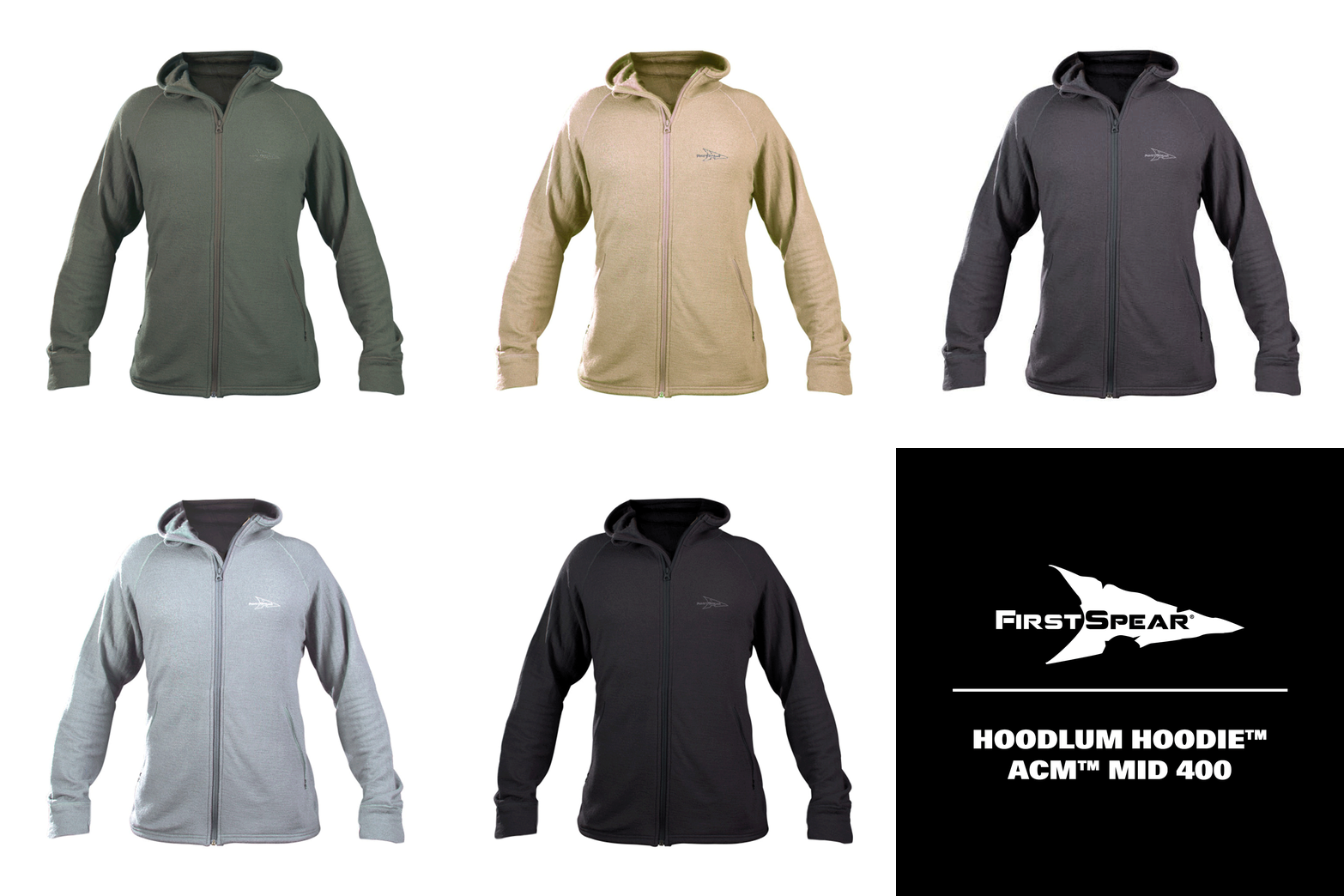
To request an estimate click image above or visit First-Spear.com/Request-For-Estimate. FirstSpear is the premier source for cutting-edge tactical gear for military, law enforcement and those who train. For more information visit First-Spear.com.
WASHINGTON — Joint Interagency Task Force 401 announced Jan. 11 its first acquisition under the Replicator 2 initiative, awarding a contract for two advanced DroneHunter F700 systems, which are expected to be delivered by April.

This acquisition provides the task force with enhanced capabilities to counter the growing threat posed by small unmanned aerial systems. It also marks a significant step in the War Department’s strategy to rapidly field counter-unmanned aerial systems to protect military installations and critical infrastructure across the United States.
“We’re designed to move at the speed of relevance, cutting through red tape, consolidating resources, and engaging venture capitalists, tech startups, and nontraditional defense firms as critical partners,” said Army Brig. Gen. Matt Ross, JIATF 401 director.
“We have just one measure of effectiveness: to deliver state-of-the-art counter-UAS capabilities to our warfighters both at home and abroad. This purchase of the DroneHunter system is a key first step in accomplishing our Replicator 2 mission,” Ross added.
Replicator 2: A New Approach to Counter-UAS
The Replicator initiative, first announced in August 2023, is a War Department effort to accelerate the delivery of innovative capabilities to the warfighter at speed and scale.
While the first phase, Replicator 1, was focused on deploying thousands of autonomous systems across multiple domains, Replicator 2 is specifically aimed at countering the threat posed by small UAS.

The joint task force, established in August 2025, is the lead organization for this effort, tasked with synchronizing counter-small UAS efforts across the department and rapidly delivering joint capabilities.
“Replicator 2 is not about starting from scratch,” Ross said. “It’s about leveraging the incredible innovation happening in the commercial sector and getting it deployed where it is needed most.”
The DroneHunter: A State-of-the-Art Solution
The DroneHunter is a reusable, artificial intelligence-driven interceptor drone that provides a unique and effective solution to counter small UAS, especially in settings where personnel, infrastructure and surrounding activity require careful control of effects.
The system uses AI and radar to detect and track small, low-altitude drones in complex environments. Once it spots a potential threat, the system can capture it with a tethered net.

The captured drone is then safely towed to a designated location for forensic analysis. This solution is ideal for use in the homeland, where the risk to civilian populations and infrastructure must be minimized.
This initial purchase is the first step in the tailored approach the task force will take to deliver state-of-the-art counter-UAS technology to protect military infrastructure and service members.
“This is one example that demonstrates how JIATF 401 has taken counter-drone efforts from a community of interest to a community of action,” Ross said. “The task force is focused on a whole-of-government approach, working with interagency partners and industry to build a layered defense against the full spectrum of small UAS threats to the homeland.”
By Lt. Col. Adam Scher, Joint Interagency Task Force 401

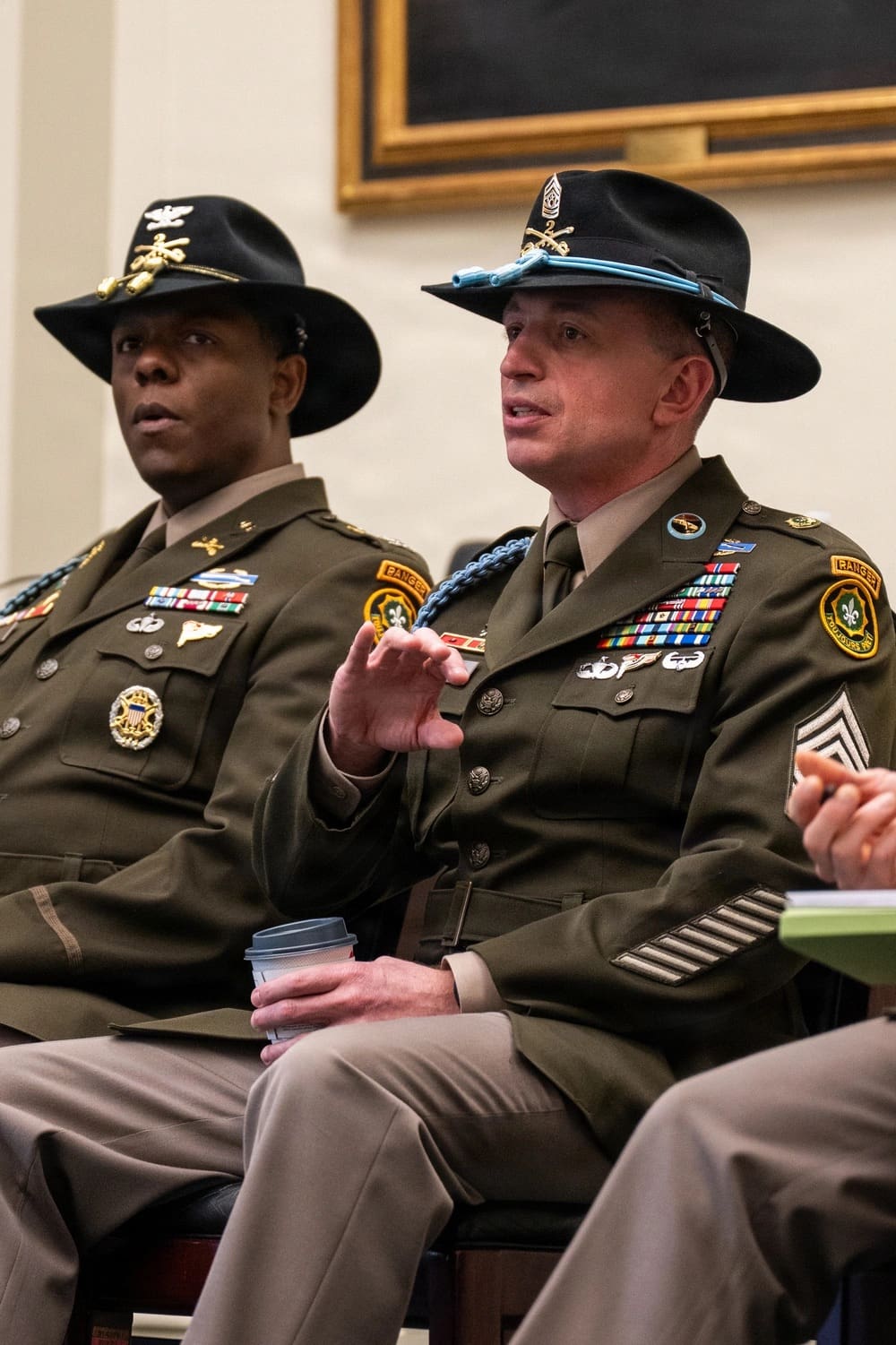
PICATINNY ARSENAL, NJ — The U.S. Army’s XM204 interim top-attack munition was approved for Urgent Materiel Release (UMR) and successfully conducted initial fielding in Europe on December 4, 2025. Managed by Project Manager Close Combat Systems (PM CCS) at Picatinny Arsenal, NJ in partnership with Textron Systems of Wilmington, MA, the XM204 completed Low-Rate Initial Production in September of 2025. The munition was then fielded to the 2nd Cavalry Regiment, based at Rose Barracks in Vilseck, Germany for training.
New Equipment Training and Doctrine, Training and Tactics were provided to 2nd Cavalry Regiment to review the performance, reliability, and integrated safety features of the XM204 and prepare for use Army-wide.
Eight Observer Coach/Trainers from the Joint Multinational Readiness Center also attended the train-the-trainer course so those personnel can continue to guide other Soldiers on the effective use of the weapon system. The training was held at Grafenwoehr Army Base and at the conclusion of training/fielding, PM CCS and JPEO Armaments & Ammunition (JPEO A&A) achieved Initial Operational Capability milestone.

The XM204 is an anti-vehicle munition with standoff and top attack capabilities designed to support terrain shaping operations by supporting a number of counter mobility tasks such as blocking, disrupting, fixing, and turning an enemy force.
“Seeing the XM204 perform so successfully reinforces the strength of our development teams and the speed at which they can design, build, test and field critical munitions that can degrade enemy mobility and create tactical advantages for friendly forces,” said Maj. Gen. John T. Reim, JPEO A&A and Commanding General of Picatinny Arsenal. This new system addresses evolving battlefield demands and the ongoing need to produce safe, reliable, and lethal munitions for our Warfighters and international partners.
The XM204 can be rapidly emplaced and is highly portable; the system can be employed alone, in multiples or in tandem with other terrain shaping systems. The lightweight munition features a dispenser launcher module that autonomously deploys multiple submunitions. Each submunition is equipped with onboard sensors to detect enemy vehicles and utilizes an explosively formed penetrator to defeat those threats. If not armed, the system is recoverable which allows Soldiers to reposition it as needed.
The XM204 also includes tamper-resistant features, armed/safe indicators, and self-destruct timers, aligning with U.S. landmine policy on anti-personnel landmines and reducing post-conflict risks to civilians.
In addition to the XM204, the XM98 Emplacement Trainer was approved by U.S. Army Tank-Automotive and Armaments Command in November. The XM98 training munition was also fielded to the 2nd Cavalry Regiment in Germany. The regiment is the longest continuously serving cavalry unit in the Army and plays a key role in North Atlantic Treaty Organization’s enhanced Forward Presence initiative.
By Michael Chambers