Kit Badger puts in his two cents regarding the gun debate with his latest, “The Gun Debate and How I Won the Internet”.
With a title like that, this had better be good! Take it away Ivan.


Kit Badger puts in his two cents regarding the gun debate with his latest, “The Gun Debate and How I Won the Internet”.
With a title like that, this had better be good! Take it away Ivan.
FORT BRAGG, N.C. — There are shooting and marksmanship competitions around the world, and then there is the annual United States Army Special Operations Command International Sniper Competition.
A 1st Special Forces Group (Airborne) sniper team earned overall first place honors in the ninth annual event after besting more than 40 special operations forces teams from around the U.S. military’s most elite units and international special forces teams.
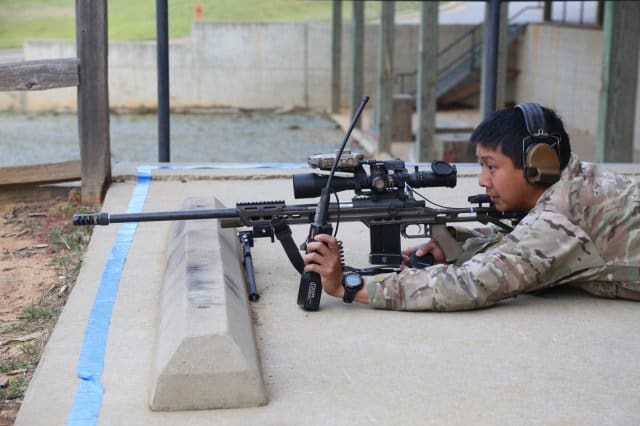
One half of the 1st Special Forces Group (Airborne) Green Beret sniper team, Sgt. 1st Class Cuong, uses communication and teamwork with his teammate Master Sgt. David at the United States Army Special Operations Command International Sniper Competition held at Fort Bragg, N.C. March 18-22. The team earned overall first place honors in the ninth annual event after besting more than 40 special operations force teams from around the U.S. Military’s most elite units and international special forces teams. Editor’s note: Due to the mission of Special Forces Soldiers, full names of members of the 1st Special Forces Group (Airborne) are not releasable. (Photo Credit: U.S. Army photo by Sgt. 1st Class Jacob Braman )
According to United States Army Special Operations Command, the International Sniper Competition consisted of 22 events over five days and four nights of physically and mentally challenging precision fires. Sniper teams converged on Fort Bragg, N.C., March 18-22, to compete in a challenging and combat oriented competition.
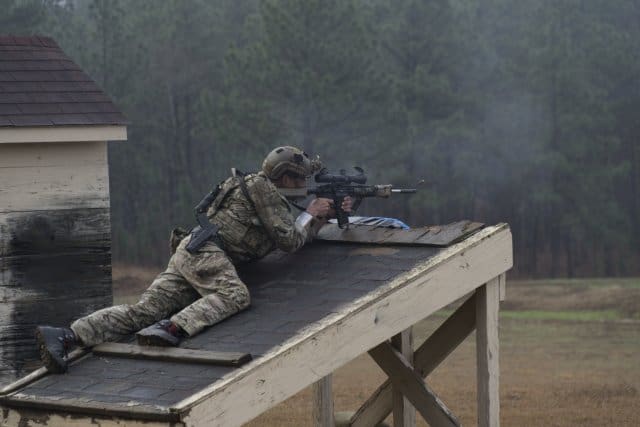
A Green Beret from the 1st Special Forces Group (Airborne) sniper team, Sgt. 1st Class Cuong fires his rifle in an event at the ninth annual United States Army Special Operations Command International Sniper Competition held at Fort Bragg, N.C. March 18-22. The 1st SFG (A) sniper team outperformed special operations teams from the Naval Special Warfare Command, Marine Corps Scout Sniper School, U.S. Army Sniper School, 75th Ranger Regiment, and international special operations teams from Germany, Ireland, Netherlands, France, Italy, and Singapore. Editor’s note: Due to the mission of Special Forces Soldiers, full names of members of the 1st Special Forces Group (Airborne) are not releasable. (Photo Credit: U.S. Army photo by Sgt. 1st Class Jacob Braman)
“We started off poorly on the first day due to some sleep deprivation,” said Master Sgt. David, a Green Beret with the 1st SFG (A) and member of the winning sniper team. “We really started clicking and things began to fall into place after we regrouped and got some rest between events.”
Master Sgt. David competed with his teammate Sgt. 1st Class Cuong, also a Green Beret with the 1st SFG (A).
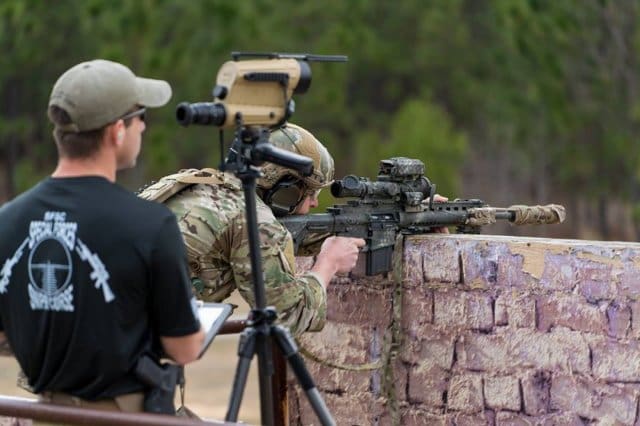
A Green Beret from the 1st Special Forces Group (Airborne) sniper team, prepares to fire his rifle at the ninth annual United States Army Special Operations Command International Sniper Competition held at Fort Bragg, N.C. March 18-22. The International Sniper Competition consisted of 22 events over five days and four nights of physically and mentally challenging precision fire. Editor’s note: Due to the mission of Special Forces Soldiers, full names of members of the 1st Special Forces Group (Airborne) are not releasable. (Photo Credit: U.S. Army photo by Sgt. 1st Class Jacob Braman )
The event is distinguished by the high level of world-class teams competing. The United States Army John F. Kennedy Special Warfare Center and School and the 1st Special Warfare Training Group (Airborne) hosted the competition.
“It is the level of competitors, the cadre, and the competition that make this event so unique,” David said. “At this level, all of these guys are the best of the best.”
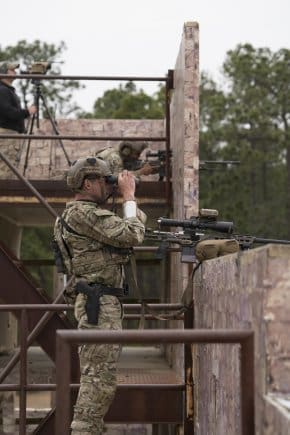
One half of the 1st Special Forces Group (Airborne) Green Beret sniper team, Master Sgt. David uses binoculars to scan targets during an event at the ninth annual United States Army Special Operations Command International Sniper Competition held at Fort Bragg, N.C. March 18-22. Master Sgt. David and his teammate Sgt. 1st Class Cuong placed first in a field of more than 40 teams from Special Operations Forces around the world. Editor’s note: Due to the mission of Special Forces Soldiers, full names of members of the 1st Special Forces Group (Airborne) are not releasable. (Photo Credit: U.S. Army photo by Sgt. 1st Class Jacob Braman )
The 1st SFG (A) sniper team outperformed special operations teams from the Naval Special Warfare Command, Marine Corps Scout Sniper School, U.S. Army Sniper School, 75th Ranger Regiment, and international SOF teams from Germany, Ireland, Netherlands, France, Italy, and Singapore.
Master Sgt. David and Sgt. 1st Class Cuong are humbled to have come out atop the competition.
“These guys were so good we knew whoever was going win was going to need to have a little bit of luck on their side,” said David.
“We are proud of Dave and Cuong,” said Command Sgt. Maj. Tony Labrec the 1st SFG (A) senior enlisted leader. “Their experience and professionalism will serve 1st Group for years to come as they pass on that knowledge to the Green Berets coming up behind them.”
Editor’s note: Due to the mission of Special Forces Soldiers, full names of members of the 1st Special Forces Group (Airborne) are not releasable.
By Staff Sgt. Christopher Harper
MARINE CORPS BASE QUANTICO, Va. —
In an effort to continually improve the clothing and equipment Marines are issued, Marine Corps Systems Command will conduct an assessment to see if lighter boots can improve recruit performance. Plans are to compare two lighter boots to the Marine Corps Combat Boot during a recruit training cycle at Parris Island.
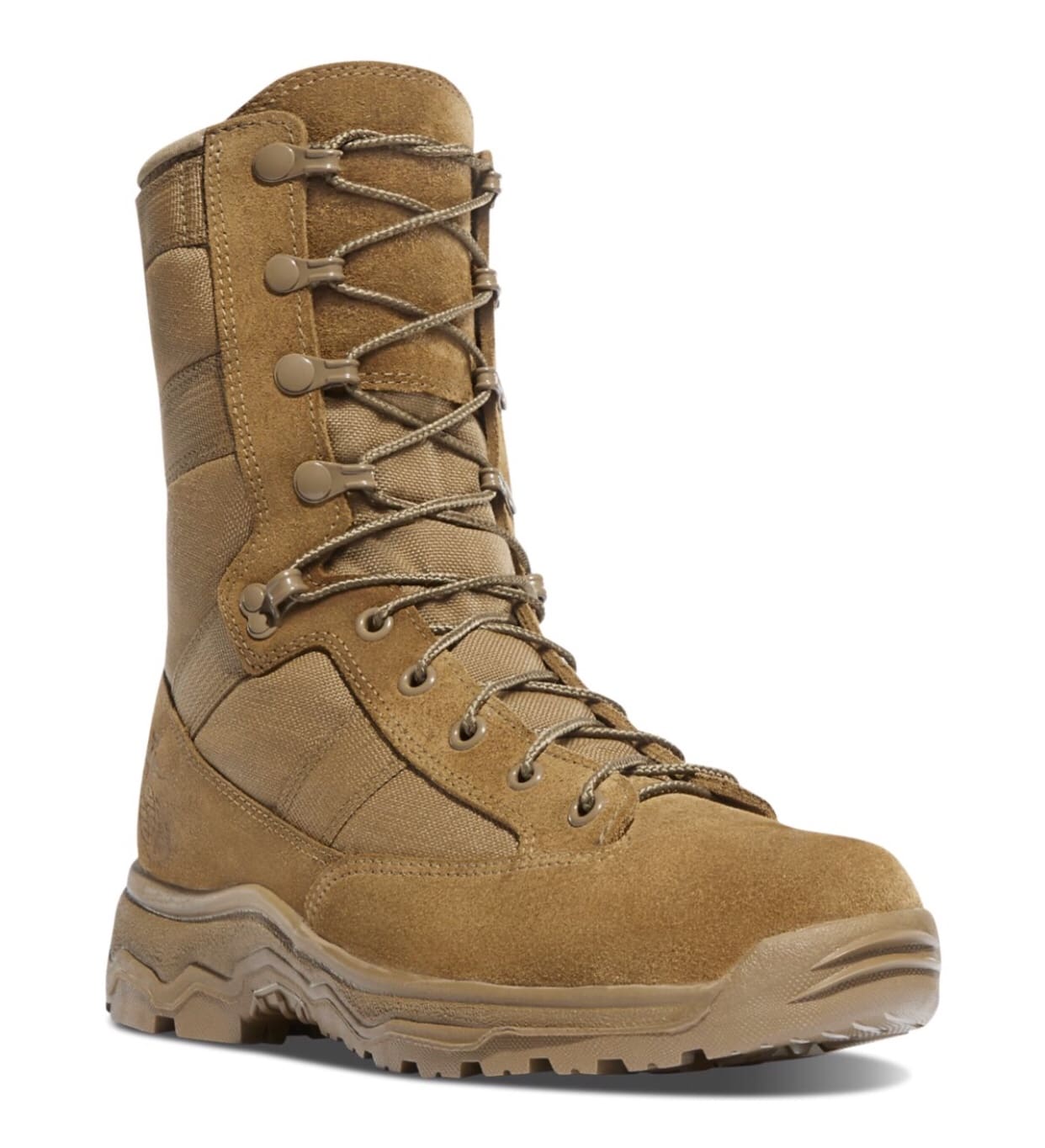
One boot, the Danner Reckoning Hot Weather Boot was authorized for optional wear by Marine Corps Systems Command in 2017.
“The feedback we’ve received from Marines on the Reckoning boots, is positive,” said Todd Towles, project officer for the Clothing and Equipment Team at Marine Corps Systems Command. “The boots are lightweight, durable, and there’s virtually no break-in period.”
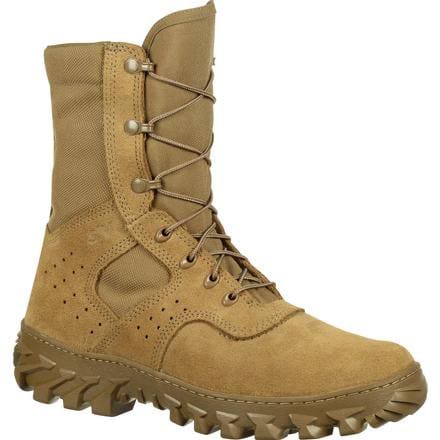
Now, program officials plan to compare the Reckoning and another relative newcomer—the Rocky Tropical boot. The Rocky Tropical performed well in jungle environments during a 2017 user evaluation with 3rd Battalion 3rd Marines in Hawaii.
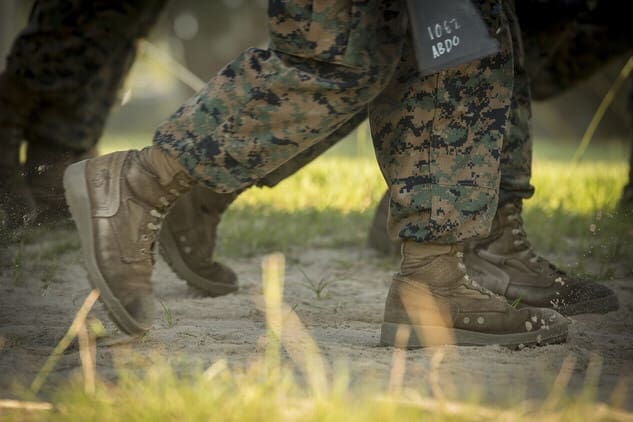
U.S. Marine Corps recruits of Bravo Company, 1st Recruit Training Battalion, march during a six-mile conditioning hike on Parris Island, South Carolina. In an effort to continually improve the clothing and equipment Marines are issued, Marine Corps Systems Command will conduct an assessment to see if lighter boots can improve recruit performance. Plans are to compare two lighter boots to the Marine Corps Combat Boot during a recruit training cycle at Parris Island. (U.S. Marine Corps photo by Lance Cpl. Joseph Jacob)
The program office will issue 700 Reckoning boots and 700 Rocky Tropical boots to male and female recruits. Half of the Danner and half of the Rocky will go to a male company and remaining boots will be issued to a female company.
The purpose of the assessment is to do a comparison between the Rocky and Reckoning and the Marine Corps Combat Boot to see if there is a decrease in lower extremity injuries.
The MCCB has been in the Corps’ inventory since 2001 and is a seabag issue item.
The three-month assessment is planned to take place this summer, Towles said.
By Kaitlin Kelly, MCSC Office of Public Affairs and Communication | Marine Corps Systems Command
SSD Note:
This is the Danner Reckoning.
This is the Rocky Jungle Boot.
The rechargeable ACTIK CORE headlamp offers 350 lumens of power which makes it ideal for outdoor activities like mountaineering, running, hiking and backpacking. A HYBRID headlamp that comes with CORE, a battery that is rechargeable via standard USB port. It is compatible with standard batteries without the need for an adapter. Red lighting preserves night vision and prevents blinding other members of the group. Its reflective headband helps you to be seen when a light is shone on it, and is equipped with an emergency whistle for rescue situations.
High Angle Solutions is a weekly series of articles focusing on military mountaineering solutions. It’s brought to you by UK-based Brigantes Consulting, in conjunction with several other brands, both here in the US and abroad. For example, this post on the Petzl ACTIK CORE was offered by Lyon Outdoor.
Kitbadger hacks the Micro Fight Chest Rig by Spiritus Systems to work as a Binocular Harness.
Full details at kitbadger.com/bino-harness-hack-for-the-spiritus-systems-micro-fight-chest-rig.
Elliot Brown watches aren’t like other so-called sports watches.
Ian Elliot and Alex Brown share 20+ years of unique watch building knowledge from the world of extreme sports which is how they were able to create the worlds most rugged “tool” watches.
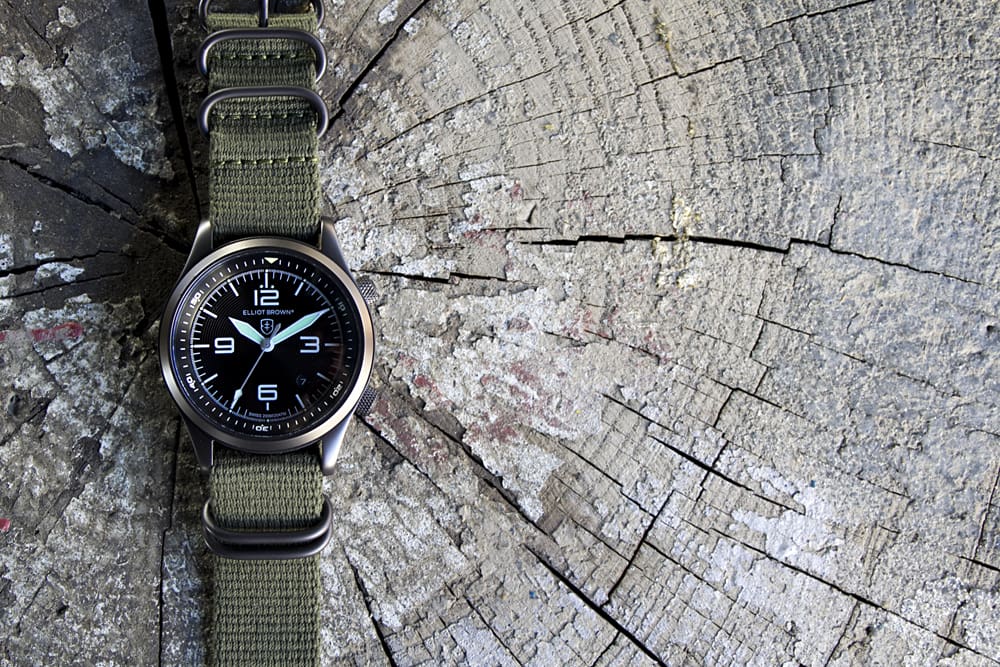
Working on the coast and enjoying just about every land and water based coastal sport was the catalyst to develop a range of watches that not only function in extremes but also look great with a suit or uniform.

This Canford 202-004, like all other Elliot Brown watches has survived at test at 200m in water before being declared fit for use. It features a neat inner timing bezel operated via the upper crown and even when in the our or adjust position, the lower time and date adjust crown is still fully water proof.
The Swiss movement is housed inside a unique steel housing, suspended on a series of elastomer dampers to give immense shock protection. The highly legible dial and hands feature a Superluminova coating that will glow for up to 8 hours.
The solid and beautifully detailed case back is bolted down for a perfect seal with multiple surfaces to minimize the contact patch with the wrist in warmer conditions.
2.8mm thick hardened and tempered crystal protects the dial with an anti-reflective coating applied to the inner surface and the strao retaing bars are solid screw in items that will stand any test.
This is one mean watch and it’s no surprise Elliot Brown are finding favour amongst many military groups.
For more information contact: caroline@brigantes.com
High Angle Solutions is a weekly series of articles focusing on military mountaineering solutions. It’s brought to you by UK-based Brigantes Consulting, in conjunction with several other brands, both here in the US and abroad.
ABERDEEN PROVING GROUND, Md. — Soldiers may be asked to carry heavier, more lethal weapons in the near future, but they soon might have a “third arm” to improve their accuracy and reduce fatigue.
Using a mechanical apparatus that resembles something out of a sci-fi movie, the lightweight device will help redistribute some of the burden Soldiers carry in their arms and shoulders to their abdomen. Engineers at the Army Research Lab here have been developing a mechanical “third arm” that attaches to a user’s back hip.
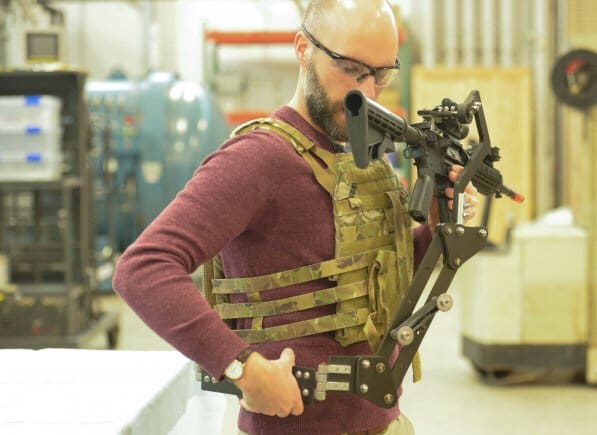
Army Research Lab engineer Dan Baechle demonstrates how to strap on the “Third Arm,” a mechanical device designed to improve Soldiers’ accuracy and reduce fatigue. (Photo Credit: U.S. Army photo by Joe Lacdan)
The project, unveiled last year at a conference, is scheduled to be tested again sometime this spring with a minimum of 15 Soldiers.
“Right now we have a prototype that’s essentially a research platform that we’re using to investigate different types of materials — how materials and structures can stabilize a weapon or a shield, reduce fatigue on the Soldiers’ arms, but also improve accuracy,” said mechanical engineer Dan Baechle.
The project is currently on its second prototype model with improvements based on Soldier feedback. Some of the improvements include an extendable hinge plate so that a single plate can fit Soldiers of different sizes and body types. Baechle said further research must be completed before the device can be fielded. The current prototype at 3.5 pounds can now support weapons such as the M249 light machine gun that weighs about 27 pounds.
The project not only helps stabilize weapons, but can aid Soldiers for defensive purposes while carrying 20-pound shields. The project team developed a custom mount that connects from the arm to the shield so Soldiers can use the Third Arm to help alleviate muscle fatigue.
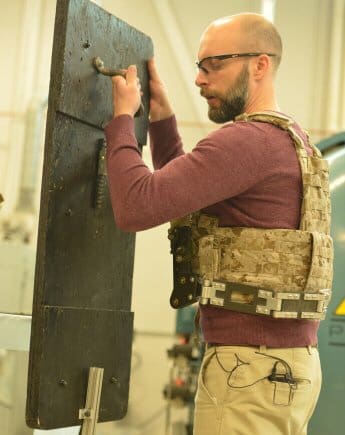
The “Third Arm” project is being developed not only for weapons but for defensive purposes. Army researchers at Aberdeen Proving Ground created a special mount to attach the apparatus to a shield and also provide stability and balance. (Photo Credit: U.S. Army photo by Joe Lacdan)
Concept development began in late 2015 when ARL engineers brainstormed ideas on how to make a dismounted Soldier more lethal. Engineers began building the first prototypes in 2016. The focus of the project centered on providing stability for dismounted Soldier. ARL engineers are examining different types of spring materials to further balance the weapon against gravity. Baechle said they used a carbon fiber material in the current prototype because of its light weight and density.
“We started out with just trying to think of a way to help improve the lethality for the dismounted Soldier,” Baechle said. “Generally that means stabilizing the weapon or giving the Soldier a more powerful weapon. Can we stabilize that weapon to improve accuracy? But also if we’re stabilizing the weapon and taking the load off of the Soldiers’ arms, does that improve the Soldier’s readiness? Does it also improve the Soldier’s accuracy with the weapon?”
Last summer, six Soldiers volunteered to take part in a pilot study, where researchers placed electromyography sensors to measure muscle activity. In particular, when holding a weapon or shield for extended periods of time, the arm begins to shake, impacting shooter accuracy. The six-person research team tested Soldiers firing weapons with and without the apparatus.
“We found that it reduced the fatigue and reduced the muscle activation for some Soldiers,” Baechle said, explaining that data is being used to motivate a larger trial this year with more Soldiers. This year he also plans to get more feedback on what Soldiers think about the device and what should be changed.
Last year researchers collected data on how much muscles were firing with the use of the third arm compared to without it.
“There are studies showing that, if you hold a weight out at arm’s length, eventually your arm starts shaking,” Baechle said. “And that shaking is going to reduce your accuracy with the weapon … and if you’re holding a shield, it’s going to reduce the amount of time that you can hold that shield. So we’re taking that weight of the weapon or the shield off of the arms and transferring it back to the torso.”
While the test yielded positive results, Baechle said some of the Soldiers had problems with the device. Improvements made this year include changing the mounting location from the front of the Soldier’s vest to the back.
Researchers hope to further improve the device to make it more comfortable and reduce fatigue even more. They are continually attempting to make adjustments to the device to boost a shooter’s accuracy.
Baechle demonstrated how ARL researchers use a motion capture system, using monitors and infra-red targeting to track a Soldier’s weapon and target.
“We use this system to evaluate both how subjects or Soldiers move the weapon and with and without the third arm,” Baechle said. “But also how the arm improves the accuracy or changes the aim point while they’re using the weapon.”
Finally researchers hope the project can reduce some of the recoil force after firing a weapon.
“You have a lighter weight weapon but potentially a higher caliber weapon which normally would increase the recoil on your shoulder,” Baechle said. “Could you use Third Arm and some clever materials on the arm to redirect that recoil back toward the body and thus allow the Soldier to wield a higher energy weapon without necessarily burdening the Soldier more?”
By Joe Lacdan, Army News Service
I’m sharing this story by the Iowa Air National Guard’s 132nd Wing PAO for two reasons:
1. My father was a full time Guard guy (technician) at the 132nd Fighter Wing while I was growing up, so I have a personal interest.
2. The Wing has given up its F-16s and now conducts ISR, as a ground control station for UAS. When they had fighters, it made sense for the Wing to deploy to other locales, in order to familiarize themselves with the operating environment and practice wartime tasks. Now that they don’t have airplanes, it’s interesting to see the Wing’s personnel still conduct exercises at other bases.
Des Moines, Iowa —
Hawaii. A beautiful island paradise full of scenic ocean and mountain views, pleasant tropical breezes and piña coladas. What the members of the 132d Wing were preparing for though is anything but pleasant. Throughout the beautiful island, gas masks were being donned, weapons readied, sleeves rolled up, boots muddied and sweat falling as Iowa Air Guardsmen prepared themselves and others for hazardous and deadly situations.
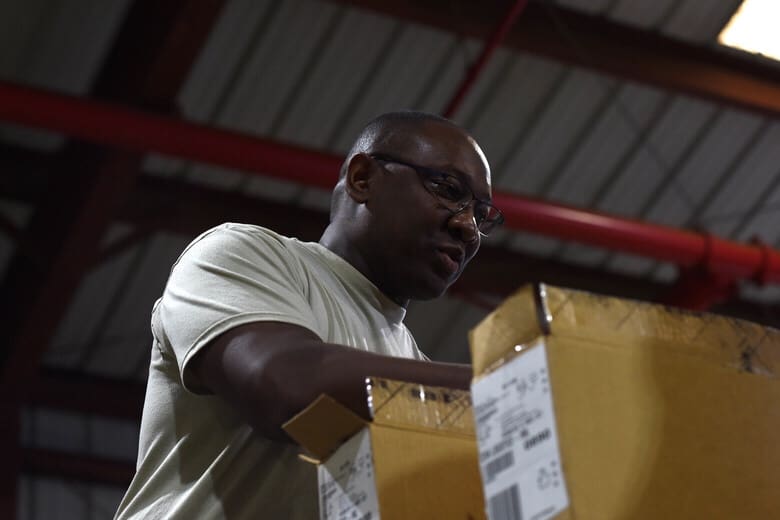
Master Sgt. Patrick Kazeze, 132d Communications Flight, takes inventory of computer equipment February 13, 2018, at Joint Base Pearl Harbor-Hickam in Honolulu, Hawaii. The 132d CF Airmen inventoryed equipment, disposed of outdated computer hardrives and performed maintenance on underground network cables. (U.S. Air National Guard photo by Staff Sgt. Michael J. Kelly)
Approximately 69 Airmen of the 132d Wing deployed to Joint Base Pearl Harbor-Hickam in Honolulu, Hawaii, February 10-23, 2018 for Exercise Sentry Aloha to develop their deployment readiness skills alongside their active duty and Hawaii Air National Guard counterparts.
Airmen from civil engineering, emergency management, fire emergency services, communications, security forces, force support squadron and medical all trained in a variety of environments and scenarios with local active duty and guard members.
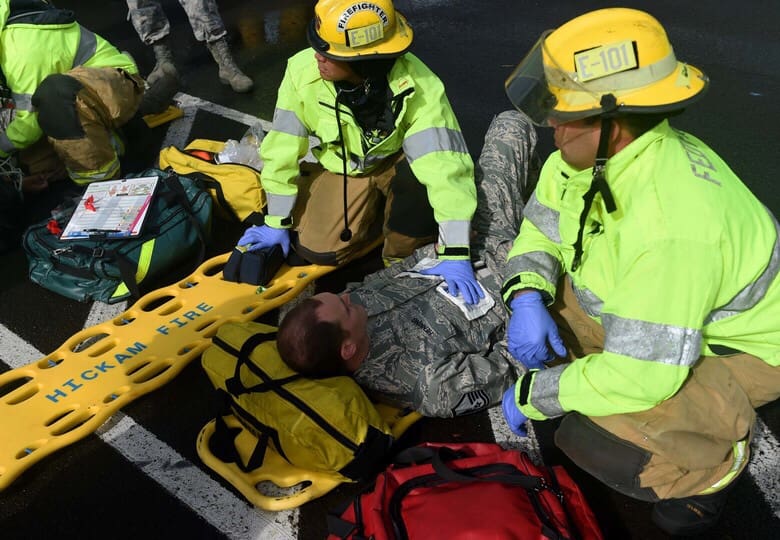
Master Sgt. Matt Henning, 132d Wing Command Support Staff, acts as a casualty during an active shooter drill at Joint Base Pearl Harbor-Hickam in Honolulu, Hawaii. The drill was conducted to measure the response time and readiness of emergency personnel. (U.S. Air National Guard photo by Staff Sgt. Michael J. Kelly)
The Emergency Management (EM) team trained approximately 466 active duty, Guard, and Reservist Airmen in Chemical, Biological, Radiological, Nuclear (CBRN) attack survival skills. The training included proper use of CBRN equipment, simulation of different disaster scenarios, decontamination training and self-aid and buddy care (SABC).
“Getting to see the different perspective each instructor brings really helps pinpoint better ways to help people survive, especially those deploying,” said Tech. Sgt. Rachel Albee, 132d Wing Emergency Management.
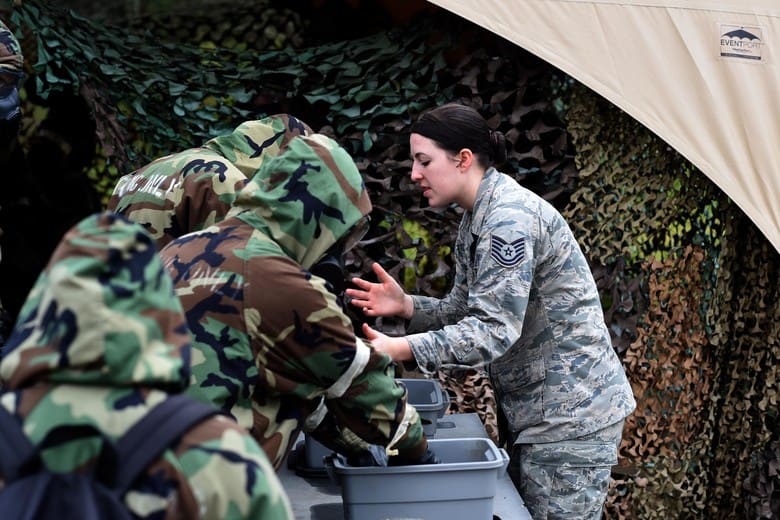
Tech. Sgt. Rachel Albee, 132d Wing Emergency Managment, instructs Hawaii Airmen in proper decontamination tactics February 13, 2018, at Joint Base Pearl Harbor-Hickam in Honolulu, Hawaii. The 132d EM trained approximately 466 active duty, Guard and Reserve Airmen. (U.S. Air National Guard photo by Staff Sgt. Michael J. Kelly)
EM had access to equipment and facilities unavailable their home station which allowed them to effectively train Airmen for disaster scenarios. The efforts of EM were instrumental in deployment readiness of the Hawaii Airmen and were greatly appreciated.
“They integrated well with our flight members and provided much needed support in the readiness surge getting Airmen deployment ready,” said MSgt. Kareem Fuertes, emergency manager, 154th Wing, Hawaii Air National Guard.

Master Sgt. Randy Warden, a combat arms training and maintenance (CATM) instructor, 132d Security Forces Squadron, gives instructions to shooters February 14, 2018, at Joint Base Pearl Harbor-Hickam in Honolulu, Hawaii. The CATM team oversaw the weapons training and qualification for deploying Hawaii Airmen. (U.S. Air National Guard photo by Staff Sgt. Michael J. Kelly)
Instructors from the 132d Security Forces Squadron’s combat arms training and maintenance (CATM) team oversaw the weapons training and qualification for deploying Hawaii Airmen. The training was conducted in new, state of the art indoor range which allowed for a greater diversity of shooting scenarios and allowed for faster qualification time.
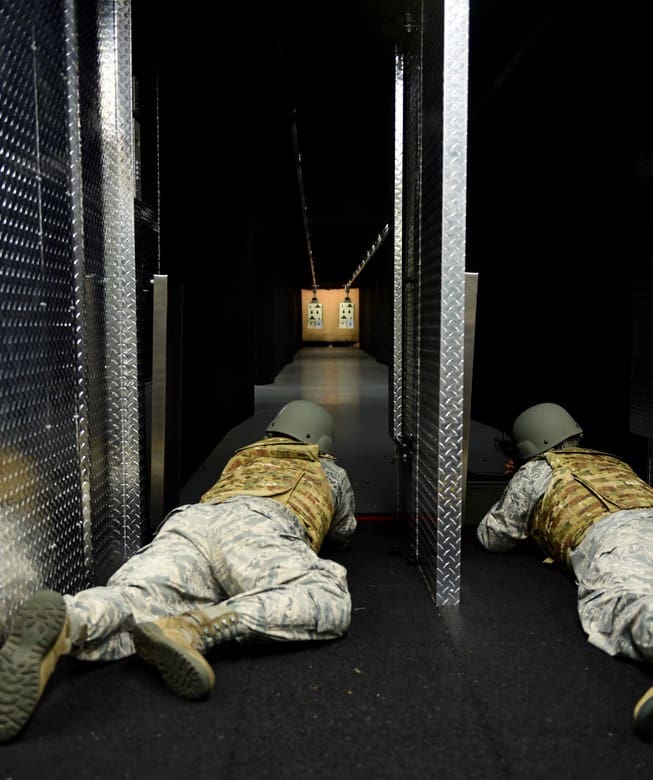
Hawaii Air National Guard Airmen fire M-4 carbines during weapons qualification February 14, 2018, at Joint Base Pearl Harbor- Hickam in Honolulu, Hawaii.The 132d Security Forces CATM team oversaw the weapons training and qualification for deploying Hawaii Airmen. (U.S. Air National Guard photo by Staff Sgt. Michael J. Kelly)
“It was great being able to see how it works and talk to the CATM group here to find out the pros, cons and all the maintenance that is needed if we were able to obtain one,” said Tech. Sgt. Savannah Page, CATM instructor, 132d SFS.
The 132d Medical Group trained on administrative systems and also worked real world medical operations at Tripler Army Hospital in Honolulu, Hawaii. The training included a rare hands-on Aerovac training mission, the on and off loading of patients in critical condition from aircraft. The training, which most ANG members seldom receive except in deployed locations, presented many challenges which the 132d MDG used to prepare themselves for future missions.
“The biggest obstacle for the training is the unpredictability of the actual flights,” said Staff Sgt. Kelsey Searls. “Aircraft availability, stability of the patients, weather, paperwork; all of it can change the flight times at any moment, making training on actual aircraft and running live missions, sometimes impossible to get during an annual training tour.”
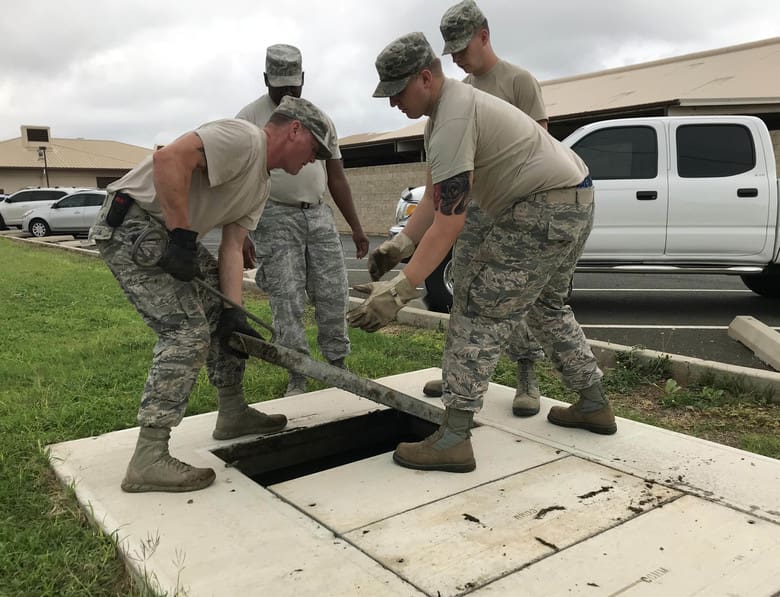
132d Communications Flight Airman from the 132d Wing, Iowa Air National Guard open up a manhole cover while working on underground cables February 22, 2018, at Joint Base Pearl Harbor-Hickam in Honolulu, Hawaii. The 132d CF Airmen inventoryed equipment, disposed of outdated computer hardrives and performed maintenance on underground network cables. (U.S. Air National Guard photo by Staff Sgt. Michael J. Kelly)
132d Communications Flight worked on a variety of projects on base including inventorying equipment, disposing outdated computer hard drives and tapes as well as prepare underground network cables for use in base operations. They also upgraded the base’s computer systems and software.
“It was great getting to work with new people in a total force integrated environment,” said Senior Airman Ben Trotter, spectrum operations technician, 132d Communications Flight. “We provided manpower which organized their assets as well as training for us which will make us a more efficient communications flight.”
Communications Flight Airmen disposed of over 200 computer hard drives, inventoried and processed in approximately 250 computers, updated the software on 40 computers and fixed approximately five thousand feet of network cable.
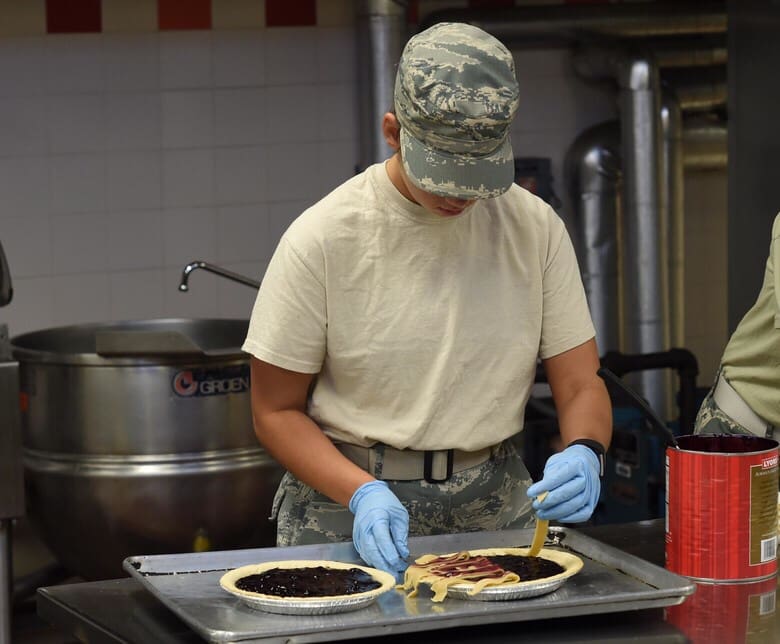
Staff Sgt. Megan Newton, services, 132d Force Support Squadron, makes a pie in the Hale Aina Dining Facility, February 14, 2018, at Joint Base Pearl Harbor-Hickam in Honolulu, Hawaii. The 132d FSS Airmen provided five thousand meals for base members. (U.S. Air National Guard photo by Staff Sgt. Michael J. Kelly)
The 132d Force Support Squadron’s services Airmen provided meals at the Hale Aina Dining Facility on Joint Base Pearl Harbor-Hickam. The Airmen were able take inventory of the produce and supplies of the dining facility which helped them gain more knowledge of accountability systems.
“Working hand in hand with the active duty was rewarding as was the mutual exchange of ideas and knowledge of the services field which will make our shop better,” Chris Newton, services shift leader, 132d FSS.
The services Airmen also helped prepare a special meal for the base in honor of Black History Month. In total, the 132d FSS served approximately five thousand meals to active duty, Guard and Reserve Airmen. They also conducted the physical training tests of approximately 500 Airmen.
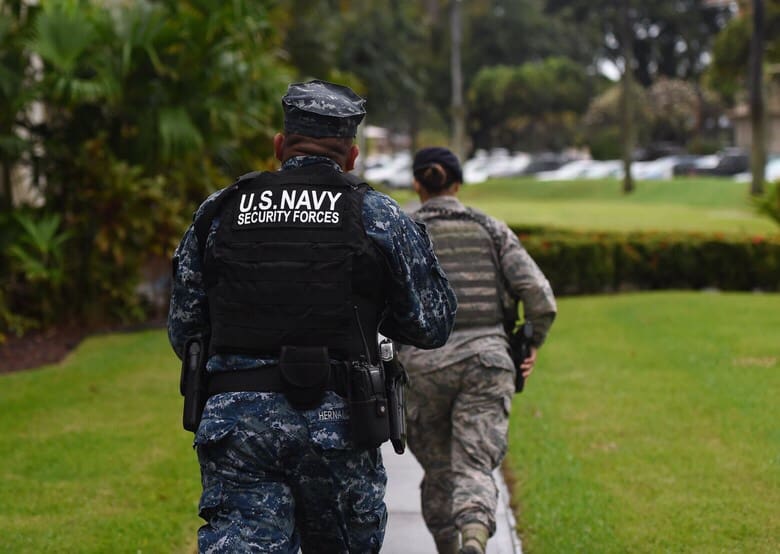
U.S. Navy and Air Force security forces rush towards the scene of a shooting during an active shooter drill February 15, 2018, at Joint Base Pearl Harbor-Hickam in Honolulu, Hawaii. The drill was conducted to measure the response time and readiness of emergency personnel. (U.S. Air National Guard photo by Senior Master Sgt. Robert Shepherd)
Sentry Aloha exercises are held to provide the Air National Guard, U.S. Air Force and other Department of Defense agencies an opportunity to execute current, realistic, integrated training specifically designed to develop combat operations and skill sets.
By Staff Sgt. Michael J. Kelly, 132d Wing Public Affairs