It has been a couple of months since Part I of the Fighting Load Continuum (FLC) series. I am not going to re-plow the same ground, but I will be referencing points from the first article. Consequently, it would probably be helpful for readers to review Part I before reading this iteration. We will start where the last part ended. “leaders have to face the fact that for the majority of dismounted combat operations – even relatively short ones – it is all but impossible to avoid at least some overloading [and]…the goal of effective load management should be to keep as many of a unit’s soldiers as possible in the more combat effective green range [of the FLC] – for as much of the time as possible – rather than the cautionary amber or high-risk red zones.
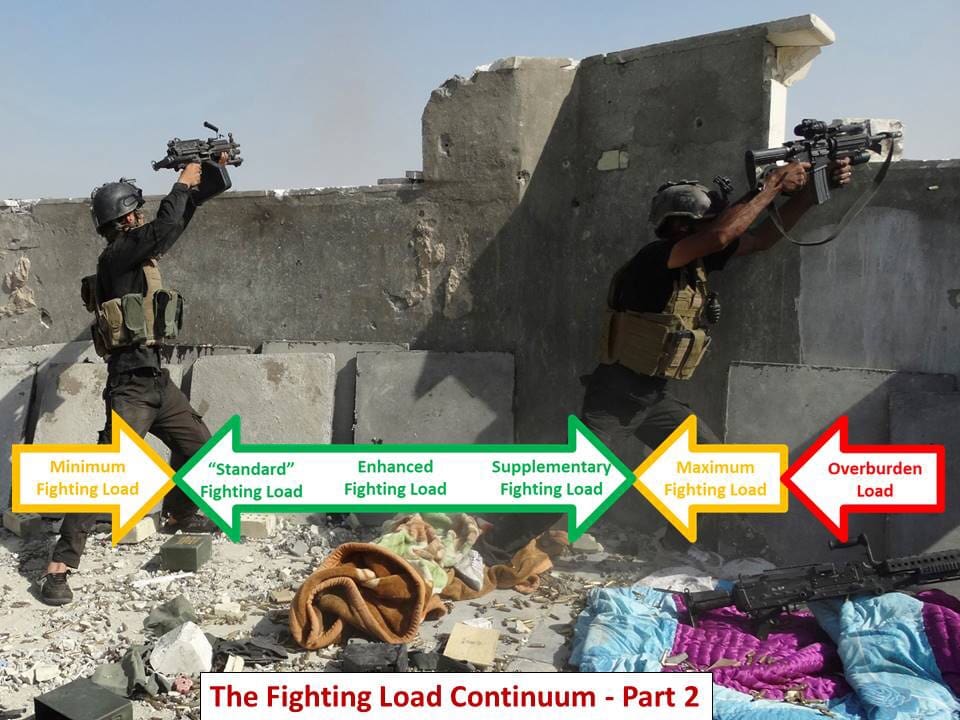
I gave away the “bottom line” of my own FLC concept last time. There is no magic solution and there is no trick to effective dismounted load management – it just requires timely, hard choices and deliberate trade-offs between firepower, protection, and mobility. However, units can be considerably more tactically effective if leaders make better-informed, pre-mission load management decisions. That involves consistently practicing the fundamentals like planning the mission first, then the load; focusing on successful prosecution of the fight, rather than equitably distributing the weight; and practicing and mastering deliberate and hasty load transitions. If a unit is following the age-old principles I outlined last time, everything carried is needed and represents capabilities deemed essential – not just unrelated or superfluous burdens to be endured.
Leaders need to acknowledge their limitations and not waste time agonizing over factors that they cannot “fix,” mitigate, or eliminate. Consider body armor for example. For extended dismounted combat operations involving “closing with and destroying the enemy by fire and maneuver,” I am – and have been – comfortable with lighter plate carriers and helmets. I accept the tradeoff between reduced protection and enhanced individual mobility. If in a static defense or mounted operations more body armor (protection) may be more appropriate. For dismounted reconnaissance perhaps no armor at all. What the leader cannot fix, mitigate, or eliminate in combat is the likelihood – sometimes the certainty – that some of your soldiers will die or be seriously injured no matter what choice you make. A leader has to live with that truth and shoulder than burden alone.
Likewise, recognize up front that load discretion is actually quite limited. Fixed weight items are a constant. Weapons, clothing items, body armor, and technological aids weigh what they weight – and if deemed necessary will be carried. NBC protective gear would be another example. If there is a realistic threat that the enemy will use chemical weapons there may not be a choice – the gear will need to be carried. On the other hand, consumables, like water, food, batteries, and ammunition, must be carried in quantities based on the anticipated rate of consumption and frequency of planned resupply. Longer duration missions, and those with limited options for external resupply, naturally force a unit to carry more of all consumables. Still, a unit should only carry what it truly needs, wasting nothing, and not burdening itself with “nice to have” items.
There is nothing new about that tactical reality. In fact, US Army doctrine on load management has been remarkable consistent for decades. ALL of the doctrine has repeatedly recommended that the “fighting load” not exceed ~48 lbs and so called “approach march load” not exceed ~72 lbs. However, FM 21-18, Foot Marches, as far back as 1990, explicitly acknowledged the inescapable conundrum. “Unless part of the load is removed from the soldier’s back and carried elsewhere, all individual load weights are too heavy [emphasis added]. Even if rucksacks are removed, key teams on the battlefield cannot fulfill their roles unless they carry excessively heavy loads. Soldiers who must carry heavy loads restrict the mobility of their units. Overloaded soldiers include the antiarmor teams (individuals carry weights of 111, 101, and 90 pounds), mortar teams (individuals carrying 83 pounds, even after distributing 100 mortar rounds of 3.5 pounds each), fire support teams (carry 92 to 95 pounds), and M60 machine gun teams (carry 78 to 87 pounds). All radio operators equipped with the AN/PRC-77 and KY57 VINSON secure device are also loaded above the maximum recommended combat load (84 pounds). AT4 gunners and low-level voice intercept teams are overloaded as well as Stinger and engineer breaching teams.”
That goes to show that recognizing the problem does not in and of itself solve the problem. One might incorrectly assume that today’s excessive loads can simply be attributed to changing public attitudes about casualties and some element of subsequent risk aversion by modern uniformed and civilian leadership. Except, the overloading of soldiers has always been a problem in every army and in every era throughout history. Generally, soldiers went to war with less capability, a.k.a. “lighter” than their opponents only because of the logistical limitations of their side in the conflict – not by choice. It is also true that lighter forces alone can reasonably delay, but rarely “win” toe-to-toe fights against heavier forces. Think Operation Market Garden.
Much has often been made of the fact that, in many cases, insurgents in Iraq and Afghanistan can run away faster than we can pursue on foot. Sure, small groups of locally based fighters that have no intention of seeking or accepting decisive battle can operate and travel extremely light. Indeed, blending quickly back into the general population enhances their chances of survival –not firepower. That is frustrating but in no way indicates that the insurgents are “winning” individual skirmishes. As a matter of fact, because of the more substantial capabilities we routinely carry and can bring to bear, we have – on average – been killing more than 100 insurgents for every one of ours lost for the last 18 years. Even overloaded by comparison, it is extremely rare for us to be at risk of losing any tactical engagement. Granted, it is also true that the prosecution and ultimately the strategic outcome of a war has very little to do with relative body counts, or whether we succeeded or failed to manage individual soldier loads, or even win tactical engagements.
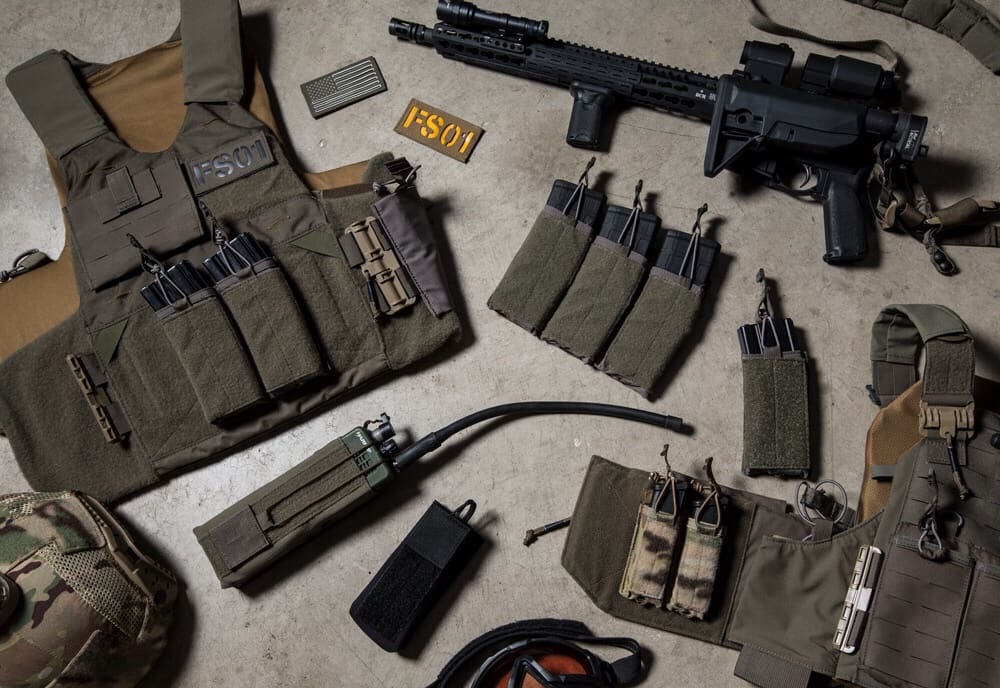
Let us focus for a moment on one consumable class of supply in particular – ammunition. Can a unit or individual have “too much” ammunition. If in a static defense the answer may be no; however, if that ammunition has to be carried on soldiers’ backs the answer is yes. Ask any overloaded trooper who drowned in the inland canals or wading ashore at Normandy. Excess weight is excess weight. As mentioned in Part I, the baseline or standard “fighting load” has been defined by whatever the “basic load” of ammunition is for a rifleman in a given timeframe. Frankly, there has never been much “science” behind determining what a basic load should be. In the First World War, when the 1903 Springfield was the standard rifle, a soldier’s basic load was 55 rounds. 50 in his ammunition belt and 5 in the rifle. For the M1 Garand it was 88. 80 in the belt and 8 in the rifle. For the M14 it was 100 rounds, 80 in ammo pouches and 20 in the rifle. During the initial fielding of the M16 it was 140 (seven 20 round magazines) – although in Vietnam soldiers habitually carried twice that or more. After Vietnam, and the standardization of the 30 round magazines, a basic load stabilized at 210 rounds (7 magazines). I am not being facetious when I say that, historically, it seems the number of rounds or magazines a solder can carry in the issue ammunition belt or pouch has dictated basic loads – not rigorous scientific study.
Do modern riflemen actually need to carry almost three times more ammunition than their World War II counterparts? There is no quantifiable evidence that I am aware of that supports any such conclusion. Logisticians have developed scientifically derived and reliable food and water consumption rates for soldiers in combat. On the other hand, ammunition consumption rates are essentially subjective; and therefore, are of limited utility and not reliable at all. Simply stated, based on even a cursory review of modern (WW II and later) historical combat engagements, the more ammunition available, the more ammunition a unit in combat expends. This is true whether the unit ultimately wins or loses any particular fight.
If a modern unit does legitimate mission analysis and concludes that double or triple basic loads – i.e. 6-9 times what the WWII infantryman carried – is necessary to take an objective, maybe the task is simply more appropriate for a larger unit to tackle? In any case, I would respectfully suggest that the unit establish an expedient range and expend that extra ammunition to improve soldier shooting skills and confidence before going on the mission instead. I can just about guarantee that would be a more effective use for that ammunition than carrying all that extra weight out of an overabundance of caution or fear.
In other words, it is much more likely that excess ammunition will be wasted rather than used for good effect. As seen in the attached picture, blindly pointing a weapon in the general direction of the enemy and going cyclic until running out of ammunition or a weapon inevitably fails is usually referred to as the “spray and pray” firing technique. Indeed, even calling it a “technique” lends it some semblance of unwarranted legitimacy and is far too kind. Let us call “spray and pray” what it is – panic fire. While panic fire may be emotionally cathartic for poorly trained leaders and scared soldiers, it produces no positive tactical results – and wastes a great deal of ammunition. In short, despite its reportedly widespread use by American forces in Vietnam, panic fire is NOT effective at eliminating the threat or winning the close fight. How do I know that with a high degree of certainty? Simple, no Army has ever had programs of instruction or ranges designed and dedicated to teaching panic fire techniques.
A unit that allows soldiers to panic fire every time they make contact does not need more ammunition – they need more training and a lot more fire discipline. Fire superiority does not mean that one side makes more noise or simply fires more rounds than the other side. Fire superiority requires synchronized fire and maneuver to gain a relatively dominate position to suppress, fix, and ultimately finish an enemy – while simultaneously thwarting his efforts to do the same to you. That means, upon contact – if not prior to contact – soldiers shed their excess load, return disciplined, aimed, and effective, fire in order to seize the initiative, out maneuver, and decisively out fight their opponents.
Historically, cohesive units with more combat experience tended to carry less rather than more ammunition into battle. Arguably, the unpopular draft, individual soldier and officer frequent rotation policies, and shake-and-bake-NCOs made the experience of some American units in Vietnam the exception that proves that rule. Conversely, American Airborne units of World War II were a great example for modern leaders to study. The paratroopers certainly jumped overloaded to get as much materiel into the fight as possible. However, the troopers dumped or cached the excess ASAP and went into the fight with not much more than ammo and water. That is because the Airborne training program emphasized speed over firepower. The ability of relatively lightly burdened troopers to secure tactical and operational objectives as fast as possible before heavier forces could react and reinforce those positions was critical to mission success. Therefore, the individual troopers and leaders trained with a focus on the lightest possible fighting load, not the necessarily heavy jump load.
Similarly, today’s leaders must triage the fight ahead and adjust load priorities accordingly to facilitate mission success. Do not confuse what you CAN carry with what you NEED to carry to win that fight. Determine what is needed, who needs to carry an essential item, and where (what echelon of the FLC) does the item need to be in to effectively support each phase of an operation. I would suggest that – except in extreme circumstances – a basic load of 7 magazines should be considered the hard ceiling for an individual rifleman’s load. Indeed, smart small-unit leaders know that their bigger organic “boom sticks” can produce better tactical effects against a determined enemy. Machineguns, recoilless rifles, and mortars provide more combat bang for the buck than individual carbines. In other words, instead of carrying more M4 magazines, a unit’s mission is likely better served by distributing more of the heavier ammunition for the crew-served weapons.
In Part III, I will discuss techniques for mastering those load transitions and some training strategies that can better prepare units and leaders to successfully manage every aspect of the Fighting Load Continuum.
LTC Terry Baldwin, US Army (Ret) served on active duty from 1975-2011 in various Infantry and Special Forces assignments. SSD is blessed to have him as both reader and contributor.