FirstSpear

Archive for the ‘Helmets’ Category

Revision Showcases FTHS Special Forces Head Systems At SOFIC

Tuesday, May 16th, 2017

Essex Junction, Vermont (May 15, 2017) – After a rigorous and collaborative development process, Revision Military, the world leader in integrated head systems, will showcase the Company’s new Special Forces helmet systems at the 2017 Special Operations Forces Industry Conference (SOFIC) in Tampa, Florida on May 16th. Revision’s Special Forces helmet solutions were developed for SOCOM’s highly anticipated Family of Tactical Headborne Systems (FTHS) program, a solicitation that is primed to define Special Operations Forces (SOF) head protection for the foreseeable future.

“True to form, Revision took this generative, ground up process to the extreme, setting ambitious goals for performance and innovation while working on a narrow timeline,” said Jonathan Blanshay, CEO, Revision Military. “The scope and creative latitude of this program fit well with Revision’s capabilities and reputation for sweeping innovation. Revision invested heavily in this project—in time, personnel, and financial capital—and, in parallel, we significantly strengthened our manufacturing—adding several million dollars of new equipment and expanding our principal helmet manufacturing facility—modernizing our operations and increasing capacity to support this program simultaneously. In this process, Revision brought a wide-range of SOF users to the table. Special Forces operators can feel real ownership of the end-product, knowing that their demands were addressed and readdressed continuously. We are genuinely excited to unleash the full scope of our vision for the future of Special Forces head protection.”

Revision’s SOF helmet suite addresses SOCOM’s technical challenges head on: optimized weight, protection, and mobility indices and system component integration. Revision has developed two cutting-edge helmet systems: a Carbon Bump System and a Ballistic System with liner system, rails, and Wilcox® Mount. Revision’s Carbon Bump helmet can be ballistically-enabled—add-on armor appliques up the protection level for ballistic, blunt-force, blast-force, and fragmentation threats. And, the skeletonization of all system components has significantly reduced the overall weight of these helmet systems.

Revision’s FTHS head systems showcase at SOFIC represents the culmination of an intensive ground-up design and development program, dating back to the beginning of 2016, as well as exhaustive testing, analysis, and trials. Communicating with esteemed Special Forces operators, from across the special ops spectrum, Revision created a head systems suite tailored to the experience and feedback of SOF operators.

Revision’s FTHS solutions will be available commercially in 2017. The suite of products will be known as the Batlskin Caiman Head System. Additional Caiman Head System accessories and components are planned for later this year and early 2018.

www.revisionmilitary.com

Warrior West – Ops-Core Superwide Ballistic Side Armor

Thursday, April 20th, 2017

The new Superwide Ballistic Side Armor attaches to the ARC Rail and gives you plenty of room for ear pro.

IMG_0996

www.ops-core.com

High Cut Helmet Designs Have Been Around For A Long Time

Monday, April 17th, 2017

What we currently refer to as high cut helmets were once commonplace. For instance, during the Roman era, many versions of the Galea or helmet featured cut outs for the ear.


(photo from Roman Hideout)

Even in the modern era, the US Army experimented with the concept during the Vietnam conflict.

This photo, taken in August, 1969 at Camp Pickett, VA, depicts a Soldier wearing a Lightweight Individual Clothing And Equipmen (LINCLOE) helmet prototype. Several versions were evaluated, made from nylon or titanium.

USSOCOM Issues Presolicitation for SPEAR Family of Tactical Headborne Systems

Friday, April 14th, 2017

Recently, United States Special Operations Command (USSOCOM) issued a presolicitation notice to industry for a Commerical-Off-The-Shelf Special Operations Forces Personal Equipment Advanced Requirements (SPEAR) Family of Tactical Headborne Systems (FTHS)-Ballistic and Non-Ballistic Helmets. The FTHS-Ballistic and Non-Ballistic Helmets will consist of a ballistic helmet system as well as a non-ballistic helmet system.  

The government intends to award a five-year Indefinite Delivery Indefinite Quantity (IDIQ) Firm Fixed Price (FFP) production contract for a fully developed item to the offeror with the best value to the Government. This is not a R&D contract; the offeror must be the Original Equipment Manufacturer (OEM) and have an existing U.S. verifiable production line for any product proposed under this solicitation. All offerors must submit a proposal for both helmet systems; partial proposals will not be accepted. The helmet systems must meet the performance requirements as outlined in the Performance Specification and meet the requirements set forth in the Berry Amendment.

The acquisition will utilize full and open competition and the final solicitation is expected to be released this month. The minimum contract value will be $150K and the maximum contract value will be $95M.

Offerors will be required to submit Product Demonstration Models (PDMs) with proposal submission for evaluation. In addition, the Government may procure additional PDMs for testing purposes as part of this solicitation. These PDMs will be purchased from only those vendors remaining in the competitive range. Word is, the Government wants each offeror to submit in excess of 300 sample helmets, cost free. That’s a serious outlay to participate, considering the offeror may walk away empty handed.

It is important to note that these helmets are not the same as the Next Generatin SOF Helmet examples produced last year by Ops-Core and Revision.  Instead, these will be much more evolutionary in nature, bringing new materials and improved fit in packages much more like SOF currently use.  For example, this procurement is looking for solutions that include ballistic and bump shells, suspension systems including left and right eye dominant straps, accessory rails, exterior Velcro kits, 3M Peltor Accessory Rail Kit, and helmet covers.  Interestingly, SOCOM is said to be looking for a new hearing protection system soon making the interest in a 3M Pelton mount interesting.  Additionally, the offeror must propose a 3-Hole VAS shroud, provide the Wilcox G24 VAS mount, 4-Hole GSGM VAS Shroud, Wilcox GSGM VAS Mount, and the helmet itself must be compatible with currently fielded shrouds.  Kind of makes you think there should be a move to a more common VAS Shroud.  However,  another procurement is expected later this year for a separate SOF coxswain helmet which will likely include a bump helmet with ballistic appliqué upgrades as well as a mandible guard.

For additional details, visit www.fbo.gov.

There’s a Reason Tankers Refer to Dismounts as “Crunchies”

Thursday, April 13th, 2017

IMG_8365

Source: US Army WTF Moments on Facebook

Velocity Systems Obtains a United States Patent for their Versatile Protective Helmet Appliqué Assembly

Wednesday, April 12th, 2017

Dulles, VA – April 11, 2017 – Velocity Systems, a provider of high performing armor solutions, has been granted a second patent regarding the Versatile Protective Helmet Appliqué. The Versatile Protective Helmet Appliqué Assembly permits a helmet wearer to upgrade the ballistic prevention capabilities of a traditional helmet quickly and efficiently. The helmet appliqué can be provided as part of a helmet appliqué system and/or assembly that includes internal-side connection means for attaching to a helmet and external-side connection means for receiving any of various external items such as identification tags, mounts and external equipment or attachments. The appliqué element can comprise various types of material, including, for example, ultra-high molecular weight polyethylene (UHMWPE).

The first helmet appliqué patent acknowledges a cutout for a night vision google mount and goggles. The second patent takes the innovative principle of the first patent a step further to include multiple helmet appliqué elements employed on the same helmet. This includes surfaces and portions that are cooperatively engageable for covering multiple areas of the helmet at the same time. Velocity Systems is committed to focusing on R&D efforts to continue to develop innovative lifesaving products. For further information about the Versatile Protective Helmet Appliqué Assembly Patent please email info@velsyst.com. *United States Patent Number 9,557,144 and 9,222,758

Revision SOF Helmet In Action

Sunday, April 9th, 2017

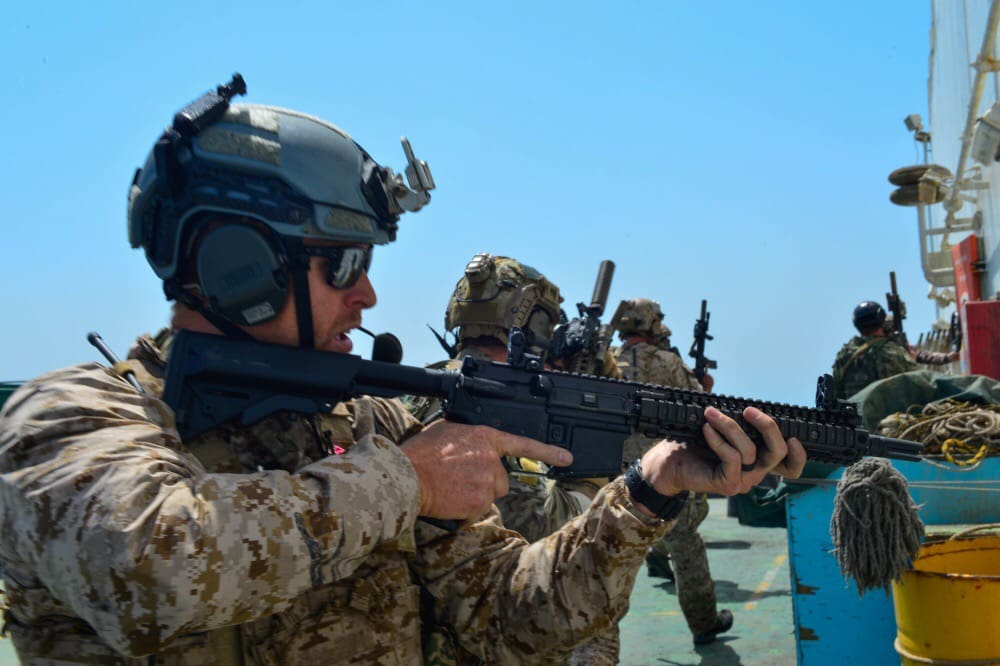
Interesting to see one of the Revision Military Family of Tactical Headborne Systems submissions for USSOCOM’s Next Generation Helmet program, out in the wild.

KUWAIT – Elite military special operations forces from the Gulf Cooperation Council, and the U.S. conducted a simulated rapid response to the hijacking of the motor tanker, or oil tanker, the Hadiyah, April 3, in Kuwait territorial waters.

Special forces teams from the GCC, and U.S. Naval Special Warfare and rigid-hull inflatable boat teams simulated an air and sea-borne rapid insertion, search and seizure of the occupied tanker and its hijackers, and the safe release of the tanker crewmen.

The raid was a cumulative joint exercise that tested the participants’ tactical skills and abilities to operate cohesively in an operational mission with our GCC partner nations.

Exercise Eagle Resolve is the premier U.S. multilateral exercise within the Arabian Peninsula. Since 1999, Eagle Resolve has become the leading engagement between the U.S. and GCC nations to collectively address the regional challenges associated with asymmetric warfare in a low-risk setting.

This work, Elite Special Forces from GCC and U.S. simulate a raid on hijacked tanker [Image 1 of 74], by MSG Timothy Lawn, identified by DVIDS, is free of known copyright restrictions under U.S. copyright law.

Thanks DM!

PEO Soldier Talks About The Advanced Combat Helmet Gen II

Thursday, March 30th, 2017

PEO Soldier held a press conference earlier today regarding the Advanced Combat Helmet Gen II fielding. Officiating the event was LTC Kathy Brown, PM Soldier Protective Equipment. She was assisted by APM, MAJ Brandon Motte.

IMG_0647

From World War II until the 1980s, the US military relied on a stamped steel helmet with liner, commonly referred to as the “Steel Pot”.

IMG_0646

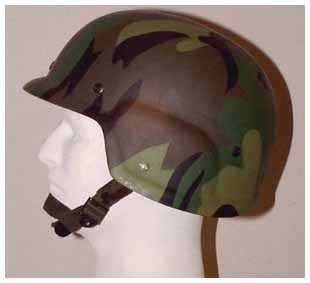
It was replaced by the Personal Armor System, Ground Troops or PASGT. Its nickname was the ‘Kevlar’ after the material it was made from.

IMG_0645

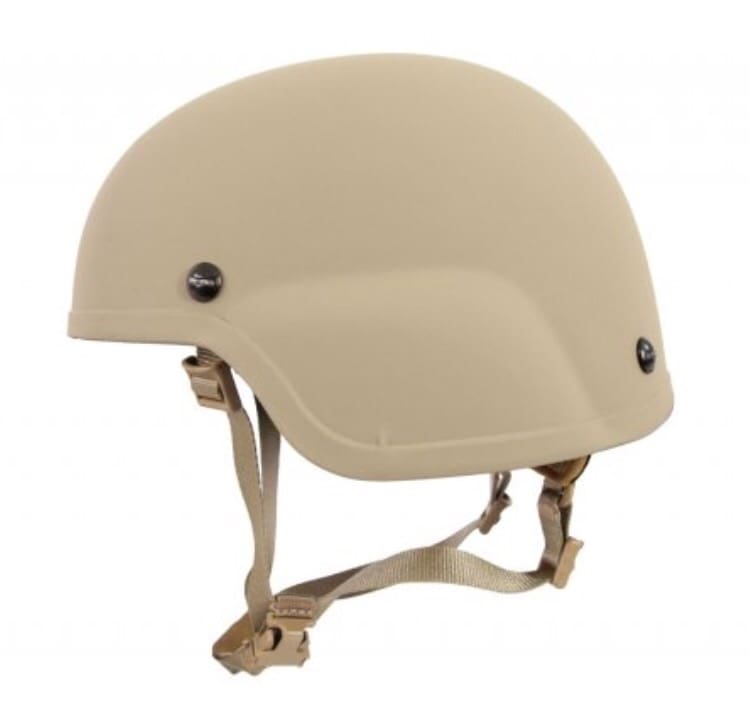
In the late 1990s, USSOCOM began to take advantage of new para-Aramid materials and embarked on a program called the Modular Integrated Communications Helmet. The helmet’s design was modified slightly to a more streamlined shell than the bulky PASGT and it was quickly adopted by the US Army as the Advanced Combat Helmet, in the early 2000s as active combat in the Middle East stepped up.

Right up front, LTC Brown told us that this is the greatest weight reduction we’ve ever seen in headborne protection. She went on to say , “I’m very proud of the work we’ve done here. Our soldiers and civilians are highly technically skilled.”

For both Large and XLarge the reduction is 24% over the legacy ACH, while for Medium and Small helmets, it is 21%. The average is 22%. For example, the XLarge legacy ACH is 3.88 lbs while the ACH Gen II in XL is 2.94 lbs, or a 24% weight reduction.

The goal of the upgrade program was to offer weight reduction with equal protection of the legacy helmet. They’ve definitely accomplished that mission.

Chief engineer Jacob Hopping said, “Reductions in weight mean more alert Soldiers.” The Legacy helmet is Kevlar, while the new ACH II is polyethylene which accounts for the weight reduction.

Along the way of fielding helmets, the US Army worked on a program with the US Marine Corps called Enhanced Combat Helmet which uses High Density Polyethylene to defeat rifle caliber threats. It’s currently used in high threat environments like Iraq, and is available via Rapid Fielding Initiative.

Additionally, the Army has access to ballistic appliqués which attach to the top of a helmet and offer full rifle caliber threat protection. Once again, these are only used in high threat environments.


The Advanced Combat Helmet Generation II looks almost identical to the ACH Soldiers have been wearing for 15 years, but it weighs 9 ounces to almost a pound less than the legacy helmet. The new helmet is made from ultra-high-molecular-weight polyethylene, a lighter material than Kevlar, but reportedly just as strong. (Photo Credit: Ron Lee, PEO Soldier)

The ACH Gen II is going to look very similar to your legacy ACH, just lighter. While the helmet will be issued in Tan 499/Coyote 498, rather than the Grey looking Foliage Green, there will continue to be a helmet cover and, when used, the ballistic appliqué can be hydrodipped in colors or camouflage patterns as needed.

Since Defense Logistics Agency Troop Support is handling this contract, the other services will also be able to requisition this helmet for their use via NSN. While the Army still hasn’t worked out a strict timetable on fielding of the ACH Gen II, it will be a one-for-one replacement of the legacy helmet and offer a full refresh of the Army’s head protection for both combat and training.

Jacob Hopping mentioned that, “In a few years, working with material developers and manufacturers, we’ll be able to maximize weight reduction and increase threat protection to optimize protection for the head.” While much work is being done with HDPE, he mentioned that perhaps the next Gen Kevlar may show even better protection.

LTC Brown said that this new capability is at the current limits of materials, but engineer Andy Meloni added that they’re not only only looking at materials, but new manufacturing processes are also under development. Andy Meloni supports the ACH II as a matrixed engineer from the Natick Research, Development and Engineering Center.

Ultimately, the Army is looking for a revolutionary leap in the performance-to-weight ratio of ballistic material but they see that as still a decade away. Until then, they’ll look at ways to integrate increased capability to current equipment.

Below is an article by the Army News Service which describe some this capability as well as some other armor technologies. (more…)