Celebrate 20 years of the TLR-1

Archive for the ‘International’ Category

DSEI 25 – Thales ACAR

Wednesday, September 10th, 2025

Thales exhibited the lasted version of their Australian Combat Assault Rifle manufactured by Lithgow.

They caliber, twist rate, finish, and performance for any mission.

Calibers offered include:

5.56mm, 458 SOCOM, 6.5 Grendel, 6mm ARC and 300 BLK.

The ACAR features a cold hammer forged for superior accuracy and chrome-lined barrel for durability, and is designed Future-ready and transfer-of-technology capable to continually evolve against emerging threats.

Landmark Upgrade to Copehill Down Village Underway

Tuesday, September 9th, 2025

London, 9th September, 2025 – Defence technology specialists, 4GD, have begun work on a significant upgrade to the military training environment at Copehill Down Village on Salisbury Plain. Copehill Down, a purpose-built “village”, is used to train for urban operations in built-up areas. The Urban Training facilities are being fitted with an Audio and Visual Closed Circuit Television capability and incorporated After Action Review (AAR) system.

Once complete, the modernised facility will support urban training serials. 4GD is delivering these improvements on behalf of the Defence Infrastructure Organisation (DIO), together with Landmarc Support Services (Landmarc) and the Land Warfare Centre.

The village upgrades will provide a much more realistic, high-fidelity training environment which will enhance the war fighting ability of military personnel and help prepare troops for future potential operational deployments. . The utilisation of 4GD’s flagship products will elevate the quality of urban training on the site. Included in this upgrade is 4GD’s 4GAV After Action Review (AAR) system, which provides unrivalled visibility of all training exercises. These works will also deliver special effects to simulate both battlefield effects as well as pattern of life.

The expansion of 4GD products across the UK’s military training estate continues at pace. The news of the Copehill Down delivery adds further credibility to the quality of 4GD’s technology, which is now in use at Merville Barracks in Colchester, Catterick Training Area in North Yorkshire and Rollestone Camp on Salisbury Training Area. This represents a geographic reach covering the South West, East and North of England. The expansion presents an opportunity for an increasing number of soldiers across the country to be booked into 4GD facilities, to hone their urban fighting skills, close to their garrison base.

At over 94,000 acres, Salisbury Plain Training Area (SPTA) is the UK’s largest training area. It offers live firing and other facilities for armoured vehicles, artillery, engineers, infantry and aircraft. The regular Army, Army reserves and cadets use the training area, as do NATO allies.

Rob Taylor, 4GD Founder and Director, said:

“4GD is at the forefront of delivering technology updates to the military training estate. Starting this work to Copehill Down Village is another major contract for the business and proves the suitability of 4GD’s products for modern defence training. This all serves to enhance training for the warfighter and help prepare the British Army for urban combat.”

DIO’s Colonel Richard Gibb, Deputy Head UK Defence Training Estate, said:

“We are delighted to see this project taking shape.

“DIO supports our Armed Forces by providing what they need to live, work and train. Current operational requirements identified that there was a need for further investment and development in the urban training infrastructure.

“This upgrade in technological systems is a significant milestone in evolving the British Army’s urban warfare capability. It offers a highly realistic space and the ability for immediate after-action reviews which will better prepare military personnel for operations around the world.”

Elbit Systems Launches Frontier: Next-Generation AI-Based System to Tackle Evolving Border Defense Challenges

Tuesday, September 9th, 2025

Elevating Persistent Surveillance with Real-Time AI-Driven Threat Detection and Decision-Making Support, Frontier reduces the workload on operating teams, reduces operational costs, and enhances mission success rates.

London, UK, September 9, 2025 – Elbit Systems Ltd. introduces Frontier, its cutting-edge wide-area persistent surveillance system, designed to address the increasing complexity and intensity of border defense challenges. Presented for the first time at the DSEI 2025 exhibition, Frontier is built to autonomously detect, classify, and assess threats in real-time. Frontier leverages advanced artificial intelligence (AI) to optimize intelligence gathering and decision-making in land, air, and maritime domains.

As global threats continue to evolve, intelligence teams are burdened with monitoring and managing thousands of alerts and massive amounts of data in real time. This challenge places significant demands on operational teams, often requiring substantial resources and risking potential errors. To address these needs, Elbit Systems developed Frontier, a smart, AI-based edge system designed to enhance surveillance operations.

Key features of Frontier include:

  • AI Based Adaptive Routine Learning: using cutting edge computing capabilities the system continuously learns and adapts to routine operations by analyzing vast amounts of data to detect anomalies and deviations.
  • Autonomous Threat Classification: Leveraging AI, the system autonomously identifies and classifies threats in real-time, enabing fast and accurate responses.
  • Smart Decision-Making Support: Frontier prioritizes and assesses the risk of potential threats, providing operators with clear, actionable insights.
  • Sensor Integration: Maximizes the capabilities of multiple sensors, turning data overflow into a coherent understanding of the peremiter.
  • Operational Efficiency: Reduces the workload on operating teams, and lowers operational costs, while improving mission success rates.

Frontier autonomously operates various types of sensors to visually confirm and classify threats, transmitting only the most relevant and analyzed information to the appropriate forces.

Milrem Robotics, Overwatch Aerospace, MSI-Defence Systems, and Pearson Engineering Join Forces to Deliver UK-Specific THeMIS Combat UGV

Tuesday, September 9th, 2025

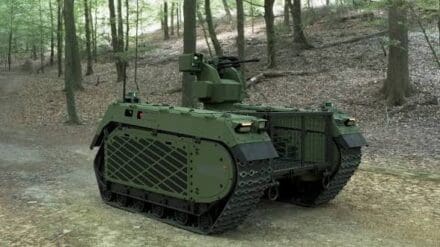
Milrem Robotics, the world’s leading developer of robotic and autonomous systems, along with Overwatch Aerospace Ltd, MSI-Defence Systems Limited (MSI-DS), and Pearson Engineering Limited, has announced the launch of a UK-specific version of the THeMIS Combat Unmanned Ground Vehicle (UGV) at DSEI 2025. This strategic relationship will see the four companies develop, test, demonstrate, and produce the combat-proven THeMIS platform in the United Kingdom, specifically designed to meet the needs of UK customers.

The UK version of the THeMIS Combat UGV will combine Milrem Robotics’ battlefield-proven THeMIS UGV platform with MSI-Defence Systems’ advanced TERRAHAWK Remote Weapon Station (RWS) and Overwatch Aerospace’s innovative APEX Unmanned Aerial System (UAS). Pearson Engineering will contribute its proven expertise in integrating mission-critical capabilities into armoured platforms, ensuring the vehicle is optimised for survivability, mobility, and adaptability to UK operational requirements.
Kuldar Väärsi, CEO of Milrem Robotics, said: “The THeMIS has proven its value in multiple theatres worldwide, and this UK-specific variant will take its capabilities even further. By working with trusted British partners, we deliver an advanced and mission-ready combat system and ensure that development, testing, and production happen here in the UK, creating local value and strengthening domestic defence capabilities.”

Drew Michael, CEO of Overwatch Aerospace Ltd, said: “Integrating our APEX UAS into the THeMIS Combat UGV introduces a completely new dimension to battlefield awareness and adaptability. By merging unmanned ground and aerial capabilities into a unified system, we enable forces to operate more effectively, with improved situational awareness and lower risk to personnel. This collaboration ensures our innovation directly aligns with UK defence priorities.”

Brigadier (ret) Haydn White, Senior Military Adviser at MSI-Defence Systems, stated: “The MSI-DS TERRAHAWK RWS is our fully stabilised remote weapon station, which offers exceptionally precise firepower and situational awareness in a package designed for rapid integration with a wide range of payloads and sensors. Collaborating with Milrem Robotics on this UK-focused UGV demonstrates how the best of British engineering, combined with proven international platforms, can deliver world-class capability to the British Army.”

Ian Bell, CEO of Pearson Engineering Limited, added: “Pearson Engineering will ensure that the THeMIS Combat UGV is adapted perfectly for UK operational environments and that it delivers reliable performance in the most challenging conditions. This partnership highlights our shared commitment to lead the industry into a new era of innovation and safety.”

The program will now move into a comprehensive development and trial phase, with the goal of delivering a deployable, scalable, and enduring robotic combat solution for the British Army.

‘A Major Win for UK industry’: Defence Industry Representatives Hail New MOD Scheme to Create Defence Inward Investment

Tuesday, September 9th, 2025

Industry representatives have lauded the announcement by the Government’s new Defence Industrial Strategy to create a new scheme to drive UK economic growth through a defence inward investment scheme when buying defence equipment from overseas.

The Defence Industrial Strategy, published today (8 September 2025) said that the MOD will launch a new defence inward investment scheme known as ‘offset’ next year – arguing that the policy “can be an effective way to create opportunities for firms to enter global supply chains, boosting the domestic industrial base, creating jobs and supporting economic growth”.

Director General of Make UK Defence Andrew Kinniburgh has described the announcement as a “major win for UK industry”.

The trade body, which represents over 700 SMEs in the defence industry, has been campaigning for the UK Government should draw inspiration from 53 other developed nations with similar policies such as Norway, Poland and South Korea and adopt a defence inward investment plan, or offset regime, as a central pillar to the UK’s growth mission and to strengthen our industrial capacity.

Earlier this year, Make UK Defence argued that such a scheme could allow up to 90% of the economic value of defence contracts going overseas to go back into the UK economy over a ten-year period, unless it was deemed necessary for national security reasons. Companies could achieve this in multiple ways such as creating new UK jobs, utilising UK supply chains with both large and small businesses, creating novel technologies and investing in skills training and apprenticeships.

Make UK Defence point to the successes other countries with similar policies such as Poland, which secured $6bn (£4.4bn) in inward investment following their F-16 acquisition in 2003. In 2023, the country also secured £200 million inward investment from the WILSA anti-aircraft and anti-missile programme. 

The trade body now want to ensure the MOD utilises the new defence inward investment scheme to incentivise the utilisation of SMEs in the defence industry and to support industries supplying critical raw materials the Defence Industrial Strategy identified as critical to UK Defence, such as steel and semiconductors.

Make UK Defence Director-General Andrew Kinniburgh said:

 “The MOD’s commitment to design a new defence inward investment plan – something Make UK Defence has spent months campaigning for – is a major win for UK industry.

“By adopting this plan, the Government will deliver more work for UK based companies, including primes, mid-tiers and SMEs, and help to fulfil the defence dividend – unlocking private investment in UK jobs, skills, and supply chains across the nations and regions.

“We look forward to continuing to work closely with the MOD to ensure the new defence inward investment plan delivers for all of industry, including SMEs, and boosts economic growth across the UK.”

Ceremonial Opening of New Ammunition Factory: Turning Point at Rheinmetall-Speed

Monday, September 8th, 2025

Rheinmetall has taken Europe’s largest ammunition factory in Lower Saxony into operation in order to meet the urgent needs of the armed forces in Europe. The technology group has invested almost €500 million in the construction of the production facility at the Rheinmetall site in Unterluess (Celle district), which was completed in a record time of just 15 months.

The presence of many dignitaries from Germany and abroad highlighted the importance of the occasion. Guests present were Vice-Chancellor and Federal Minister of Finance Lars Klingbeil, Federal Minister of Defence Boris Pistorius, NATO Secretary General Mark Rutte and General Carsten Breuer, Chief of Defence of the German Armed Forces. The highest-ranking guest was Rumen Radev, President of Bulgaria. Olaf Lies, Minister-President of Lower-Saxony, also attended the ceremony, as did many other high-ranking persons, including guests from the United States of America, Latvia and Lithuania.

In future, up to 350,000 artillery shells are to be produced annually in Unterluess at the new Lower-Saxony plant (Werk Niedersachsen), which covers an area of around 30,000 m2. The first 25,000 rounds are to be produced before the end of this year. Next year, 140,000 rounds are scheduled for delivery, with full capacity to be reached in 2027. In addition to that, the production of engines for artillery rockets is planned for the year 2026. Rheinmetall CEO Armin Papperger: “After having accelerated the production to the maximum until 2027 and then being at full capacity, the Werk Niedersachsen will be the largest ammunition plant in Europe, if not the world”.

In total, this will create up to 500 jobs – 350 at the plant in Lower-Saxony and a further 150 in the rocket engine production, which is still under development. Hundreds of more jobs will thus be created in areas such as supplementary services and suppliers.

The supply of ammunition is essential for restoring the defence capabilities of Germany and its European allies. Rheinmetall takes on the responsibility as a leading manufacturer and is investing at large-scale at various locations. Most recently, in the summer of 2023, the Düsseldorf-based group spent around €1.2 billion on the acquisition of Spanish manufacturer Expal Systems. Rheinmetall plans to produce a total of around 1.5 million artillery shells per year from 2027 onwards throughout its production network, which also includes sites in Spain and South Africa.

The urgency of the defence alliance’s need for ammunition was underscored in Unterluess by a major order from NATO member Romania, which was placed just before the inauguration ceremony began. Radu-Dinel Miru??, Romania’s Minister of Economy, and Armin Papperger, CEO of Rheinmetall AG, signed a Letter of Intent which is the basis for the next steps. Together with partners, Rheinmetall plans to invest around €550 million in the new plant in Romania.

Federal Minister of Defence Boris Pistorius: “Your success means security for our country”

The politicians praised the importance of the plant for Germany and Europe: “We are herewith investing in our security”, emphasised Federal Finance Minister Lars Klingbeil in his speech. The Vice-Chancellor also reiterated: “This plant indicates that we are taking action”.

Federal Minister of Defence Boris Pistorius addressed Rheinmetall and the defence industry as a whole: “We want you to be successful, because your success means security for our country”. And then continued: “You, the industry, deliver what is important: speed and substance”. He also categorized Germany’s efforts to increase arms production for the armed forces massively in the context of alliance policy: “NATO must become more European so that it can remain transatlantic”.

NATO Secretary General Mark Rutte emphasised in his speech: “Strong and successful is exactly what Rheinmetall is”. He cast a warning glance at the massive armament efforts in Russia and China: “Their military build-up points in a clear direction: they are preparing for long-term confrontation and competition – with us”.

Rheinmetall CEO Armin Papperger accented: “From the groundbreaking to production in just 15 months – that’s a real turning point at Rheinmetall speed”. Since the ground-breaking ceremony in February 2024 and in just over a year of construction work, Rheinmetall has created the possibility to independently meet the requirements of the German Armed Forces from national production in the future and, if required, to guarantee independent deliveries to partner countries. “Our new national production facility is setting standards and will, above all, ensure the supply of the German Armed Forces”. Rheinmetall is not limiting itself to Germany when it comes to building such plants: “This means that we can also erect comparable plants in other NATO-countries within a very short time, thus creating a pan-European defence ecosystem”, Papperger emphasised. “For example, we have already launched specific projects in Lithuania and the United Kingdom, with more to follow”.

Rheinmetall in Unterluess

The traditional site in Unterluess, which Rheinmetall has been operating in the Suedheide region since 1899, is currently the Group’s largest worldwide with 3,200 employees. Two companies are based here: Rheinmetall Landsystems GmbH and Rheinmetall Weapon and Munition GmbH. Unterluess is also an important location for Rheinmetall IT Solutions GmbH. Alongside the ammunition production, the site’s activities also focus on the development and manufacture of weapon systems. At the same time, Rheinmetall maintains its competence centre for the development, construction and support of tracked vehicles here.

The company owns an area that covers a total area of about 60 square kilometres which is largely used as a firing and testing range. Nevertheless, large parts of it are also used for forestry. 

The New Playbook for Effective Multilayered Air Defence: Adaptation, Not Escalation

Saturday, September 6th, 2025

By Ivor, Thales in the UK

The arms race was forged in an era of binary threats, when overmatch was measured in mass and tonnage. Today’s battlespace is asymmetric, accelerated and unbounded. As faster, more fragmented, more unpredictable threats take to the skies, the idea of outpacing them simply with larger numbers of heavier munitions grows increasingly obsolete.

The concept of an arms race assumes a finish line but in an environment of evolving, multi-vector threats, that assumption no longer holds.

Relevance, not dominance, is the new measure of air superiority

On today’s frontlines, a tactical advantage can expire in a matter of weeks. In Ukraine, where countermeasure cycles move fast and systems evolve in near real time, a capability that takes too long in transit may already be outdated on arrival. What matters isn’t the volume of the capability, but how fast it arrives, how easily it adapts, and how well it integrates.

This is a fast-moving operational reality with far-reaching implications. Modern threats – from hypersonic glide vehicles and autonomous drone swarms, to smaller, faster loitering munitions – have shifted the ground under traditional air defence, prompting nations to invest in multilayered systems that promise comprehensive protection – a dome guarding troops from above as well as in front. In the UK’s case, and as set out in its 2025 Strategic Defence Review, £1bn is being earmarked for Integrated Air and Missile Defence (IAMD).

Whether this investment turns promise into real deterrence depends on how ready, relevant and integrated those capabilities truly are. This often means adapting what we have rather than racing to replace existing capability with the shiniest kit that could be outmanoeuvred and outgunned before they leave the production line.

Technical integration as a strategic weapon

By adapting, I mean layering resilience into existing systems and platforms by ensuring they can communicate, adapt and respond as one – helping operators do the same.

While I don’t want to repeat myself, I do want to emphasise a point made in my previous article: just as no single service, government or nation can fend off the array of threats they face alone, no single product, capability or solution can hope to arm these entities with everything they need. Myriad threats require integrated, multilayered solutions which work seamlessly not only within but between Front Line Commands, across allies, domains, borders and time zones.

A NATO ally that goes beyond co-operation, to be truly integrated – capable, for instance, of firing another’s missiles – is one that can respond faster, adapt on the fly, and turn interoperability into a real-time strategic advantage. In this way, agile, agnostic technical integration fosters the kind of Integrated Force outlined in the SDR’s vision for 2035 – one that “deters, fights, and wins through constant innovation at wartime pace.”

Better connected and better protected, allied militaries can gain a competitive edge that’s out of reach of autocratic adversaries characterised by top-down, centralised control. They can exploit the imagination and experience of decision makers at every level by giving them the agility, ability and authority they need to move fast and strike first, augmented by integrated capabilities that can flex to meet any mission and be updated as the threat evolves.

Integration in action: the ACE advantage

In partnership with L3 Harris Technologies, Thales is developing an integrated short-range air defence (SHORAD) Command and Control (C2) capability.

The new capability integrates L3Harris’ Target Orientated Tracking System (TOTS) into Thales’ Agile C4I @ Edge (ACE) system to enhance C2 capabilities. This collects, fuses and correlates data from sensors and effectors across the battlespace, providing a common operating picture and accelerating decision making.

Cultural adaptation as an enduring, evolving edge

Such capabilities are only as valuable as their perceived utility. Without a clear idea of their role within the wider kill chain, decision makers may struggle to deploy them effectively. Without the requisite training and support, end users likely won’t advocate for their adoption, instead leaving them to gather dust on the shelf in favour of what they’re comfortable and familiar using.

It’s why talk of effective technical integration must begin with a foreword that addresses the necessary cultural transformation: the mindsets, habits, incentives and partnerships that matter as much as the technology.

To start with, suppliers and customers must work hand in glove to foster a deeper understanding – on the part of industry – of what’s needed to drive change in the right direction, at the relevant pace. The palpable sense of trust and shared intent at joint hubs like Thales’ facility at Thorney Island is testament to what’s possible when one closes the distance between industry and defence. Here, our engineers, including some ex-service personnel, work side by side with MoD teams: training new air defenders, refining systems and gathering feedback from live experiences to ensure every solution is grounded in operational realities.

As service wrappers go, it extends from system design and kit delivery all the way through to mission support. More broadly, it’s the mindset and trust that makes a difference: availability, willingness, reliability and responsiveness on the part of industry fosters competence at the front line, continuity across operations, and a culture with backbone: confident, composed, and agile enough to evolve with the threat.

The arms race that never ends

New and emerging threats are relentlessly lapping procurement cycles. Traditional air defences are struggling to keep up with a landscape where threats multiply and adapt faster than they can be contained – where eliminating one threat leads to two more appearing in its place. Amidst it all, the imperative for the UK’s Armed Forces to stay ready, responsive and relevant is both an unignorable challenge and an unambiguous aim.

It is not, thankfully, an unattainable one. What’s needed is a mindset shift from periodic reinvention to continuous evolution: spiral development over wholesale replacement, cultural adaptability over rigid process and integration over isolation. The UK must not just be ready to fight tonight, but also able to adapt tomorrow with the systems and skills we already possess.


 

Integration in action: the ACE advantage

In partnership with L3 Harris Technologies, Thales is developing an integrated short-range air defence (SHORAD) Command and Control (C2) capability.

 

The new capability integrates L

Rheinmetall Builds Facility for Destroying Legacy Ammunition

Friday, September 5th, 2025

For the future to come, Rheinmetall is planning to destroy large quantities of legacy ammunition in the district of Dillingen an der Donau, Bavaria/Germany. 

As part of explosive ordnance disposal projects in offshore and onshore areas, the Düsseldorf-based technology corporation intends to destroy not only legacy munitions from the two world wars, but also so-called ‘newer stockpiled ammunition’, and to take over the disposal of old stocks of the Bundeswehr and other NATO forces.

An estimated 1.6 million tonnes of legacy munitions are believed to be on the seabed of the North Sea and the Baltic Sea alone. These include artillery shells, land and sea mines as well as aircraft bombs. In addition, over 2 million tonnes of bombs were dropped on Germany and the occupied territories during World War II. In southern Germany alone, it is estimated that there are still more than 20,000 tonnes of old ammunition that needs to be deactivated and disposed.

Rheinmetall has acquired a site covering around 41 hectares on Lerchenberg, which is part of the Bavarian municipality of Zusamaltheim. The ammunition disposal facility is scheduled to commence operation in early 2026. The property, which also served as a Bundeswehr depot in the past, also has 32 bunkers that can store up to 900 tonnes of net explosive mass.

In April of 2025, Rheinmetall had already acquired the ammunition recovery company Stascheit GmbH, based in Gardelegen, Saxony-Anhalt. Its main activities include the detection, evaluation, recovery and destruction of explosive ordnances, for example in connection with offshore wind farms. Like the new facility on Lerchenberg, Stascheit GmbH will also be integrated into the Projects & Services business unit of Rheinmetall AG.