Atrius Development Group

Archive for the ‘Materials’ Category

Visit Propel at the SHOT Show Supplier’s Showcase

Tuesday, January 15th, 2019

Propel LLC is exhibiting at the Supplier Showcase. They are an amazing small business, focusing on:

• Electrically enabled yarns and connections
• E-textile material components
• Stitchless engineering (a complete tool kit for materials design and materials)
• 3-D textile design and manufacturing

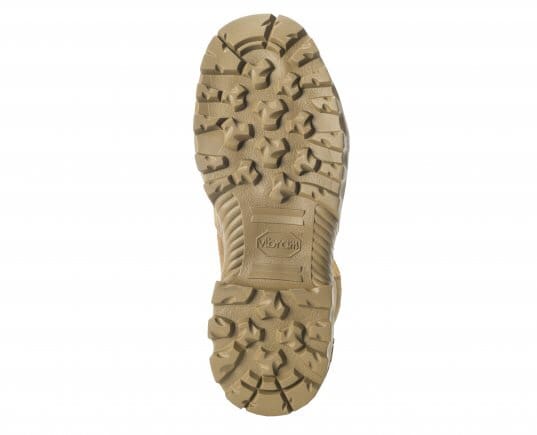
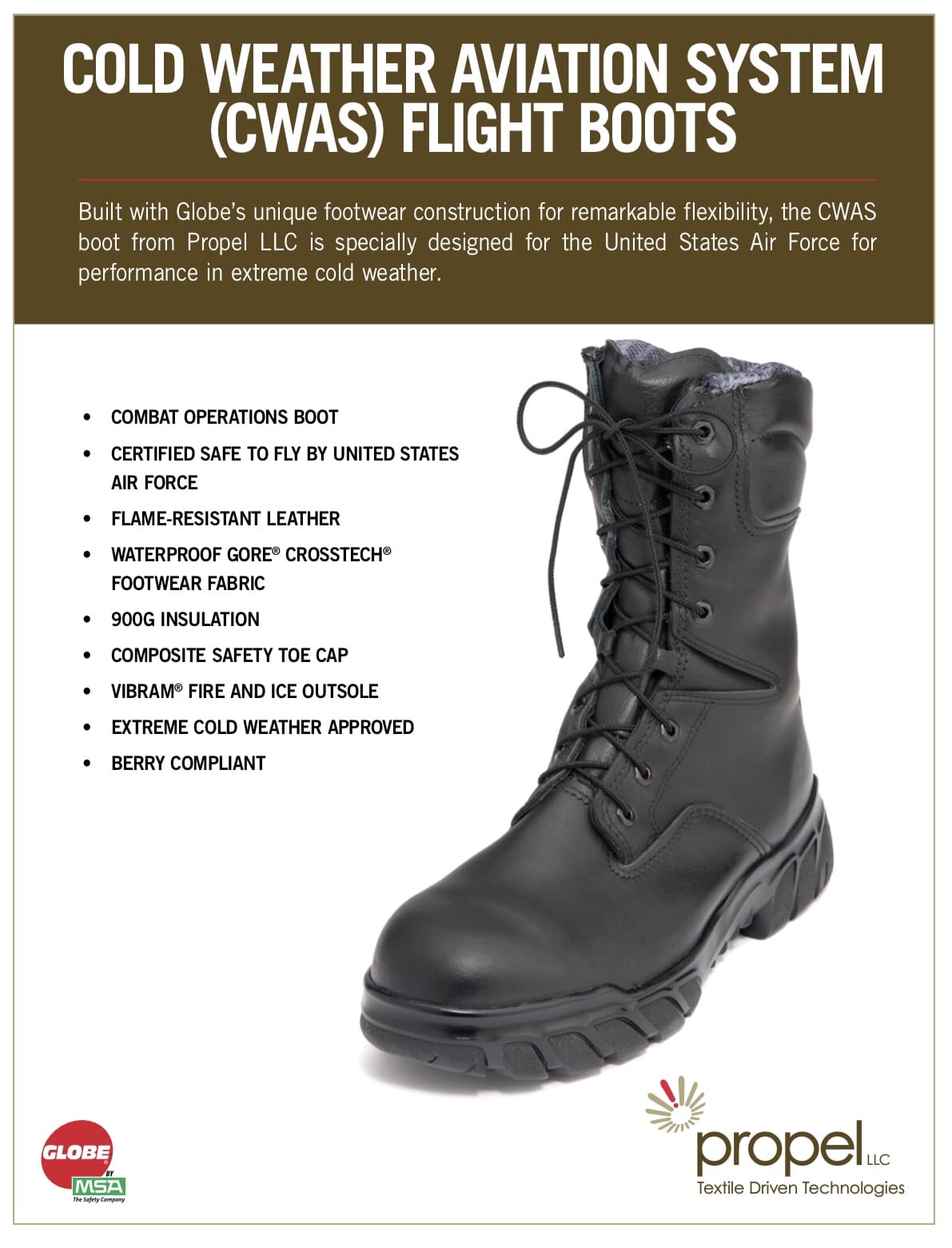
They have also developed a great insulated boot for flyer’s.

See them in booth #1232 8:30 AM–5:30 PM, January 21–22, 2019 during SHOT Show, Palazzo Ballroom, 5th Floor, Venetian Hotel Meeting Rooms in Las Vegas.

Natick Evaluates New Boot Technologies

Thursday, January 10th, 2019

NATICK, Mass. — The U.S. Army Research, Development and Engineering Command Soldier Center at Natick is testing new Army Combat Boot (ACB) prototypes at three different basic training and active duty installations over the next four months. The effort will gather Soldier feedback toward development of improved footwear.
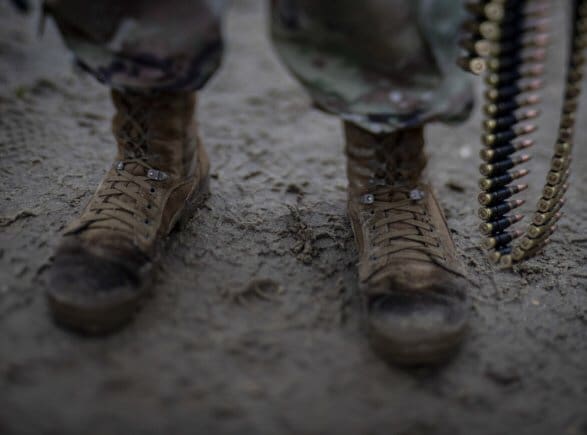
The U.S. Army Research, Development and Engineering Command Soldier Center at Natick is testing new Army Combat Boot (ACB) prototypes at three different basic training and active duty installations over the next four months. The effort will gather Soldier feedback toward development of improved footwear. Pictured, a U.S. Army Soldier from the 1-114th Infantry Regiment stands in the mud holding 7.62mm ammunition during M240 machine gun weapons training on Joint Base McGuire-Dix-Lakehurst, N.J., Nov. 6, 2018. (Photo Credit: Master Sgt. Matt Hecht)

The Army’s current inventory of boots includes seven different styles designed for different environments and climates. The boots issued initially to recruits are the Hot Weather and Temperate Weather Army Combat Boots. Requirements for these are managed by the Army Uniform Board as part of the recruit “Clothing Bag.” The Program Executive Office Soldier’s Project Manager Soldier Protection and Individual Equipment maintains and updates the specifications for both boots.
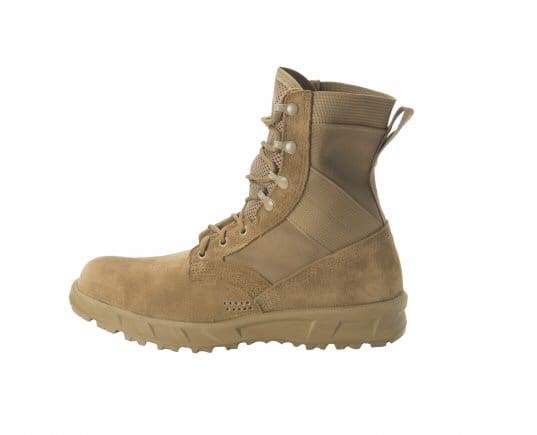
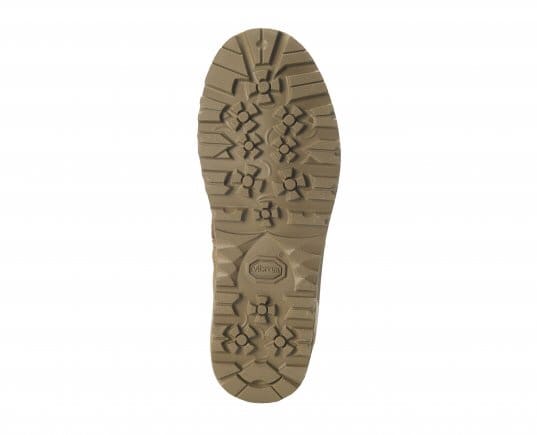
The Army’s current inventory of boots includes seven different styles designed for different environments and climates. The boots issued initially to recruits are the Hot Weather and Temperate Weather Army Combat Boots. (Photo Credit: Mr. David Kamm (RDECOM))

The current generation of Army Combat Boots has not undergone substantial technical or material changes since 2010. New material and technologies now exist that may improve physical performance and increase Soldier comfort.

“Great strides have been made recently in the Army’s environment specific footwear, for jungle, mountain, or cold weather locations, but there is substantial room for improvement in the general purpose boots which are issued to new recruits,” explains Anita Perkins, RDECOM Soldier Center footwear research engineer and technical lead for the Army Combat Boot Improvement effort. “Most components of these combat boots have not been updated in almost 30 years.”

Surveys conducted by the Soldier Center report Soldier satisfaction with ACBs is lower than that with commercial-off-the-shelf, or COTS, boots, leading many Soldiers to purchase and wear COTS boots.

“The survey of over 14,000 Soldiers world-wide discovered that almost 50% choose to wear COTS combat boots instead of Army-issued boots,” Perkins said. “Many Soldiers reported choosing combat boots from the commercial market because the COTS boots are lighter, more flexible, require less break-in time, and feel more like athletic shoes than traditional combat boots or work boots.

Unfortunately, these characteristics often come at the cost of durability and protection.”
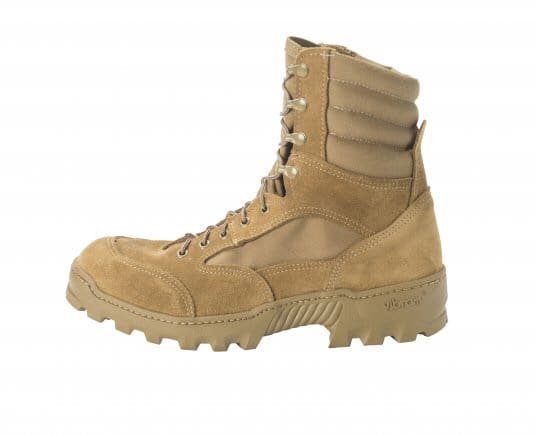
The Soldier Center’s Footwear Performance team believes new technologies can bridge the gap between the lightweight, comfortable, COTS boots and the durable, protective, Army boots. Recent advancements in synthetic materials and rapid prototyping can produce a boot with potentially the same protection, support, and durability of current Army boots, but lighter and more comfortable out of the box. To reach this goal, the Soldier Center is evaluating new types of leather and even some man-made materials which are much more flexible than the heavy-duty, cattle hide leather used in the current boots.

“Also included in the prototypes we are testing are new types of rubber and outsole designs, which are more than 30% lighter than the outsoles on the current boots,” said Al Adams, team leader for the Soldier Clothing and Configuration Management Team at the Soldier Center.
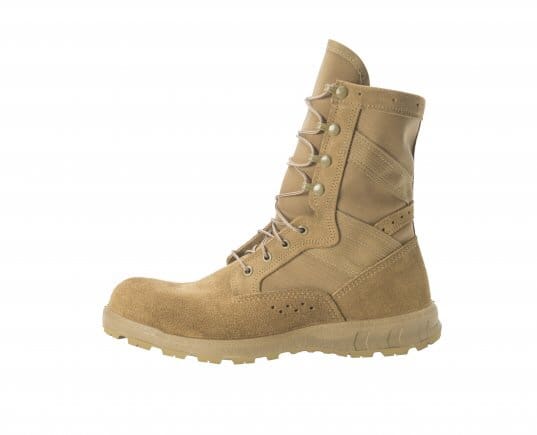
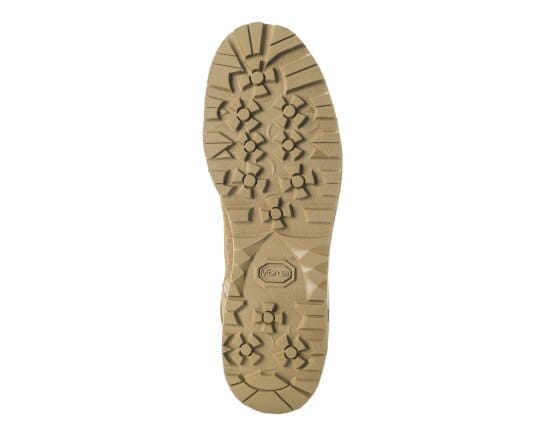
When working with industry to develop the prototype boots for this effort, Adams and Perkins put an emphasis on cutting weight. The boots being tested are up to 1.5 pounds lighter per pair than the ACBs currently being issued.

“In terms of energy expenditure or calories burned, 1-pound of weight at the feet is equivalent to 4-pounds in your rucksack,” Adams said.
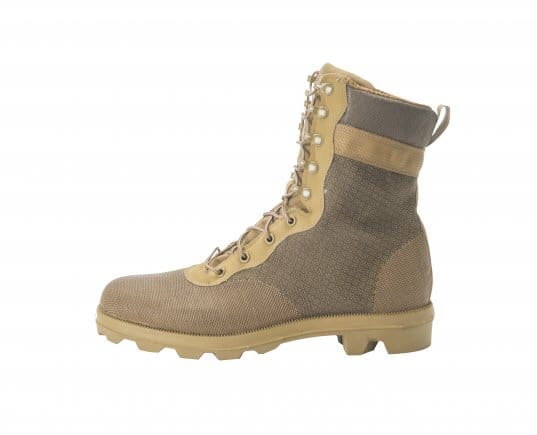
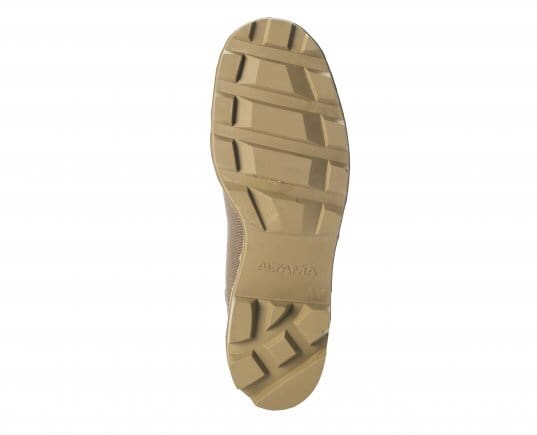
The test boots will be fitted and fielded to 800 basic trainees at Fort Leonard Wood, Missouri and Fort Jackson, South Carolina, followed by 800 pairs going to infantry Soldiers at Fort Bliss, Texas. The Soldier Center team will be hand-fitting each pair of prototype boots throughout the month of January and then return in March and April to collect surveys and conduct focus groups to gather specific feedback.

“Soldiers live in their boots and many will tell you that there is no piece of equipment more important to their lethality and readiness,” said Adams. “A bad pair of boots will ruin a Soldier’s day and possibly result in injuries, so we really believe that each of these prototype boots have the potential to improve the lives of Soldiers”.

Simultaneous to the field testing, lab testing will be conducted on the boots at the Soldier Center to quantify characteristics like flexibility, cushioning, cut/abrasion resistance, and breathability. The combination of lab testing and Soldier recommendations will identify Soldier-desired improvements to the boot prototypes and rank the state-of-the-art materials and designs for Soldier acceptance, durability, and safety. The Soldier Center will then provide recommendations to PM SPIE and the Army Uniform Board to drive the next generation of Army Combat Boots.

“The development of new boots take advantage of the latest materials technology, and are functional and comfortable, is critical to ensuring that our Soldiers are ready to fight and win in any environment,” said Doug Tamilio, director of the RDECOM Soldier Center. “Soldiers are the Army’s greatest asset, and we owe it to them to make them more lethal to win our nation’s wars, and then come home safely.”

By RDECOM Soldier Center Public Affairs

1947 LLC Updates MultiCam Materials Pricing For 2019

Wednesday, January 2nd, 2019

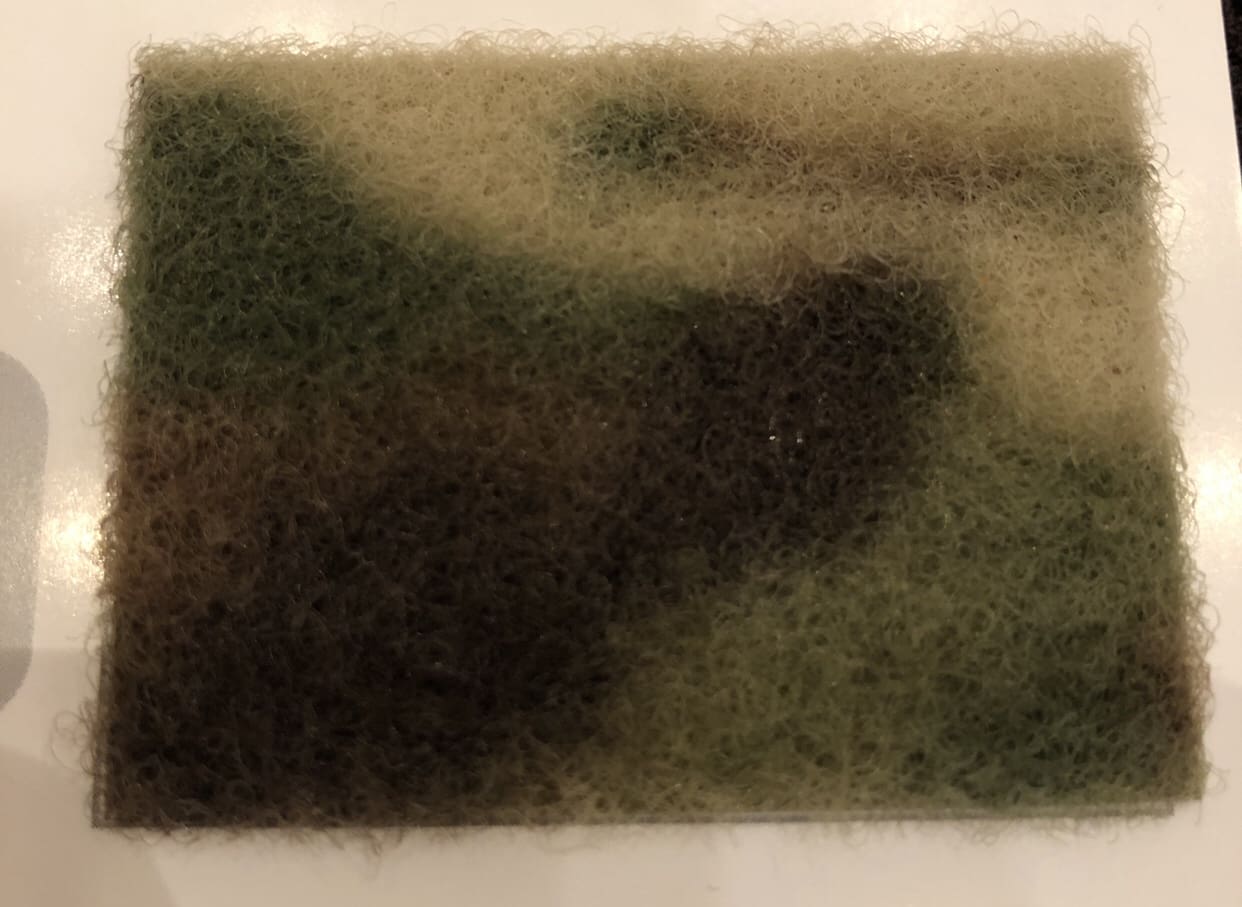
Download their latest price list here. Also, check out the latest trends in MultiCam fabrics, webbings, and trims between January 22-25, 2019, in Booth #32408.

FirstSpear Friday Focus – New Base Layer Bottoms

Friday, December 28th, 2018

Meet the all new Base Layer Bottoms from FirstSpear’s Advanced Clothing Materials Line (ACM). Featuring three available styles a Boxer Brief, Calf Length, and Full Length. All three are built with FirstSpear’s ACM BASE-100 a super light wool package providing excellent natural moisture wicking properties. All three feature a front facing fly, gusseted crotch and flat seamed technology.

The full length is a traditional full length inseam finished with a low ankle cuff, the Calf Length is cut just below the knee designed to pick up where your boot sock stops reducing clutter under footwear and increasing comfort. The Boxer brief is finished in a traditional boxer brief length. 100% American Made with American Materials, now shipping on first-spear.com

www.first-spear.com/technical-apparel/american-merino-wool/base-layer-bottoms

Polartec Announces 2018 Apex Design Award Winners

Thursday, December 6th, 2018

Polartec, the premium provider of innovative and sustainable textile solutions, announces the winners of its 2018 Polartec Apex Awards, an annual design award program celebrating the finest products made from Polartec fabrics. The winning products were selected based on skilled and creative uses of Polartec fabric technologies.

The winners are:

Bight Gear Swelter Jacket, an insulating parka for cold conditions made from 100g Polartec® Power Fill™ insulation (also available in men’s)

Bonne Gueule Blouson Épais Laine Cardée, a clean and versatile jacket made of Polartec® Alpha® insulation, with a Jules Tournier fabric lining, and a wool exterior

Burton women’s [ak]® Turbine Quarter Zip Fleece and Pant, a cozy fleece outfit made of Polartec® High Loft™ fleece, originally designed for the U.S.A. Olympic Snowboarding uniforms

Crazy Idea Skinny Woman Suit, a ski mountaineering racing suit made of Polartec® Power Stretch® fabric

Crye Precision G4 Hot Weather Combat Shirt, a light, breathable combat shirt made of Polartec® Power Dry® fabric, available winter 2019

Dainese Flexagon PL Waistcoat, a winter sports back protector vest made of Polartec® Power Wool™ fabric

Filson NeoShell® Reliance Jacket, a practical jacket made from breathable waterproof Polartec® NeoShell® fabric

LC23 Polartec Down Jacket, a reversible jacket with Polartec® Classic fleece on the intended exterior

Rag & Bone Fleece Tactic Jacket, a cozy, protective hooded jacket made of Polartec® Windbloc® softshell with a plush High Loft™ lining

Reusch Jérémie Heitz Promodel, freeride ski gloves designed with breathable Polartec® Alpha® insulation for outstanding grip and tactility

Rhone Delta Pique Polo, a versatile polo shirt made of Polartec® Delta™ cooling fabric

Santini Vega Xtreme, a high performance cold weather cycling jacket made of protective Polartec® Windbloc® fabric with breathable Alpha® insulation

Sportful R&D Intensity Jacket, a cool weather cycling jacket designed for intense riding, made with breathable Polartec® Alpha® insulation

Todd Snyder + Champion Sherpa Tipped Sweatshirt, a sweatshirt inspired by Champion’s iconic design, made from a Polartec® Thermal Pro® fabric with a shearling aesthetic

Every winner is an embodiment of Polartec fabric innovation and design inspiration, and the winning designers are being recognized with a Malden statue, an industry award unlike any other.

Polartec Introduces First Fabric Technology Engineered To Reduce Fiber Shedding: Polartec Power Air

Tuesday, December 4th, 2018

(Andover, Mass.) – November 28, 2018 – Polartec, the premium provider of innovative and sustainable textile solutions, announces Polartec® Power Air™, the first fabric technology engineered to reduce fiber shedding. By encapsulating lofted fibers within a multilayer, continuous yarn fabric construction, this revolutionary new platform offers advanced thermal efficiency that is proven to shed five times less than other premium ‘mid-layer’ weight fabrics.

Insulation that effectively regulates core body temperature has traditionally been achieved via lofted or high-pile knit structures that hold warm air. Although Polartec is a leader in making resilient materials, it has recognized that any exposed fiber is susceptible to shedding as a function of normal wear. The Polartec Power Air construction process mitigates this by encasing the insulating lofted fibers within the knitting process.

“By using the efficiency of encapsulated air to shelter lofted fibers, Polartec Power Air will drastically improve how fabrics perform over their lifetime with respect to versatility, comfort, and sustainability,” says Gary Smith, Polartec CEO. “We’re only beginning to realize the potential for this new type of fabric construction.”

While creating a more environmentally sound construction was the initial inspiration for Power Air, the innovation also enables greater design versatility, with distinctive visual signatures. The initial release features an internal grid structure on one side not unlike ‘fabric bubble wrap’ which simultaneously holds air and increases breathability, while the other side features a smooth, durable outer surface that resists pilling and minimizes drag.

As the first fabric construction to encase air with a continuous yarn, Polartec Power Air is a foundational technology platform that will eventually provide shedding reduction to all existing apparel categories (including insulation, lightweight next to skin, and extreme weather protection). The innovation has recently gained recognition from the World Textile Information Network with its Future Textile Award for Best Innovation: Sustainable Textiles.

“Polartec has never shied away from solving tough, intractable problems,” says Mike Rose, Polartec VP of Product Development. “Power Air has the potential to be our most significant development since pioneering the process to knit fabrics made of post-consumer plastic bottles.”

Power Air is the culmination of a multi-year development consisting of thousands of work hours and dozens of iterations, and is the latest product of Polartec Eco-engineering™. Eco-engineering is the process by which Polartec deploys recycled inputs, advanced production techniques, highly efficient logistics, and rigorous testing and certifications to create an unrivaled innovation pipeline devoted to producing sustainable fabrics with elite performance characteristics.

Throughout its history of innovation, Polartec has built many unique, robust and repeatable testing protocols that emulate a lifetime of use and abuse from serious athletes and professionals. In the case of Polartec Power Air, a whole new testing protocol had to be invented to measure shedding due to home laundering. The protocol simulates dozens of launderings in a single cycle to accurately capture any microfibers lost in a lifetime of use. The test then accurately determines the percentage of weight loss due to shedding.

Pioneers of eco-engineering sustainable fabrics, Polartec invented the process of knitting technical fleece from post-consumer plastic bottles in 1993, upcycling well over one billion bottles to date, and continues to lead the industry in offering fabric technologies made of recycled content. Earlier this year, Polartec introduced its 100% recycled Power Fill insulation that further reduces environmental impact by eliminating the need for wasteful and non-recycled carrying agents used in other insulation options.

Initially for apparel, Polartec Power Air technology will be publicly unveiled by Polartec CEO Gary Smith tomorrow, November 29, at Performance Days in Munich Germany. The Polartec Power Air Hoody is now available from Adidas, with more brands including Houdini and Mammut set to release their own offerings in the coming months.

To view the Polartec Power Air launch product from Adidas:

Women’s Power Air Fleece Jacket

Men’s Power Air Fleece Jacket

“Polartec Power Air is more than solving a problem and creating a new platform,” says Gary Smith, Polartec CEO. “It’s a brand statement about the power of fabric.”

www.polartecpowerair.com

Teijin Aramid Invests in Increased Defense and Security Customer Support

Friday, November 30th, 2018

Arnhem, The Netherlands, November 29, 2018 – Teijin Aramid, leading manufacturer of premium aramid,  has expanded its development support for customers of the defense and security industry. A completely new, first-class shooting range, based on the latest standards in technology and software, has been created in its Application Competence Center (ACC) close to the EMEA sales office in Wuppertal, Germany. This new state-of-the-art shooting range will allow customers to develop their new products designed to counter specific threats.

For over 30 years, Teijin Aramid supports customers in the development of tailor-made solutions used in soft and hard ballistic applications for police, army, and VIP environments. Changing threats and individual demands are challenging development requirements. At the EMEA Application Competence Center (ACC), Teijin covers a wide range of testing standards for safety and defense applications. Their aramids Twaron®, Teijinconex®, Technora® and the ultra-high molecular weight polyethylene (UHMW-PE) Endumax® are tested in individual customer solutions and partly even with other products or components. The different tests and developments in the ACC take place in order to generate protective solutions against heat, open fire, cut, stab and ballistics.

The ACC is a strategic location for development support and testing. Customers from all regions benefit from the long term experience in aramids and polyethylene, their converting and the broad offering of testing possibilities. Efficiency was one of the major drivers for this investment. A combination of work process optimization and implementation of new technology and testing software, turns the new shooting range into a first-class testing facility. The range length was increased to 17 meters and is compliant with various soft ballistic and hard ballistic testing standards, including helmet testing. This latest technology protects operators and the environment from ballistic threats, pollutions, etc.

For the near future, additional enhancements are planned, e.g. a back face measurement performed via automatic scanning, providing information on depth and volume of deformation. Depending on market needs, an increased threat spectrum will be considered, as well as providing video streaming capability allowing customers around the world to witness ballistic testing live.

Rapid Equipping Force’s Afghanistan Ex Lab Transforms Soldiers’ Ideas Into Reality

Sunday, November 25th, 2018

BAGRAM AIRFIELD, Afghanistan — At Bagram Airfield, Afghanistan, there is a place that wants to know about your tactical problems.

img_9498.jpg

The forward team of the U.S. Army Rapid Equipping Force or REF, wants Soldiers to bring their ideas regarding equipment on how to accomplish their missions more efficiently.

REF’s mission is to provide innovative materiel solutions to meet the urgent requirements of U.S. Army forces employed globally, inform materiel development for the future force, and on order, expand to meet the operational demands. Its focus is on immediate-need materiel solutions at the small-unit level.

EE4DD7EF-C412-40CA-A211-B4FE69EACDAB

“We try to paint that picture for them that you know there’s a lot of capabilities that reside in this building, in the organization,” said Lt. Col. Scott Cantlon, REF forward team chief.

Cantlon is not new to this position as he has also spent time as the REF Forward Team chief in Iraq, Kuwait and Afghanistan for periods in 2016 and 2017.

9AAE5C2C-11FD-4B39-A8D9-67ABE856A22C

“If you need something here and now and rapidly produced, if you have an idea ,a problem, and you think you have a solution in your head, you can sit down and talk with our engineers and there’s a good chance they’re going to be able to design something,” Cantlon said. “Not only design it, but prototype it, and give it to you for some operational feedback.”

The REF team in Bagram offers the capability of rapid prototyping through the Expeditionary Lab or Ex Lab.

BD1CFB6A-137A-4DF4-9B4E-272ECBCF9496

The engineers in the Ex Lab are capable of taking a Soldier’s concern, and if feasible, fabricating the solution through 3D printing, sewing, machining, or electrical work.

“Three-Dimensional printing has come a long way in the last 10 to 15 years. Today we have 3D printers where you can drop a design on a computer, hit print, and the next morning have a full made-out part that is of the same quality as a machine part in term of tolerance and the cavities (compartments) it can do,” said Dr. Patrick Fowler, former lead engineer of the Ex Lab, who redeployed back to the U.S. Army Research, Development and Engineering Command at Fort Belvoir, Virginia, in late October.

E48963D5-3634-475C-8171-101F3918F43E

“And in fact, it exceeds what you can do with a machine because you can create spaces that you would never be able to reach with a tool,” Fowler said.

Fowler has a bachelor’s, master’s and doctorate degrees all in mechanical engineering. Fowler volunteered for this deployment — his first — to fulfill a lifelong dream of serving in his own way with Warfighters.

641EE3B9-D90F-4AA7-9AD9-7F0C849DD620

“This is the only job that I’m aware where an engineer can get a requirement directly from the Warfighter and give them something that goes out the next day on a mission and immediately get feedback, and be able to keep the Warfighter in the design loop,” Fowler said.

The Ex Lab is equipped with design software and other limited metal bending capability among other things.

68A447D4-89A4-4044-A270-FB5E04C93C81

And depending on what it is, these new products can be made in limited quantities to equip Soldiers.

“We make things that have never been made before to respond to a tactical gap,” Fowler said.

“If you can imagine it, then we can make it for you,” he said. “The capabilities that we have here are broad ranging even though we use a lot of 3D printing, we can do traditional metal parts, we can do electronics fabrication, we can do programming, there’s a lot of capability here.”

5FE03219-AA08-45B2-8D07-508C1506CE32

The REF, headquartered at Fort Belvoir, Virginia, started in 2002 after Soldiers realized the need for non-standard equipment to meet the demands of their wartime mission.

The Ex Lab has reachback ties with the RDECOM for its expertise and additional manufacturing capabilities.

67D6D33D-1F2E-48AF-AF6D-CFF3A5DD0B23

The REF is the Army’s quick-reaction capability for getting urgent material solutions in the hands of Warfighters. It’s able to do this using a request document known as “10-Liner”, where Soldiers capture the requirements and submit.

Sometimes, the need is met with commercial and government off-the-shelf technologies. But when not available and if approved, the engineers will design and fabricate a solution to meet a Soldier’s needs.

C98EAC4C-8488-436D-BDEC-51D2C3D777B9

“The work out here, the things we do, it’s very rewarding,” said Ryan Muzii, a support engineer with the Ex lab. “We can do things no other organization can do. A Warfighter can come in with a problem and we can get after it. It’s just such a great asset.”

Muzii has nine years total working for the REF’s reachback support element, Edgewood Chemical Biological Center’s Advanced Design and Manufacturing Division, whose headquarters is at Aberdeen Proving Ground, Maryland. He also has a bachelor’s degree in mechanical engineering and a minor in mathematics.

As of November, Muzii will have been deployed two years to Afghanistan in support of the Ex Lab.

The time to procure and deliver nonstandard equipment. REF’s goal is to fill a requirement within 180 days.

The Ex Lab typically produces a solution in less than 30 days…sometimes in a few days depending on the requirement.

Locations and manning requirements for the REF have varied during the last 16 years based on the missions and number of personnel in theater. The REF also has forward teams in Kuwait and Iraq.

Since 2002, many new technologies have been equipped to help accomplish the mission more efficiently. Current projects include persistent duration unmanned aerial systems, electronic warfare, unmanned and counter-unmanned aerial systems, expeditionary force protection and so much more.

“Honestly, practically all these projects [we do here] someone walks in on I never would have thought. I have no prior military experience … I’ve always been an engineer,” Muzii said.

“Some of the things they (Soldiers) come up with are so innovative and creative, but not reliable, you know, it’s kind of thrown together,” he said. “But a lot of times people make it work; I mean we’re the U.S. Army, we make it work.”

On January 30, 2014, the Army declared the REF an enduring capability. It now reports to the Army’s Training and Doctrine Command where it will continue to support Soldiers deployed globally for years to come.

“Hey, you have this asset at your disposal. It doesn’t matter what rank you are,” said Muzii. “It doesn’t matter where you are in the CJOA-A — Combined Joint Operations Area-Afghanistan — we will come to you. It doesn’t matter how big or small your problem is, as we can help you.”

In Afghanistan, contact the REF and Ex Lab at:
DSN Unclassified:
(318) 481-6293
DSN Classified:
(308) 431-5012

Story and photos by Jon Micheal Connor, Army Public Affairs (Select photos courtesy of REF PAO)