SIG SAUER - Never Settle

Archive for the ‘Optics’ Category

Norotos Product Briefing

Monday, May 9th, 2011

Norotos Director of Manufacturing Rob Prendergast gave us a great rundown on three products during last week’s Warrior Expo West.

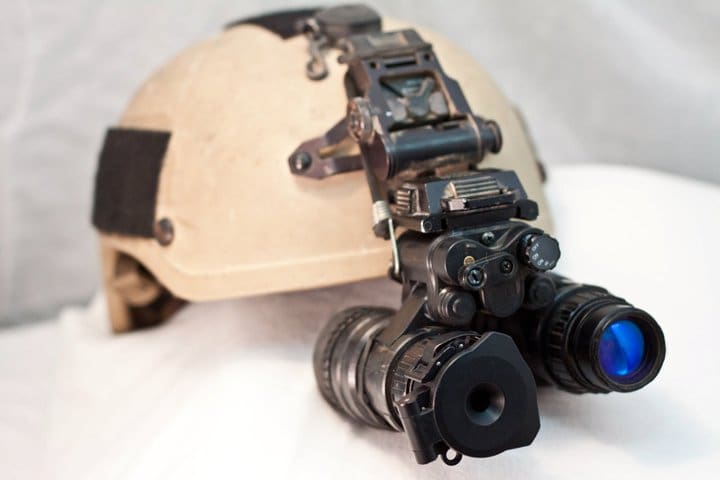
The Universal Shroud fits helmets with one or three holes and can be fitted with a strap for helmets that are not drilled. It also features a low profile as well as a breakaway tether plug.

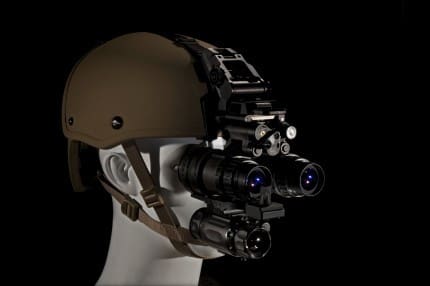
Adaptable to the PVS 7,14,15,18,21, the Improved Night Vision Goggle Mount is backward compatible to any standard mount out there. Of all three of these products it is the most versatile and most applicable due to its compatibility with a variety of systems and unparallelled adaptability.

Finally, the Dual Dovetail Adapter allows you to rapidly transition the sight from right to left eye or vice versa. It also turns the PVS14 off when in the up position and turns it back on when lowered.

www.norotos.com

Norotos products are available for agency purchase from www.ADSinc.com/Norotos.

DLOC – PVS-14 Mount

Saturday, April 30th, 2011

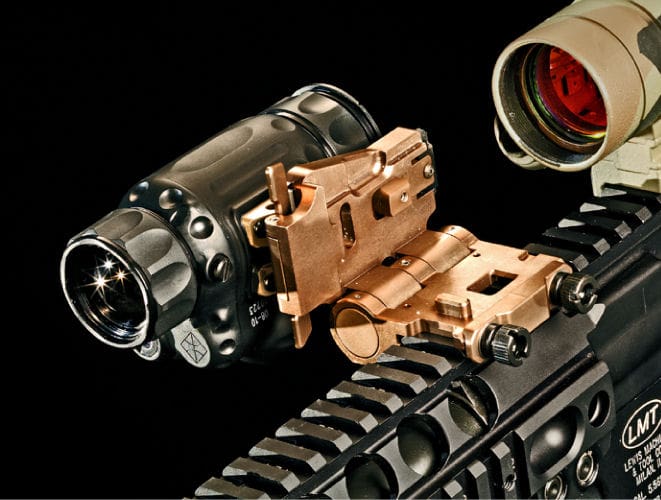
US Tactical Supply is now offering Alamo Four Star, LLC’s PVS14 mount which allows you to instantly transition your NODS from helmet to weapon.

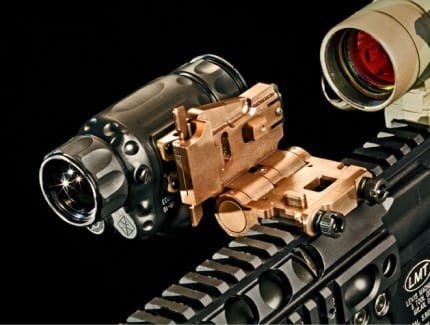
The mount quickly attaches the PVS14 monocular night vision system to any MIL-1913 rail system without throw levers or any tools yet allows the 14 to be mounted close to optics due to its unobtrusive design. Additionally, the mount does not interfere with helmet mounting. It also features a simple, one-handed, pincher-type attachment. Finally, while the mount comes standard for right hand use, it can be converted for left hand use.

ustacticalsupply.com

STAT and LMT Collaborate on the Quick Fire Sight System

Friday, December 31st, 2010

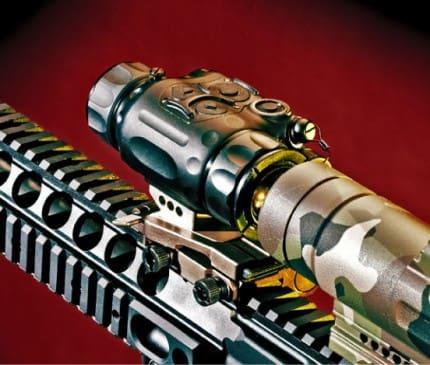
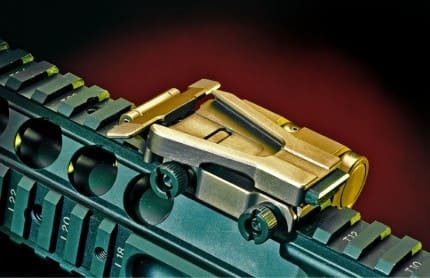
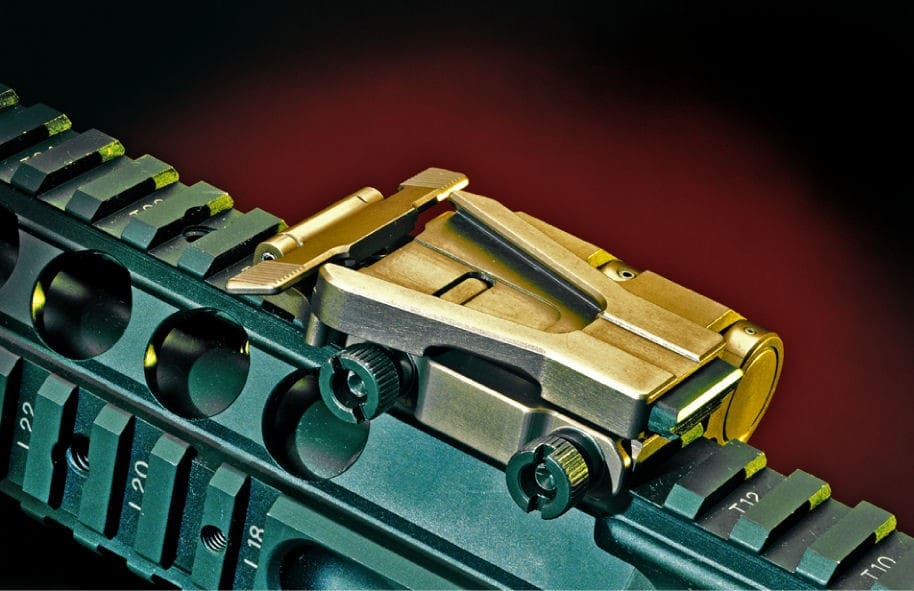
STAT International, in association with Lewis Machine & Tool (LMT), has developed an angled offset mount system for mini red dot (MRD) optics. The Quick Fire Sight System (QFSS) as it is known, maintains height over bore consistent with the primary optics commonly used on A2 platforms, eliminating the “prairie-dogging” often associated with top mount MRDs. When mounted to the rear of the rail, the red dot can be easily accessed and the dot is already in field of view when at the high ready. According to testing conducted by STAT, 86% of evaluators and testers preferred the rear mounting position which allows the sight to be on the same focal plane as the primary optic.

The QFSS is designed to be used as a primary/backup to a magnified optic such as an ACOG or most Sniper/DM precision optics. This provides the precision shooter the ability to patrol and have a rapid acquisition, close quarter sight at the ready. The LMT manufactured mount attaches to any Picatinny-spec rail, works for both left or right hand, is machined from T6 aluminum and comes with all necessary mounting hardware. The system was initially developed by competitive 3 gun shooters needing quicker, accurate close shot acquisition, and was rapidly adopted by the military close quarter combat community.

For more information, please contact info@statintl.com.

LMT Quick Fire Sight System

BAE Systems to Acquire OASYS Technology

Wednesday, September 8th, 2010

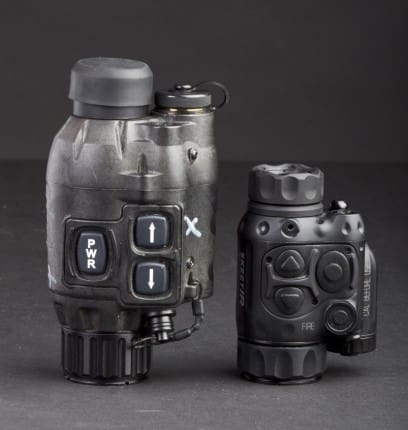
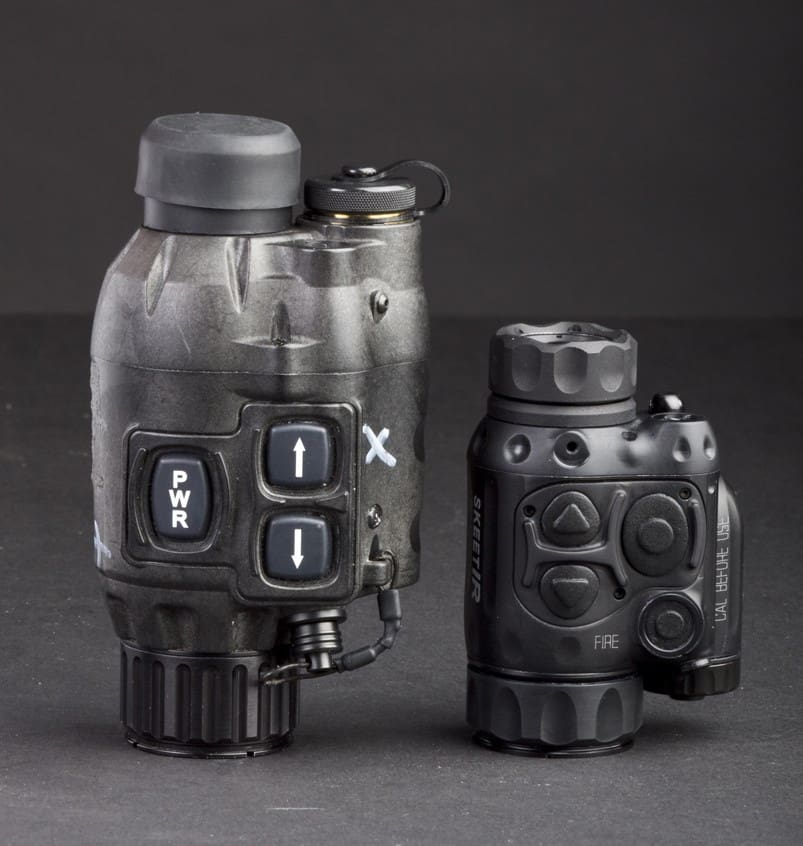
BAE Systems announced yesterday it has entered into a definitive agreement to acquire OASYS Technology, a privately owned company specializing in the design and manufacture of electro-optical systems and subassemblies for aerospace, defense, industrial and commercial markets. For those of you unfamiliar with OASYS Technologies, they build some fantastic thermal sights such as the SkeetIR Thermal Mono-Sight.

“OASYS Technology’s talented workforce and technologies will enhance BAE Systems’ ability to serve its customers as a leader in day/night surveillance and targeting systems as well as precision guidance,” commented Bob Murphy, executive vice president of BAE Systems, Inc. product sectors.

OASYS Technology employs 65 people at its 40,000 square foot design and manufacturing facility in Manchester, New Hampshire. Upon successful closing, OASYS Technology’s operations are expected to be integrated with the BAE Systems business headquartered in Nashua, New Hampshire.

OASYS Technology Chief Executive Officer Mike Couture stated, “We look forward to the opportunity to become part of the BAE Systems family. We will be better positioned to serve our current customer base and broaden both the market and potential applications for our expertise, technologies, and products.”

The proposed acquisition is conditional, among other things, upon receiving certain U.S. regulatory approvals, and it is expected to close during the fourth quarter of 2010. The purchase price is said to be up to $55 Million.

M150 Rifle Combat Optic

Wednesday, August 18th, 2010

Much ado has been made about the lack of lethality of the M16 and M4 at the increased ranges encountered in Afghanistan but you can’t hit what you can’t see. One of the Army’s answers to this quandary is the M150 Rifle Combat Optic (RCO) which is is designed to increase the probability of a first-round hit at distances up to 600 meters.

Adopted in 2007 for use on the M4, M16A2, M16A4, and M249 weapons in addition to increased range, it also allows the use of reflexive fire techniques. When a target is acquired, the ranging reticle can be used to get an accurate range to the target. Then, the range aiming point on the bullet drop compensator can be used to engage the target.

Manufactured by Trijicon, the RCO features a 4 x optic illuminated by fiber optics and tritium. The reticle is of a chevron pattern and is red in color both day and night. Naturally, the issue item also incorporates a laser and anti-reflection filters as well as an integral Mil Spec 1913 attachment.

www.trijicon.com

SKD Tactical Updated Their Look

Wednesday, July 28th, 2010

SKD Tactical has updated their look and with it, the entire shopping experience for that matter. As you can see, it is not only more user friendly, but the most popular brands are one click away from the front page. SKD Tactical still offers industry-leading shipping times and great service. Click on the image to check it out.

Vortex SPARC Red Dot Sight

Monday, June 28th, 2010

New from Vortex Optics is the Speed Point Aiming for Rapid Combat (SPARC). The single piece body is crafted from aircraft-grade 6061-T6 aluminum and the optics are sealed with O-rings and feature nitrogen filled barrels. While you will generally see this sight on rifles and shotguns we have already seen a couple of pistols sporting the SPARC. One of the most interesting things about the SPARC is the mounting solution. The Picatinny modular three-piece base offers four separate mounting heights including absolute or lower 1/3 co-witness for the M16 family. The parallax free sight also features an optional screw-in 2x magnifier. The dot is of variable intensity and also offers a night-vision mode. The SPARC’s 6-hour auto-shutdown feature maximizes battery life. Typical battery life in normal mode of operation: 120 hours (maximum brightness), 3400 hours (minimum brightness). Typical battery life in night vision mode: 4200 hours (maximum brightness), 4600 hours (minimum brightness).

The Vortex SPARC is available from AFMO as well as Blackheart International.

British Troops Get New Sights

Saturday, September 12th, 2009

According a comprehensive article in the British website The Register published earlier this week, UK forces will begin receiving new weapon optics beginning in 2011. According the the article the Ministry of Defence announced during the annual DSEi arms expo that £150 Mil would be spent on new sights. The new kit will be purchased with Future Integrated Soldier Technology (FIST) funding.

New Weapon Sights
Photo: UK MoD

Somewhat awkward was a further assertion that the acquisition would “support the British defence industrial base”. Unfortunately, most of the equipment is actually made in other countries but prime Thales will at least be bringing home some bacon as they serve as integrator.

Quoting the article for information on the new equipment:

“• Underslung 40mm grenade launchers, which have been fitted beneath the rifle of one man in each fire-team of four since 2003, will now get new sights – and also new “fire-control systems”. The 40mm launcher is a low-velocity weapon and has to be pointed high above the target in order to lob its grenades any distance, a process which calls for range to be estimated accurately.
The new fire-control gadget to be mounted alongside the launcher will use a laser rangefinder to work out the correct elevation angle automatically – but our military sources say it makes the rifle/launcher combo unrealistically heavy for combat use, and that troops will find ways to get rid of it.
• Thermal sights will be provided for rifles, marksman’s weapons and light machineguns. These can be used to detect hidden enemies and bombs while on patrol, and function even in total darkness – when the regular light-amplifying night vision gear now in use doesn’t work. This stuff is already in use by some units, and is considered good by our sources.
• New Lightweight Day Sights will be provided, replacing the SUSAT* sights which came in when the SA80 weapons were introduced during the 1980s. SUSAT was very popular in its day (unlike the SA80s, which were only sorted out twenty years later in a German factory), but according to our sources the new sights are much better, offering improved field of view and a clearer picture. “A gleaming bit of kit,” we’re told.
*SSD Note: This sight is the Elcan Specter currently part of the SOPMOD program.
• The new thermal scopes, in a popular bit of good sense, have open Close Quarter Battle Sights mounted on top of them. This means that a soldier in a close-up gunfight doesn’t need to peer through a scope as he shoots, and lose track of what’s happening around him. This gets the thumbs up as well.



• Fire-team commanders will get new “Target Locating System” binoculars containing laser rangefinders and digital compasses, allowing them to mark things they see accurately on a map. This is actually quite basic stuff nowadays, and even in the British army forward artillery spotters and similar specialists have had such kit for some time. It’s new for ordinary infantrymen to have it, however.

There is the option to hook up the binos to a sat nav and a data net, so calculating the coordinates of a target and sending them to other units automatically, but it wasn’t clear at DSEi how much of this capability will be delivered to British infantry and our informants were also unsure. One does note that the only current option for infantry data transmission, the Bowman section-leader’s radio, has a very poor reputation.
• There will also be some ruggedised digital cameras and simple periscopes for peering over walls and round corners without getting shot. The FIST project was originally expected to include on-gun cameras feeding an image to a helmet display for this sort of purpose (those ignorant of shooting realities also thought the weapon might be fired usefully in such a position). It seems that an outbreak of realism has occurred in the MoD.”