TYR Tactical

Archive for the ‘Power’ Category

Army Prototype Uses Windshield Washer Fluid to Power Soldier Electronic Devices

Friday, April 1st, 2022

AUSTIN, Texas – The Army recognizes the need to provide future Soldiers with more durable and reliable energy sources, and is experimenting with a variety of new and creative solutions to deliver the power required for tech-supported warfighting.

One such innovation uses commonly available, filtered windshield washer fluid — which contains the key ingredient methanol — to recharge Soldiers’ mission-critical electronic devices – such as radios and situational awareness aides – while on the go.

The tool, referred to as the Soldier Wearable Power Generator (SWPG), is a small and mobile fuel cell capable of rendering power through innovative thermal energy technology.

Developed in partnership with UltraCell, the SWPG weighs 5 pounds, is designed to be Soldier-worn on a back plate or carried in a backpack, and can run off either filtered windshield washer fluid or a commercial methanol/water mix.

When filtered properly, 1 pound of windshield washer fluid can provide enough energy to charge the equivalent of three Conformable Wearable Batteries that weigh 7.8 pounds; the SWPG’s refillable cartridges can be as small as 1 pound or as large as 24 pounds, depending on charging needs.

Beyond charging individual batteries, the SWPG is equipped to directly support tactical, software-based systems such as Nett Warrior. It can also feed battery-charging power scavengers, such as the Universal Battery Charger-Lite and hubs like the Integrated Soldier Power and Data System-Core. While the SWPG provides a 50-watt base load on its own, it can be paired with rechargeable lithium ion batteries to help fuel hybrid charging systems that offer increased power surges.

The apparatus, which does not get excessively hot or cause ventilation issues for the Soldiers wearing it, seeks to address the Army’s small unit power requirement of providing on-the-move recharging capabilities that extend battery life and minimize the need for frequent battery exchange or reliance on heavy generators.

The Army’s Command, Control, Communications, Computers, Cyber, Intelligence, Surveillance and Reconnaissance (C5ISR) Center leads the service’s applied research and development in energy storage and power generation component technologies.

“Army researchers are continually working on solutions to meet Soldiers’ anticipated needs during this time of rapid modernization,” said Marnie Bailey, C5ISR Center’s Power Division Chief. “The SWPG is the latest example of using our in-house expertise to enable greater Soldier lethality.”

In addition to being compact, lightweight and more efficient than traditional recharging methods, the SWPG is also significantly quieter than conventional gasoline or diesel-powered generators — an important consideration in combat settings. The reception to the device has been positive, with Soldiers saying that the system does not interfere with their ability to conduct their operations.

The SWPG is just one of the unique technologies undergoing field assessment during this month’s Army Expeditionary Warrior Experiment (AEWE) at Fort Benning, Georgia.

The experiment, which is hosted annually by the U.S. Army Maneuver Center of Excellence, takes a closer look how small unit innovations — those geared toward advancing capabilities at the Soldier and squad levels — can have powerful impacts on Soldier maneuver, lethality and survivability.

Insights gathered during AEWE inform the development of priority warfighting capabilities and support the ongoing modernization work of Army Futures Command Cross-Functional Teams. For example, previous AEWE events helped to shape iterative SWPG prototypes by incorporating valuable Soldier feedback, which was then used to tailor and improve the new device.

“AEWE serves as an innovation engine, providing collaboration opportunities and Soldier touchpoints that enable capability developers to rapidly iterate tactical solutions,” said Col. Christopher Budihas, Director of the Army’s Maneuver Battle Lab, adding that “the SWPG is a great example of what this innovation engine can produce.”

By Maureena Thompson, Army Futures Command

Short Battery Life: A Drone’s Worst Enemy

Tuesday, March 22nd, 2022

IARPA awards $10.2 million for battery research to a team of performers led by Rutgers University for the RESILIENCE program

CAMBRIDGE, MA—March 23, 2022—Sensors and small aerial drones are touted as force multipliers for the military. Drones, known to specialists as unmanned aerial vehicles (UAVs), serve as the eyes and ears for combat and surveillance operations while keeping soldiers and intelligence personnel out of harm’s way.

UAVs can be configured to detect weapons, track troop movements and even pick up trace amounts of chemicals. But a key component that has long stymied UAVs is an adequate power source: aerial drones typically cannot fly for as long or as well in demanding operational conditions as many missions require.

Now scientists and engineers are developing a power source for UAVs that can better withstand conditions such as large temperature fluctuations, vibration and shock. The new tech incorporates recent advances in electrochemistry, microelectronics and packaging that combine for novel energy storage. The aim is to create reliable power solutions for missions conducted in extreme and challenging environments—and potentially triple battery life over best-in-class lithium-ion.

Rob Doe, an energy storage expert and microsystems integrator at Draper, says improving a drone’s power supply, or battery, is possible given recent advances in science and technology. “A battery that doubles or triples the energy density while meeting all other necessary performance requirements is well beyond the current performance of commercial solutions, but is within reach of the developer community,” Doe said.

Doe and his colleagues at Draper are contributing to the development of sensors and UAVs as part of a team recently selected by the Intelligence Advanced Research Projects Activity (IARPA). Led by Rutgers University, the team is developing portable power solutions for IARPA’s Robust Energy Sources for Intelligence Logistics In Extreme, Novel and Challenging Environments (RESILIENCE) program.

Battery cell development, using rechargeable lithium metal, is headed by Glenn Amatucci, Ph.D., professor of materials science engineering and director of the Energy Storage Research Group at the Rutgers School of Engineering. Draper’s primary contribution is to leverage its expertise in custom microelectronics, packaging and systems integration to optimize the energy storage system output, meet stringent size requirements and accelerate adoption of Rutgers’ energy storage solution.

The team has set a goal of developing a power source for drones, small sensors and portable devices that exceeds that of rechargeable lithium-ion batteries and single-use legacy lithium batteries. The team is working to create new electrochemical energy storage solutions, and lay the foundation for using rechargeable lithium metal in the power source they create. The vision is to extend battery life and design a battery that can be charged and discharged thousands of times.

IARPA says the aim of the RESILIENCE program is to develop “portable power solutions for electronics that can operate under the demanding operational conditions experienced by intelligence community officers.” If successful, the effort will provide power sources to extend the function of unmanned aerial vehicles (UAVs) with vertical takeoff and landing capability and unattended electronic devices, which must operate in extreme environmental conditions for years.

The company has previously applied its multidisciplinary engineering capabilities to a variety of related programs including to tiny, robust communications and navigation devices; persistent surveillance systems; and navigation software for drones.

www.draper.com

This publication was supported by a subaward from Rutgers, the State University of New Jersey, under Award No. 2021-21060200003 from the Office of the Director of National Intelligence – IARPA.

Any opinions, findings, and conclusions or recommendations expressed in this publication are those of the author(s) and do not necessarily reflect the views of Rutgers or those of the Office of Director of National Intelligence – IARPA.

IWA 22 – Allradwerk

Monday, March 7th, 2022

Austria’s Allradwerk refurbishes and sells surplus military vehicles like the Pinzgauer series and G-Wagen. Displaying with renowned Bavarian hunting outfitter Frankonia they have unveiled their electric modifications to these icons.

They promise 120 Km at peak performance of 18kwh.

www.allradwerk.at

Exo Charge To Exhibit At Ft Benning Maneuver Warfighter Conference

Wednesday, February 9th, 2022

The EXO Charge division was established by Xentris Wireless to deliver next generation, rugged, high-performance power solutions for the modern Warfighter. EXO Charge will be showcasing several of its solutions as a premiere exhibitor at the Maneuver Warfighter Conference, McGinnis-Wickham Hall, Fort Benning, Feb 15-17 booth # EE.

“The EXO Charge team is on a mission to reduce the battery burden and deliver power solutions with higher performance and greater interoperability for the modern Warrior.” – said Mike Stein, V.P. of Military and Government Services.

The EXO Charge team is comprised of industry and military veterans with expertise in commercial mobile and military power programs.  This includes previous experience with the Conformal Wearable Battery (CWB), Soldier Worn Integrated Power Equipment System (SWIPES), the Squad Power Manager (SPM), the Vest Power Manager (VPM), the Advanced Battery Charger (ABC), and more.

“Enabling the Warfighter is our #1 priority. Through our expertise, we aim to help Warfighter operate lighter, faster, and more effectively – and with greater system interoperability and performance.” – said Jeff Jubin, Director of Business Development.

EXO Charge will be showcasing the following products from the company’s ever-expanding range of power solutions and accessories:

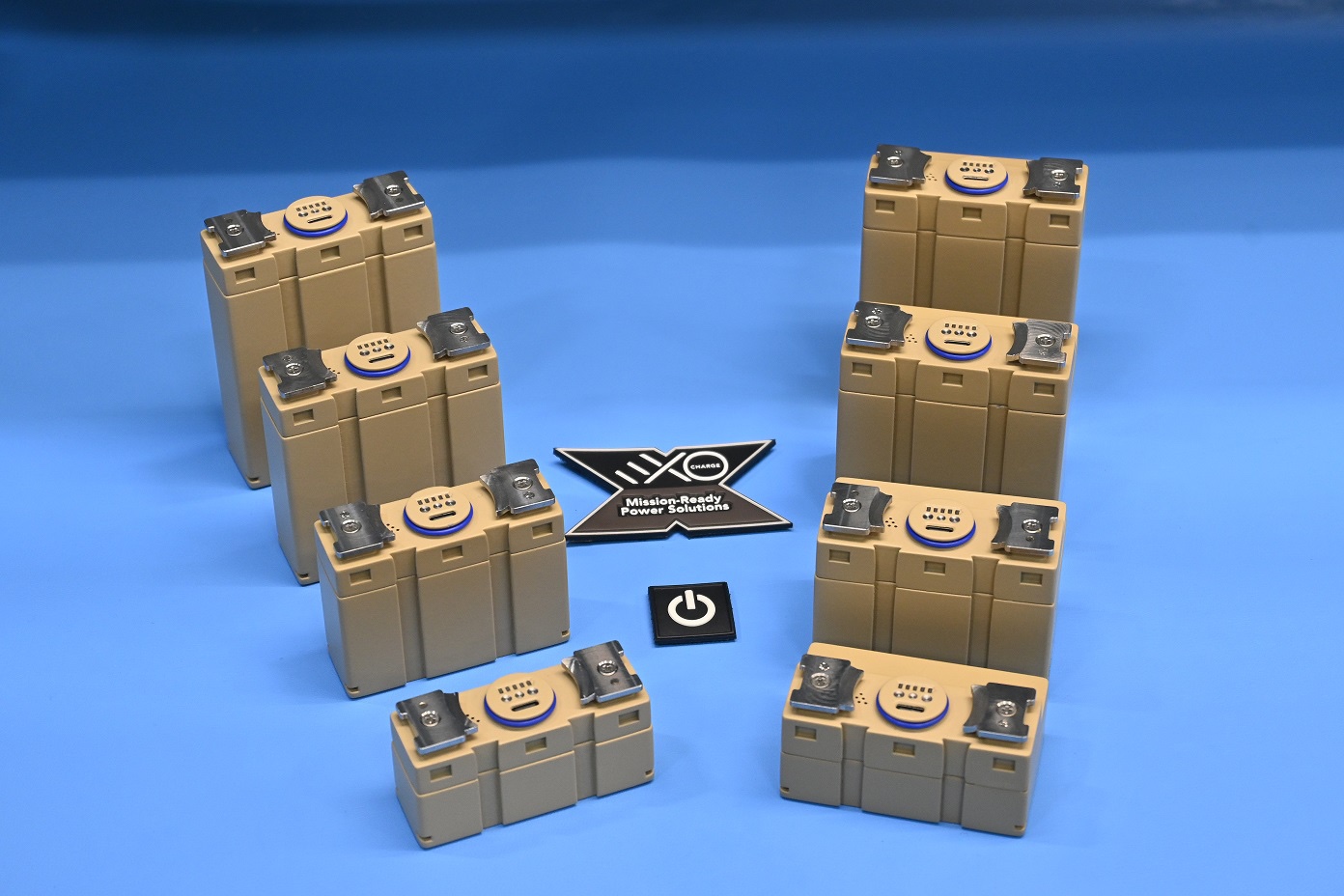
Small Tactical Universal Battery (STUB) – The STUB is a new family of standardized, rugged, rechargeable batteries for military applications. They feature a common mechanical and electrical interface, and the latest USB Power Delivery (USB PD) and Programmable Power Supply (PPS) fast charging technology. Created as a family of 8 different capacities/sizes ranging from 15-80W, the STUB enables leaders to adapt their troops’ battery load to meet their mission-specific power needs. Built for rugged, dependability in operational environments, the STUB series provides a common power source that can be shared across different electronic systems and devices – helping to make every ounce count.

Augmented Power Pack (APP) – The APP is a fully ruggedized 300Wh power bank designed for operational use in austere environments that can charge several devices simultaneously using USB Power Delivery (USB PD) and Programmable Power Supply (PPS) fast charging technology. Featuring two USB Type C ports and a Nett Warrior connector, the APP delivers multi-voltage support (5V-20V) for exceptional power flexibility and system interoperability. Built to be tough, reliable, and easy to use, the APP features an NVG-compatible display screen and a form factor optimized for tactical carriage and use.

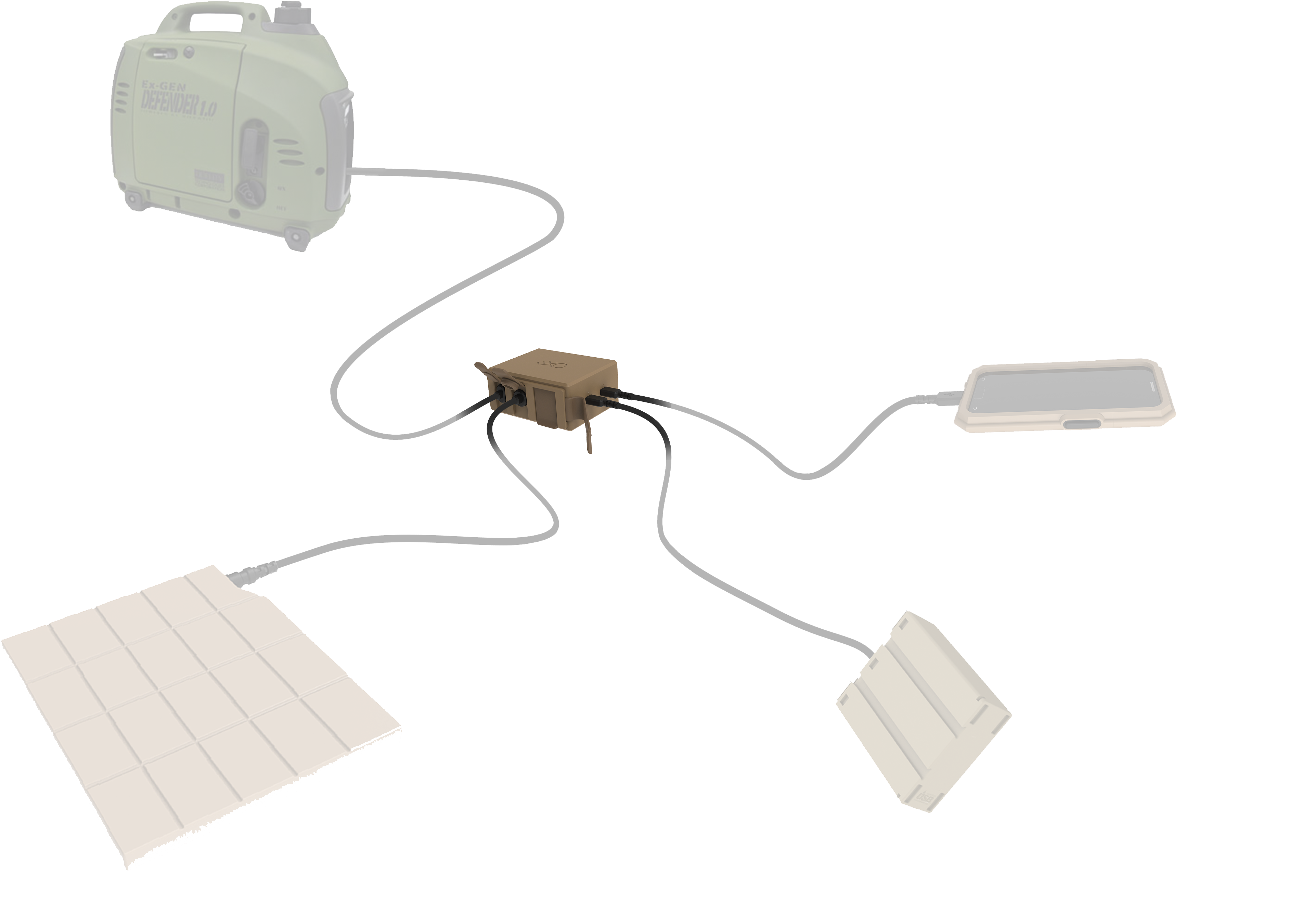
Rugged Auxiliary Charger (RAC) – Small, light and rugged, the RAC utilizes USB Power Delivery (USB PD) and Programmable Power Supply (PPS) fast charging technology to charge several devices simultaneously. Supporting up to 300W of total power and equipped with an SAE and a Nett Warrior connector, the RAC is compatible with the UBC standard military bulk charger, as well as working as a stand-alone charger for standard batteries such as the 2590 and CWB. The RAC also features two USB-C ports for fast charging the latest generation of COTS devices and the new STUB series of batteries.

Building on the company’s 30+ year track record in the commercial mobile technology industry, Xentris Wireless created the EXO Charge division specifically to address the needs of next-generation portable power solutions for military applications. Incorporating globally proven, and industry standard, technologies such as USB help improve the operational capabilities of electronics at the tactical edge – as well as helping to reduce the battery weight and logistical burden borne by the Warfighter.

Visit the EXO Charge booth at the Fort Benning Maneuver Warfighter Conference to find out more, and also follow EXO Charge online and on Facebook, Instagram, and LinkedIn to keep up to date on the latest news, views, and developments.

Army Applications Laboratory Names Four Companies to Soldier Power Cohort

Tuesday, February 1st, 2022

Cohort Aims to Help the US Army Power Soldiers on the Move
AUSTIN, TX – Four companies have been selected for the Soldier Power Cohort with the Army Applications Laboratory (AAL) through a program managed by Huntington Ingalls Industries (HII). Sourced from across the country, the selected companies are developing innovative power generation and power conversion, high-density energy storage, and intelligent management and distribution technologies that can support self-sufficiency, reduce burdens, and lessen dependence on resupply.

“Technology is a force multiplier for the Army, but with more technology comes more weight and the need for more power. We need to find a smart way to lighten that load for Soldiers who work in expeditionary environments for days at a time,” said Col. Jay Wisham, director of AAL. “While the commercial market for these technologies is relatively niche, both the Army and industry are facing similar challenges in how to maintain power for devices when away from the grid. This Cohort offers a way to join forces and move the field forward while keeping our Soldiers safe and effective in the harshest environments.”

Dramatic improvements in energy and power density for low-power commercial applications have increased the amount of output achievable while reducing size and weight. Intelligent power management and distribution solutions have also been instrumental in enhancing overall efficiency (as well as convenience) for consumers. As part of the Soldier Power Cohort, companies will earn $100,000 to develop conceptual designs that translate these existing solutions to address the Army’s specific problem. Cohort participants will learn about the Soldier Power problem set directly from key stakeholders, including Army Futures Command’s Soldier Lethality Cross-Functional Team; the Network Cross-Functional Team; and Combat Capability and Development Center Command, Control, Communications, Computers, Cyber, Intelligence, Surveillance, and Reconnaissance Center.

The 8-week Soldier Power Cohort began on January 24, 2022, with concept design presentations planned for March 17, 2022.

The following companies will participate in the cohort:

Epirus, Inc.

Hawthorne, CA

Epirus is a high-growth technology company that develops directed energy systems and power management solutions for broad applications across industries. The nucleus of Epirus’ innovation is the company’s machine intelligent SmartPower technology platform, a multi-layered management solution that delivers precision control, unprecedented power density, and high-power efficiency to various devices.

Resonant Link, Inc.

Shelburne, VT

Resonant Link powers fleets and devices while they work by wirelessly charging medical devices, consumer electronics, and electric vehicles. Through a breakthrough wireless charging technology called the Multi-layer Self-Resonant Structure (MSRS), Resonant Link provides wireless power for multiple Fortune 500 companies and government agencies.

Spark Thermionics, Inc.

Emeryville, CA

Spark Thermionics is an early-stage energy startup developing a “powerplant on a chip” — lightweight and fuel-flexible electricity generation based on a thermionic energy conversion. Spark is led by world leaders in thermionic technology and has received recognition in Physics Today, Fortune, the Official White House blog, and elsewhere.

Xerion Advanced Battery Corp.

Kettering, OH

Founded in 2010, Xerion Advanced Battery Corporation is a fast-growing battery company located in Dayton, OH, that works with Fortune 500 companies in a variety of industries. Through its patented battery technologies, the company aims to revolutionize the energy industry by introducing a step change in innovation in Li-ion batteries for portable electronics, power tools, and unmanned aerial systems (UASs).

USB Technology for Tactical Electronics Applications

Monday, January 10th, 2022

If you gave, or received a new cell phone, tablet, or notebook computer over the holidays, chances are that it included a USB Type-C® port and cable – even if you didn’t know it.

The first major, and obvious, advantage of USB-C® to the end-user is the fact that it’s a common standard physical interface that works across a wide range of different devices and manufacturers. This is a huge improvement in convenience and interoperability over how things were just a few years ago. It’s made even better by the fact that the connectors are omnidirectional – no more fumbling around or needing to visually check that you’ve got the cable / connector the right way around.

But while the Type-C connector is the visible front-end of the latest USB innovations, the real magic is what has been happening inside…

The Universal Serial Bus (USB) standard was first released in 1996 to standardize the connection of peripherals to personal computers – for low-speed devices such as a keyboard or a mouse with data speeds of 1.5Mbps. With the USB4 specification released in 2019, data speeds can reach up to 40Gbps (allowing you to transfer an entire movie from your phone to a computer in less than 1 minute) and is backwards compatible with USB 3.0 and USB 2.0.

Along with these increases in power and data capabilities – and a connector that can conveniently handle them – has come a desire for shorter charging times for device batteries, as well as more efficient use of power. USB Power Delivery (PD) is a specification for handling higher power and allows a range of devices to fast-charge over a USB connection. The latest release of USB PD enables up to 240W of power with a full featured USB Type-C cable and port – providing one of the fastest charging protocols available on the market.

Programmable Power Supply (PPS) allows for stepwise changes in current and voltage – decreasing the conversion loss during charging, and thereby ensuring that charging is more efficient. Due to more efficient charging less heat is produced, which increases a battery’s lifespan, and decreases a device’s (and operator’s) heat signature.

USB PD now has become the de-facto charging protocol in the consumer market, and USB-C is becoming the universal cable / connector standard, due to its ability to supplying continuous high power plus blazing fast data transfer speeds. The end-user benefits of convenience, ease-of-use, and commonality are nothing to be underrated either.

The US military has issued USB-enabled tactical electronic devices through such programs as Nett Warrior, IVAS, and the upcoming Small Tactical Universal Battery (STUB) series. This trend is likely to increase as the US Army, US Marine Corps, USSOCOM and other government agencies look to modernize and upgrade their tactical electronics systems – while also looking to increase standardization and interoperability, while shortening development cycles and reducing overall program cost. Incorporating globally proven and industry standard technologies such as the USB specifications helps achieve these goals – as well as reducing the battery burden borne by the Warfighter.

Commercial mobile technology industry-leader Xentris Wireless created the EXO Charge division specifically to support such modernization efforts by developing rugged, lightweight, intuitive power solutions for the modern Warfighter. Learn more about EXO Charge at EXOcharge.com.

AFC VERTEX | Energy Event Will Examine New, Advanced Energy Technologies

Monday, January 10th, 2022

Austin, Texas — On February 8-10, 2022, a group of founders, technologists, investors, and market experts will converge at VERTEX | Energy in Austin, Texas, to examine new and novel energy technologies that are attracting private and public sector investment. This three-day symposium, hosted by Army Futures Command (AFC), aims to shed light on cutting-edge commercial energy advancements that can also support U.S. Army modernization goals.

“As part of the FY22 budget, the DOD requested billions to invest in next-gen installation and operational energy technologies,” said Lt. Gen. Thomas Todd, Army Futures Command. “The Army is interested in the same energy technology that’s gaining traction in the commercial market and among private investors. It’s the only way we can stay ahead. So concentrating our market intelligence through this event will allow us — and allow participants from private industry — to get a look at these technologies firsthand.”

According to industry reports, in the past five years, “gov tech” companies raised nearly $2B in private investment, indicating major growth — and major opportunities — in the government market. In November 2021 alone, the federal System for Award Management listed more than 450 energy-related contract opportunities open with the US Army. The Army VERTEX | Energy event will help to inform future investments while also providing attendees with insight into the Army’s funding roadmap directly from the 4-Star Command that determines how and where the Army invests.

This approach is part of a critical AFC effort to ensure Army modernization efforts extend beyond materiel improvements. As part of its modernization plan, the Army wants to diversify and bring more startups and small companies into its portfolio of partners. Doing so at the speed of business will require modernization of formal acquisition processes as well as improvements to the business processes through which those organizations or technologies are discovered.

“The Army is great at gathering operational intelligence to support our missions, but we are less adept at capturing critical intelligence on what new technologies or companies are developing in the commercial market,” said Todd. “VERTEX | Energy is a way to up our game in that area — going beyond what we can discover online and really diving into the technology and how it can help to address some of our most pressing problems.”

Army VERTEX attendees will include personnel from across AFC as well as Army Program Executive Offices (PEOs) with a vested interest in these technologies. It will also include commercial technologists, founders, and market experts who can contribute to a meaningful dialogue on next-generation energy technologies.

While anyone can watch VERTEX sessions virtually via the AFC YouTube livestream, in-person participation will be limited to 150 industry participants per day. In-person attendees will be selected based on alignment between their expertise and critical Army energy use cases.

To learn more about the event or the technology areas that will be discussed, visit armyvertex.com.

By Army Futures Command, Acquisition & Systems

2021 … Another Crazy Year

Wednesday, December 29th, 2021

          MIAMI, OKLA. – After the inaugural pandemic year of 2020, who would have imagined 2021 could have gotten any crazier? But it did. A riot on the nation’s capital. A gas pipeline held for ransom. Tornados that flattened towns in Kentucky and hurricanes that traveled from the Gulf Coast all the way up to New England. And then, ending where we started … with another version of COVID stressing out and sickening people around the world.

           Through all the ups and downs of 2021, including massive supply and demand challenges, companies have pulled together to keep products flowing and their people employed.

          In response to severe weather events and natural disasters, the portable fuel containers industry worked hard to meet staggering demand this year for 21 million portable fuel containers.

        “In today’s marketplace, where there are extreme situational challenges, along with staffing and COVID-19 health concerns, it’s very significant that our company was able to successfully unite to fulfill accelerated fuel container demands in 2021,” says Daniel Marshall, vice president of marketing and business development with Scepter.

Demanding Year Right from the Start

           Marshall relates that product demand started early in 2021 when January ice storms and the 2021 Ground Hog Day Nor’easter impacted the East Coast. Immediately following those events, there were power outages in February in Texas due to a deep freeze. Every situation had consumers scrambling for fuel containers to operate generators and equipment. 

           “While we can sometimes foresee bad weather circumstances and ramp up in advance for them, there was no way to plan for the Colonial Pipeline ransomware attack in May,” says Marshall. “Gasoline shortages were immediate, which meant people were reacting by wanting to fill fuel containers. This was happening right about the time of National Hurricane Preparedness Week in May when people are starting to think about hurricane prep. The amount of fuel containers required during this month skyrocketed.”

Second Half of Year Push

           As the summer of 2021 progressed, so did the 2021 Hurricane Season. In late August/early September, Category 4 Hurricane Ida brought strong weather from the Gulf Coast all the way up throughout the Northeast. In total, there were 21 named storms in the season, with seven hurricanes and four major hurricanes — all good reasons for people to prepare their homes and businesses to handle wicked weather. 

            “While many people always keep fuel and water containers filled and ready to go, there are greater numbers of people who purchase containers reactively, based on severe weather forecasts,” says Marshall. “They may never have been in a location impacted by bad weather before. Then along comes a mega storm and they need to prepare. That’s when people seek out reliable containers. And, that’s why our team works so hard to create those containers and keep the inventory available.”

          The various “unplanned events” impacting container sales during 2021 occurred over just 25 to 30 specific days — or seven percent of the year. According to industry reports, on those specific days, consumer purchasing hit its peak for fuel container sales. Almost five million fuel containers were sold during a total of those days online and in stores such as Walmart®, Lowe’s® and The Home Depot®. When totaled, that’s close to 25 percent of all the containers purchased by consumers from all manufacturers for the entire year. On those extreme, high sales days, an average of 200,000 fuel containers were purchased every day. That’s enough to fill between 75 and 100 semi truckloads each day!

A Year for the Books

           “This is the second record year of high demand for fuel containers for our industry,” says Marshall. “It’s actually a bit surprising. We see many items in the world transitioning to battery operation — like lawn equipment, generators and even some cars. That would make you think that demand for fuel containers would be down. However, it’s just the opposite. Consumers are purchasing more gas, diesel and kerosene containers than ever before.

            “We’re proud that Scepter sold more fuel containers than any other company in 2021. And, we are exceptionally proud that we accomplished this milestone without any business interruptions, and while doing this under continued COVID restrictions.”

           Scepter fuel and water containers can be found throughout the U.S. in Walmart®, The Home Depot®, Lowe’s®, AutoZone®, Pep Boys, Amazon and Northern® Tool + Equipment stores. Visit www.scepter.com for more information.