TYR Tactical

Archive for the ‘SOF’ Category

Naval Special Warfare Basic Communications Accessory Suite Solicitation

Thursday, July 14th, 2022

Naval Special Warfare Command (NSWC) has issued a small business set-aside solicitation for a basic communications accessory suite designed primarily for use by support personnel. According to the solicitation, it is not intended to replace current advanced USSOCOM communications accessory suites; rather, it is intended to be a simplified capability with limited environmental hardening and interoperable with current USSOCOM-fielded manpack and handheld multi-band radios.

Key minimum specifications from the solicitation are:

– IP67 rating

– Compatible with common 19-pin and 6-pin radios

– Use of common connectors such as the TP-120/NATO 4-pin

– Simple and easy to use

– Able to monitor dual nets

– Provide noise protection (steady state and impulse)

– Use commercial power sources

– Able to be configured for use on ARC rails or over the head

Companies interested in participating should note that NSWC is requiring offerors to deliver two product demonstration models with their quotes by the closing date of the solicitation (August 12, 2022). NSWC intends to conduct an evaluation of each offer that meets minimum product descriptions, then make a best value five-year indefinite delivery indefinite quantity (IDIQ) award. NSWC intends to purchase approximately 2,500 systems over the life of the contract, not including sustainment and spares.

Questions of a technical nature can be directed to NSWC N83 Combat and Survival Programs at warcom-N83@socom.mil. Note the solicitation number in the subject of the email (H9224022Q0003).

Read the full solicitation here.


Historic Highway Landing Advances Agile Combat Employment

Thursday, July 7th, 2022

ALGER COUNTY, Mich. (AFNS) —  

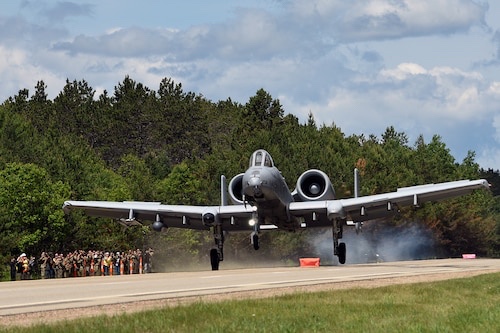
Air National Guard A-10 Thunderbolt II, Air Force Special Operations Command MC-12W Liberty, C-145A Combat Coyote and U-28A Draco, and a C-146A Wolfhound from the Air Force Reserves landed, took off and performed integrated combat turns on a closed 9,000-foot section of Michigan highway M-28.

It was the first time integrated combat turns, which enable the quick rearming and refueling of a running jet, have been conducted on a public highway in the United States. The temporary landing zone is one of several progressive training scenarios held this week during the Michigan Air National Guard’s exercise Northern Agility 22-1 in Michigan’s Upper Peninsula. 

Northern Agility 22-1 demonstrates the Air Force’s Agile Combat Employment doctrine — ready to execute missions quickly in unpredictable ways. The landing zone was named “Hawk LZ” in honor of F-16 pilot Maj. Durwood “Hawk” Jones from the Wisconsin ANG’s 115th Fighter Wing, who lost his life in a training accident in Michigan in 2020. 

“Northern Agility 22-1 is an historic exercise that supports the Air Force’s directive to ‘accelerate change or lose,’ as well as the ability of our Airmen to generate combat power anytime, anywhere,” said Brig. Gen. Bryan Teff, assistant adjutant general and commander of the Michigan ANG. “Michigan is a champion for Agile Combat Employment, so when it comes to leveraging our state’s unique partnerships, training environment and resources to ensure the Joint Force stays one step ahead of our adversaries, today was a huge success.” 

Staging and additional training activities for contested logistics, sustainment and multi-capable Airmen concepts were being held this week at other locations in Alger County, including Sawyer International Airport and Hanley Field. 

Participating units include AFSOC’s 1st Special Operations Group, Hurlburt Field, Florida, and 6th Special Operations Squadron, Duke Field, Florida; Air Force Reserve’s 119th Special Operations Wing, Duke Field; Michigan ANG’s 127th Wing, Selfridge ANG Base; Oklahoma ANG’s 137th Special Operations Wing, Will Rogers ANG Base; and Maryland ANG’s 175th Fighter Wing, Warfield ANG Base. Additionally, an MQ-9 Reaper from the North Dakota ANG’s 119th Wing, Fargo ANG Base, crewed by Airmen from the Michigan ANG’s 110th Wing, Battle Creek ANG Base, were involved.

“Northern Agility 22-1 would not be possible without the long-term partnerships that exist between the Michigan National Guard and the Michigan State Police, Michigan Department of Transportation, Alger County Sheriff’s Office, and of course, support from our neighbors in the Upper Peninsula,” said Lt. Col. Brian Wyrzykowski, Northern Agility 22-1 lead operations planner.  

The Kelly Johnson Joint All-Domain Innovation Center also teamed with industry partners during Northern Agility 22-1 to demonstrate technologies for augmented reality to enhance the multi-capable Airman concept, rapid integration of the command and control ecosystem, synthetic aperture radar and advanced threat detection and visualization. 

“Michigan is home to an incredible manufacturing spirit, business culture, and immense pride and patriotism that makes it a great place for the Department of Defense to continue to train for the future war fight,” said Maj. Gen. Paul Rogers, Michigan National Guard adjutant general and Michigan Department of Military and Veterans Affairs director.”

Story by Capt Andrew Layton, Michigan National Guard

U.S. Air National Guard photo by MSgt David Kujawa

United States Air Force Crews of Shadow 77 and 78 Flight to Receive 2021 Mackay Trophy

Tuesday, July 5th, 2022

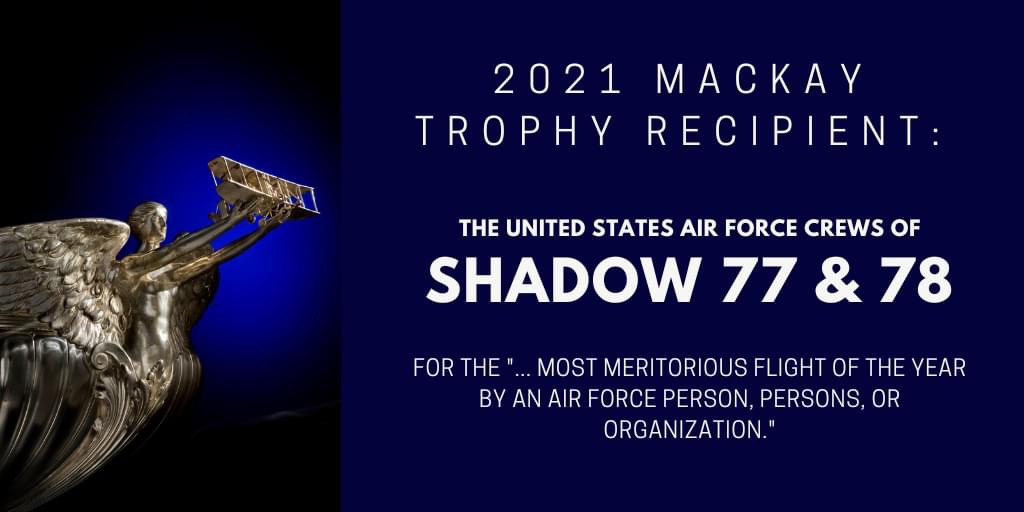
Washington, DC, June 30, 2022 – The National Aeronautic Association (NAA) is pleased to announce that United States Air Force Crews of Shadow 77 and 78, 73d Expeditionary Special Operations Squadron, Joint Special Operations Air Component-Central, have been named the recipients of the 2021 Mackay Trophy.

Crew of Shadow 77:

Capt Lawrence S. Bria

Capt Sam B. Pearce

Capt Aaron M. Rigg

Maj Joshua T. Burris

Capt Michael G. Shelor

SSgt Daniel J. Mayle

SSgt Kevin P. Heimbach

SrA Denver M. Reinwald

SrA Timothy J. Cisar

Crew of Shadow 78:

Capt Culley R. Horne

1Lt William A. Bachmann

Capt Ryan M. Elliott

Capt Benjamin A. Hoyt

SSgt Dylan T. Hansen

SSgt Andrew J. Malinowski

SSgt Tyler J. Blue

SSgt Gregory A. Page

SrA Miguelle B. Corpuz

The Mackay Trophy was first presented by Clarence Mackay in 1912 and was later deeded to the National Aeronautic Association. Administered by the United States Air Force and NAA, the trophy is awarded for “…the most meritorious flight of the year by an Air Force person, persons, or organization.” The Mackay Trophy is on permanent display at the Smithsonian’s National Air & Space Museum in Washington, DC.

As outlined in the United States Air Force nomination, the crews distinguished themselves in support of Operation Freedom’s Sentinel when in August 2021 they alert launched from Al Dhafra Air Force Base, United Arab Emirates, for a Close Air Support mission to protect the 2,000 Americans evacuating the embassy in Kabul, Afghanistan. The crews skillfully maintained visual custody of all American personnel enroute to Hamid Karzai International Airport and provided full-motion video in real-time to the Secretary of Defense and the Joint Chiefs of Staff as they watched the evacuation transpire. Overall, the crews of Shadow 77 and 78 flew the longest unaugmented AC-130J flight to date and their efforts to safeguard the embassy evacuation directly resulted in the successful rescue of 2,000 American diplomats with zero casualties.

The professional ability and outstanding aerial accomplishments of the crews of Shadow 77 and 78 reflect great credit upon themselves and the United States Air Force.

“For more than a century, the Mackay Trophy has rewarded bravery, skill, and determination in recognizing the most meritorious flight of the year,” said NAA President, Greg Principato. “Some years, the feat defies imagination, as is the case with Shadow 77 and 78. There were a lot of moving parts during their mission, including 2,000 American souls, and the success of Shadow 77 and 78 will live forever in the annals of U.S. Air Force history. We are proud to award these amazing crews the 2021 Mackay Trophy and I look forward to joining with Chief of Staff of the U.S. Air Force General Charles Brown in presenting it.”

The Mackay Trophy will be presented on a future date to be determined. For more information or to view a complete list of previous recipients, please visit www.naa.aero.

SCUBAPRO SUNDAY – OPERATION Gunnerside

Sunday, June 19th, 2022

Only a few months after the discovery of nuclear fission on December 17, 1938, the military potential of nuclear power became apparent, and the race to develop an atomic bomb began.

Germany began its nuclear-weapons development program in April 1939. During their research for a nuclear reactor, the scientists discovered that deuterium oxide, also known as “heavy water” because it has a higher molecular weight than regular water, performed well as a moderator, allowing them to have greater control over the fission process than they had previously thought.

There was only one area on the planet capable of creating heavy water on an industrial scale: Norsk Hydro’s Vemork hydroelectric power plant in southern Norway, which was built in the 1960s. Heavy water was produced as a byproduct of the plant’s primary function, which was to manufacture ammonia for use in nitrogen fertilizer.

As early as January 1940, German officials inquired about the possibility of purchasing the whole Norsk Hydro heavy water storage and increasing the plant’s monthly output by a factor of ten to fulfill German demand.

This defeat only temporarily hampered the Nazis. Germany attacked Norway precisely one month later and seized the country by the beginning of June. Vemork, now under German control, raised its heavy-water output BY 50%.

In collaboration with the Norwegian Resistance, the Special Operations Executive (SOE) devised a plan for two squads to be dropped into Norway simultaneously.

The first, codenamed Operation Grouse, was composed of four Norwegian commandos. They were to parachute into Norway, conduct reconnaissance, and secure a landing zone for a 34-man team of British commandos, codenamed Operation Freshman, who would land in two gliders and then assault the plant, destroying the 18 electrolysis cells that produced heavy water.

The launch of Grouse took place on October 18, 1942. During the next three weeks, the group trekked to Freshman’s intended landing place, which they finally reached on November 9. Operation Freshman was officially initiated on November 19. An aircraft carrying a glider crashed after experiencing mechanical issues and poor weather, killing the flying crew and several commandos on board. When the bomber towing the second glider decided to cancel the operation, the cable attached to it snapped, leading it to crash as well.

In response to Hitler’s Commando Order, survivors from both gliders were apprehended and executed by the Germans. The loss of 41 soldiers resulted in enhanced security at Vemork, including land mines on the surrounding mountains, and the Grouse crew was trapped and forced to fend for itself.

Norway’s Operation Gunnerside was planned to drop a team of six Norwegian commandos into Norway to hook up with members of the Grouse squad. They would be dressed as British soldiers, so the Germans would not retaliate against the locals if captured.

The unit parachuted into Norway on February 16, 1943; it would take them five days trekking thru waist-deep snow to join up with the Grouse team on February 22. On February 27, nine members of both teams embarked on their journey to Vemork, with one member remaining behind to connect with their counterparts in Great Britain.

On reaching the plant’s perimeter, they discovered that the bridge, which served as the only direct entry point into the complex, was now heavenly guarded because of the failed British raid. Currently, the only way in was to follow the railway (the only place not mined) and to reach the railway gate, and the team had to drop 350 feet into a riverine and then climb an almost 500-foot rock face to gain access to the complex’s rear entrance through a fenced railway gate. As soon as they arrived, the guards changed shifts, and they could cut their way through the barrier just after midnight.

Once inside, the group was divided into two sections. During the attack, five commandos took up positions outside the barracks, the bridge, and the main gate, while the remaining four entered the factory. In the building, they came across only one Norwegian employee, who didn’t put up any resistance or raise the alarm.

The target chamber, which was in the basement, was rigged with explosives. The members of the team were evacuated and were waiting for the blast. It was possible to escape because the room was so far underground, and the walls were so thick because there was little noise when the bombs went off, allowing the entire team to flee before the Germans discovered what had happened. As they rushed through the barracks, they could hear the muffled crump of the explosion ahead of them. At the factory, sirens began to blare shortly after. When German soldiers raced out of the barracks and workers scattered in confusion, the saboteurs had vanished out of the picture. A hunt involving 2,800 soldiers was conducted throughout the area. However, by the time the sun rose, the saboteurs had already embarked on a 280-mile journey across forests and mountains to neutral Sweden.

The commandos demolished the electrolysis cells and more than 500 kg of heavy water in the process. They could flee without firing a single shot or inflicting any fatalities on the other side. By May, the Germans had repaired the damage, but successive Allied air raids had prevented the company from ramping up production. Eventually, the Germans halted all heavy water production and attempted to divert the remaining supplies to the country’s borders.

First In-Air Refueling Conducted Between KC-46 and Air Force Special Operations Command CV-22

Sunday, June 19th, 2022

CANNON AIR FORCE BASE, N.M. —  

One of the most renowned aircraft in the Air Force’s fleet, the CV-22 Osprey tiltrotor aircraft combines the vertical flight qualities of a helicopter with the fuel efficiency and speed of a fixed wing plane. This combination makes it the ideal aircraft for conducting infiltration, exfiltration and resupply missions for special operations forces across long distances.

Now, thanks to pathfinding efforts from the 20th Special Operations Squadron and the 349th Air Refueling Squadron, assigned to the 22nd Air Refueling Wing at McConnell Air Force Base, Kansas, CV-22 aircrews across Air Force Special Operations Command can ensure their aircraft’s extended range by calling on Air Force Mobility Command’s newest tanker.

The 20 SOS & 349 ARS brought a CV-22 and KC-46 Pegasus tanker together for  in-air refueling training over Cannon, June 1, 2022. The flight was the first time a KC-46 refueled an AFSOC CV-22.

“This being the first time we operationally refueled with a KC-46, we were able to get some good video for training and development,” said Maj. Anthony Belviso, the CV-22 aircraft commander. “We were also able to get some understanding of what it feels like to fly behind the jet, and work on some different refueling techniques and practices”

One of the new capabilities the KC-46 brings to the table is a hose and drogue system in the same centerline position as it’s refueling boom pipe for fixed-wing aircraft.

“This capability allows the KC-46 to the refuel the Osprey and other drogue compatible receiver aircraft without any modification,” said Maj. Benjamin Chase, the KC-46 aircraft commander. “This is important because it enables flexibility in mission planning and limits the amount of maintenance it takes to prepare for air refueling, especially compared to most aircraft in the legacy tanker fleet.”

The KC-46 is not the only aircraft the CV-22 can receive fuel from while flying. However, its advanced refueling, communications and defensive systems, range and large fuel storage capabilities make it an ideal system for getting CV-22s the fuel they need, even in or near contested environments.

“The CV-22 is specifically designed for long range missions, and when you add on top of that an aerial refueling capability you can extend that distance to the point where you’re only limited by how long the crew is able to fly,” said Belviso. “The KC-46 can get enough fuel to get multiple CV-22s that much further both into and out of combat.”

“The 22 ARW has showcased the capability of the KC-46 to operate out of austere locations in recent exercises,” said Chase. “This is unique among tanker aircraft,  and replicates the types of environments the KC-46 to operate out of when refueling the Osprey in real-world missions.”

Another advantage of CV-22s being able to refuel from KC-46s is that it allows for faster refueling during real-world missions.

“Normally, an MC-130J aircraft would have to go up to a tanker to get fuel, then fly to us and give us that fuel, and would have to repeat that process several times,” said Belviso. “Because KC-46s can refuel us directly, we can go straight to them and get everything done much more quickly.”

With the successful training mission, both Chase and Belviso said it would provide the data and real-world experience the Air Force’s KC-46 and CV-22 fleets need to ensure the two airframes could work well together for a long time to come.

“The refueling of the CV-22 marks another success in the program,” said Chase. “It really paves the way for support of the Osprey and other aircraft in the future.”

“I’m glad we were able to get the mission done for the CV-22 community,” said Belviso. “I think this new capability will be tremendous for us going forward, so I’m very happy about that.”

By SSgt Max J. Daigle, 27th Special Operations Wing Public Affairs

Highly Decorated EOD Technician Retires from Elite Unit after Recovering from Paralysis

Thursday, June 16th, 2022

FORT BRAGG, N.C. — The most highly decorated explosive ordnance disposal, or EOD, technician in the history of an elite U.S. Army airborne EOD company recently retired after recovering from a combat-related gunshot wound that paralyzed him from the chest down.

Sgt. 1st Class Jeffery M. Dawson completed his legendary career with the 28th Ordnance Company (EOD), the Army’s only Special Operations-focused EOD company with handpicked and highly trained EOD Soldiers who support direct action missions around the world.

The Fort Bragg, North Carolina-based 28th EOD Company (Airborne) is part of the 192nd EOD Battalion, 52nd EOD Group and 20th Chemical, Biological, Radiological, Nuclear, Explosives (CBRNE) Command, the U.S. military’s premier all hazards formation.

In an Army EOD community first, 75th Ranger Regiment Commander Col. Jim “JD” Kiersey and Command Sgt. Maj. Curt D. Donaldson attended his ceremony and upgraded Dawson’s status from an “honorary member” to a “distinguished member” of the Ranger Regiment.

Part of U.S. Army Special Operations Command, the 75th Ranger Regiment is the U.S. Army’s premier direct action light infantry force. The regiment can deploy one Ranger Battalion to hotspots around the world within 18 hours of notification.

A seasoned combat veteran who is originally from Coalville, Utah, Dawson deployed to Iraq with the 722nd EOD Company before being selected for the 28th EOD Company. During his six years with the 28th EOD Company, Dawson deployed to Afghanistan seven times.

Dawson said EOD technicians safeguarded forces and enabled operations during the Global War on Terror by confronting and defeating the enemy’s preferred weapon — the improvised explosive device. EOD forces have rendered safe more than 100,000 improvised explosive devices in Iraq and Afghanistan since 2006 and have trained thousands of host nation forces.

“During the Global War on Terror, IEDs and other complex explosive devices were at an all-time high. Many maneuver elements relied heavily on the skill and competency of EOD technicians. Not just from the Army but all services. Often times, the elements would embed EOD as an organic asset,” said Dawson. “I often overheard many members of the elements we’ve supported say that they would never go outside of the wire without EOD on the manifest. That’s what makes EOD techs so important to the military.”

During his career, Dawson defeated hundreds of explosive devices and earned the Purple Heart for combat injuries twice.

“As an EOD tech, the most memorable missions stand out because they were either really good or really bad,” said Dawson. “Working with special operations forces, you often find yourself in situations where the outcome can sway in either direction in a moment’s notice.”

The missions that stand out the most for Dawson are the one where he earned the nation’s second highest military medal, the Distinguished Service Cross, and the mission that nearly ended his life and left him paralyzed from the chest down.

In Afghanistan on Oct. 5, 2013, Dawson participated in a mission to capture or kill a high value Taliban leader who was planning terror attacks.

“The IED threat was low and it was supposed to be a quick easy target,” Dawson said. “Upon infiltration everything changed in minutes.”

A fleeing insurgent detonated an explosive and killed a team member and the team’s multi-purpose canine, Jani.

Dawson soon realized that his team was surrounded by pressure plate IEDs. He halted the mission, located the improvised explosive devices and aided in the evacuation of dead and wounded Soldiers. Four U.S. Soldiers were killed by explosive devices during the mission.

Although seriously injured during two different explosions, Dawson worked in limited visibility to locate three confirmed pressure plate IEDs and six additional suspected devices. He then cleared a path to evacuate the fallen and wounded Soldiers.

On Feb. 17, 2015, then-Army Vice Chief of Staff Gen. Daniel B. Allyn presented the Distinguished Service Cross to Dawson during a ceremony on Fort Benning, Georgia. Sgt. Bryan C. Anderson, the Ranger Platoon medic on the same mission, also received the Distinguished Service Cross during the ceremony. The 75th Ranger Regiment submitted them for the award.

On another mission in Afghanistan in July 2019, Dawson was shot and seriously wounded.

“When I was shot, it came in my right arm and came to rest upon impacting and fracturing my left shoulder blade, collapsing both lungs and exposing my spinal cord in the process,” said Dawson. “I’m thankful for the expertise of the medic that performed life-saving treatment which allowed me the opportunity to live despite all odds.”

The medic saved Dawson by using a chest tube to inflate his collapsing lungs.

Dawson was medically evacuated to Germany for surgery and then to Walter Reed National Military Medical Center in Bethesda, Maryland. He moved next to James A. Haley Veterans Hospital in Tampa, Florida, a facility that specializes in spinal injuries.

Working with physical therapists and using the tough and tenacious “never quit” approach that made him successful on the battlefield, Dawson stood again and then he walked again.

Less than a year after being severely wounded, Dawson took on 5K and walked 3.1 miles unassisted. Since then, he has completed a 6.2-mile walk and a triathlon with a quarter-mile swim, 11-mile bike ride and 3.1 mile walk without assistive devices.

“The key to my recovery was mostly mental,” said Dawson. “I lost control of everything from the chest down, with that I lost any physical conditioning prior to my injury. I essentially had to start over as a newborn in a 33-year-old man’s body.

“Since I am still trying to relearn everything, I have to keep a positive mental attitude so I can continue to progress,” said Dawson.

After returning home to North Carolina, Dawson has taken time to focus on healing the visible and invisible scars from multiple combat missions. “I still remain active as much as I can,” said Dawson. “I enjoy hunting, fishing, hiking and other outdoor activities that get my heart pumping. In the future, I would like to complete a mud run.”

He has enrolled in college and he is looking for opportunities to help other veterans.

Dawson said the highlight of his career was being recognized by the 75th Ranger Regiment for actions on the battlefield.

“I was surrounded by people who wanted to be there,” said Dawson. “It has been an honor working with the 75th Ranger Regiment. Their expertise and professionalism set the standard for others to look up to.

“What makes the 28th a great company is that it is filled with specially selected and well trained Soldiers who will never accept defeat and never fail to complete the mission. Soldiers who have the willingness to shoulder more than their share of the task, whatever it may be, one hundred percent and then some,” said Dawson. “To be successful in the 28th, you need to be in shape, comfortable working autonomously, intelligent, and most importantly, you must be trainable.”

Maj. Stephen M. Knudsen, the commanding officer of the 28th EOD Company, said his company has always relied on the expertise, grit and determination of noncommissioned officers like Dawson to support Special Forces units at the tip of the spear around the world.

“The 28th is a one-of-a-kind formation with forward elements continuously deployed throughout the entirety of its 13-year history,” said Knudsen. “It provides a painfully light and disproportionally lethal airborne EOD capability to the 75th Ranger Regiment and Special Operations Command during crisis response, raid and joint forcible entry operations.”

Knudsen, a 14-year veteran from Sutter Creek, California, has deployed to Iraq once and Afghanistan three times. The 28th EOD Company commander said Dawson had never let his heroic deeds and storied service in the Explosive Ordnance Disposal community go to his head.

“The thing that stands out about Sgt. 1st Class Dawson is how approachable and down to earth he is,” said Knudsen. “He’s a legend in the career field, yet he’s such a light hearted, funny and genuine person. If there was anyone who has earned the right to be super arrogant or macho, it’s him, but instead you’re greeted by a humble guy with a warm grin wearing a cat shirt.”

By Walter T. Ham IV

Using VR Through VALOR to Improve Combat Casualty Care

Tuesday, June 7th, 2022

HURLBURT FIELD, Fla. —  

The 24th Special Operations Wing Surgeon General’s office has implemented the use of virtual reality training devices, in partnership with SimX, throughout special tactics to maintain the critical pararescueman’s skill in an ever-changing operational environment.
“The operational mission is going to continue to grow in complexity in the future fight,” said U.S. Air Force Col. John Dorsch, 24th SOW Surgeon General. “The PJs must be prepared to treat both injury and illness in austere environments for longer periods of time with limited reach-back.”


When looking at what the future operational environment may look like, the 24th SOW SG team must consider the implications to operational medicine. Scenarios PJs face could be in low-visibility areas where they have to keep patients alive for longer periods under possible chemical, biological, radiation or nuclear conditions.


“Preparing PJs medically for the future fight will require an advanced interoperable standard, optimized initial and sustainment training, deliberate tech development and integration, and enhanced performance tracking and feedback,” said Dorsch.
The virtual reality program objectives are to improve realism, increase flexibility and reduce cost. Through more than $10 million in Department of Defense Research and Development Funding and the Air Force Small Business Research Innovation Research program, SimX and the 24th SOW have been able to create more than 80 training scenarios including canine treatment and care, blast injuries, severe gas exposure, and more.
These training devices provide intricate and realistic training scenarios that other methods, such as medical dummies, cannot, and improves the effectiveness of the training.
“By using a flexible piece of equipment, we are able to deliberately and efficiently target specific desired learning objectives based on evolving mission requirements,” said Dorsch. “We now have the time and bandwidth to provide trainees with enhanced real-time feedback from the through the program, which grades the trainee on a point system through data analysis and a performance tracking system.”


Currently, there are 14 sites online using the PJ Tactical Combat Casualty Care curriculum, including Air Force Special Operations Command and Air Combat Command. In the future, they plan to expand access to the existing medical training portfolio across all SOF TCCC responder tiers, broaden capabilities and integrate partner force training.

“The VALOR program has increased the availability of efficient and effective medical training and has allowed us to develop complex decision-making, which will improve survival rates in U.S., coalition and partner force combat casualties in the future fight,” said Dorsch. “VR training is critical for ensuring that the highest level of combat trauma and austere medical care are provided by our special operations ground forces. We have only scratched the surface of its incredible potential.”

Story by Capt Savannah Stephens, 24 SOW Public Affairs

Photos by TSgt Carly Kavish

AFSOC Incorporates Weapon Systems Cyber Defense in Emerald Warrior 22.1

Friday, June 3rd, 2022

HURLBURT FIELD, Fla. (AFNS) —  

Air Force Special Operations Command recently incorporated defensive cyberspace operations actions, for the first time, into the overall training objectives during Emerald Warrior 22.1.

The exercise fused cyber effects into aircraft operations and employed two mission defense teams, with the cyber defense correlation cell and demonstrated how AFSOC will deploy MDTs to defend weapon systems from cyber-attacks.

The communications and information element within AFSOC developed a realistic scenario to maximize training and awareness of cyberspace threats to aircraft avionics. The identified scenario and events allowed maintainers, cyberspace and aircraft operators, and intelligence and battle-staff members the opportunity to see the impacts of cyber threats to weapon systems, firsthand.

During the exercise, AFSOC staff and MDTs worked with Shift5, a commercial cyber security company, to test and validate a real-time cyber intrusion detection system on an aircraft, and a cyber-incident response software tool within the Cyberspace Vulnerability Assessment/Hunter to assist MDTs in executing cyberspace defense operations.

Shift5’s technology enabled MDTs with the 1st Special Operations Communication Squadron and 27th SOCS, Cannon Air Force Base, New Mexico, to test their training, and raised awareness of cyber threats to the operational community.

The MDT with the 1st SOCS included three personnel with the 87th Electronic Warfare Squadron, Eglin AFB, Florida, and two instructors with the 39th Information Operations Squadron. Additionally, the MDT with the 27th SOCS was augmented by three personnel with the 193rd SOCS at Harrisburg Air National Guard Base, Pennsylvania.

The Defense Enterprise Cyber Range Environment for Command, Control and Information Systems provided a realistic training environment which challenged the participating MDT’s technical, analysis and mission-planning skills, while being actively attacked and challenged by a cyber-red team with the U.S. Army’s threat system management office.

Members with the 318th Cyberspace Operations Group, Joint Base San Antonio-Lackland, Texas, provided a secure data transport between all players and teams on a closed-looped network.

The scenario involved a flying aircraft experiencing a critical event of unknown origins that exercised numerous operational processes, leading to the discovery of a cyber-threat. During the exercise a sortie reported mission computers failures and performed actions enabling the aircraft to “limp home.” When the plane touched down, maintainers with the 901st Special Operations Aircraft Maintenance Squadron executed a cybersecurity checklist and MDTs began to work.

The MDT’s actions saved the maintainers from replacing the mission computers, as well as saving the U.S. Air Force $750,000 for each mission computer that would need to be replaced.

With the realistic training incorporated into Emerald Warrior 22.1, impacts of cyber threats to aircraft, and how those threats affect operations and readiness, ensured aircraft maintainers, MDTs and operators remain ready and relevant to cyber-attacks.

Air Force Special Operations Command Communications and Information