Colt

Archive for the ‘Space’ Category

72nd ISRS In Line With SPAFORGEN model

Tuesday, May 28th, 2024

PETERSON SPACE FORCE BASE, Colo. (AFNS) —  

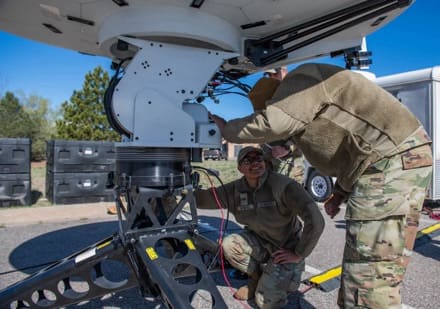
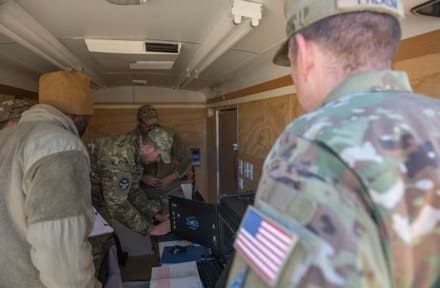
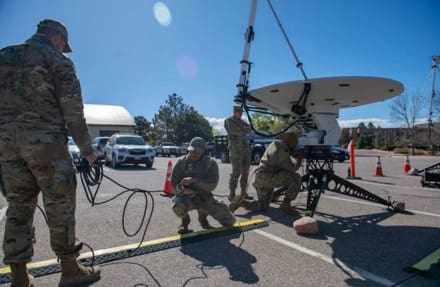
The 72nd Intelligence, Surveillance and Reconnaissance Squadron held a readiness exercise at Peterson Space Force Base, May 8. The exercise focused on practicing mission-essential tasks, training Guardians in a low-threat environment and validating unit readiness for deployments.

“Our Guardians will be able to go through the entire deployment process, from required training to using equipment, as they exercise our mission essential tasks,” said 1st Lt. Wyatt Packard, 72nd ISRS operations flight commander. “This will validate the previous training they undertook in their ‘Prepare Phase’ of [Space Force Generation].”

A framework that the USSF is using to present forces to combatant commands, SPAFORGEN provides force element packaging tailored to meet combatant commander’s requirements.

“SPAFORGEN is the model we use to build readiness. It is based on the straightforward observation that day-to-day space operations do not prepare Guardians for the challenges they will face in a high-intensity combat environment… Under SPAFORGEN, the force elements that comprise combat squadrons and detachments rotate through three phases. During the Prepare Phase, Guardians build expertise in assigned roles. Next comes the Ready Phase where Guardians participate in advanced training to equip them for high-intensity conflict. Guardians then rotate into the Commit Phase as part of a combat squadron or combat detachment. Once complete, they rotate back into the Prepare Phase and begin the process again,” according to Chief of Space Operations Gen. Chance Saltzman in his 26th CSO Notice to Guardians published April 19.

Tech. Sgt. Matthew Hahnrauch, exercise lead and 72nd ISRS operations flight chief, discussed the organizational structure of how the units are designed to operate.

“The goal is to collect radio frequencies, provide electromagnetic support and then conduct reporting,” Hahnrauch said. “The six-person crew is designed with mobility and survivability as a priority. This team structure is designed for 24/7 operations and minimal support from other military forces to accomplish the designed tasks.”

The 72nd ISRS uses Deployed ISR Support Crews, which are modular, agile teams designed for worldwide deployment and operations, Hahnrauch said. They are composed of five components.

“These components are collection apertures, processors, communication suites, data relay and temporary Secure Compartmentalized Information Facilities,” Hahnrauch said. “Each variation of DISC is trained on slightly different equipment and DISCs are scaled up or down depending on the systems they are operating.”

Communication technologies have rapidly advanced in the last 20 years and the need to advance U.S. collection systems has increased.

In cyberspace, the barriers to entry are continually reduced and more actors can enter the domain with relative ease, Hahnrauch said. Military systems are increasingly disconnected and do not rely on communications and when over-the-horizon communications are required, dedicated military satellite communications are leveraged. This presents opportunities for cyberspace, electromagnetic warfare and space operations.

“Failure to field and employ expeditionary, mobile collection systems will place the joint force at a disadvantage in cyberspace operations, electromagnetic warfare and space operations and degrade our ability to produce the intelligence necessary to drive operations across the spectrum of competition and conflict,” Packard said. “We will continue to execute iterations of this training event with the intent of mission rehearsal for contested environment operations. In the future, we’ll be incorporating more austere components into the exercise to provide a dynamic and mobile collection with the ability to rapidly deploy, maneuver and communicate in a high-end fight. Our capabilities continue to grow and expand.”

The 72nd ISRS is a unit within Space Delta 7, with the mission to provide expeditionary ISR in addition to electromagnetic support to joint and allied partners worldwide.

By Keefer Patterson

Space Base Delta 1 Public Affairs

Special Operations Joint Task Force Central Establishes Space Force Team

Thursday, April 18th, 2024

UNDISCLOSED LOCATION, Southwest Asia —  

Special Operations Joint Task Force Central established Space Force-Team Sentinel, Feb. 16, 2024.

Team Sentinel is SOJTF-C’s designated space support element operating throughout Central and South Asia and the Arabian Peninsula. It provides integrated full spectrum space-based capabilities across SOJTF-C’s area of operations.

Designed to optimize Special Operations Forces space integration, this team will provide integrated SOF specific space support, deliver innovative space solutions to unique problems, maintain awareness of threats, coordinate regional space operations, and integrate SOJTF-C with global space components to enable multi-domain special operations.

Team Sentinel supports and integrates with U.S. Central Command’s space component, U.S. Space Forces Central, contributing to unity of effort across the CENTCOM space enterprise.

Special Operations Joint Task Force-Central

Army Pilots Leasing Model for Commercial Satellite Communications

Thursday, April 11th, 2024

ABERDEEN PROVING GROUND, Md. — A new pilot will inform Army decisions on a lease-versus-buy business model for acquiring and delivering scalable commercial satellite communications to support unit readiness and unique missions in future large-scale combat operations.

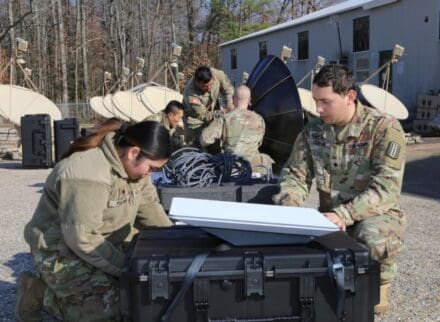
To kick off the pilot — known as Satellite Communications (SATCOM) as a Managed Service, or SaaMS — the Army is fielding different bundled commercial equipment, bandwidth and service packages to units in several regional coverage areas around the globe.

Instead of the Army having to procure, field, sustain and modernize equipment on its own for every unit and every mission, SaaMS could enable the Army to lease these capabilities at the point of need. This business model would be scalable to expand or contract as missions change, helping to reduce on-hand inventory, satellite airtime and cost. SaaMS would ensure bandwidth is allocated at the right place and time to support data exchange in a wide variety of mission sets.

“In today’s dynamic [operational] environment, a SaaMS model could allow us to scale and adapt network connectivity seamlessly,” said Col. James Sullivan, commander, 11th Corps Signal Brigade, one of several units supporting the pilot. “We could easily increase or decrease bandwidth and services based on mission requirements, unlike fixed capacity with owned equipment. This flexibility is crucial for diverse missions across Europe, the Pacific or the Arctic.”
The Army will leverage the data and Soldier feedback from the pilot and other DOD efforts to make informed decisions on the implementation of SaaMS to meet the increasing demand for secure reliable satellite communications.

In line with the Army’s Unified Network Plan, a SaaMS model could help the service to more affordably keep up with the accelerating speed of technology advancement, while reducing, equipment obsolescence and other sustainment challenges. Solutions will be flexible and tailorable to meet the needs of specific mission sets and enable SATCOM connectivity and hardware to be surged for deployments or humanitarian assistance and disaster relief missions.

Sullivan added that instead of having fixed assets tied to specific locations, SaaMS could allow units to more freely allocate resources globally as needed.

“Imagine seamlessly shifting resources from a quiet Pacific base to a suddenly active European theater,” Sullivan said.

The SaaMS Pilot encompasses commercial capability in both low Earth orbit and the traditional geosynchronous Earth orbit constellations. Leveraging SaaMS’ multi-vendor, multi-orbit SATCOM capability could fuel the Army’s efforts to enhance network resiliency through transport diversity, especially in denied, degraded, intermittent and limited bandwidth environments.

The pilot also includes network connectivity to commercial teleports and internet services, and the Army is integrating the commercial capability into Global Agile Integrated Trasport network design, enabling units to tie into the unified network from anywhere in the world.
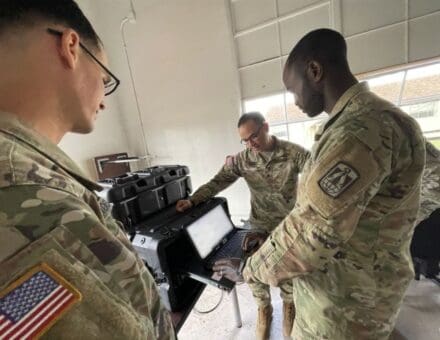
“SaaMS strengthens our primary, alternate, contingency, emergency (PACE) communications plan and network resiliency through redundancy,” said Lt Col. John “Chris” Acosta, deputy commander for the 11th CSB. “We can access diverse, geographically dispersed network providers. This could ensure communication even if specific regions face disruption.”

Further enhancing resiliency and ease of use, SaaMS allows for quicker signal rerouting and failover to alternate providers through the use of commercial auto-PACE software technology, minimizing downtime and mission impact, Acosta said.

Project Manager Tactical Network, assigned to the Program Executive Office Command, Control, Communications-Tactical, manages the SaaMS Pilot for the Army and expects to complete training and fielding the regional pilot units this spring. The intent of the pilot is not to create a separate SaaMS evaluation event, but to enable operational units to use the different service and equipment sets to best suit their individual needs and roll it into their existing training events through fiscal year 2024.

During the pilot, the Army will assess varying degrees of leased end-to-end service models, with tailorable features that include satellite terminals, bandwidth capacity, security compliance, logistics and repair, said Lt. Col. Mark Scott, product manager for Unified Network Capabilities and Integration — or PdM UNCI — assigned to Project Manager Tactical Network.

“As our adversaries strive to enhance their own network capabilities, agile procurement methods will be critical to U.S. forces in retaining technological overmatch on the battlefield, and it will enable us to more rapidly refresh units with dated equipment,” Scott said. “By leveraging commercial research and development, SaaMS could enable the Army to securely integrate emerging commercial capabilities into its SATCOM fleet at a much quicker pace and at less cost, compared to procuring capability through traditional methods with lengthy acquisition cycles.”
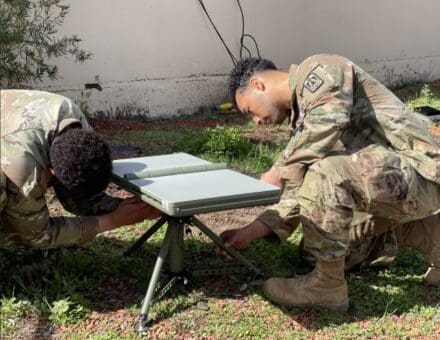
During the pilot, the Army will assess different scenarios, such as using SaaMS to provide a stop gap for maintenance issues due to obsolescence, or to rapidly deliver the “latest and greatest” in commercial technology to an Army National Guard unit prior to a deployment, said Seth Chouinard, PdM UNCI SaaMS project lead.

“If a unit that hasn’t deployed in several years and is then called up to support a mission, SaaMS becomes the solution for rapid equipment refresh,” Chouinard said. “When their deployment mission concludes, the unit can simply return the equipment back to the industry partner.”

If fielded to a National Guard joint force headquarters, SaaMS could also allow for quicker deployment for domestic response operations, said Cpt. Sam Stout, signal officer for the Virginia Army National Guard 29th Infantry Division, another of the pilot units.

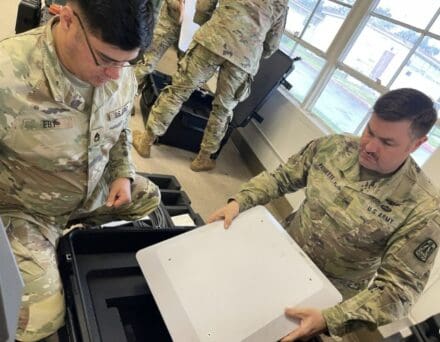
“You can pack it into the back of a truck and roll it out with pretty much any of the communications packages we have now, versus our current large trailer-mounted satellite terminal,” Stout said. “With this [more expeditionary] satellite terminal, we could set up a response cell pretty much anywhere.”

Stout also noted that the commercial equipment is also easy to use and train, aiding in the Army’s network design goal to enhance simplicity at edge so Soldiers can focus on the fight.
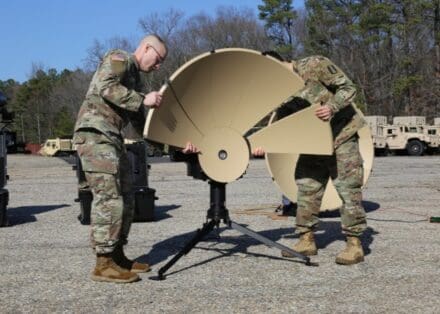
Alongside the pilot, the Army is accelerating the potential use of an “as a service” business model by concurrently leveraging lessons learned from other DOD efforts in the managed services realm, including those conducted by the U.S. Navy and Marine Corps.

Similarly, the Army is looking into the potential of leveraging a commercial “as a service” model for tactical radios as well, releasing a request for information to industry last month to gain further insight into such an effort. To further examine the pros and cons of the SaaMS model, the Army also leveraged John Hopkins University to conduct a SaaMS business case and cost analysis to aide in future lease-vs-buy decisions.

“[With SaaMS,] we can adjust the scope of technology adoption based on needs and budget, allowing us to test and evaluate new solutions before full-scale deployment,” Sullivan said. “[Additionally,] we only pay for what we use, eliminating costly unused capacity during low-intensity periods…and we eliminate the need to maintain and manage diverse communication equipment. This frees up resources for other mission-critical needs.”

By Amy Walker, Project Manager Tactical Network, PEO C3T, Public Affairs

Assignment Incentive Pay to be Authorized for Airmen, Guardians Stationed at Extremely Cold Locations

Wednesday, April 10th, 2024

ARLINGTON, Va. (AFNS) —  

Effective April 1, the Department of the Air Force approved a new incentive pay for Airmen and Guardians assigned to qualifying bases in the U.S. where the temperature is expected to drop below minus 20 degrees Fahrenheit. 

Cold Weather Assignment Incentive Pay is a single lump sum payment given to Airmen and Guardians after signing an agreement to serve a prescribed tour length of at least 12 months, depending on qualifying location.  

Locations that meet this threshold include Minot and Grand Forks Air Force Bases and Cavalier Space Force Station in North Dakota, Clear Space Force Station, Eielson Air Force Base and Joint Base Elmendorf-Richardson in Alaska, as well as Malmstrom AFB, Montana.  

“Airmen and Guardians living in extremely cold conditions faced unique out-of-pocket costs,” said Alex Wagner, Assistant Secretary of the Air Force for Manpower and Reserve Affairs. “In addition to the assignment and retention benefits of the pay, it also comes down to making sure we do our best to take care of our service members and their families stationed at these critical installations.”  

This payment intends to ease the financial burden of purchasing certain cold weather essentials, such as extreme cold weather gear, all-season and/or snow tires, tire mounts and alignments, engine block heaters and emergency winter car kits, as well as further incentivizing assignments. 

Although AIP-CW is effective April 1, the first pay date is anticipated for July 1, 2024, meaning Airmen and Guardians who move to a qualifying location between April 1 and June 30 will receive payment retroactively.  

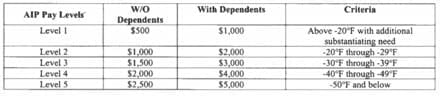
The amount of AIP-CW Airmen and Guardians are eligible to receive is based on criteria in the five pay levels outlined in the table below and is subject to change. 

This change follows the Department of Defenseimplementation of the Fiscal Year 2023 National Defense Authorization Act, which included language authorizing special duty pay for members based in cold-weather climate conditions and the FY24 NDAA, which clarifies the temperature parameters that qualify an area as a cold-weather location. 

“We want to ensure Airmen, Guardians and their families have the resources needed to safely live and work in an extreme cold-weather environment,” Wagner added.  

The official guidance memorandum can be found here

Secretary of the Air Force Public Affairs

Carryology Presents: Mission to Mars | Designing a NASA Backpack

Saturday, April 6th, 2024

Carryology has shared a great video about the NASA x Mission Workshop BASALT EVIB.

In 2016, Mark Falvai, co-founder of Mission Workshop, received a call he’d always dreamed of. On the other side of the line was an engineer named Mike Miller. He worked for the National Aeronautics and Space Administration. A government organization known to the world as NASA.

Mike had a top secret project and he needed Mark’s help. NASA was preparing for a Mars Landing, and they needed the perfect backpack designed for the mission.

And many months later, the NASA x Mission Workshop BASALT EVIB was born.

Read the full article here: www.carryology.com/projects/carry-collaborations/mission-to-mars-designing-backpacks-for-nasa

Space Force Guardians Advance SOF Space Interoperability During Emerald Warrior Exercise

Sunday, March 31st, 2024

HURLBURT FIELD, Fla. —

Air Force Special Operations Command, in collaboration with the United States Space Force Special Operations Element (USSFSOE), unveiled the 527th Space Aggressor Squadron full suite of capabilities for the first time during its annual Emerald Warrior exercise, underscoring the unique and invaluable role of USSF Guardians in advancing SOF Space integration.

Emerald Warrior is an AFSOC-sponsored combined joint exercise that provides realistic, relevant, high-end training to prepare special operations forces, conventional forces and international partners for the evolving strategic environment.

The USSFSOE coordinated Guardian support to deliver specialized space expertise, space-related intelligence and integration over the three-week exercise. As representatives of the newest service, the USSFSOE is responsible for space coordination and support to U.S. Special Operations Command.

“The United States Space Force Special Operations Element is strengthening the SOF-Space relationship by integrating our service capabilities into SOCOM exercises like Emerald Warrior,” said Maj. Jonathan Green, USSFSOE plans and programs chief. “These exercises and training opportunities provide Guardians and SOF personnel with much needed interoperability for future joint operations.” 

Support for the exercise from the 527th SAS included joint personnel from the USAF, USMC and USSF.

During the exercise, they replicated satellite communication and GPS-based electromagnetic interference to emulate a contested, degraded, operationally limited environment prevalent in areas of operation around the world. This support provided operators the real-world experience that they require. 

“Our team allows units to operate in a realistic radio frequency limited environment, providing commanders the benefit of preparing their units with the most effective training,” said U.S. Marine Corps Capt. Bryan Hernandez, 527th SAS mission commander.

“The relationship between the USSF and special operations is imperative as we address next-generation challenges related to great power competition,” said Green. “We will continue to integrate space capabilities and personnel with special operations to meet joint warfighter needs.”

By Maj Jessica Gross & 1st Lt. Cassandra Saphore, Air Force Special Operations Command Public Affairs

1st Space Brigade’s Tactical Close Space Support is on the Move

Tuesday, March 19th, 2024

WHITE SANDS MISSILE RANGE, N.M. — Partnering with joint and coalition forces, U.S. Army Space and Missile Defense Command’s 1st Space Brigade continues to experiment with new tactical space control technology to support the warfighter in increasingly complex and contested environments.

Soldiers with the brigade’s 18th Space Company participated in experimentation at White Sands Missile Range during Project Convergence-Capstone 4 from mid-February into early March to advance the Army space, cyber and special operations forces “Triad’s” ability to conduct space operations at the tactical edge.

Project Capstone, an experiment hosted by U.S. Army Futures Command, saw warfighters from across the U.S. military and allied countries including the Five Eyes nations – United States, United Kingdom, Canada, Australia and New Zealand – as well as France and Japan, explore the future of warfighting communications, operations and maneuver.

As part of the first phase of PC-C4, these space Soldiers experimented with a small form factor system to determine if the kit fulfilled the Army’s current demand for a ruggedized, tactical space control system.

While the brigade’s current program of record is mobile, the Army is seeking technology that allows the capability to be hand-carried by the Soldiers themselves or transported by small tactical vehicles.

“Larger space capabilities cannot effectively integrate with more expeditionary units, such as SOF,” said Capt. Noah Siegel, Triad Experimentation Team platoon leader, 18th Space Company. “Shrinking our equipment and focusing on mobility allows our Soldiers to provide space support to units of all types at or beyond the tactical edge. For warfighters on the ground, this tactical space support enables the synchronization and convergence of joint and multidomain effects to enhance lethality.”

Amid the desert scrub and sand at the base of the Organ Mountains, the 1st Space Brigade Soldiers operated the small form factor from the back seat of the utility task vehicle – driven by soldiers with the British Army Special Operations Brigade – to demonstrate how space operations crews not only support American SOF partners but integrate with friendly coalition forces.

At the tactical level, Army space capabilities, such as the small form factor, would enhance ground maneuver formations’ ability to see, sense, stimulate, strike and assess across the spectrum. Special operations forces allow space Soldiers deeper physical access into austere operating environments.

“It was great to see the similarities and differences in how space, signal, cyber, as well as U.S., U.K., and Australian SOF partners operate,” said Sgt. Jon Rizzo, 18th Space Company. “We enjoyed working with these forces and exploring where and how we can fit in.”

Though the small form factor is not an Army program of record, experimentation initiatives such as PC-C4 allow the Army to assess the suitability of certain equipment to inform future programs of record.

Data and lessons learned from the brigade’s experimentation during PC-C4 was presented at Camp Pendleton, California, to Department of Defense senior leaders, allies and partners on March 4-5.

Story by Brooke Nevins 

U.S. Army Space and Missile Defense Command

USSF Rolls Out New Physical Training Uniform at BMT

Tuesday, March 12th, 2024

ARLINGTON, Va. (AFNS) —
The United States Space Force began the roll-out of its Physical Training Uniform March 8, when it was provided to the newest Basic Military Training Guardian trainees.

“This is more than a uniform rollout, this is the first finalized service-specific uniform that Guardians can wear with pride,” said Maj. Gen. Steven Whitney, Space Force Director of Staff.

The new uniform now includes performance features such as breathable, moisture-wicking shorts designed for running, and soft, quick-drying material to help curb sweat and odor. The uniforms will be available in both men’s and women’s sizes, rather than unisex, for a better fit.

Overcoming material shortages and supply chain delays stemming from the COVID-19 pandemic, the uniform development team diligently worked to design the Space Force PT uniform with Guardians in mind.

“From the word ‘go’ we have been committed to keeping Guardian feedback at the forefront of developing service-specific uniforms,” said Catherine Lovelady, Space Force change management team program analyst. “We are grateful to our partners at the Air Force Uniform Office who helped make this a reality for Guardians.”

The Space Force will celebrate its fifth anniversary Dec. 20, 2024; this rollout is significant as the youngest military service continues building its culture and identity.

“The Space Force is committed to making the Guardian experience something that our service members can be proud of,” said Chief Master Sergeant of the Space Force John Bentivegna. “The uniform connects Guardians to each other and their service. It represents our spirit and our strength operating as one team.”

Uniform delivery to select AAFES locations will begin in the next several months at Peterson, Schriever, Buckley, Vandenberg, and Patrick Space Force Bases, Los Angeles Air Force Base, and the Pentagon.

Guardians will utilize the same wear instructions as the U.S. Air Force physical training uniform utilizing DAFI 36-2903, Dress and Personal Appearance of United States Air Force and United States Space Force Personnel, until a standalone Space Force Instruction for Dress and Appearance is released later this year.

The PT uniform cost will be calculated into the Guardian uniform replacement allowance beginning April 2024. Guardians are encouraged to only purchase one set of the uniform as supplies will be limited as rollout begins.

Story courtesy of Secretary of the Air Force Public Affairs

U.S. Space Force photos by 2nd Lt Kate Anderson