G24 Mount from Wilcox Ind

Archive for the ‘Veterans’ Category

BIFROST GEAR Announces the New “COM-RAC” AMP Arms Adapters for Peltor, Sordin, and Howard Leight

Monday, May 9th, 2022

L

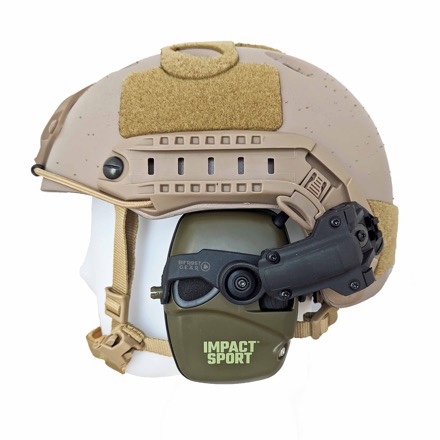
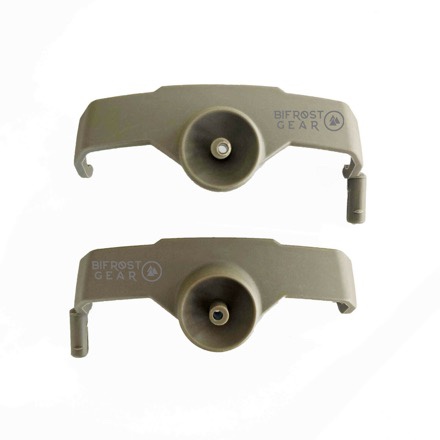
The Bifrost Gear COM-RAC allows operators to easily convert their Peltor Comtac, MSA Sordin, and Howard Leight Impact Sport headsets to work with the Ops-Core AMP Helmet Rail Mount Kit (RAC Arms).

Features:
• Converts OPS-Core AMP arms to work with Peltor, Sordin, and Howard Leight Headsets and Earmuffs
• Lightweight but high strength mil-spec polymer
• Installs in seconds, no modifications to OPS Core AMP arms or headsets required
• Allows headsets to attach to rear dovetails on ARC rails

Models available for the following headsets:
• Peltor Comtac II / III / V / VI
• MSA Sordin / TCI Liberator / TEA High Threat (over the head versions)
• Howard Leight Impact Sport

Dealer inquiries and Government orders welcome

www.bifrostgear.com

Whiskey 5 – Intraloop

Thursday, May 5th, 2022

Who:

We are a Team of veterans, engineers, designers, and business professionals which was founded and grew out of a need to fix a system that wasted human and material resources and ultimately let servicemen and women down.

We wanted to solve key pain points and began with the question, “How can we unlock the complexities of human insight and use this information to make better products?”

The system in which we operate has inherent flaws that makes it challenging to achieve desired outcomes. Having been there, we knew that the voice of the end user, the individual who deeply understands what they need, should be heard. We also knew the problem existed and persisted at every level, from military operator in the field, to congressmen and women stewarding our nation’s resources, from the consumer to the board room.

What:

Our motto is “Humans Before Hardware”. Intraloop is returning to software’s original promise: solving problems in the physical world. We’re starting with the DoD because America’s competitive advantage comes from building the right things for our national security – better, faster, cheaper.
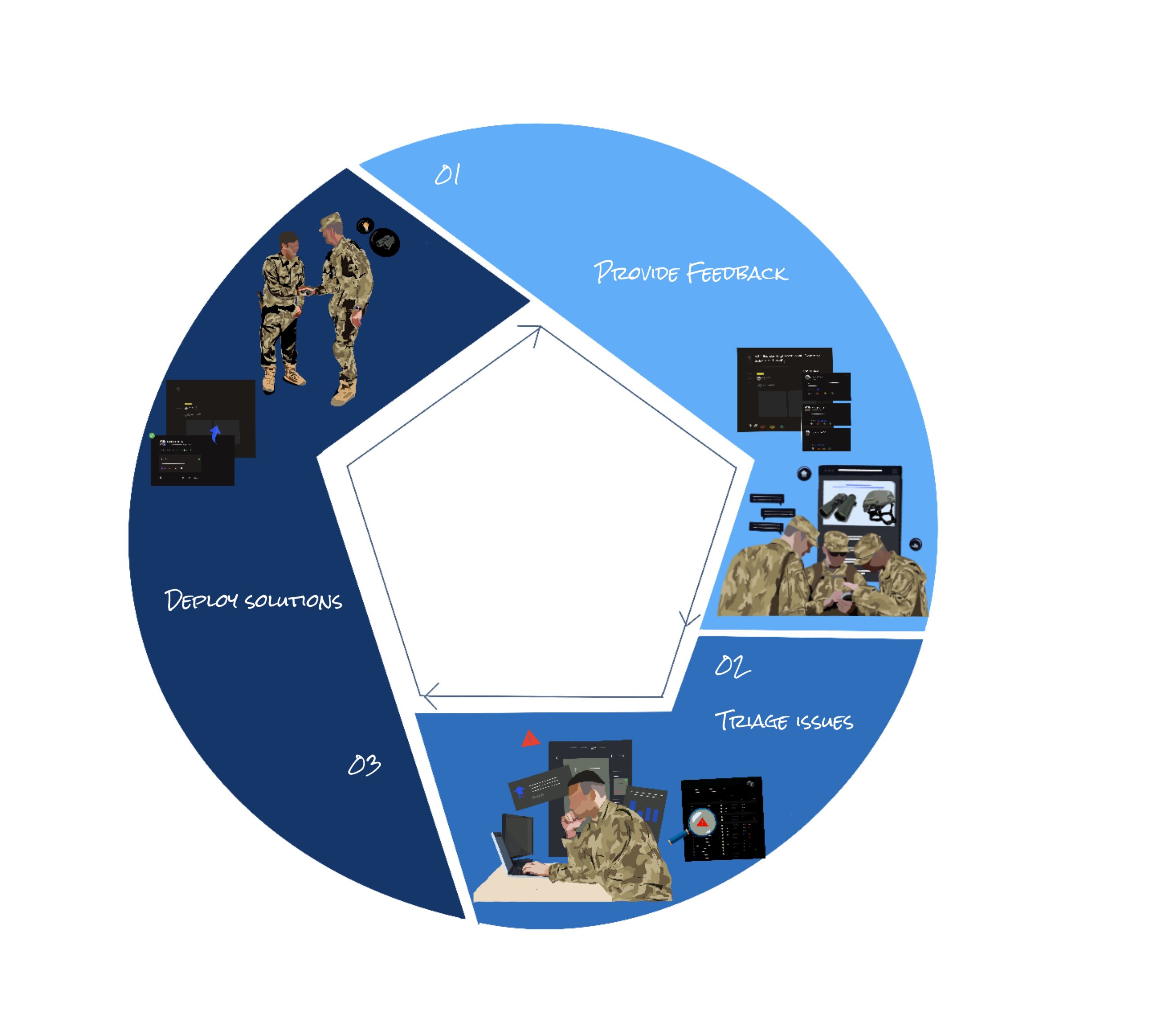
At the heart of what we do is connecting organizations and communities and giving them the tools and ability to make informed decisions that move the needle.

We’ve created a platform that includes:

-The ability to collaborate across end user communities and organizational administrators.

-Various engagement techniques that gather quantitative and qualitative data in novel ways.

-An admin dashboard that turns end user interactions into faster, data-driven decisions.

By bringing user concerns to the forefront, it reshapes the process and allows for early engagement on products and services. The system is focused on human-centered product design and decision grade analytics which empowers organizations to have a greater impact and increases buy-in at all levels.

Where:

Our platform goes where you go. It can be deployed anywhere, with both Commercial and Government/Defense partners.

When:
The time is now. There’s a clear signal that this is needed and it’s coming in from many directions.

In the Office of the Secretary of Defense’s memo for ‘Software Modernization’ published in February 2022, the document emphasized the following themes:

Speed Innovation into the Hands of the Warfighter – “The Department must evolve and innovate smartly, leveraging industry, academic, and scientific communities to drive toward technical solutions of mutual benefit, to establish creative relationships through agreements, and to foster experimentation.”

Empower the Broader Workforce as Contributors to Technology – “Developers are not the only ones who can impact software modernization. From infrastructure managers to operators, the entire workforce has the opportunity to help evolve technology. The entire workforce must understand their role in delivering software and find ways to streamline processes, push for automation, and better leverage technology.”

Testing & Acquisition – “As software plays a more significant role in weapons platforms and mission capabilities, robust software testing must be integrated into delivery pipelines and account for end-to-end mission thread evaluations.”

We see a shifting world order with the current conflict in Ukraine resulting in increased defense spending across Europe. The question arises on how to best use that money. We must offer ways to accelerate readiness while saving costs.

Why:

There’s a problem that needs fixing. In a 2019 Government Accountability Office report, it was reported that out of the top 20 major defense acquisition programs (MDAPs), the government went $628 bn over budget in the last 5 years. Part of the reason this happened is that they don’t have the tools to gather and rapidly analyze robust user generated data.

When you speak to operators, it’s clear that their needs aren’t being met. There is simply no means to send that signal in a meaningful way. What’s more, acquisition officials lack the necessary data to make better, faster decisions.

Time is a precious resource and more “traditional” ways of conducting research is time and labor intensive and the data isn’t always easily tied to decisions.

Software should support the people. We allow for rapid data collection and analysis to happen in a fraction of the time, in an intuitive way. The result is data that is easy to digest and leads to decisions, but also reduce waste as well as the human and material cost. We feel this is an important goal because it is how we maintain both our military and industrial edge against global adversaries.

intraloop.io

Bravo 5 from Stroup Knives

Thursday, April 14th, 2022

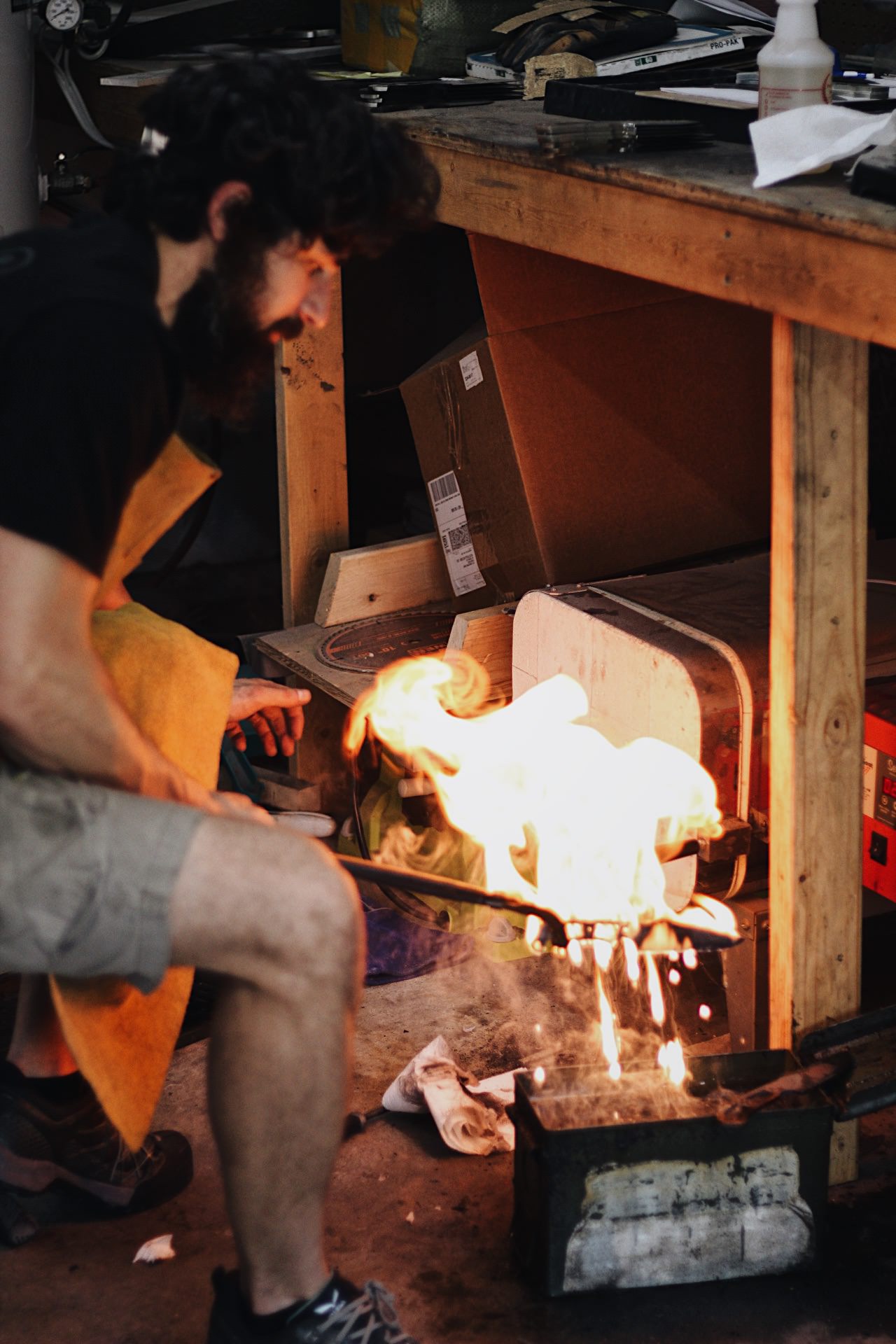
Army Veteran Chris Stroup has begun making a name for himself as an up and coming bladesmith.

He recently partnered with Justin Melnick of the hit TV show SEAL Team to create the Bravo 5.

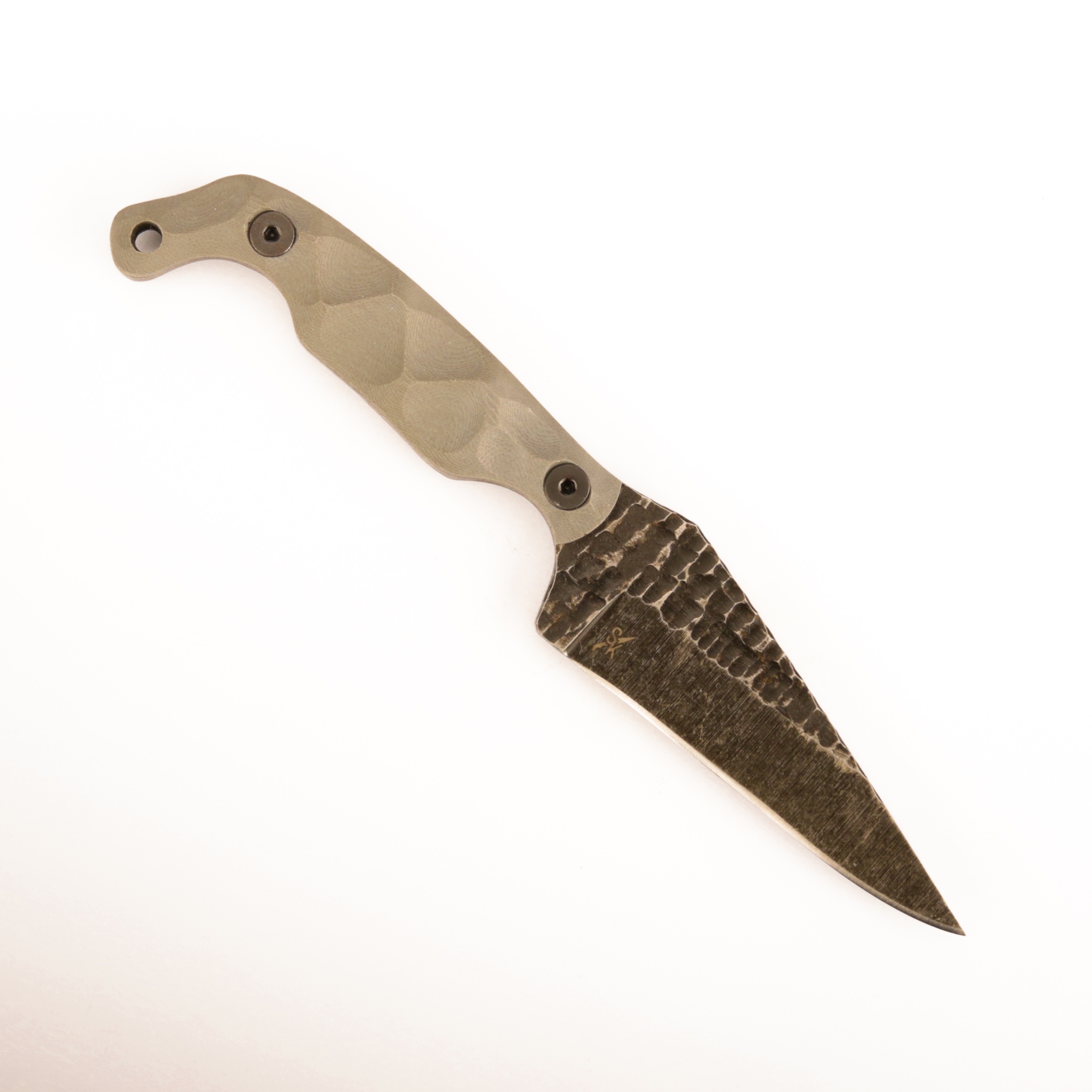
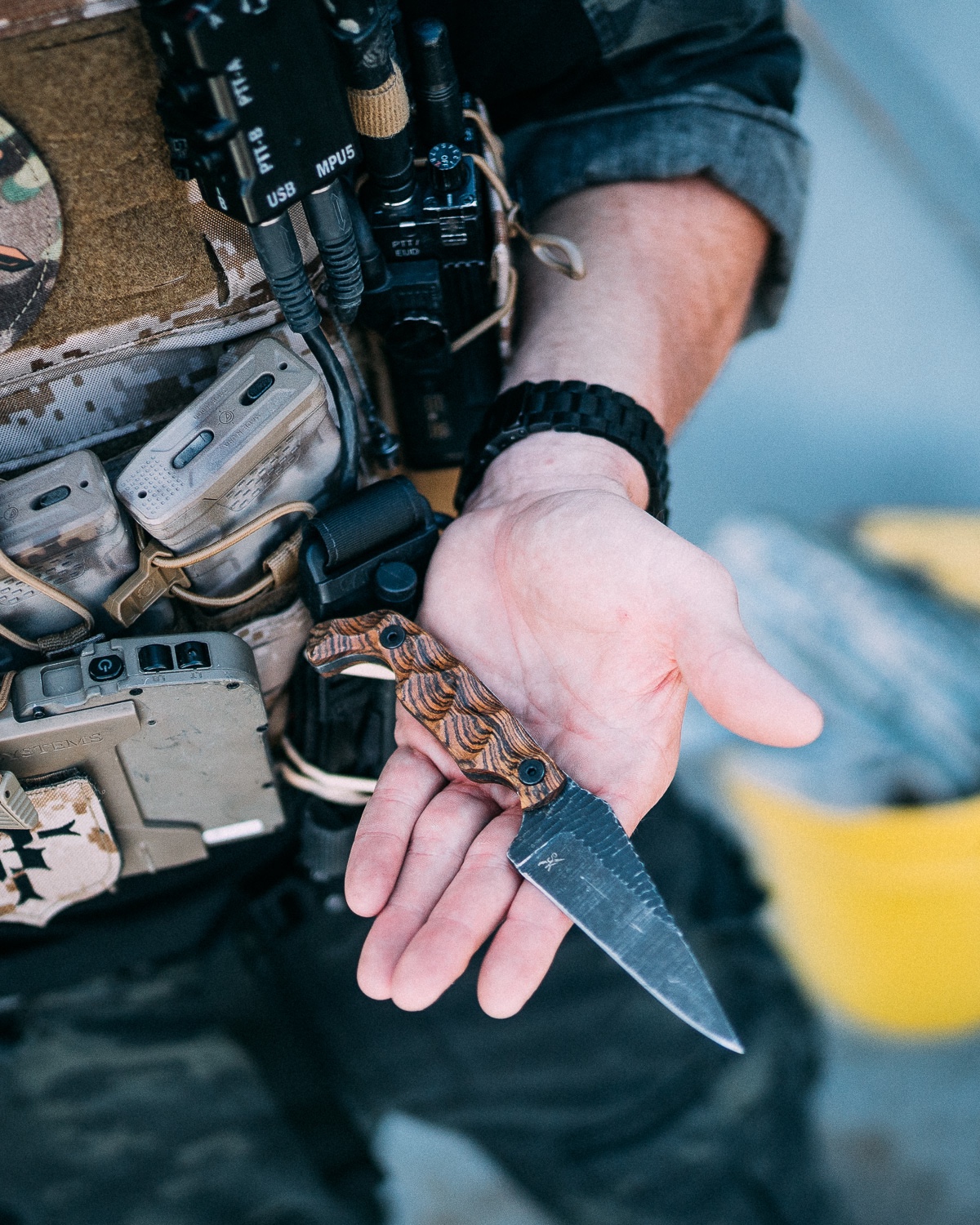
Designed for every day carry, the Bravo 5 is a great companion whether for duty or camp use. It features a full tang and 3.5″ drop point blade made from 1095 High Carbon Steel. This is paired with a Gray G10 or Wood handle giving the knife an overall length of 7.75″.

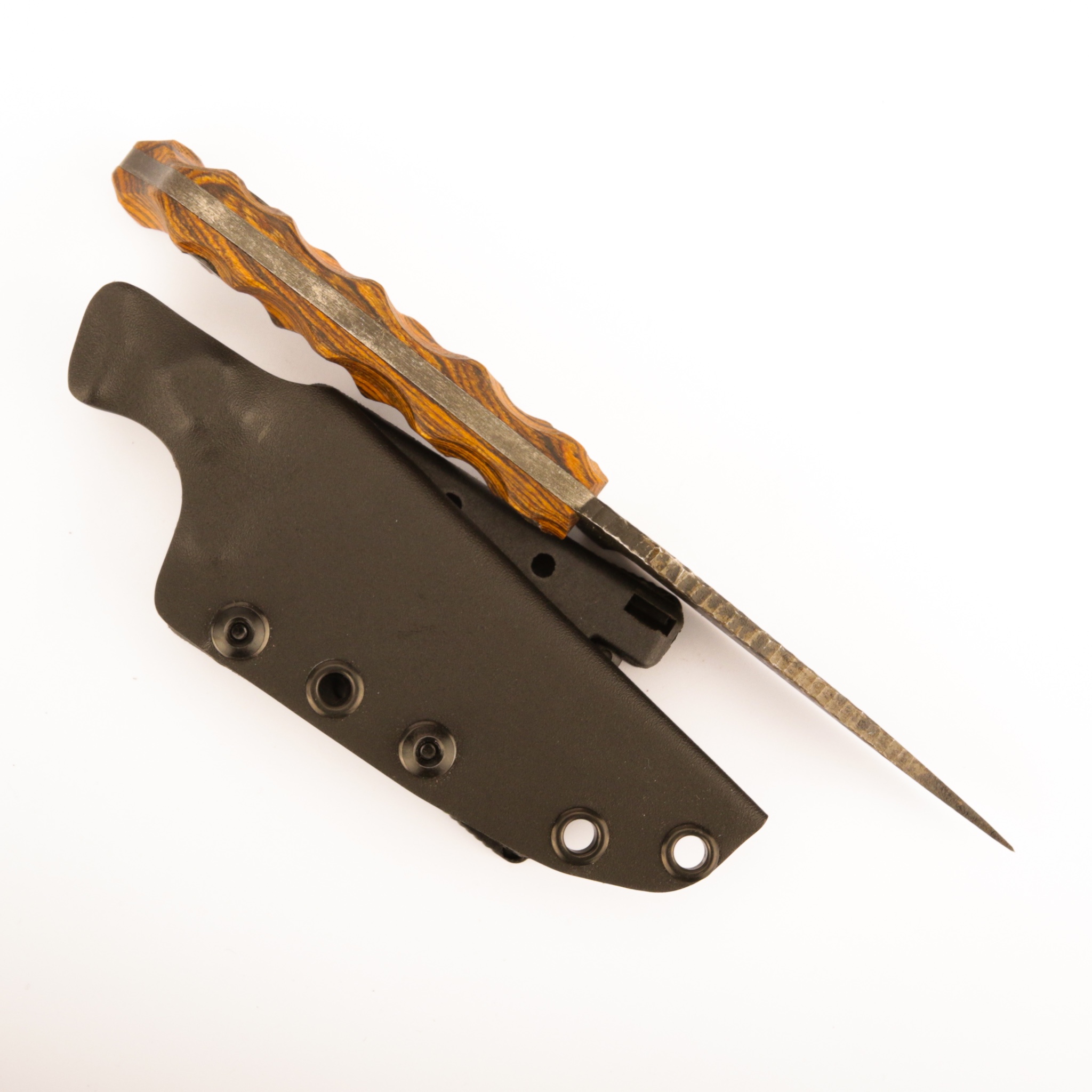
The Kydex sheath can be configured for vertical or horizontal carry.

stroupknives.com/bravo-5-knife

10% of the proceeds of Bravo 5s from Stroup Knives sales are donated to SOWW Charity to support the US Special Operations Community.

Veteran, Linguist Reflects on Vietnam Service

Wednesday, April 13th, 2022

ELLICOTT CITY, Md. — Originally from the San Francisco Bay Area in California, Dr. Tom Glenn originally enlisted in the Army so he could attend the Army Language School — later called the Defense Language Institute, or DLI. With a passion and knack for linguistics, Glenn taught himself French and Italian as a child, studied Latin during high school and German during college.

With a craving for more, Glenn enrolled in DLI with the hopes of learning Chinese.

“I wanted to go to the best language school in the U.S., maybe in the world,” he said. “But when I got [there], they told me they weren’t going to teach me Chinese, they were going to teach me a language I had never heard of: Vietnamese.”

Glenn was a Soldier and had to follow orders, so he spent all of 1959 learning Vietnamese. He spent six hours a day in class with two hours of private study each night for a full year.

“I graduated first in my class of ten,” he said. “I asked the Army to send me to Vietnam but [they said] they had nothing going on there.” Instead, Glenn was assigned to the National Security Agency, or NSA, at Fort Meade, Maryland.

Still hoping to study Chinese, Glenn enrolled in George Washington University in Washington, D.C. as a part time graduate student. Glenn went on to earn a master’s degree in government and a doctorate in public administration.

By the time Glenn finished his enlistment in 1961, he said he was “comfortably speaking” Vietnamese, Chinese and French; the three main languages spoken in Vietnam.

The NSA immediately offered Glenn a job at “five steps above the normal level” and sent him to Vietnam for the first time in 1962 as a civilian.

“Between 1962 and 1975, I spent more time in Vietnam than in the U.S.,” he said.

Despite being a civilian, Glenn lived with the military as if he were still a Soldier.


Tom Glenn poses for a photo in his fatigue uniform in Dak To, Vietnam in 1967. One morning while assisting U.S. 4th infantry division and 173rd airborne brigade, Glenn woke up to find his uniforms missing. Some of the Soldiers at his camp had “snitched” his fatigues and taken them to a local tailor whom they paid to sew tags above the breast pockets that read ‘Glenn’ and ‘Civilian.’ (Photo Credit: Courtesy photo)

“I was one of them — sleeping on the ground next to them, eating [field rations while] sitting in the dirt by their side, using their latrines and going into combat with them,” he said. “I was the only civilian I knew who was willing to put his life on the line by working with the military in combat on the battlefield.”


Tom Glenn in Saigon, Vietnam in 1962 (Photo Credit: Courtesy photo)

Glenn’s job was in intelligence; using signals intelligence, intercepting and exploiting the enemy’s radio communications, informing friendly forces on what enemy force intentions were and where they were.

He says that the strongest human bond he’s ever seen was that between two men fighting side by side.

Glenn spent his thirteen years in Vietnam all over the country, “wherever combat was going on.” He worked most often in central Vietnam, just south of the demilitarized zone that separated North and South Vietnam. The day-to-day was just like any other Soldier in combat.

“[The days were] defined by the boredom of waiting and the terror of close combat,” he said.

Glenn wants Americans to know the “grisly horror” of war. He wants citizens to respect and admire service members who “put their lives on the line for our good.”

After the Vietnam War, Glenn’s readjustment to civilian life would have been more difficult had he been sent straight home. Instead, he was sent abroad to serve on the battlefield all over the world after Saigon fell in 1975.

Glenn retired from NSA in 1992.


Tom Glenn in Saigon, Vietnam in 1974 (Photo Credit: Courtesy photo)


A Civilian Meritorious Medal that Glenn earned for saving lives during the fall of Saigon, Vietnam under fire in 1975 (Photo Credit: Courtesy photo)

“Welcome home, brother”

When Glenn meets other Vietnam veterans, he puts his hands on their shoulders and looks them in the eye. They share an experience unknown to other Americans.

For years following the war, many Americans saw Vietnam as “the war we never should have been involved in.” During those years, Glenn never mentioned his service overseas.

“Then, several years ago, I was invited to a welcome-home party for Vietnam veterans,” he said. “After some hesitation, I went. A bunch of young people, who hadn’t even been born before the end of [the war], shook my hand, hugged me and thanked me for my service.”

Glenn urges other Americans to approach those who served and thank them. Only then will that service member know that their service is “worthy of gratitude.”

Award-winning author

“The real adjustment [came] thirty years ago when I retired as early as I could [to] write full time,” Glenn said. “I was so intent on writing that the transition was a relief rather than an adjustment.”

Glenn’s first book is titled “Friendly Casualties” and consists of a collection of short stories to highlight the horrors of war. He chose to write about Vietnam because of his post-traumatic stress injuries, or PTSI. “[It] wounded my soul,” he said.

He learned that the only way to survive his injuries was to face the memories “head-on.” The best way to force himself to face those memories was to write it all down, which has resulted in six books and 17 short stories as of March 2022.

Glenn’s books are categorized as “fact-based fiction” which he said is the only way he could “delve into the emotions [he] lived through in real life.” He said he’s lived through experiences “far more compelling” than anything completely made up.

“I want people to know what [it was like],” he said. “I needed to vent, to stand face-to-face with my memories and learn to live with them.”

By Megan Clark

Kit Badger Covers The 8th Annual SOC-F Fundraiser

Sunday, April 3rd, 2022

If you’ve ever wondered what it’s like to attend a SOC-F fundraiser, Kit Badger takes you beyond the velvet rope.

2022 SOC-F Sporting Clays Invitational Silent Auction is Now Open

Tuesday, March 22nd, 2022

Each year the non-profit Special Operations Care Fund holds an invitational Sporting Clays shooting tournament as a fundraiser. They also host a silent auction and open it up to the public. This year’s slate of items is exceptional.

Check them out here.

HunterSeven Foundation – Warfighter Health Symposium – March 22 in San Diego

Monday, March 21st, 2022

The HunterSeven Foundation and Task Force Dagger Special Operations Foundation invite you to attend an interactive event designed to educate service members, veterans, their families and healthcare providers on the importance of understanding military exposures as they relate to wellness.

Veterans and Clinical Researchers Chelsey Simoni, MSN-RN, FP-C and Jack Ratliff, APRN-BC of the HunterSeven Foundation, along with MSG Geoff Dardia, Director of the TFDSOF Health Initiatives Program will present research on post-9/11 toxic exposures, deployment and operational environments, risk factors, and explain how a personalized and preventative approach to healthcare will lead to optimal wellness in the veteran and warfighter community.

Guest speakers will include: 

Dr. Gabrielle Lyon, D.O., Founder of the Institute for Muscle-Centric Medicine

Get tickets here.

Sponsored by NFQ

H/T to Tactical Distributors

In Memoriam – Col Gail S. Halvorsen (USAF, Ret)

Friday, February 18th, 2022

Earlier this week Col Gail S. Halvorsen (USAF, Ret) aka The Berlin Candy Bomber and Uncle Wiggly Wings passed away. His family was at his side at the Intermountain Utah Valley Hospital in Provo, Utah, where he was admitted following a short illness.  Colonel Halvorsen was 101 years old and he is survived by his five children and numerous grand- and great grandchildren.

We received this information from the Airlift/Tanker Association:

Col Halvorsen, a Utah native, began his flying career when he earned his private pilot’s license in 1941 through a Civil Air Patrol program.  His passion for aviation led him to join the Army Air Force in 1942 flying transport aircraft.  In 1948, peace in Europe was threatened as the Soviet Union blockaded all ground access to war-torn West Berlin. Then, Lt Halvorsen, a member of the newly formed United States Air Force, began flying humanitarian airlift missions to starving West Berliners.  During one mission, he paused to share two sticks of gum with nearby German children who were watching the aircraft and busy flightline.  Two sticks of gum did not go far and he promised the children he would be back the next day to drop candy from his airplane, telling them, you will know it is me when I “wiggle” my wings.  That simple act of kindness and compassion led to “Operation Little Vittles” and, in all, over 23 tons of candy were dropped from Allied aircraft. His impact spread beyond the smiles of German children.  He brought visibility to the plight of the German people and put a human face on their suffering—Americans now saw the Germans as humans, not enemies. Strategically, the Allied resolve strengthened, and West Berlin’s freedom was secured without a single shot fired and his act of kindness forged the strong bond between America and Germany that endures today.

After hanging up his uniform Col Halvorsen continued his life of service by inspiring youth and adults around the world to a life of service. 

May He Rest In Peace