GORE-TEX Professional

Archive for the ‘weapons’ Category

Barrett Lands New US Army Contract for M107 Rifle System

Saturday, December 7th, 2024


A U.S. Army soldier fires down range with the Barrett M107. (U.S. Army photo by Sgt. Michael J. MacLeod)

MURFREESBORO,TN — Barrett Firearms Manufacturing Inc. has secured a new U.S. Army contract for the M107 Rifle System and variant systems, such as the Model 82A1 and M107A1, extending the company’s long-standing support of America’s military.

The Barrett M107 has been an integral part of the U.S. Armed Forces’ long-range arsenal for more than two decades, delivering unmatched firepower, accuracy, and reliability in the field.

The new$14,999,500 contract, which includes accessories, spare parts and training support, will be delivered through late 2029.

Barrett Vice President of Business Development and Sales Ryan Krantz said the latest contract ensured the continued supply of the M107 Rifle System and its variants to support U.S. Army missions worldwide.

“This contract reaffirms the trust that the U.S. Army has placed in the M107 Rifle System and Barrett’s commitment to excellence,” he said. “We are honored to continue providing our troops with a superior platform that has stood the test of time in both performance and reliability.”

Kit Badger Asks, “What’s the Best Length?”

Saturday, November 30th, 2024

In this video by my friend Ivan, he looks at carbine barrels from 13.7″ to 16″ to determine the best barrel length. Specifically, he examines what is gained or lost by deviating from the non-NFA 16″ barrel length.


Learn more at kitbadger.com/13-7-to-16-the-best-barrel-length.

Barrett Celebrates Marine Corps Full Operational Capability for MK 22 Advanced Sniper Rifle a Year Ahead of Schedule

Saturday, November 30th, 2024

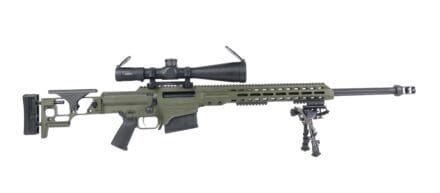
MURFREESBORO, TN — Barrett Firearms Manufacturing Inc. is proud to announce that the Marine Corps Systems Command has achieved Fully Operational Capability (FOC) for the MRAD® MK 22 Mod 0 Advanced Sniper Rifle (ASR) a year ahead of schedule.


A U.S. Marine fires a MK 22 Advanced Sniper Rifle during a new equipment training range on Camp Schwab, Okinawa, Japan. (Photo by Cpl. Alex Fairchild)

The MK 22 represents the culmination of Barrett’s dedication to innovation and collaboration with the Department of Defense. Originally developed through a Special Operations Command contract, the MK 22 transitioned to the Marine Corps via the “Special Operations Forces (SOF) to service” process, with contracting led by the U.S. Army. This seamless interservice cooperation enabled the Marine Corps to achieve FOC a full year ahead of schedule, delivering critical capability enhancements to warfighters sooner.

“The MK 22 isn’t just another rifle; it’s a modular, mission-adaptable system that empowers the warfighter with unmatched precision and flexibility,” said Bryan James, CEO of Barrett. “We’re honored to contribute to this pivotal modernization effort for the U.S. Military and Marine Corps, and to support our nation’s elite forces.”

The MK 22 offers unparalleled versatility, with caliber conversion kits allowing for seamless transitions between 7.62mm, .300 Norma Magnum, and .338 Norma Magnum. This adaptability enhances the ability to engage targets with precision at extended ranges. Paired with the state-of-the-art M317 Precision Day Optic – a variable power optic providing a 7-35x magnification – the MK 22 delivers a significant leap forward in capability over legacy sniper systems.

Barrett designed the MK 22 to be a complete system, providing soldiers with an integrated solution tailored for operational efficiency. Each rifle kit includes three barrels, a hard and soft carrying case, 15 magazines, a cleaning and tool kit, a sound suppressor, optic with scope mount, and mission-specific components such as a scout sniper tripod kit and anti-reflection device.

“The MK 22 consolidates what was previously two rifles into a single platform, lightening the Marine’s load while improving logistical efficiency,” Mr. James said. “The ability to conduct caliber conversions in the field ensures that Marines are equipped for any mission, anytime, anywhere.”

Another key advantage of the MK 22 is its sustainability. Maintenance is streamlined, with most repairs now performed at the organizational level. In the rare event of a barrel failure, the rifle can quickly be reconfigured to a different caliber, ensuring continuous operational readiness – an improvement that was unattainable with previous systems.

“At Barrett Firearms, we are committed to equipping our armed forces with the tools they need to succeed in an ever-changing battlefield,” Mr. James said. “The MK 22 Mod 0 Advanced Sniper Rifle exemplifies our dedication to precision, innovation, and mission success. As the Marine Corps ushers in this new era of sniper capabilities, Barrett stands ready to support their efforts and the future fight.”

USMC Fielding of MK22 Program Reaches FOC a Full Year Ahead of Schedule

Friday, November 22nd, 2024

Marine Corps Base Quantico, Va. —

Marine Corps Systems Command recently reached Fully Operational Capability (FOC) for the MK 22 Mod 0 Advanced Sniper Rifle (ASR). This milestone marks a critical step forward in modernizing the Marine Corps’ sniper capabilities of Reconnaissance and Infantry units.

“Fully Operational Capability is achieved when all the Infantry and Reconnaissance units, as well as MOS-producing schools, have been fielded to and new equipment training is completed,” stated Maj Michael Billings, Weapons Team Lead, Marine Corps Systems Command.

The MK22 is more than just another rifle; it results from a partnership across the Department of Defense. Initially a Special Operations Command contract, the MK22 entered Marine Corps hands through the “Special Operations Forces (SOF) to service” transition process, allowing the U.S. Army to take responsibility for contracting actions.

“This collaboration accelerated the entire program, pushing us to FOC a full year ahead of schedule—a significant win for the Marine Corps and our warfighters,” explained Billings.

The rifle offers caliber conversion options, allowing Marines to tailor their loadout to missions. With barrels chambered in 7.62mm, .300 Norma Magnum, and .338 Norma Magnum, Marines can engage targets more precisely and at greater ranges.

“The M317 Precision Day Optic (PDO) paired with the MKk22 is a game changer. The M317 PDO is a 7-35 Variable Powered Optic, a huge leap in capability over our previous sniper systems like the M40 and MK13,” explained Brian Nelson, MK22 project officer, Marine Corps Systems Command.

Each rifle kit has three barrels, a hard and soft carrying case, a comprehensive cleaning and tool kit, a sound suppressor, the M317 PDO, and its accompanying scope mount. Reconnaissance and Infantry units also receive a .300 Winchester Magnum barrel, a scout sniper tripod kit, a laser filter unit, and an anti-reflection device.

“Marines like the ability to conduct caliber conversions at their level and the fact that they only have one rifle instead of the two it replaced,” emphasized Kevin Marion, a Logistics Management Specialist with Marine Corps Systems Command. “This shift improves operational efficiency, reduces the logistical burden on units, and lightens the individual Marine’s load.”

One of the MK22’s most significant benefits is its sustainability. Maintenance times are reduced, and repairs can now be conducted at the organizational level—unlike the old sniper rifles, which required more time-consuming evacuation to an intermediate level for repairs. Should a barrel fail, the MK22 can still be employed in a different caliber, maintaining the unit’s operational readiness.

“[Replacing a barrel] was impossible with previous systems, where a condemned barrel would render the weapon unusable, directly affecting mission readiness,” said Nelson. “Now, the MK22 ensures that even if a barrel fails, Marines are still mission ready.”

With the MK22’s enhanced capabilities, Marines are more lethal, more versatile, and better equipped to handle the challenges of modern warfare and equipped for the future fight.

By: Morgan Blackstock, Office of Public Affairs and Communications, Marine Corps Systems Command

SIG SAUER and Nibe Defence Announce Joint Venture in India

Friday, November 8th, 2024

NEWINGTON, N.H., (November 8, 2024) – SIG SAUER, Inc. is excited to announce a joint venture with Nibe Defence and Aerospace Limited to advance small arms and ammunition manufacturing operations in India. This new partnership will support India’s ‘Make in India’ initiative, underscore both entities commitment to the region and bolster SIG SAUER’s role as the primary provider for India’s defence needs.

“SIG SAUER is meeting the increased international demand for our products by solidifying key partnerships across the globe,” began Ron Cohen, President, SIG SAUER. “This important new alliance in India serves to meet that demand in one of the most significant regions for growth in the coming decades. The joint venture with Nibe Defence gives SIG an expanded presence, greater customer engagement, and new collaboration opportunities to meet India’s growing needs.”

Officials from Nibe Defence joined representatives from SIG SAUER and the Chief of Defence Staff of the Indian Armed Forces for an official signing of a Memorandum of Understanding in Pune, India on November 6, 2024.

As part of the “Make in India” initiative by the Government of India to accelerate the domestic manufacturing industry, the collaboration between Nibe and SIG SAUER will strengthen India’s defence capabilities while reinforcing India’s commitment to self-reliant defence manufacturing.

The Government of India, Ministry of Defence first awarded SIG SAUER a contract for the SIG716 in 2019 for 72,400 rifles. The successful fielding and overwhelming soldier acceptance led to a follow-on award for an additional 73,000 rifles.

“SIG SAUER is excited to partner with Nibe Defence, a proven leader in India’s defence sector, as the primary provider for India’s defence needs,” concluded Cohen.

AUSA 24 – SIG Remote Operated Equipment

Friday, November 1st, 2024

SIG gave us an update on their robotics and remote operated weapon station programs which they are referring to, with an eye to the future, as Remote Operated Equipment. As you may recall, SIG purchased Israel’s General Robotics last year.

This is the first fully US-produced SIG weapon station, mounted with an MMG 338 Machine Gun, and sitting atop the tracked Donkey concept platform.

The weapon station is capable of remotely charging and firing the weapon as well as rendering it safe.

The flexible feed chute is from Nobels Worldwide and the weapon is fed from a 300 round quick change ammo can. The entire system can be controlled via a tether or remotely via a Persistent Systems MPU5 radio.

Finally, the weapon station optics include a variable powered day camera along with a thermal camera and 1550 eye safe laser range finder.

101st Airborne Soldiers Assess New Next Generation Squad Weapon with 6.8mm Ammo

Tuesday, October 29th, 2024

FORT CAMPBELL, Kentucky — Roughly 200 Airborne Infantry Soldiers of the 101st Airborne Division (Air Assault) are running the Next Generation Squad Weapon (NGSW) system through its paces here from Sept. 1 to Oct. 30.

Soldiers from Alpha and Bravo Company, 1st Battalion, 506th Infantry Regiment are taking part in an operational assessment (OA) featuring a range of weapon configurations, force-on-force engagements and static live-fire ranges.

It is a key step in modernizing the combat force and aims to impact over 120,000 U.S. Army Soldiers, according to Mr. Elbert L. Grayson, Supervisory Military Test Plans Analyst, Maneuver Test Directorate, U.S. Army Operational Test Command.

“The Army needs equipment to continually evolve, to meet the threat of our adversaries,” said Grayson.

The NGSW system will be the next stage in that evolution.

“Information is needed to make improvements to the NGSW that will benefit America’s most precious resource, our Soldiers,” Grayson added.

The new weapon system is slated to replace the M4 carbine and M249 squad automatic weapons, representing a significant advancement in firepower, range and accuracy.

“Having seen the capabilities of the 6.8 [mm] round, I have confidence that it will easily do in one to two rounds, what the 5.56 [mm] did in two to four,” said Capt. John M. Green, Commander of A-CO, 1-506th, 101st ABN DIV.

Direct feedback from U.S. Army Soldiers provides invaluable insight to ensure future warfighters receive the best possible equipment when it matters most.

“The force on force is really exciting, really fun, getting in there and doing training against human beings, not just targets, and actually squaring off [against another] unit making plans and objectives, I think it is a really good training experience for sure,” explained Sgt. Todd Smallwood, First Squad Team Leader, A-CO, 1-506th, 101st ABN DIV.

According to Grayson, the NGSW testing is being conducted under the most rigorous conditions to simulate real combat and ensure that the weapon can meet the demand of future conflicts.

“We have been doing the operational assessment on the NGSW weapons, the XM7, the XM250, and also with the XM157 scopes on the weapon systems,” said Smallwood. “We’ve been doing quite a bit of ranges, and pop-up targets, trying to recreate platoon assault objectives.”

Besides standard training environments, the operational assessment was designed to simulate combat as closely as possible.

“The capability of the [6.8mm] round being able to puncture and turn cover into concealment, I think it will make a huge difference in urban and forest environments,” said Smallwood.

Soldiers were challenged to perform individual movement techniques (IMT) while engaging targets up to 300 meters away. This IMT lane requires Soldiers to bound, low-crawl, and high-crawl while maintaining accurate fire, ensuring that the weapon performed reliably under strenuous conditions.

They had to complete the course while under simulated combat stress, pushing their physical and mental limits.

“We did 72 hours of force-on-force (FOF), urban rifle marksmanship (URM), and we’re going to finish with a stress shoot,” said 1st Sgt. Barron C. Garrard, First Sergeant of A-CO, 1-506th, 101st ABN DIV. “I think it [the NGSW] will change daily life in the way that we fight.”

In preparation for future operational environments, Soldiers also tested the NGSW in simulated chemical, biologic, radiological, and nuclear (CBRN) environments.

“I like the fact that the testing of equipment has a possible impact on the next generation Soldiers that will be using it,” said Grayson. “My son is a Soldier that may use equipment that I have had a part in testing, so I’m motivated to provide the most accurate data for Army leadership to make the most informed acquisition decision.”

This critical aspect of the assessment ensured that the weapon system can be operated even in the aftermath of a chemical, nuclear or biological environment.

“The NGSW’s advanced capabilities and comprehensive training program will significantly enhance the lethality and survivability of our troops,& ensuring they are prepared for the challenges of future combat operations,” said Mr. Troy , Test Officer in Charge with MTD. “The 6.8mm round offers superior ballistic performance and the NGSW overall represents a significant leap in lethality.

“I feel privileged to be part of this transformative period for the Army,” Willey continued. “Working with the Soldiers who are assigned this system during the assessment is an absolute honor.”

By Mr. Thomas Mort, Audio Visual Specialist, and Maj. Thomas Lorenson, Senior Test and Evaluation Officer, Maneuver Test Directorate, U.S. Army Operational Test Command

AUSA 24 – FN Lightweight Intermediate Caliber Cartridge (LICC) Individual Weapon System (IWS) Update

Monday, October 28th, 2024

We initially showed you the FN Lightweight Intermediate Caliber Cartridge (LICC) Individual Weapon System (IWS) just before SHOT Show 2023. Since then, it’s undergone some improvements. FN America exhibited version 2.2 of the IWS at this year’s AUSA.

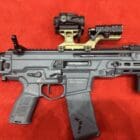
Here we see the 11.5″ Close Quarter Battle version with the 2.1 selector (it has been modified slightly more based on user feedback) and slightly larger charging handles as well as an improved buttstock mount. Changes to the operating system have also improved the feeding of the carbine.

This is the latest version of the dedicated magazine, produced by Magpul.

The carbine and machine gun are both chambered to fire the Lightweight Intermediate Caliber Cartridge (LICC) in .264 USA which was initially developed by the the Army Marksmanship Unit. As you can see, the case is steel.

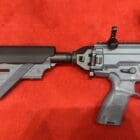
Here’s a look at the stock which both folds and is collapsible.

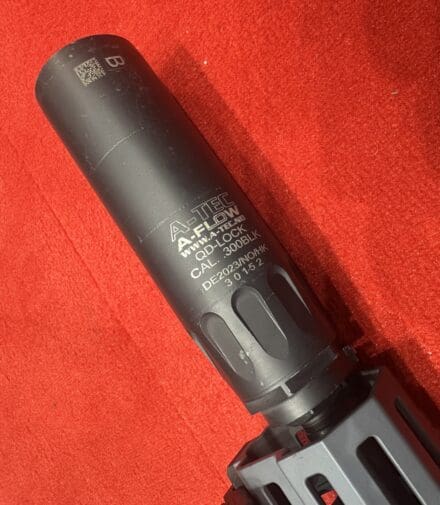
Seen here is the latest suppressor, from HUXWRX.

In mid-November, FN will join the Irregular Warfare Technology Support Directorate (IWTSD) program office in delivering carbines, machine guns, and ammunition to the SOF user community for evaluation.