XC3 Weaponlight

Archive for the ‘weapons’ Category

Industry Responds to Blast Over Pressure Effects from Weapons Firing

Saturday, October 18th, 2025

Last week I wrote about Service Member exposure to the effects of Blast Over Pressure (BOP) firing weapons during training and combat.

There has been a great deal of innovation in the suppressor industry over the past few years as government demands and manufacturing technology both increase. However, most of the improvements have been on four areas:

1. Sound suppression

2. Light suppression

3. Thermal dissipation

4. Particulate blowback

We’ll break those down one by one and look at ways industry has worked to improve performance in those areas.

Sound Suppression

Silencers as they were known at the time were initially created to deaden the sound of a firing weapon. It’s a very straightforward concept and different construction techniques and materials have been used over the years to facilitate the process. Manufacturers have become so good at this attribute that they are willing to sacrifice some performance for improvements in the other areas described here. Interestingly, the desire to suppress more and more weapons has increased. There is even discussion of suppressing the upcoming Precision Grenadier System, a semi-automatic, magazine-fed grenade launcher.

The advent of additive manufacturing, or as it is commonly known, 3-D printing, has given rise to very complicated designs, which can control the release of sound from firing as well as other advantages we’ll get into next.

Light Suppression

Early in the Global War On Terror, Special Operators who operated primarily at night began to realize that sound suppression was only of particular advantage during the first memory’s of contact with the enemy. After that, visual cues in the form of flames coming out the end of weapons identify the location of operators and they asked suppressor manufacturers to deal with the issue. Now, shooters observe only a first round pop visual signature as initial gasses in the suppressor are ignited while other manufacturers have eliminated even that.

Thermal Dissipation

As suppressors heat up under fire they often take on an orange glow in the visual spectrum and almost serve as a beacon when observed under thermal or Infrared sensors. Not to mention, they plain old get hot and can burn the operator. US Special Operations Command’s Suppressed Upper Receiver Group program attempted to acquire an integrally suppressed M4 upper receiver with the suppressor under the weapon’s handguard but ended up buying a URP with a suppressor featuring a cage to prevent burn injuries.

As opponents on the battelfield began to use sophisticated sensors, special operators began to be targeted for their hot weapons and several systems and techniques were investigated to mitigate the threat. This remains a requirement in new NATO weapon acquisition programs.

Particulate Blowback

Special operators have been using suppressors for decades and have taken for granted being gassed in the face, particularly during sustained fire or in confined spaces. The burning of the eyes and difficulty breathing became the cost of doing business but the advantages of using a suppressor far outweighed the discomfort.

But as the Army and Marines Corps began to experiment with suppressors, the troops who were unused to the blowback started to complain and the acquisition community began to take a look at the issue. Turns out, sucking down fumes created by the combustion of propellants is very bad for your health.

When a semiautomatic firearm is suppressed, the suppressor doesn’t allow all of the propellant gases from flowing forward and out the end of the barrel. Many are pulled rearward into the shooter’s face during cycling.

Getting the Balance Just Right

The US Army’s Next Generation Squad Weapon program is one of the first that demanded that this new capability would be suppressed and provide sound and light suppression as well as mitigation from propellant fumes.

As the requirement was added during the competition, all three of the companies involved had to hit the ground running and tweak their systems to lower the amount of particulate expelled into the face of the firer.

SIG already had some experience with this answering the SURG requirement when they reduced the amount of fumes that reach the operator by up to 80%, but as it turns out, the Army and SOCOM have different particulate standards and measure differently meaning they still had their work cut out for them. All three met the requirement after learning a few things and applying some changes and the firers of the current NGSW rifle are exposed to lower noxious fumes levels than Soldiers firing the M4.

Still more may be done to mitigate the exposure to noxious fumes as propellant manufacturers rise to the challenge.

Meanwhile, some companies like SureFire have taken to using super computers at the national laboratories to conduct exhaustive fluid dynamic simulations to try out different suppressor designs before they actually cut any metal.

Attacking Blast Over Pressure

Unfortunately, the government had not until recently identified the medical threat posed by BOP. Consequently, industry has just begun to attack this new problem. Multiple concepts have been proposed, and several have made it past the white paper stage into actual material solutions. It’s a new frontier that will affect design and how weapons are employed, particularly during training.

Once thought to be the Holy Grail, we are learning it is attainable. In our next installment we are going to look at how one company has balanced the already identified suppressor attributes with a new capability, to mitigate the effects of BOP on both man and material and on me of the most difficult weapons to suppress, the M2 heavy machine gun.

AUSA 25 – AeroVironment Switchblade 400

Friday, October 17th, 2025

Released during the 2025 AUSA meeting, the new Switchblade 400 is a medium-range, man-portable anti-armor loitering munition with rocket-assisted take-off (RATO). At under 40 pounds for the all-up round (AUR), the effector provides lethal standoff capability in under five minutes to defeat tanks and heavily armored targets with precision accuracy.

With 35 minutes of endurance, Switchblade 400 enables rapid target acquisition and high-confidence strikes against both fixed and moving threats.

Sized to fit in common launch tubes (CLT), the unit’s design streamlines training and enables rapid, plug-and-play integration. Its advanced pan-tilt EO/IR optic suite with hybrid Aided Target Recognition (AiTR) delivers reliable target recognition at 5.5 km in EO and 1.4 km in IR and advanced edge computing provide autonomous detection, classification, and elimination of threats, day or night.

Driven by AV_Halo Vision (previously AV’s SPOTR-Edge software) which is part of AV’S unified suite of mission-ready software tools. These platforms provide onboard computer vision for detection, classification, localization, and tracking of operationally relevant objects, including people, vehicles, and maritime vessels, day or night, even in GPS-denied or comms-degraded environments.

AUSA 25 – FN Multi-Purpose Tactical Launcher 30mm (MTL-30)

Friday, October 17th, 2025

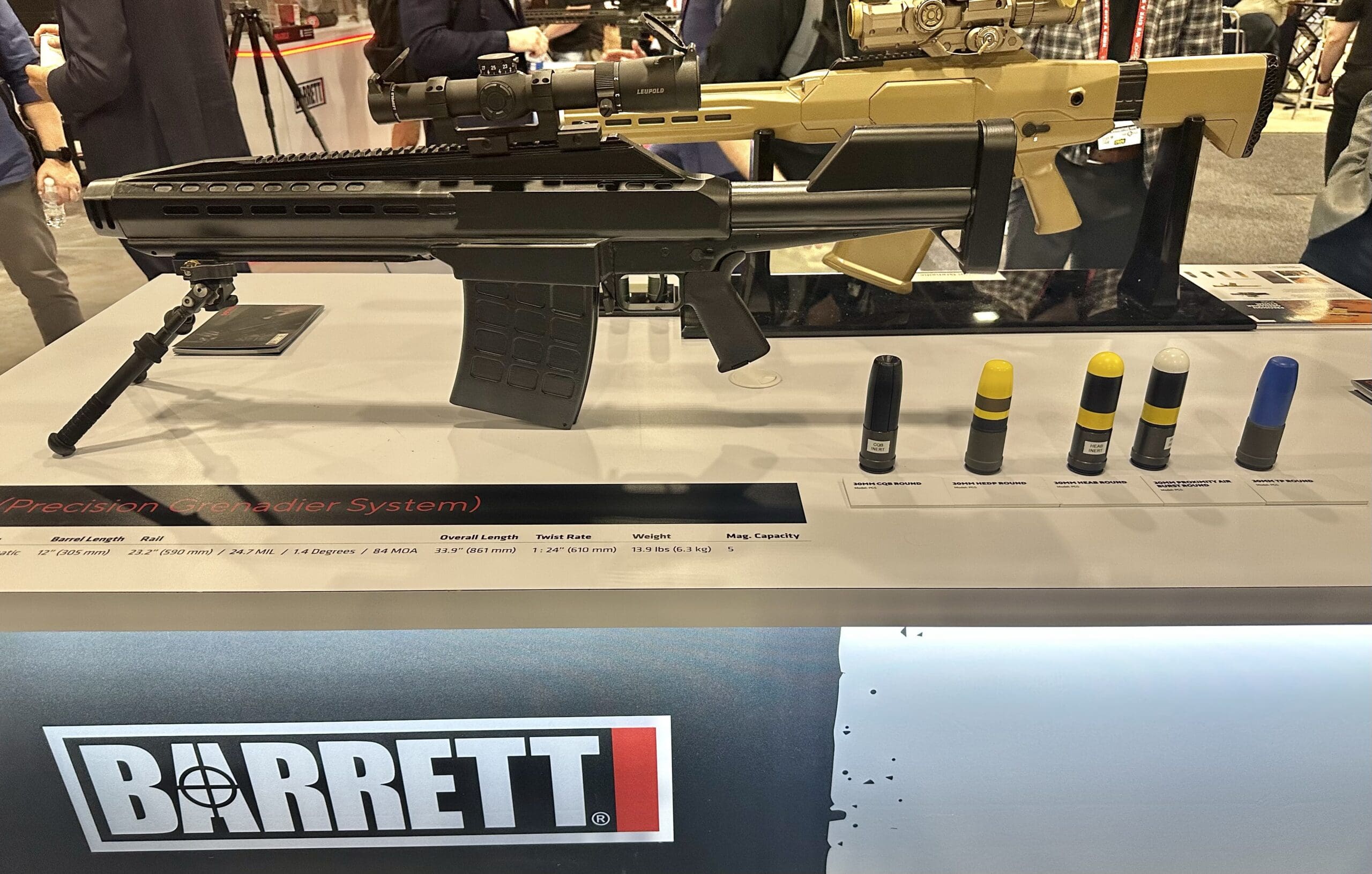
I got some hands on time with an example of FN America‘s new Multi-purpose Tactical Launcher 30mm (MTL-30), one of several designs vying to become the US Army’s Precision Grenadier System, a semi-auto, box magazine fed grenade launcher with programmable bursting munitions.

The Army’s requirement was caliber agnostic and FN engineers chose 30mm as their “Goldilocks” caliber to achieve the desired effects. The medium velocity rounds produce 45 ft lbs of recoil and shoot pretty flat. With under 3 seconds time of flight to 300 meters, the max elevation for the ammunition is 11m out to 500m.

It features a detachable box magazine with 3- or 5-round capacity. At just 35 inches in length and 8.5 inches tall, the weapon weighs just over 10 lbs. The bolt catch, magazine release and safety selector are all ambidextrous, plus there is an M4-style telescoping buttstock with a modular cheek riser. The modular rail system has a contiguous top rail for mounting of visual augmentation systems (VAS) and other devices, plus side M-LOK slots with a MIL-STD Picatinny rail.

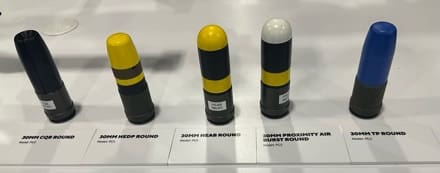
Ammunition is from Nostromo LLC and includes High Explosive Air Burst, Counter-UAS, and Training rounds.

Finally, mag pouches have been developed.

AUSA 25 – SIG SAUER Introduces New Robotic Solutions

Friday, October 17th, 2025

Over the past few AUSA meetings SIG SAUER has incrementally introduced new robotic solutions such as the Pitbull Remote Weapon Station and small arms integration into aerial drones.

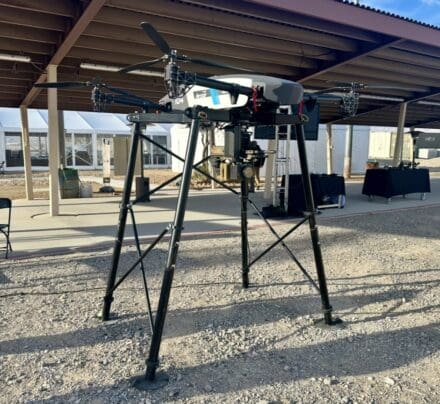
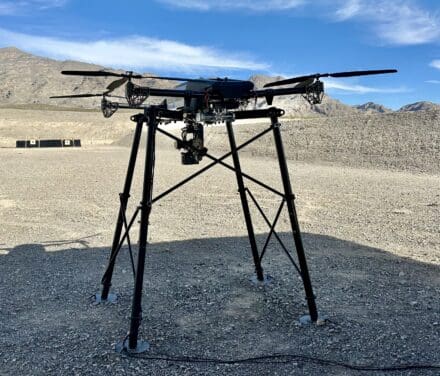
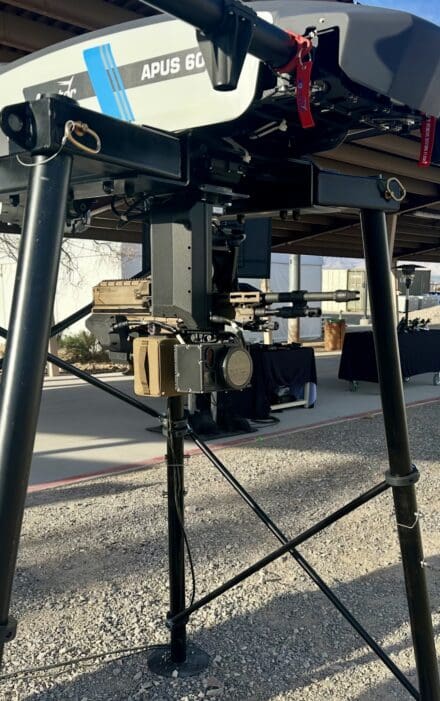
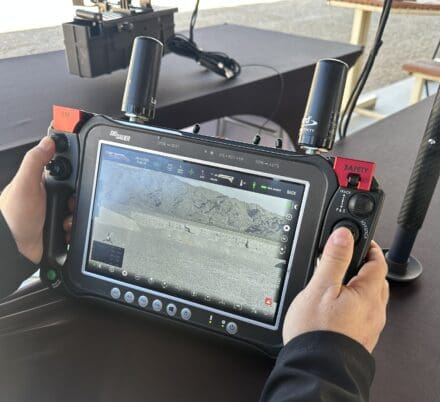
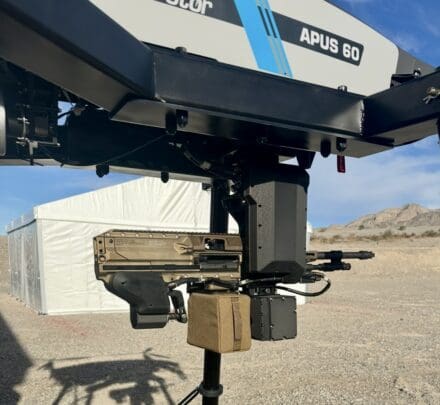
This year they exhibited a scaled down version of their RWS mounted to an IAI Fire Storm APUS 60 quadcopter which was developed specifically for this application. It is fuel powered and offers 3 hours of endurance.

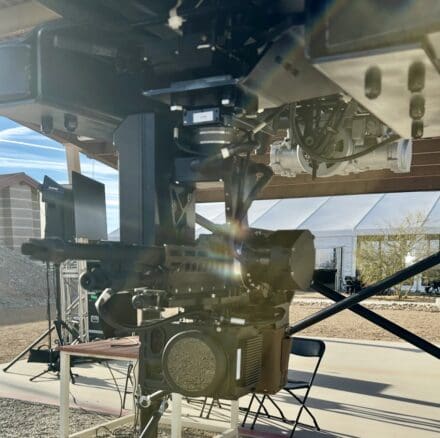
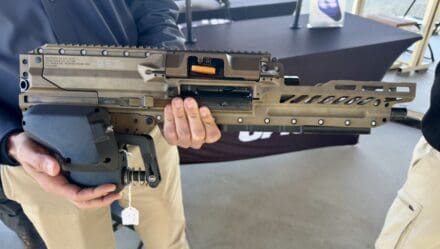
The RWS features an LMG and 200 rounds of 7.62 NATO ammunition for a total weight of 24 kg.

It uses the same tech as the ground based RWS but scaled down for aviation use. Consequently, it is purpose built for use with the LMG and is not modular, or meant to accept a variety of weapons.

It will traverse 30 deg left and right and depress -45 deg. That combined with the maneuverability of the drone will ensure target acquisition, PID, and engagement via the controller.

Additionally, they showed the Pitbull RWS mounted to a Deka Sentry Security Platform. This all-terrain, wheeled, multi-mission robot is offered in 3 models with this being the Monster Bot.

It is adapted from a carriage for individuals with mobility challenges and is gyrostabilized to offer a solid, upright platform for any application including ISR and weapon employment. For example, it keeps the payload level even when negotiating stairs.

While the weapon station relies on SIG’s controller, the platform itself can be autonomous, negotiating terrain on its own with little to no human input other than waypoints.

FN Ceasing Civilian Production of SCAR

Thursday, October 16th, 2025

Earlier today FN America released this statement on social media in response to online rumors regarding the future of the SOF Combat Assault Rifle, developed in 2007 in response to a USSOCOM requirement. Production for commercial sales for all models except the 15P have ceased.

Contract production will continue and there are ample magazines available for current customers but barrels and other accessories will be limited.

AUSA 25 – CODiAQ by Skyborne Technologies

Thursday, October 16th, 2025

Every year the Australian pavilion at AUSA’s annual meeting gets larger and this year it was packed with both companies and victor’s checking out their wares.

Our friends at Ghost Robotics told us to check out a project they were working on with Skyborne Technologies called Controller Operated Direct Action Quadruped or CODiAQ.

Mounted in a roll cage to Ghost’s Vision-60 Quadraped Unmanned Ground Vehicle, this lethal direct-fire and ballistic breaching robot boasts the HAVOC 40mm Weapon Payload which is a rotary launcher with five tubes. Alternatively there is the CHAOS 12 ga payload, a 10 rotating cylinder weapon.

This sits atop the Targeting Electronics &Optics Box (TEOB) and utilizes a Silvus Streamcaster MANET Radio. The TEOB is powered by Skyborne’s Targeting Software which provides AI assisted target recognition, ballistic computation, and platform control via a single RF link and control station (GCS).

The system weighs 66 kg / 145 lbs and can be mounted to the Vision-60 in 10 minutes with weapon swap-out or reload in just 90 seconds.

The program is sponsored by ASD/SOLIC’s Capability Development and Innovation office.

AUSA 25 – Rheinmetall Skyranger 762 Ultra Short Range Air Defense Remote Weapon Station (U-SHORAD RWS) Mounted to US Army ISV

Wednesday, October 15th, 2025

Rheinmetall displayed their Skyranger 762 Ultra Short Range Air Defense Remote Weapon Station (U-SHORAD RWS) mounted to a US Army Infantry Squad Vehicle Cargo variant made by GMC.

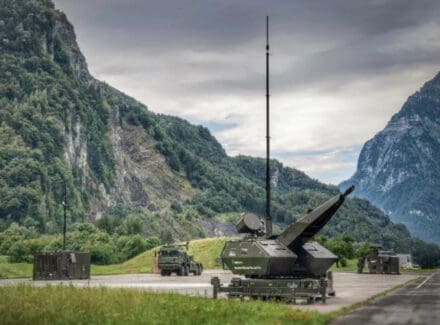
The system combines the Echodyne EchoShield radar with two 7.62mm M134D Miniguns mounted on the Fieldranger Multi Remote Combat Weapon System to go after unmanned aerial systems, in particular small drones (NATO Class I) and lightly armored ground vehicles in a pinch.

AUSA 25 – Northrop Grumman Precision Grenadier System

Wednesday, October 15th, 2025

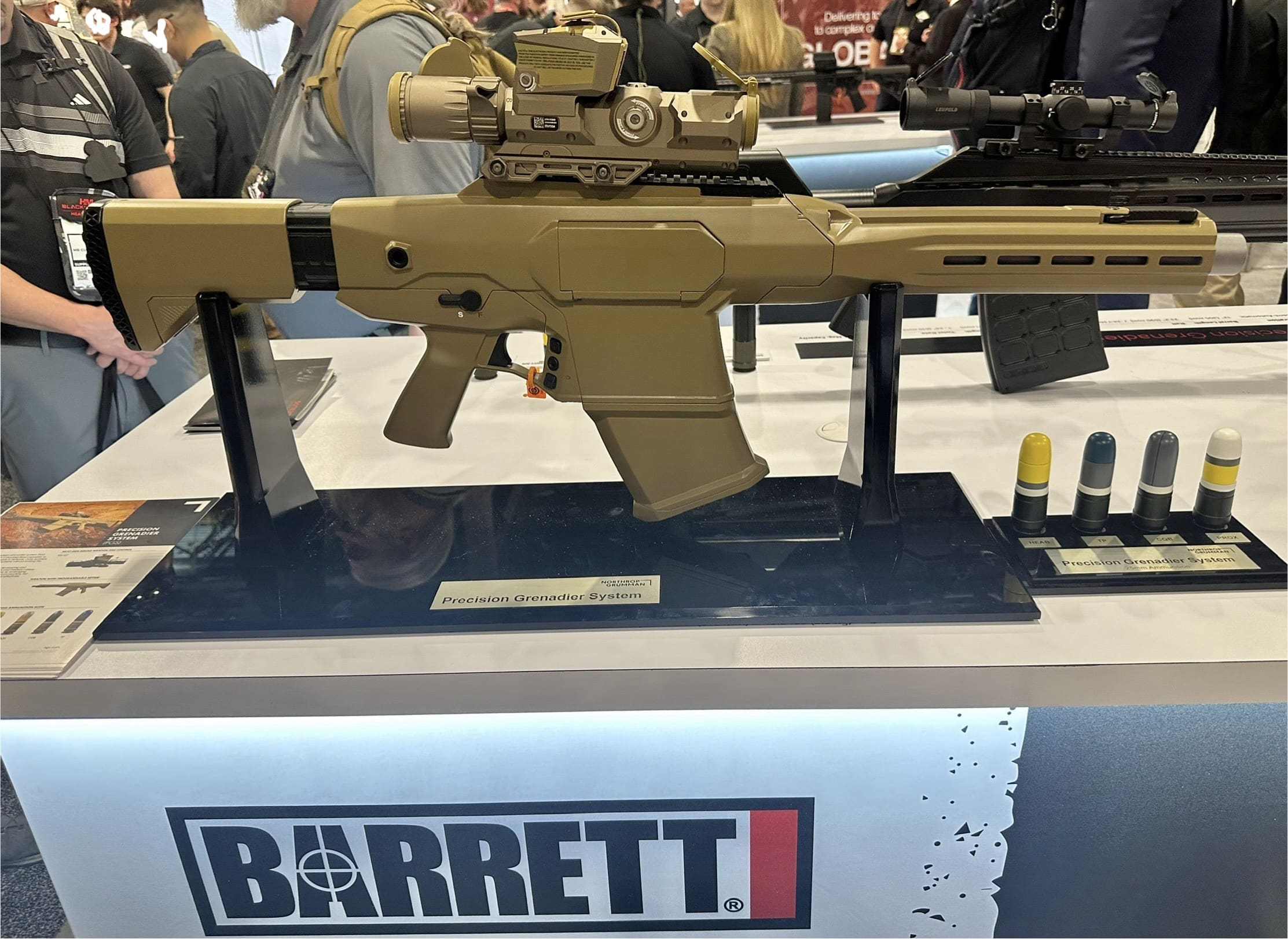
During AUSA I got to spend some time with a model of the Northrop Grumman Precision Grenadier System which is one of several counter defilade and counter UAS weapon systems currently being evaluated by the US Army.

They’ve been at this project longer than most with early experience during the XM25 Punisher program. A study undertaken years ago for OICW (which the XM25 was derived from) led them to the 25mm ammunition size. Others are using 30mm or even 40mm.

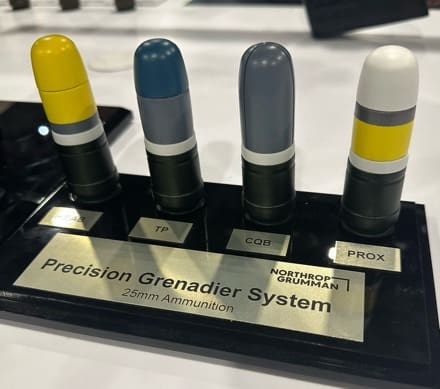
So far, they’ve developed rounds for air-bursting, proximity, close quarter battle as well as target practice and they produce them themselves.

I find the airburst round to be the most impressive. It is a programmable, dual-warhead high-explosive fragmenting round that can be fired in both airburst and point detonate. By dual-warhead they mean that there are explosive charges at both the front and rear of the warhead.

To arm the round, the target is lased (in this case with the XM157) using the middle button. The Grenadier can use the plus and minus buttons above and below the lase button to add or subtract a meter per detent to where the warhead will detonate. This, combined with the dual-warhead would allow for a round to detonate above an open trench or fighting position, or within a room of fired through a window, door, or breach.

The High Explosive Proximity incorporates a proximity sensor to identify and explosively fragment the projectile in-flight to defeat stationary or moving UAS. This round does not require programming.

The CQB round uses buckshot for trench clearing a close-in CUAS.

The training practice round is a marker similar to the 40mm ammunition used in the M320 and is ballistically matched to the 25mm HEAB and 25mm PROX rounds.

Is my understanding that the army is considering replacing the M3 20 grenade launchers in the squad with PGS and that PGS will be the Grenadier’s primary weapon.

Because they selected 25mm, Northrup Grumman offers three round as well as five round removable, box magazines.

Lastly, I’d like to mention that the weapon weighs in at 12.9 lbs loaded with 5 rounds and 11.4 lbs empty and is ambidextrous in controls and ejection. There are ejection ports on either side and the weapon can configured to use either one. For charging, the black lever at the top is spring loaded and nonreciprocating. The shooter pulls it to either side and it snaps back onto the carry position once it is released.