SIG SAUER - Never Settle

Archive for the ‘weapons’ Category

US Army Files Trademark Application for M8 Carbine

Tuesday, March 17th, 2026

In late January the US Army filed a trademark application with the US Patent and Trademark Office for the term “M8” for all categories of firearms. As SSD revealed yesterday, the US Army issued an experimental type classification of XM8 to the Carbine version of the M7 Rifle.

The XM8 Carbine has been making the rounds. Above you can see a member of the Army Marksmanship Unit coaching a VIP on the range. In case you were wondering, this one is outfitted with the Vortex “Eleanor” AMG 1-10x optic and the B.E. Meyers’ MAWL-X1 aiming laser. In the background you can see an M7 equipped with the XM157 Next Generation Squad Weapons – Fire Control.

US Army Designates Carbine Version of M7 NGSW Rifle as XM8

Monday, March 16th, 2026

Last month, the US Army designated the XM8 and issued a national stock number: NSN 1005-01-737-3402. Featuring an 10″ barrel, the XM8 (bottom carbine) weighs 7.3 lbs versus the 8.3 lbs of the M7 carbine with 13.5″ barrel (top rifle). These weights are weapon only and do not include suppressor and optic.

Developed by SIG SAUER as part of the Product Improvement Effort, it is a carbine version of the M7 Rifle. Along with the M250 Automatic Rifle, these weapons are being issued to the US Army’s close combat forces (think infantry, etc) as part of the Next Generation Squad Weapon program. They are chambered to fire 6.8 x 51mm composite case ammunition.

Although the main changes to the XM8 carbine are the shorter, tapered barrel, it also eliminates the side folding buttstock for a fixed, telescoping stock like the M4, and features a few changes in the upper receiver group to eliminate weight.

Many had anticipated the PIE variant to be designated as the M7A1 but this move falls more in line with the M16 and M4 as distinct weapons. Perhaps we will see an M7A1 yet.

Considering the Carbine has been given an M designation it looks like there’s a good chance that it will be adopted for issue to at least some of the force.

iRocket Completes Successful iRX-100 Missile Test with Arnold Defense Launcher

Thursday, March 12th, 2026

Successful integration test of iRX-100 missile with Arnold Defense launcher 

Missile reached Mach 2 and ~6 km range during flight demonstration 

Programme targets scalable counter-UAS capability compatible with existing launch platforms 

(HAPPUAGE, NY, March 10, 2026) — iRocket announced today the successful completion of the iRX-100 test using a launcher provided by Arnold Defense. The demonstration validated launcher integration and system performance, marking a significant milestone: the missile successfully reached Mach 2, traveled approximately 6 km, and is now fully qualified for use with Arnold Defense’s launcher system. 

The test supports iRocket’s efforts to deliver a scalable, production-ready capability for urgent defense needs. By focusing on repeatability, traceability, and high throughput, the company is industrializing missile and propulsion manufacturing capacity in the United States to meet rapidly evolving requirements. 

“Today’s successful iRX-100 demonstration with Arnold Defense’s launcher proves we can deliver a modern, scalable counter-UAS effect with speed and repeatability,” said Asad Malik, CEO of iRocket. “We’re rebuilding the arsenal of freedom by combining high-rate manufacturing, robotics-driven quality, and a partner ecosystem that can surge production when the mission demands it.” 

The partnership highlights a shift toward pairing combat-proven systems with 21st-century manufacturing techniques. This approach ensures that defense solutions are not only effective in the field but can also be mass-produced to meet large-scale demand. 

Former Secretary of Commerce Hon. Wilbur Ross plays a pivotal role in iRocket’s strategic growth as a member of its Board of Directors and is taking the company public in 2026. Ross has been instrumental in securing international partnerships, such as the $640 million agreement with Saudi Arabia’s Spacebelt, and facilitating other introductions with government customers for iRocket. Highlighting the company’s critical role in modern warfare, Ross noted, “Every day, we and our allies are using up their inventories of small missiles to intercept drones at one-tenth the cost of Patriot missiles. iRocket’s recent launch successes prove its qualifications to meet the demand.” 

By leveraging robotics-enabled consistency and a quality-first discipline, iRocket is positioning itself as a leader in high-rate defense production, ensuring the U.S. and its allies maintain a decisive advantage through industrial readiness. 

iRocket has also secured a position on the Missile Defense Agency’s (MDA) Scalable Homeland Innovative Enterprise Layered Defense (SHIELD) indefinite-delivery/indefinite-quantity (IDIQ) contract vehicle. The 10-year program, valued at up to $151 billion, enables the rapid procurement of advanced technologies, engineering capabilities, and research supporting U.S. homeland missile defense, including interceptor and missile systems. 

“Advancing extended-range capability for the 70mm system is about delivering greater reach and effectiveness to the warfighter,” said Chris Mignano, VP of Business Development and Manufacturing at iRocket. “By working closely with our partners and focusing on compatibility with launchers already used by the services, we’ve been able to move quickly and accelerate meaningful capability to the field. This kind of collaboration across the defense industrial base is what will ultimately make the difference for the future of our nation’s security.” 

“As the preeminent 2.75in. rocket launcher manufacturer in the world, we are excited to be working with iRocket as they bring needed improved capability to the 2.75in./70mm rocket,” said Frank Ferrante, Vice President of Programs and Business Development at Arnold Defense and Electronics. “The speed at which they moved to get to this round of testing has been impressive to watch first hand and participate in, and we look forward to continued collaboration efforts between our companies.” 

For more about iRocket, visit www.irocketusa.com

Army Approves M111, First New Lethal Hand Grenade Since 1968

Wednesday, March 11th, 2026

PICATINNY ARSENAL, N.J. — The U.S. Army has cleared the M111 Offensive Hand Grenade for full material release. Developed by the Capabilities Program Executive Ammunition and Energetics, CPE A&E, in conjunction with the U.S. Army Combat Capabilities Development Command Armaments Center at Picatinny Arsenal, the M111 OHG will replace the obsolete body and fuze of the Mk3A2 hand grenade series, marking the first new lethal hand grenade to achieve full material release since 1968 when the Mk3A2 entered service. The Mk3A2 is restricted for use due to its asbestos body, unlike the M111 which utilizes a plastic body that is fully consumed during detonation.

The M111 will provide increased training and operational readiness while providing the Soldier with a safer option. It also offers Soldiers the ability to fight more effectively in closed quarter urban environments by leveraging blast overpressure, BOP, instead of fragmentation to deliver lethality. When used in grenades, BOP delivers devastating effects to enemy personnel and equipment without fragmentation and is a potent tactical advantage in the field. The M67 fragmentation hand grenade projects lethal and incapacitating fragments that can be deflected when employed in enclosed, restricted terrain like buildings, rooms and structures, whereas the M111 OHG projects high BOP effects that are less affected by obstacles in enclosed and restricted terrain.

“One of the key lessons learned from the door-to-door urban fighting in Iraq was the M67 grenade wasn’t always the right tool for the job. The risk of fratricide on the other side of the wall was too high,” explained Col. Vince Morris, Project Manager Close Combat Systems, CPE A&E. “But a grenade utilizing BOP can clear a room of enemy combatants quickly leaving nowhere to hide while ensuring the safety of friendly forces.”

In open terrain, the Soldier will employ the M67 to maximize lethal fragment effects, whereas in enclosed and restricted terrain, Soldiers will employ the M111 to maximize BOP effects on the enemy.

“We’ve given our Soldiers and joint warfighters the flexibility to determine in the field which type of grenade will best suit the current situation they are facing, be it open space or confined area,” explained Tiffany Cheng, one of the DEVCOM Armaments Center engineers that developed the M111 at Picatinny Arsenal.

Another major benefit of the new M111 design is standardization. The new grenade and its training version, the M112, leverage the same five-step arming process as the M67 and its training version, the M69, allowing Soldiers to train as they fight, improving combat performance and effectiveness. In addition, the M111 and M112 use the same fuzes as the M67 and M69 respectively, thereby enabling Army acquisition professionals to save costs by leveraging economies of scale made possible by common fuze production lines when sourcing both grenades. Both grenades also have government-owned intellectual property that enables the Army to effectively compete production contracts across the industrial base, enhancing production opportunities for multiple vendors while providing best value to our customers, the Soldiers and the taxpayer.

“By standardizing the arming process and the fuzing, the Army saves taxpayer money without sacrificing lethality on the battlefield,” said Morris. “This is the kind of acquisition reform that is currently underway throughout the Army acquisition enterprise. We are taking advantage of that initiative to drive down costs while increasing combat effectiveness.”

By Michael Chambers

FN Awarded $9.9 Million Contract From U.S. Army and Navy for Machine Guns

Thursday, March 5th, 2026

(McLean, VA — March 05, 2026) FN America, LLC, is pleased to announce that it has been awarded a $9.9 million contract to supply the U.S. Army and U.S. Navy with FN® M240B machine guns, continuing the supply of FN America’s longest-standing military weapons platform.

“This contract continues FN’s legacy of providing the most effective and advanced weapon systems for the warfighter,” said Jim Williams, Vice President, Military Programs for FN America, LLC. “The U.S. Army contract for the M240 machine gun was the first military contract FN was awarded and the first to be produced from our production facility in South Carolina. We’re incredibly honored to continue supporting the U.S. military with high-quality and reliable weapon systems for our servicemen and women.”

The FN® M240B, built on the M240 platform that was adopted and has been in use by the U.S. military since the late 1970s, is the “go-to/can-do” medium machine gun for all branches of the U.S. military. It offers unmatched reliability, extended range and an exceptional service life. This weapon’s high volume of fire makes it the principal suppressive firearm for the infantry platoon and company.

Chambered in 7.62x51mm NATO, the M240B’s cold hammer-forged MIL-SPEC barrel has a hard-chromed bore for longer life, improved accuracy and maximum range of 3,725 meters. The receiver is machined steel and is equipped with a top-mounted MIL-STD-1913 optical rail. The crossbolt safety and curved trigger help enhance operator control.

“Since beginning our first production in 1981, FN has produced millions of firearms for the U.S. military at our Columbia, SC, manufacturing facility,” said Daryl Atkins, Director, Industrialized Weapons for FN America, LLC. “FN is extremely proud of the high-quality, reliable firearms we build for our military servicemen and women, and we look forward to continuing the tradition with this contract.”

Throughout its history, FN has been one of the largest suppliers of small arms to the U.S. military and continues to develop innovative, future technology. In addition to the M240 platform, the company currently holds contracts for the FN® M249, MK 46, MK 48, MK 17 and MK 20 SSR for USSOCOM and various other contracts.

More information about FN’s military contracts and military product line can be found here

X-Bow Completes Largest Privately-Funded Solid Rocket Motor Test by Non-Traditional Contractor

Wednesday, March 4th, 2026

X-Bow recently successfully completed testing of the XB-34 Ballesta SRM, one of the largest privately-funded solid rocket motors ever tested by a non-traditional defense contractor.

The 34.5-inch diameter XB-34 demonstrates X-Bow’s range from tactical 2-inch motors to strategic-class SRMs. Working Monday-to-Friday and sometimes Saturdays, they’ve tested nearly 300 motors.

This venture-backed, dual-use non-traditional, SRM is 30-50% cheaper than comparable existing options with scalable production at the company’s 220-acre facility, capable of producing thousands of motors annually.

Transition to Production: In the last 5 months X-Bow has secured three production contracts:

$191M production contract for solid rocket motors;

$8.9M production contract for igniters to strengthen their vertical integration, and supply chain;

Another $8.9M production contract for yet to be announced motor.

This achievement positions X-Bow as a key player in addressing the SRM shortage affecting various defense programs, and positions X-Bow for affordable solutions to futuristic challenges such as space-based interceptors as part of Golden Dome.

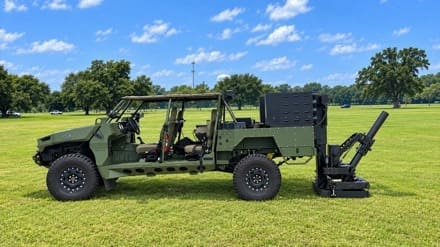
Global Military Products Receives Contract to Provide Scorpion Light Mobile Mortar System on the Polaris MRZR Alpha 6×6

Wednesday, February 25th, 2026

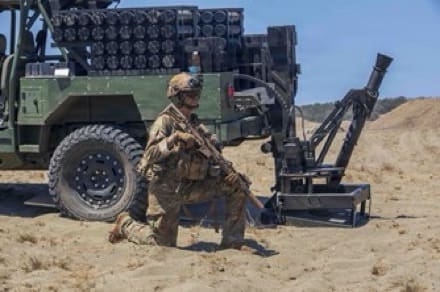
TAMPA, FL – (Feb. 24, 2026) Global Military Products, a Global Ordnance Company, received a contract to deliver its Scorpion Light mobile mortar system through the Naval Surface Technology & Innovation Consortium for the U.S. Marine Corps. Mounted on the Polaris MRZR Alpha 6×6, the fully integrated platform enhances the mobility, lethality, operator safety and air transportability of these assets.

“This contract signals a step forward in the Marine Corps’ mortar modernization,” said James Knight, director, Global Military Products. “This partnership delivers a revolutionary ‘shoot and scoot’ capability designed for expeditionary forces operating in high-threat, dispersed environments by providing critical indirect fire support to light infantry formations.”

The Scorpion Light mobile mortar system can be deployed, fire 8 rounds and relocate in less than 2 minutes, which was recently demonstrated on a range at Quantico in conjunction with the Marine Gunners Symposium. Rapid emplacement and displacement are critical for survivability on a modern battlefield, allowing mortar teams to engage targets and reposition before an adversary can return effective counter-battery fire.

The Scorpion Light mobile mortar system will also incorporate an advanced digital fire control system that enables rapid, accurate targeting and re-aiming with minimal crew intervention. Marines can use the rapid-fire control system to engage multiple targets quickly and efficiently during combat operations, elevating operational efficiency, while the expanded payload of the MRZR Alpha 6×6 variant allows for 48 mortars to also be transported.

The pre-production MRZR Alpha 6×6 is manufactured by Polaris. This TRL-8 prototype vehicle is a two-seat platform with a 65 percent larger cargo bed optimized for heavier systems and payloads, like the Scorpion Light. The vehicle has 3,600 lbs (about 1632.93 kg) of payload available, with 3,000 lbs (about 1360.78 kg) of that available in the extended cargo bed. The third axle and short wheelbase also have a positive impact on mobility, enhancing performance in soft soil, mud and bogs. The MRZR Alpha 6×6 maintains top speed and has more than 90 percent parts commonality with the base MRZR Alpha that are currently being fielded with the U.S. Marine Corps and U.S. Special Forces.

With its ability to be internally transported by a V-22 Osprey helicopter, the integrated Scorpion Light and MRZR Alpha 6×6 platform provide rapid deployment in remote and austere environments.

The firm-fixed price contract has a ceiling of $4.9M. Once delivered, the systems will undergo Marine Corps live-fire testing and evaluation.

Breakthrough for Seasnake: Sweden Becomes First NATO Customer

Friday, February 20th, 2026

The newest NATO member, Sweden, has commissioned Rheinmetall to supply eight Seasnake 30 weapon systems for the Swedish Navy. These systems will be the primary armament of the new Combat Boat 90 fast military assault craft. The first order under the framework agreement is worth around €63 million and was placed in February 2026. Delivery of the first system is scheduled for February 2028.


The framework agreement also includes airburst and 30 mm calibre training ammunition, with a term of four years. Spare parts and services are also included in the agreement. Additionally, the contract includes an option for up to 29 extra Seasnake weapon systems.

The Seasnake 30 is a state-of-the-art remote-controlled naval light gun designed for close-range defence. Alongside the weapon itself, the system incorporates modern daylight cameras, infrared sensors, and a laser rangefinder. It features automatic target detection and the ability to track multiple targets simul¬taneously. The revolver cannon’s nominal maximum rate of fire is 1,100 rounds per minute.

Thanks to its integrated airburst capability, the Seasnake 30 is particularly effective against air targets, such as drones. Its low silhouette and compact stealth design also make it difficult for enemy sensors to detect.

This order from Sweden marks an important market success for Rheinmetall, as it positions the Seasnake 30 with a NATO customer for the first time. This decision highlights confidence in the performance and future viability of Rheinmetall’s modern naval weapon systems. At the same time, the order reinforces the Group’s standing as a dependable provider of maritime defence solutions within the alliance.