TYR Tactical

The Royal Dutch Marines: A Way of Life

April 7th, 2022

GRAFENWOEHR TRAINING AREA, Germany – It is a commitment not to be taken lightly. The choice to become a Royal Dutch Marine is more than committing oneself to a new job – it’s committing to a new way of life.

“It was a lot harder than I thought it was going to be,” admitted Marine 2nd class Collins. Collins, born to a Dutch mother and an American father, followed in the footsteps of his father who served in the United States Army. “I was looking for the biggest challenge I could find, and I was looking for an exciting job, and I found both.”

Collins said that waking up early, not always getting enough food or sleep, combined with the rigors of physical training, initially made adjustment to military life a challenge.

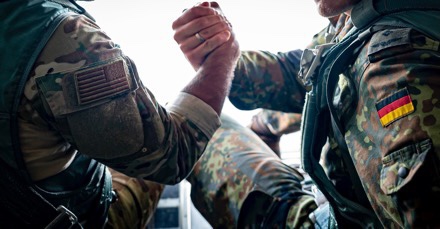
“The Dutch Marines are known for their arduous training programs, which are primarily focused around hardship,” said 1LTC van Haaren. Enlisted Marines must complete two phases to become a Royal Dutch Marine. Part of the second phase takes place at Grafenwoehr, Germany, because according to van Haaren, the Netherlands lacks live-fire ranges. This phase is initial tactical training, and consists of 15 weeks of rigorous training, which is demanding both physically and mentally.

At the completion first phase, only half of the enlisted hopefuls will pass.

The speed march is an example of one of the more challenging physical and mental events for prospective Royal Dutch Marines. The Marines ran carrying rucksacks weighing approximately 40 pounds, in addition to weapons (the Colt C7 and switching off the general-purpose machine gun FM MAG 7.62). The speed march was five miles long and completed in under just 50 minutes.

The reason for the demanding nature of training is simple – to fashion the Marines into their most strong and capable selves, and to ensure only the most resolute of them make it to the Royal Dutch Marine Corps.

“Once you’re in, it’s usually for life,” said van Haaren, who himself plans to make a career of the Royal Dutch Marines.

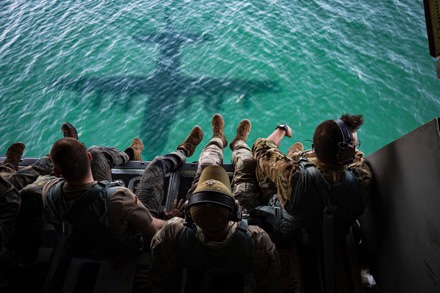
According to van Haaren, the Royal Dutch Marine Corps specializes in carrying out special maritime operations, amphibious landings, and expeditionary land operations with light infantry units. They can be deployed for long periods of time, under all climatological and geographical circumstances. As sea soldiers, they deploy from Royal Netherlands Navy ships to carry out amphibious landings. On the ground, the Royal Dutch Marines must be capable of sustaining their own survival for up to 72 hours with zero support.

For that reason, both phases of training must be intense.

On the ranges of Grafenwoehr Training Area, equipped with Colt C7s, the Marines practice fire and movement drills which consist of individual and platoon movements. The Marines also work in pairs to train on their general-purpose machine gun, the 7.62 FN MAG, with one Marine reloading and signaling to the firer when to shoot. The ability to do this requires a great deal of teamwork, discipline, and situational awareness.

The practice of live fire could be potentially unnerving for some, but for the right few, the process can be invigorating.

“I really enjoyed the shooting drills,” said Collins, with a grin. “Probably one of my favorite things to do.” Collins had never shot prior to enlisting.

After their time in Grafenwoehr, the Marines will return to the Netherlands and continue their second phase of training. It takes place at the Mariniers Opleidings Centrum at the Van Ghentkazerne in Rotterdam. During this time, the Marines execute multiple land and amphibious validation operations. Fresh challenges will await them, with more demands on their bodies and minds.


For Collins, these demands are worth it. He motivates himself by thinking of his father, who he wants to make proud, and by avowing to himself to finish what he started.

“Being a Marine, to me, means to keep going where others might quit,” said Collins. “To always help the guy to the left and right of you, and to help the less fortunate around the world.”


Once both phases of training are successfully completed, van Haaren said the Marines will receive their “dark blue beret”. From there, they will be assigned at last to the operational units of the Royal Dutch Marine Corps. Their training will be complete, but their real journey and the rest of their lives, will have just begun.

Learn more about the Grafenwoehr Training Area at: www.7atc.army.mil

By SPC Elizabeth MacPherson

DroneShield Achieves UK MOD SAPIENT Compliance

April 6th, 2022

DroneShield Limited (ASX:DRO) (“DroneShield” or the “Company”) is pleased to advise it has reached compliance with UK Ministry of Defence (UK MOD) SAPIENT format. SAPIENT is a common operating format for defence devices (with similar principles to the US Department of Defense ATAK system), originally developed by the UK’s Defence Science and Technology Laboratory (DSTL). It was since adopted as the standard counter drone communication system in the UK.

SAPIENT offers a standard approach for AI and autonomy in networked multi-sensor systems in security and defence, and is being evaluated as a potential NATO standard for counter-drone systems.

Additional information on SAPIENT is available at www.gov.uk/guidance/sapient-autonomous-sensor-system

Going forward, DroneShield’s AI-enabled counterdrone/C-UAS RfPatrol, RfOne, and DroneSentry-X products now have the capability to provide a SAPIENT compliant output.


Image: DroneSentry-X system, now with SAPIENT interoperability

Oleg Vornik, DroneShield CEO, commented, “In the current challenging geopolitical environment, DroneShield continues to substantially progress our engagement across the NATO militaries, and specifically UK, alongside Australia and the US. We have on-the-ground team members in all 3 countries, supported by a network of highly capable local partners – in the case of UK, our partner is BT with its substantial defence credentials, as well as being a household name in the UK market.”

“Compliance with the SAPIENT format was driven by end-user requests from our UK and European militaries. It ensures our networked devices are plug-and-play compatible to the common operating format of other devices and systems of those end-users. We are currently involved in meaningful acquisition tender processes with UK and European end-users, which require this compliance as part of the deployment.”

After Denmark, Lithuania Joins the Growing List of Small Arms Training Indoor Simulator (SATIS) Customers

April 6th, 2022

On March 17th, RUAG Defence France and the Lithuanian Armed Forces signed a major contract for the delivery of Small Arms Training Indoor Simulators (SATIS), following an international competitive bid process.

SATIS is a high-fidelity simulator for indoor shooting training at individual and unit levels. It is an evolution of SITTAL, which is used by the French Armed Forces in more than 50 garrisons countrywide, and by the Ivorian Armed and Law Enforcement Forces. Lithuania opted for the mobile version, allowing fast and easy deployment from garrison to garrison.

Enhanced, tetherless technology

Supporting a variety of tetherless weapons, SATIS helps individuals improve weapon handling, accuracy, and shooting procedures. Instructors can monitor and analyze all relevant data, including firing position, aiming, cant, cast and pitch, shots, and trigger pressure. SATIS features an automatic after-action review (AAR) to improve the assessment of all shooting parameters and results.

Customizable combat scenarios

The Lithuanian Armed Forces will also be able to use SATIS to strengthen decision-making and coordination competencies by running exercises with groups of up to ten soldiers.

SATIS supports AI (artificial intelligence) managed combat scenarios customizable by the instructor and taking place in a great variety of terrain ((urban, countryside, semi-desert, …).

Strong market position

With this new contract, RUAG Simulation & Training further reinforces its position as a benchmark in the field of combat simulators.

DARPA Completes Underminer Program

April 6th, 2022

New tactical tunneling technologies will support national security objectives

DARPA’s Underminer program has demonstrated the feasibility of rapidly constructing tactical tunnel networks that enable secure, responsive resupply in denied environments. These networks could provide infrastructure for logistics support, such as pre-positioning supplies in advance of an operation or providing ongoing resupply as troops move through a contested area. The ability to rapidly bore tactical tunnels could also be helpful in rescue missions.

Adversaries, peer competitor nations, and allies around the world are building and exploiting tunnels for tactical operations. Tunneling capabilities exist in United States’ commercial applications – mostly in the oil/gas, utility, geological, and environmental sectors – but the U.S. Department of Defense is not currently taking advantage of such technologies or equipment to support tactical tunnel creation or exploitation.

“The technologies demonstrated in the Underminer program offered unique insight into applications for tactical tunneling networks,” said Andrew Nuss, Underminer program manager in DARPA’s Tactical Technology Office. “Through Underminer, DARPA has advanced the community’s use of high-speed tactical tunnel creation, sensing, and positioning.”

Three teams collectively produced and matured technologies for rapid tunnel creation with a focus on diameter, distance, speed, and accuracy.

1 The Colorado School of Mines designed and demonstrated a continuous feed directional drilling concept that incorporated a hybrid drill bit system, an innovative drilling fluid management approach, and an intelligent drilling support system.

2 General Electric Research Center developed and demonstrated a novel robotic approach consisting of multiple artificial muscle systems.

3 Sandia National Laboratories implemented modifications to existing commercial hardware to demonstrate improvements to rate of penetration, accuracy and reduced operator demands.

“Tactical tunneling capabilities have tremendous opportunities to expand the combined arms maneuver trade space to include the vertical dimension in both natural and man-made subterranean environments,” added Dr. Nuss. “These unique capabilities have the potential to create secured logistics pathways in contested environments.”

Novel tunneling technologies and processes developed under the program have already transitioned to multiple industry and government partners. Some of those advances include an increased understanding of fluids management while drilling, localization of the drill bit without the use of beacons, and how to conduct branching operations while drilling at high rates of penetration.

Special Projects Division STS-B

April 6th, 2022

Expertly Made, Modern, Folding Chute Knife w/Integrated Bolsters

This Spring 2022, Prometheus Design Werx introduces their STS-B folding chute knife under their Special Projects Division label. This modern, precision made, framelocking chute knife is inspired by the classic Loveless Chute Knife and features integrated, titanium bolsters. The STS-B comes with the OD Green G10 scales installed but also includes an extra set of Black G10 handle scales for user swap out if so desired. Many fine details are machined throughout this purpose driven folder including fine jimping for saber and reverse grips, handle fullers, internal lanyard pin, replaceable lockbar limiter, and dive watch grade glow-in-the-dark cabochons inlaid in the dual thumbstuds. Built with a Böhler M390 blade, the STS-B is highly versatile, capable, and practical wilderness tool for a wide range of field conditions.

The STS-B is available with OD Green G10 handle scales installed and includes an extra set of Black G10 handle scales for user DIY swap.

The Design and R&D Team at PDW states:

“This is the level up STS model, which has proven to be one of our most popular folder models. It is certainly one our staff favorites. With its heritage DNA, the design is a well-balanced design of old and new; and uses state of art materials. We don’t do flashy or superfluous knife designs and our purpose driven ethos is defined by the many fine, pragmatic details found in this knife. The STS-B’s use case intent is the same as when Loveless made his Chute Knife under the direction of the legendary Harry Archer.”

The STS-B G10 Combo will be available for purchase for $369.00 on Wednesday, April 6th, 2022 at 12:00pm Pacific via their website, prometheusdesignwerx.com.

S.O.Tech x GWA ARVN Pack Redux in Tiger Stripe

April 6th, 2022

“A combination of the old tried and true with modern technology – a reflection of SOTECH.”

Respecting the calls for us to reintroduce our h-harnesses and belts, we recognized a trend to go back to the battle tested designs of the past. In doing so, we wanted to honor our beginnings by doing a reboot of an ALICE Pack predecessor – the ARVN Ranger Pack, a favorite of MACV-SOG and other SOF units.

At a base level, this is a hat tip to our early days modifying ALICE packs, but it’s much more significant than that. SOTECH started in a time when we were issued the same tired designs that barely evolved from World War Two through Korea and Vietnam and into the Cold War of the 80’s.

There was a creativity born from lessons from the field, and a handful of innovators started companies to modify and then create alternatives. In this vein, we took the day pack version of what would become the ALICE and modernized and modified the design with Tegris and improved cuts (the pack was designed for small-framed Vietnamese soldiers). The result is an EDC pack that takes you back to your days in BDUs every time you cinch that ribbed web through those metal tabler buckles.

The ARVN pack meticulously recreated, every small detail accounted for. Original steel hardware upcycled from original issued kit.

Updates from the original:

-Updated 420D Nylon vs canvas. Same nylon as the Medium and Large ALICE packs

-Snap closure front 2 pockets for easier and faster access

-Hidden HDPE insert with foam backer for extra comfort

-Updated frame, from steel to modern laser cut Tegris, designed in collab. with GWA

-Repositioned bottom shoulder strap ring to the side for extra comfort

S.O.Tech x GWA ARVN Packs in Tiger will run $200.

Packs go live on sotechtactical.com main page on 4/8 at 12pm PST.

Use following code at checkout for free shipping (domestic orders only): asseenonssd

www.sotechtactical.com

“Built to survive the world’s worst!”

Delta Three Oscar Releases New Fit-and-Forget P12 Limb Protector Range

April 6th, 2022

April 5, 2022 – Delta Three Oscar is proud to announce the release of its new P12 Knee and Elbow pads, which have been specially engineered to deliver the next generation in protection and stealth for military and law enforcement professionals. The range is unbeaten in terms of ergonomic fit, forming perfectly to the body for effortless movement, while providing vital cushioning on impact.

The defense arm of D3O, the world’s leading impact protection brand, Delta Three Oscar makes the most advanced protective gear on the planet. Its gear is tested and trusted in some of the world’s harshest environments: from state-of-the-art helmet liners to fit-and-forget knee pads, and the most dexterous protective gloves. Delta Three Oscar packs every advantage gained from multi-industry know-how into its gear so military, security and law enforcement communities can keep their minds on the mission and come back to tell the tale.

The new P12 Knee and Elbow pads offer market-leading flexibility and comfort during movement and when kneeling, an advantage gained, thanks to their unique ergonomic design and molded relief points. Enhanced ventilation is made possible through TriVent technology, and the pads provide long-term protection with durable cushioning. Low profile and lightweight, the pads claim superiority from the use of long-lasting, soft and flexible D3O materials to enhance users’ experience.

The P12 line is a standout addition to Delta Three Oscar’s existing limb protection range, comprising of P5 knee and elbow pads and P10 knee pads. Building on the success of the P10’s advanced modular outer cap system, P12 Knee and Elbow Pads can be combined with a Rubber Outer Cap to deliver the world’s most protective hard cap and soft armor solution for military and law enforcement.

The Rubber Outer Cap option is extremely thin and lightweight, making it ideal for pad reinforcement, while meeting puncture, flammability, and abrasion standards.

A Berry-Compliant option of the P12 range is available, with U.S. production managed out of Delta Three Oscar headquarters at the Virginia Tech Corporate Research Center in Blacksburg, Virginia.

Bill VanMullekom, COO at D3O, said: “We’re thrilled to evolve our limb protection offering with the introduction of this all-new, fit-for-purpose limb protection range. As modern conflicts send our troops to increasingly unpredictable environments, the warfighter must be confident that what they’re wearing equips them to perform effectively and safely every time, without failure. The P12 range exceeds this requirement, acting as true fit-and-forget armour delivering market-leading protective performance and maximum stealth.”

www.deltathreeoscar.com

U.S. Army Special Operations Command Troops Test RA-1 Ram Air Parachute Automatic Activation Device

April 6th, 2022

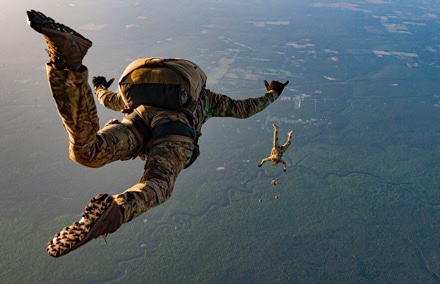
FORT BRAGG, North Carolina – Airborne equipment testers here are busy with Special Operations Soldiers testing the Army’s newest Enhanced Electronic Automatic Activation Device (EEAAD).

The Airborne and Special Operations Test Directorate (ABNSOTD) is gathering data from the operational user to support an Army-wide fielding decision to replace the aging reserve automatic activation device currently fielded to military free-fall (MFF) units.

“The EEAAD provides the capability of the rigger shop to download the data instantly, which is not provided by the currently fielded automated activation device,” said a Parachute Rigger with the U.S. Army Special Operations Command.

The ABNSOTD first completed risk reduction efforts for the EEAAD using only ABNSOTD test jumpers to ensure that the intended test item did not impose additional and unforeseen risks or hazards to the jumper before operational test jumps.

Operational testing started in the vertical wind tunnel.

“This allowed the test team to observe the approach load system under simulated free-fall conditions being employed by a MFF qualified test jumper,” said James Cochran (JC), a seasoned Military Test Plans Analyst with the ABNSOTD.

“The ABNSOTD employed a host of risk reduction measures to ensure the potential test item was safe and effective from the intended user’s standpoint,” he said.

Operational Soldiers from USASOC finished testing with the RA-1 main parachute and reserve with the EEAAD installed by conducting MFF test jumps into the Laurinburg, North Carolina drop zone.

“The EEAAD will not only provide MFF operators with a next-generation reserve parachute activation device but will also facilitate after action reviews,” said Lt. Col Derek Johnson, Chief of ABNSOTD’s test division.

“The EEAAD will also support jump incident investigations by providing the ability to download and analyze flight data at the unit level,” he added.

The operational testing consisted of new user training and military free fall jumps followed by data collection of jump data, downloaded from the EEAAD.

“The simplicity of the menus and setting provides more confidence to the jumper that the device will work as expected,” said one USASOC Operator.

By Mr. Richard Hedgecock, Military Test Plans Analyst, Airborne and Special Operations Test Directorate, U.S. Army Operational Test Command