FirstSpear TV

US Army Scientists Developing Solutions to Improve Thermal Toughness in the Arctic

May 18th, 2021

NATICK, Mass. – For the Arctic Soldier, thermal toughness is essential for operating and training in the coldest conditions. Scientists from the U.S. Army Research Institute of Environmental Medicine are developing solutions to make this ability a reality.

These innovations could not come sooner. The increasing accessibility of the Arctic has led to the U.S. Army focusing on rebuilding its ability to operate in extreme cold-weather conditions. This spring, the Army released its Arctic Strategy, which lays out how the service can better position itself to operate in the region.

The strategy includes plans about establishing an operational two-star headquarters with specially trained and equipped units. The Army also has ongoing efforts to improve the quality of life for its Soldiers, civilians and families who live and work in the Arctic-region installations.

USARIEM’s cold research team has spent decades studying the effects of cold weather on warfighter health and performance. Dr. Karl Friedl and Dr. John Castellani have been key players in the field.

Friedl, USARIEM’s senior research scientist for Army physiology, has studied the limits of human performance in extreme environments, including the cold. He has even joined Arctic training exercises to learn first-hand what Arctic warfighters need to fight and win. Castellani, a research physiologist, has led USARIEM’s efforts in studying the causes, management and treatment of major cold injuries, including trench foot, frostbite and hypothermia.

Both scientists know better than anyone that “A man in the cold is not necessarily a cold man.” Yet, to get to that level, Soldiers need a high level of preparation and training, as well as every advantage the Army can provide.

Modern Guidance for Modern Warfighters

“A very critical part of the training is to learn the early signs of cold on the body and to understand how to be comfortably cold,” Friedl said. “The Soldier has to know when they can readily recover and when they are entering a physiological danger zone of cold exposure where they must take action immediately.”

Training in the Arctic is a formidable task. In cold conditions, a single mistake may be only minutes from disaster. A lost glove, an ignored cold foot, heavy sweating during exertion, or a snowmobile accident can result in a rapidly progressing injury without hope for a quick evacuation to warmer surroundings or even shelter from the freezing temperatures.

Castellani explained that freezing and non-freezing cold injuries are treatable when they’re caught early. When left untreated for too long, they can result in lifelong nerve damage, or worse, loss of appendages.

“We certainly know what causes these injuries,” Castellani said. “The next thing we need to do is to develop solutions and guidance to prevent them in the first place. Modernizing the Army’s medical guidance on cold injury prevention, Technical Bulletin Medical 508, is one of our most significant efforts.”

TB Med 508 gives military and civilian healthcare providers medical guidance for cold-weather conditions. This medical guidance is based on decades of USARIEM’s research on health and performance in cold weather. Some of the topics in TB Med 508 include information on how the body responds to the cold, how Soldiers should prepare when deploying to the Arctic and how to mitigate and treat different cold-weather injuries.

USARIEM published the most recent copy of TB Med 508 in 2005. Castellani’s team is now leading an effort to update this guidance in partnership with the Office of the Surgeon General, specially trained Army Arctic installations, and several military hospitals and training centers.

“This is going to be a significant update to the Army’s medical guidance on cold weather,” Castellani said. “We are particularly focused on the treatment sections. We are also adding new guidance derived from significant data findings on performance in cold, wet environments, like swamps and bogs.”

Friedl added that USARIEM also develops predictive models that will help the AI-enabled warfighter plan missions and mitigate injuries in cold or wet environments. These include solutions like the Cold Weather Ensemble Decision Aid, or CoWEDA, which prevents hypothermia and frostbite by predicting how long warfighters can endure the cold based upon their clothing, activity and environmental conditions. The CoWEDA was recently used by Soldiers in the 2021 Arctic Warrior Training Exercise.

Another mission planning tool is the Probability of Survival Decision Aid, or PSDA, a computer program that predicts an individual’s survival time during water immersion by taking to account hypothermia and dehydration. The PSDA has been transitioned to the U.S. Coast Guard since 2010 and is implemented as a mandatory element to their Search and Rescue Operations. It has also been transitioned internationally to collaborative partners.

A Hands-On Approach

Improving cold-weather guidance is only part of the solution. According to Castellani, even the best equipment and guidance do not benefit Soldiers if they cannot use their hands and fingers in the field.

“The loss of hand dexterity can occur because the body’s natural reaction to more frigid temperatures is to decrease blood flow to the hands and feet,” Castellani said. “The body sends that blood to protect and warm the core, where major organs are located. The problem is that warfighters need hand dexterity for many military-relevant tasks, including shooting, handling equipment and treating injured Soldiers.”

Castellani is leading several USARIEM efforts in developing physiological and technological solutions to improve hand blood flow. These solutions could lead to Soldiers having warmer hands and fingers and improved dexterity in cold conditions. These innovations could especially come in handy as the Army veers toward using gear that requires more dexterity and hand function.

One of these solutions includes USARIEM’s forearm heating device, called the Personal Heating Dexterity Device, or PHD2. Castellani’s team has developed a prototype of the PHD2 for field testing using two parallel efforts, both in-house and through the Small Business Innovation Research program. His team is preparing to test the product in the field next winter with Alaska National Guard troops during Arctic Eagle 2022.

“Our previous research has shown that warming the forearm increases hand and finger temperatures significantly,” Castellani said. “The result is that Soldiers can have improved hand dexterity.”

His team is also conducting a Defense Health Program-funded effort this year to examine the effect of a cocoa-based flavanol supplement in cold conditions. Studies have shown that flavanol, a nutrient often found in cocoa beans and tea leaves, can help improve blood flow. The researchers are now testing if taking this supplement could increase blood flow to the hands and fingers, improving hand dexterity in the cold.

The researchers will be testing other methods of hand-warming in future studies, including one on occlusion training and another on cold-weather habituation. Occlusion training is typically used in bodybuilding. It involves intermittently restricting blood flow in the arm and allowing it to flow again every five minutes. According to Castellani, recent studies have shown that this method may increase normal blood flow. His team will be investigating whether this method can be used to improve hand function in the cold. The research study is being proposed for the fiscal year 2022.

He added that USARIEM’s cold habituation study will be learning how people’s bodies get used to the cold over time. It is unknown how this change occurs in our bodies.

“We’re trying to understand what changes happen in your skin and underlying tissue that help you adapt to a cold environment after you have been exposed to it for a while,” Castellani said. “This will help us develop novel countermeasures that will improve thermal toughness.”

Approximately 11,600 Soldiers serve at Fort Wainwright and Joint Base Elmendorf-Richardson under the command of U.S. Army Alaska. While there are no current plans to station more Soldiers in Alaska, a decision on that could occur within a year.

As an increasing number of Soldiers pour into the Arctic, it’s important that Army scientists ensure that Soldiers will have the biomedical solutions needed to fight and win in the frigid temperatures. According to Friedl, USARIEM is up for the task.

“It has been said that Soldiers who successfully perform in the Arctic can function in any other environment in the world,” Friedl said. “USARIEM has been the U.S. Department of Defense leader in cold physiology research for over 50 years. This research improves our understanding of what Soldiers need to be resilient in these environmental extremes.”

By Mallory Roussel

Nunatak – Liten 35

May 17th, 2021

The Liten 35 from Nunatak is a lightweight pack offering 35 liters of total carrying space with a 27L main compartment. There are also external mesh pockets as well as long rear pockets and a roll top opening integrated with side compression system. The hip belt is optional.

Materials are 210D Gridstop main pack body, waterproof Xpac VX21 bottom area, and 330D classically Cordura for the back panel and straps.

Offered in Black with 16″, 17″ or 18″ Frame length. At the bottom, you can carry quite a few different items such as a sleep system, shelter, or foam pad.

These are made by allmansright which is a Bronx-based apartment sized ultralight gear lab founded by Livio and Jen.

There are a limited number available and they generally has a long waiting period for production.

Get yours at nunatakusa.com/ultralight-backpacks/237-liten-35.

Safran Optics 1 is Exhibiting During vSOFIC

May 17th, 2021

Be sure to visit Safran Optics 1 during this week’s vSOFIC. Their booth is located here.

RVCA All The Way Poncho

May 17th, 2021

Admittedly, the Woodland camouflage caught my eye, but it made me consider that as organizations integrate females into their formations the need for additional modesty while changing clothing becomes more prudent.

The All The Way Poncho from RVCA offers just that. Essentially, it’s a large, poncho-shaped cotton towel that can be donned over your marops gear and there’s enough room to swap clothing underneath.

www.rvca.com/all-the-way-poncho

SOFWERX – At the Edge Integration Virtual Tech Sprint

May 17th, 2021

SOFWERX, in concert with the USSOCOM Science and Technology (S&T) Office, will host a Virtual Tech Sprint to identify technology solutions that will provide advanced computing to support localized SOF teams in degraded, disconnected, and contested or anti?access/area denial (A2/AD) communications environments, 05 July – 07 October 2021.

Data collection, management, storage, and dissemination have become complex and will continue to increase in complexity. In addition, body-worn Internet of Things (IoT) to Battlefield of Things (BoT) sensing has not been effectively integrated into an open architecture, system-of-systems design for next-generation computing at the edge.  

Special Operations Forces (SOF) require real-time situational awareness and connectivity in the highly-contested future operating environment. SOF require portable, interconnected sensors that enable data fusion, networking, and processing at the edge. Such edge computing solutions will deliver increased Warfighter safety and mission effectiveness by providing real-time information that is not dependent on distant command resources. Edge computing hardware solutions must be able to process and analyze data from multiple sources to deliver a holistic picture of the operating environment. Edge computing hardware solutions miniaturized to a minimal form factor (i.e., individual chips) that will allow for body?worn hardware components supporting either individual or multiple functions in a lower?power consumption manner than most traditional commercially sourced edge compute offerings. Edge computing hardware solutions must facilitate numerous varieties of evolving analytical software and toolset processing needs. These requirements will need to deliver an edge compute solution that delivers a holistic picture of the operating environment for the SOF Operator. The following attributes are preferred:

1 Provide low-power-consumption computing relative to existing, Commercial?Off?The?Shelf (COTS) CPU/GPU hardware

2 Support software applications that provide advanced data analytics and visualization tools

3 Provide the ability to compute and derive insights at multiple points within a tactical network before reach?back to an enterprise?level network connection

4 Support networking of multiple body?worn computing chips that are capable of fusing numerous data types

5 Provide the ability to host Artificial Intelligence/Machine Learning software that conducts face?to?face engagement with non?English speaking individuals with a wearable system that automatically changes the words spoken into the desired language and transversely converts the foreign language back to English.

6 Novel, new smart sensors for collection and filtering

7 Low signature management should be considered. This includes visual, electro-magnetic, infrared, etc

8 If proposed solution utilizes communication between various points, then Low Probability of Intercept/Low Probability of Detection methods should be incorporated

9 Ability to be used in Air, Maritime, and Ground Environments

The desired end state is to create an integrated, body-worn, sense, and compute system of systems that aggregate useful data, provide analytics, and visualization to Operators at the edge.

Submit NLT 09 June 11:59 PM ET.

Visit events.sofwerx.org/edgecompute for full details.

Troy Industries Moving to Tennessee

May 17th, 2021

Troy Industries was founded in Massachusetts by Air Force Veteran and Massachusetts State Trooper Steve Troy. There’s no doubt that Massachusetts? is Troy’s home so it came as quite a surprise to find out that Troy Industries had recently announced that they are moving their operation to Clarksville, Tennessee beginning in June. Of course, Steve Troy is also a pragmatist.

“While TROY has enjoyed a very successful period of growth in Massachusetts, the changing climate for firearms manufacturers in the state determined the need for our relocation to Tennessee to ensure the continued success of the company. We are excited to begin this new venture and appreciate all the support we have already received from Representative Mark Green, Governor Bill Lee and the state of Tennessee in making this relocation possible.”

Steve Troy,
President and CEO,
Troy Industries, Inc.

They plan to employ 75 employees and Tennessee is glad to have them.

“I appreciate TROY for choosing to relocate to Tennessee and am proud to partner with this world-renowned firearms manufacturer. When companies pick Tennessee to locate or expand their operations, it is a vote of confidence to our state’s business-friendly climate and skilled workforce. I thank TROY for this investment and the creation of new jobs for Tennesseans.”

Bill Lee
Tennessee Governor

Adventure Tactical Pathfinder Kit

May 17th, 2021

The new Adventure Tactical Pathfinder Kit contains everything you need to set up a HLZ/DZ. It’s the smallest and lightest DZSO kit on the market.

To carry the system, they selected Raptor Tactical’s new MARVN Pack which is a modernized version of the Vietnam war-era ARVN pack. More details on this pack soon.

Supporting the Future Fight: MCSC Modernizing Infantry Capabilities

May 17th, 2021

MARINE CORPS BASE QUANTICO, Va. —

The Marine Corps has been investing time, money and resources into modernizing the force to meet objectives outlined in the Commandant’s Planning Guidance, Force Design 2030 and the National Defense Strategy.

Brig. Gen. A.J. Pasagian, commander of Marine Corps Systems Command, has stated that no investment is more important than those in support of the infantry Marine.

“The Marine Corps in 2030 does not exist without the individual Marine, what they’re wearing and what they’re carrying,” said Pasagian. “Enhancing our infantry Marines by providing them with the best capabilities available remains an integral, ongoing priority for the Marine Corps.”

MCSC has placed great emphasis on meeting the demands of the future force to ensure Marines are never in a fair fight, said Pasagian. To achieve this objective, the command has concentrated on increasing infantry communication, lethality and survivability.

Increased close combat lethality

Over the last few years, MCSC developed and fielded several new, modernized capabilities to Marines, including the M27 Infantry Automatic Rifle, Squad Common Optic, Squad Binocular Night Vision Goggles and M320A1 grenade launcher.

The M27 Infantry Automatic Rifle, originally fielded in 2011, is lighter and reaches farther distances than its predecessor, the M249 squad automatic weapon, said CWO4 David Tomlinson, MCSC’s infantry weapons officer.

“The M27 is fully automatic and increases their accuracy compared with previous weapons systems,” said Tomlinson. “The increased accuracy leads to increased lethality.”

Over time, the popularity of the weapon blossomed among Marines. They raved about its ease of use and overall effectiveness. This led to the Corps expanding its fielding to all rifle platoons as their primary individual weapon.

Earlier this year, Marines began receiving the Squad Common Optic, an innovative new rifle sight that better enables shooters to identify and engage the enemy from farther distances in variable light conditions. It can be attached to the M4 and M4A1 Carbine as well as the M27 Infantry Automatic Rifle.

“The Squad Common Optic is a variable-power optic that allows Marines to engage to threats at the maximum effective range of their weapons system, improving target acquisition and probability-of-hit with infantry assault rifles,” said Tomlinson.

In 2020, MCSC also fielded the Squad Binocular Night Vision Goggle—a lightweight, helmet-mounted night vision system that provides increased depth perception, improved clarity and a thermal-imaging capability to detect targets in extreme darkness or through battlefield obscurants.

The SBNVG enables Marines to operate vehicles at night, move through dark buildings or tunnels, and engage targets after sunset. By using this system, Marines can be as lethal at night as they are in the daytime, said Tomlinson.

The Marine Corps also began fielding a new grenade launcher last year. The M320A1 is a single-fire system that Marines can either mount onto another rifle or use as a stand-alone weapon.

“The M320A1 provides an improved capability to engage the enemy day and night, while retaining the capability of short range, reflexive fire of the primary weapon,” said Capt. Nick Berger, MCSC’s project officer for the M320A1. “In addition, the M320A1 increases the small unit flexibility in employing lethal, nonlethal and special-purpose munitions by allowing them to tailor the weapon configuration to the mission.”

Lightening the load

Infantry units need more than just weapons to get the job done. The Marine Corps leans heavily upon MCSC’s Program Manager for Infantry Combat Equipment to research, develop and field lightweight protective gear designed to increase survivability.

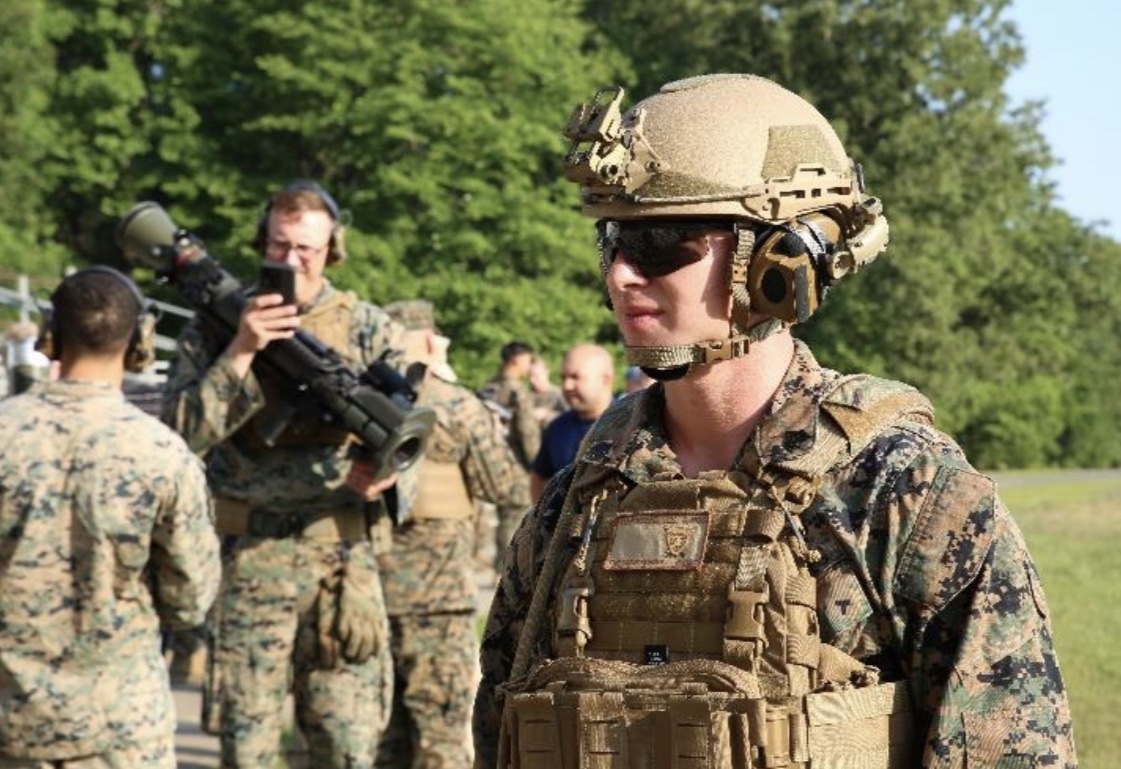
In 2020, MCSC began updating its enhanced combat helmet to improve fit and comfort. The improved, high-cut helmet includes a retention system that tightens around the circumference of the head and adjusts easier. Female Marines, in particular, have noted how the high-cut ECH fits their hair buns better than the legacy ECH.

Another notable fielding in 2020 was the Plate Carrier Generation III, a next-generation protective vest that provides improved fit, form and function for Marines. The PC Gen. III guards against bullets and fragmentation when coupled with protective plates.

The PC Gen. III uses less material than the Plate Carrier that fielded in 2011. Lt. Col. Andrew Konicki, the program manager for Infantry Combat Equipment, explained that the improved designed of the PC Gen. III reduces the overall weight and bulkiness of the vest, increasing maneuverability.

“Lightening the load is important because it allows Marines to be more agile when moving from covered position to covered position,” said Konicki. “Improved mobility increases survivability while preserving endurance, which enhances a Marine’s lethality.”

In 2021, MCSC began fielding the Marine Corps Intense Cold Weather Boot—a full-grain, leather boot designed for use in temperatures as cold as -20 degrees Fahrenheit. The ICWB is lighter and less bulky than the Extreme Cold Weather Boot, employed in -65 to -20 degrees Fahrenheit.

The ICWB allows Marines to complete various missions that might involve hiking or skiing in arduous, cold weather environments without having to change boots, said Konicki.

“This boot lightens the load for Marines because they’ll need only one boot for cold weather operations instead of having to carry two sets of boots and change based on the weather conditions,” said Konicki.

On the ammunition front, MCSC awarded a contract in 2020 to test and evaluate new, lightweight .50-caliber polymer ammo, with an intent to further lighten the warfighter’s load. The ammo, to be used in the M2 Machine Gun, is significantly lighter and easier to haul than the traditional brass casings.

Polymer is a class of plastic-like material that weighs less than brass and other metals commonly used in weapon systems. As the Marine Corps evaluates .50-caliber polymer ammo, other services are also evaluating other types of ammo.

The Army, for instance, is validating a 7.62mm polymer round, which could also potentially make its way to Marines in the future.

CWO3 Chad Cason, a project officer with MCSC’s Program Manager for Ammunition, said polymer ammo enables Marines to carry more with less fatigue, enhancing combat readiness. He also noted how the ammunition is just as effective as the brass ammo of the past.

“This is truly an innovative program, as [PM Ammunition] continues its modernization efforts in support of increasing lethality and capability to the Fleet Marine Force,” said Cason.

MCSC will host several limited user evaluations in 2021 and 2022, allowing Marines to assess the effectiveness and performance of the ammunition. Marine feedback during these assessments will inform a future fielding decision, said Cason.

Enhanced communication

Operating in a 21st century environment also requires innovative command and control equipment to increase communication on the battlefield.

In 2019, the Marine Corps fielded a lightweight, tablet system that improves situational awareness on the battlefield. The Marine Air-Ground Task Force Common Handheld enables Marines to use commercial smart devices to plot and share points, offering an overall view of the battlespace to commanders.

Later that year, MCSC upgraded the MCH to allow Marines to communicate with one another through several additional communication systems, including the Advanced Field Artillery Tactical Data System and the Army’s Joint Battle Command-Platform.

“Communication is critical to ensure Marines and commanders in the field have access to information and data at the right levels,” said John Maurer, deputy portfolio manager for MCSC’s Command Element Systems. “It enables, facilitates and accelerates decision-making and situational awareness.”

In 2020, the Marine Corps also fielded a next-generation High Frequency Radio II, which provides Marines with long-range, beyond line-of-site radio communications. The radio system comprises Wideband HF, increasing the data rate to more quickly communicate larger amounts of information.

Maurer said the HFR II is a modern, resilient and sustainable capability that is significantly smaller and lighter than the legacy HF radio. MCSC’s Ground Radios HFR II Team, led by Leigh King, accelerated the acquisition process and achieved fielding one year earlier than originally planned.

The MCH, HFR II and several other communication systems acquired by MCSC are designed to make communication more seamless and efficient for infantry Marines, said Maurer.

“We are positioned to meet the Commandant’s Planning Guidance by providing multiple new systems to infantry Marines to enable the kill chain,” said Maurer. “The capabilities provided will support the initial operational capability of Force Design 2030 by providing assured command and control in a degraded environment, information warfare superiority and protected mobility for enhanced maneuver.”

The importance of training

The Marine Corps cannot accomplish its modernization goals alone.

Chris Woodburn, of the Capabilities Development Directorate at the Combat Development and Integration, said they will continue to solicit support from industry and other services to field innovative capabilities and posture for the future fight.

“The Marine Corps is fielding several close combat lethality enhancements to address near-term requirements while working with the Army to pursue the next generation capabilities for the future,” said Woodburn. “These enhancements facilitate our close combat forces’ ability to leverage the best capability now, while posturing for the future through continued work with partner services.”

Tomlinson believes updating infantry units relevant gear is a critical step in gaining a competitive advantage over adversaries. However, he said the acquisition of effective equipment and the employment of active training can help the Marine Corps reach its modernization goals.

“Lethality isn’t just an item,” said Tomlinson. “We can give Marines a new system, but that doesn’t necessarily make them more lethal. Lethality also involves incorporating proper, effective training.”

Tomlinson said MCSC often employs New Equipment Training events to furnish Marines with the knowledge necessary to operate new capabilities. MCSC’s Training Systems program office also ensures Marines are equipped with the technology and systems needed to use newly-fielded capabilities in a simulated environment.

The Marine Corps’ Training and Education Command also plays an important role in increasing the lethality of Marines.

TECOM leads the Marine Corps’ individual entry-level training, professional military education and continuous professional development, through unit, collective and service-level training. The group’s intent is to enhance warfighting organizations that enable Marines to build and sustain the combat readiness required to fight and win today and in the future.

“The modernization of gear and equipment needs to be seamless to the training piece,” said CWO4 Anthony Viggiani, TECOM’s infantry weapons officer. “It’s not just the gear and equipment that makes an individual more lethal, it co-aligns the training as well.”

Viggiani said training offers the preparation needed to increase battlefield lethality. Training equips Marines with the confidence and capabilities needed to employ a piece of equipment to its maximum effectiveness, he said.

“You can’t just give an individual gear and equipment and think that’s going to solve all our problems,” said Viggiani. “Training is an important steppingstone to increasing lethality on the battlefield.”

Matt Gonzales, MCSC Office of Public Affairs and Communication, Marine Corps Systems Command