Seen here are the Captain AmeriCAS logos for Special Tactics and Special Forces.

These and others are available on T-shirts in several colors from www.onstationapparel.com.



Trooper Clothing makes uniforms for kids.

Their latest offering is the Overwatch Battle Shirt and Combat Pant made from Woodland Camouflage ripstop fabric.

They also offer other colors like OD, Black and MultiCam as well as other styles including Marine Corps Combat Utility Uniforms, Navy Working Uniforms, Coast Guard Operational Dress Uniforms, and the Army Combat Uniform as well as flight suits.


A7 Defense “Gunfighter” tactical gloves. Lightweight (1.4 ounces), super high dexterity, super grip palms even when wet, comfortable, and with full touchscreen capability. They are also fully licensed by the United States Air Force, but you could probably guess that already.

Here’s a inside look at the storage features of the G4 Combat Pant:
(1) Hand pockets incorporate mesh for ventilation and the right one has a reinforced knife/light holder.
(2) Zip thigh pockets are sized for a phone, with mesh for ventilation and a secure closure.
(3) Two charge loops and one knife/light/baton holder allow long items be stowed in the cargo pocket.
(4) Cargo pockets are low profile with bellows at the back for expansion. They feature thermo-bonded flaps that tuck away cleanly, internal water/bottle/magazine stabilizers and mesh for ventilation.
cryeprecision.com/ProductDetail/aprcpw0232r_g4-combat-pant
Considering my black eye after I qualified with the G3 the first time, I think Håkan is on to something.

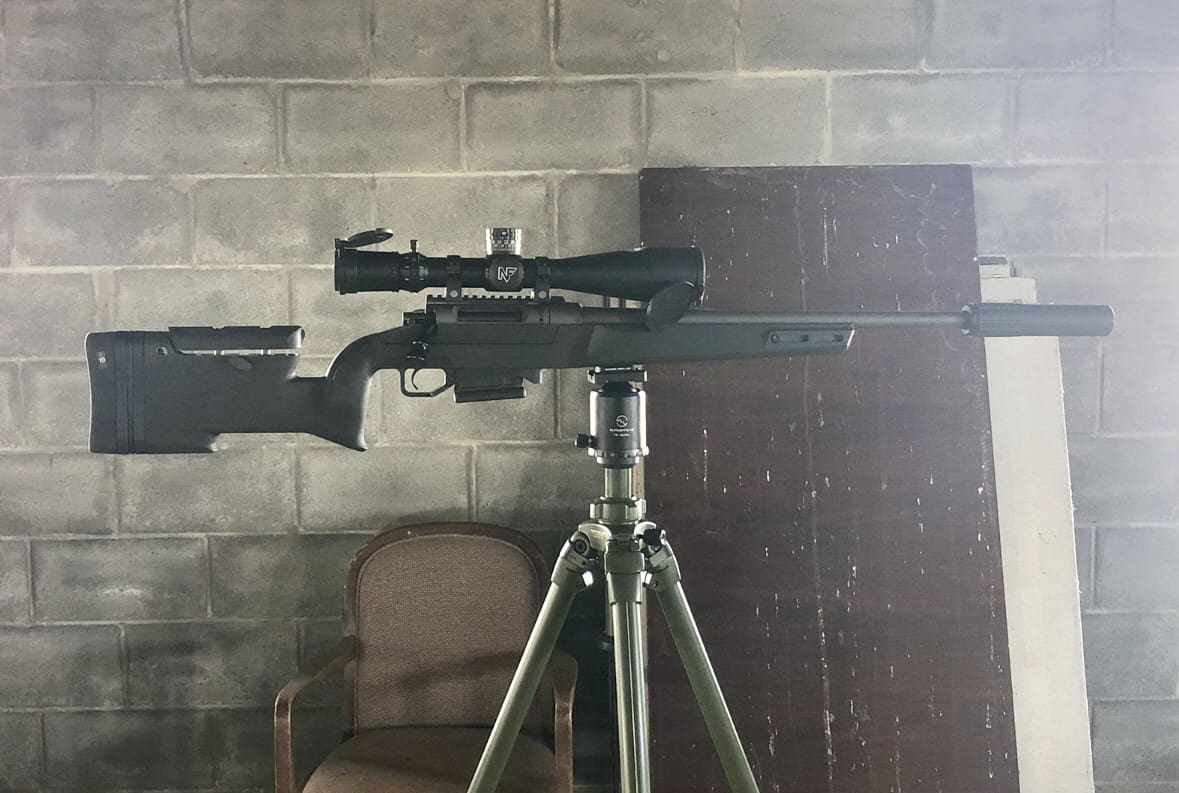
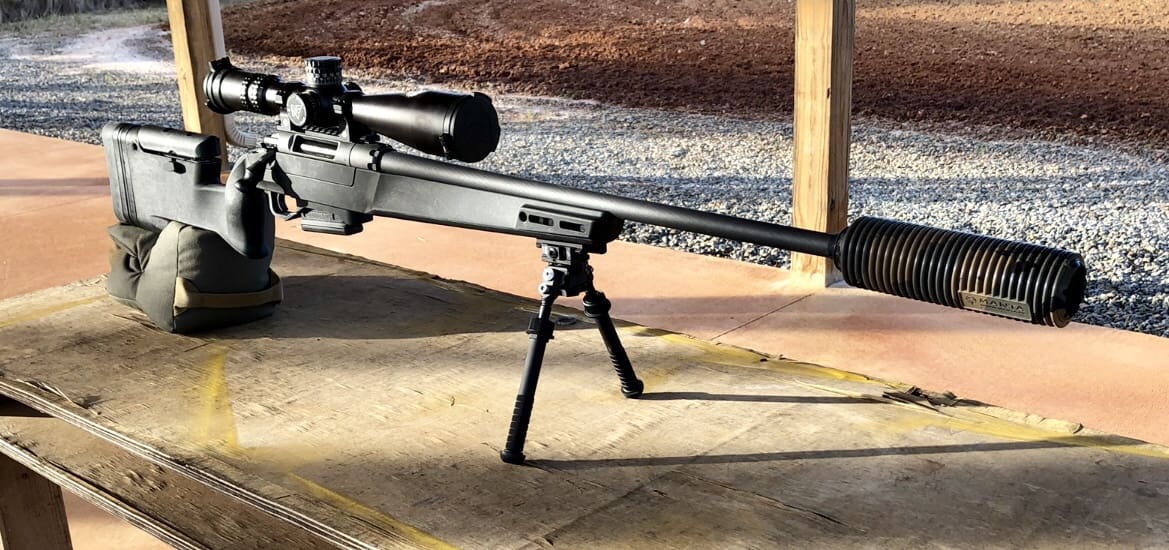
CGS Group is incorporating interchangeable front caps into Hyperion 762 and Helios 556 rifle silencers for 2019. But these aren’t just normal front caps. Due to the unique construction and signature suppression methods used in the CGS Hyperion Tech, which they claim “has actually neva bin fun befo”, by using different types of front caps the user can change the function of the silencer entirely. Use the flat cap to have the quietest rifle silencer ever produced on a bolt gun where back pressure and gas in the shooters face isn’t a concern. For a semi auto rifle host, if the user feels that the already low back pressure design of the default flat cap config isn’t enough, the user can easily install a perforated front cap which vents excess gas into the atmosphere while still being hearing safe for the shooter.
So to put it simply, function swappable front caps, and effectively two types of silencers in one simple, strong, concentric package. The vented front cap have pictured here acts as a flash hider not only for the bore, but also for the peripheral vents. There are multiple types of front caps which have different features depending on what the user is looking for in a can.

All front caps sit on a taper so they don’t come loose but will maintain concentricity. We’ve had these for quite a while but it was never shown publicly before. Patented and multiple patents pending. CGS Group promises more details to follow after SHOT Show.
ABERDEEN PROVING GROUND, Md. — For their efforts in answering an Operational Needs Statement from U.S. Army Europe and delivering first-of-a-kind electronic warfare prototypes for brigade and below, the Army Rapid Capabilities Office and Project Manager Electronic Warfare & Cyber have earned the 2018 David Packard Award for Acquisition Excellence.
The award, announced Dec. 7 by Hon. Ellen Lord, Under Secretary of Defense for Acquisition and Sustainment, is the Department of Defense’s most prestigious acquisition team award and is given annually to a few select recipients across the armed services and defense agencies. It recognizes organizations with significant contributions demonstrating exemplary innovation and best acquisition practices.
“This award is a remarkable honor and we are proud of the unique partnership that was formed between the two organizations to close a strategic capability gap against a rapidly modernizing adversary,” said Dr. Bruce Jette, Army Acquisition Executive. “Their approach, working with operational units every step of the way, enabled the Army to move much faster than traditional acquisition methods and serves as a model for other Army rapid acquisition efforts.”
In addition to the Army Rapid Capabilities Office (RCO) and Project Manager Electronic Warfare & Cyber (PM EW&C), other winners of the 2018 David Packard award were the Air Force’s Enhanced Polar System Team, the Special Operations Command’s Stand-Off Precision Guided Munitions Team, and the Missile Defense Agency’s Spacebased Kill Assessment Program Management Office.

Soldiers with CEWI Platoon, Delta Company, 54th Brigade Engineer Battalion, provide actionable signal intelligence to help the 173rd Airborne Brigade during Saber Junction 18 in Germany. Soldiers with the 173rd were among the first units to receive the new electronic warfare prototype systems provided by the Army Rapid Capabilities Office and Project Manager Electronic Warfare & Cyber in response to an Operational Needs Statement.
The Army award was based on the delivery of new equipment to the 2nd Cavalry Regiment, 173rd Airborne Brigade, and the 1st and 2nd Armored Brigades, 1st Infantry Division. The prototypes, fielded earlier this year, enable Soldiers to implement electronic protection for their own formations, detect and understand enemy activity in the electromagnetic spectrum, and disrupt adversaries through electronic attack effects.
This freedom of action is essential to ground maneuver operations, since the majority of equipment, vehicles and air support Soldiers rely on to complete their missions either emit, receive on, are connected into, or are otherwise networked back into the electromagnetic spectrum or cyber domain.
In Europe, where Russian aggression, tactics and capabilities have demonstrated the ability to use the electromagnetic spectrum to affect military operations, the impact of the prototype capabilities is significant.
“This award is a testament to the outstanding work of the men and women of both PM EW&C as well as our RCO partners,” said Maj. Gen. Kirk Vollmecke, program executive officer for Intelligence, Electronic Warfare & Sensors. “We are extremely proud to have piloted this effort as it afforded the Army an opportunity to accelerate its EW capabilities and close the capability gaps with our near peers. The implementation of agile, adaptive acquisition processes are imperative as we balance the immediate needs of our men and women in the field today along with future enduring requirements.”
The team’s acquisition approach — which adapted existing systems and incorporated emerging technologies to provide new electronic warfare effects and meet the emerging threat — represented a fundamental and innovative shift in how the Army delivers a new capability. In teaming up, the organizations created a phased prototyping, experimentation and fielding approach that incorporated Soldier feedback throughout, infused new technology as it became available, and quickly delivered incremental upgrades to reduce operational risk while also informing the program of record capabilities currently under development.
It also enabled the Army to move faster than traditional acquisition methods have allowed in the past, delivering needed capabilities into the hands of Soldiers approximately a year after they were first envisioned.
“In delivering these electronic warfare systems to Europe in less than 12 months, it demonstrated how the Army can go fast, streamline processes and meet the needs of a combatant commander,” said Col. John Eggert, acting executive director of the Army RCO. “What enabled this success was the total team effort between the RCO and PM EW&C on iterative prototyping that was informed early and often by Soldier advice.”
The systems, which include mounted, dismounted and command and control systems, are prototypes that serve as an interim solution until the Army’s enduring EW programs of record can be fielded.
Winners will receive the award at a Department of Defense ceremony held at the Pentagon in February.
By U.S. Army Public Affairs