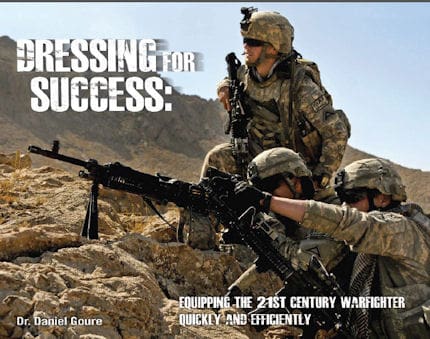
Warrior Protection and Readiness Coalition (WPRC) membership visited Capitol Hill on April 6th and representatives met with over 100 members of Congress. While on Capitol Hill, WPRC members provided an overview of their business footprint and explained why it is critical that Congress and the DoD prioritize funding for the equipment and apparel that keep American Warfighters safe and combat effective. In addition to discussing policy and speaking from their own experiences, the WPRC membership was proud to share with Congress the results of new independent research findings by the Lexington Institute on the need for sustained funding and sustainable fielding of Warfighter protective equipment. The Lexington Institute’s “Dressing for Success: Equipping the 21st Century Warfighter Quickly and Efficiently†by Dr Daniel Goure can be found here:
www.lexingtoninstitute.org
Overall, this is a good document and provides a great history of funding challenges as well as the Rapid Equipping Force and Rapid Fielding Initiative. The Lexington Institute report urges the institutionalization of both the REF and RFI. In 2005 the REF became a permanent organization. With RFI, some may argue that this has already happened as we enter year 10 of this war.
What the document does not discuss is that RFI was initiated by GEN Schoomaker while he was Chief of Staff of the Army and was based on his experience in SOF. In fact, the program was led by COL Dave Anderson who had served in SOF as well and the initial issue was very much based on equipment already issued to SOF units such as cold weather gear. RFI is the best thing to every happen to the Soldier, at least in regard to his personal equipment. The intent of the program is to constantly upgrade the individual items as newer capabilities are introduced. It is absolutely essential that RFI remain a part of the Army.
The REF on the other hand is concerned with the entire gamut of warfighting capability rather than just Soldier Systems items. A lot of goodness has come from the program as well as a few flops but this is to be expected due to the nature of the beast. The “R” in REF is for Rapid and when you do things quickly sometimes things get overlooked. This however, is no reason to throw the baby out with the bathwater. The REF’s biggest weakness is that after nine years, there is still no way for industry to identify solutions for teh myriad challenges posed to the REF. Instead, the REF relies on a team of contractors to identify candidate technologies and this approach suffers from, “we don’t know what we don’t know.” The perfect answer to a problem might exist with company X but if the contractors at the REF don’t know about company X the solution will never see the light of day. This needs to be fixed and could be with increased BAAs as well as APBIs (yes, multiple) as well as an industry requirements portal that identifies requirements. Currently, vendors can submit technologies through the REF portal but good ideas are not solutions without a problem that needs fixing.
What is very important to understand is that Afghanistan in particular is a Soldier-centric environment, much more so than any where the US military has operated since Viet Nam. The military that I cut my teeth on in the 1980s faced a peer competitor and the anticipated operational environment was system-centric with concerns over Nuclear Biological and Chemical threats on the Northern German plain. Consequently, Soldier Systems development was concerned more with development of NBC gear than boots, armor, and uniforms. For example, the Battle Dress Overgarment or MOPP Suit had pockets more suited for use in a combat environment than the so-called Battle Dress Uniform which, was truthfully a caricature of a combat uniform intended for wear in garrison. When the BDU made its combat debut in Grenada it was deemed too hot for tropical use. So naturally, the Global War on Terror caught the US military flat footed when it came to Soldier Systems items. The military’s concern was with recapitalizing the expensive fleet of armored vehicles and aircraft designed 20 to 30 years earlier. Naturally, a lot of Soldier gear needed updating. The military did a great job with a lot of kit (clothing systems, MOLLE), a so-so job on others (Armor) and got it completely wrong in a few instances (UCP). None of this would have been possible without the “all-in” approach industry has taken.
Is there an inherent goodness to consolidating and formalizing funding for the Soldier-as-a-System? Absolutely. But there is an inherent danger as well and Dr Goure’s study fails to identify this course of action. Right now, funding comes from disparate sources and often as supplemental funding. This means it does not directly compete with other budget line items within the various departments. Additionally, members of Congress can more easily support these measures as stand-alones because they can champion the Soldier. As part of a larger budget the Soldier gets lost in the weeds. Furthermore, as part of a larger whole, the Soldier now has to compete with other capabilities for their piece of the pie. When the Army desperately needs new combat vehicles it is easy to decide that what the Soldier has is “good enough”.
Then, there is the final danger to a large budget line item for the Soldier and that is that the “Primes” will notice the dollar amount and desire it. Take any of the large, independent companies left in the Soldier Systems industry and they are like fleas when compared to the size and political capital that any one of the “Primes” can bring to bear. The traditional Soldier Systems companies simply can’t compete with that. And, if the “Soldier-as-a-System” were awarded to any one of these “Primes” expect mediocrity to rule the day. Don’t agree? Take a look at any one of the programs currently run by one of these companies; vehicles, aircraft, satellites. You name it. All we see is cost overruns and schedule delays. Want new technology insertion, like maybe a new type boot? Sure thing once you let a new contract for the upgrade. In the Soldier Systems industry we have enjoyed almost ten years of continuous competitive development. This means increased capability and lower prices. No other commodity that DoD purchases benefits from an environment like that. Give the whole kit and caboodle to one company (or team) and that goes away. Why would competitors continue to develop new products if there is no hope of seeking a contract award? Americans innovate and we do it for capitalist reasons. Take away an incentive to turn a buck and you stifle innovation.
The Government does need to do a better job of working with industry to mitigate the feast and famine cycle that has plagued our industry. It can be difficult for companies to keep the lights on when there is delay after delay in releasing contracts. Due to globalization, the corporate desire for profit, and the desire on the part of the consumer to pay big box prices, the American textile base has all but disappeared. Except for a very narrow niche market, the domestic textile industry exists solely to support the Department of Defense’s Berry amendment requirements. Consequently, they are a national resource and should be looked upon by the Government as such. They must be supported and perpetuated. Some might call this a jobs program but how is employing Americans to build something we need a “jobs program”?
The Lexington report highlights some great issues and the work of the WPRC on behalf of industry should be applauded. I agree with the recommendations and conclusions of the report but caution against creating an unwieldy process that stifles innovation and competition in the industrial base. Additionally, I harbor a great deal of concern over turning the Soldier into just another program.
But don’t take my concerns to mean that I disagree with the WPRC. I am convinced that the WPRC is committed to providing our service members with the best equipment available. However, there are problems in both industry as well as how the military deals with industry that must be addressed. Keep the good and get rid of the bad. The American Warfighter has never been so well equipped. We’re on a roll. Let’s keep it going.
www.warriorprotection.net



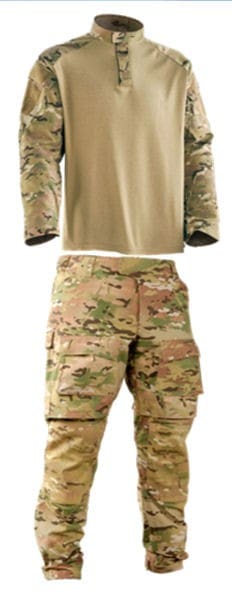 The new DRIFIRE® Combat System was designed to deliver permanent FR protection whether in the air or on the ground. Additionally, it regulates your skin temperature across all types of environmental conditions in addition to antimicrobial odor control.