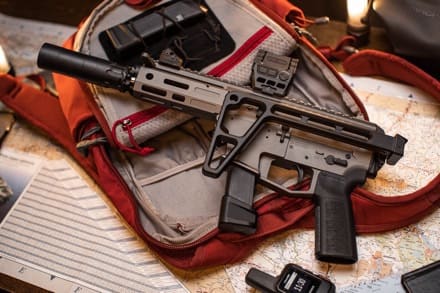
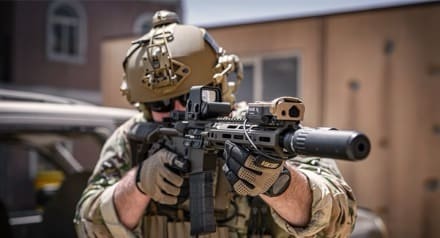
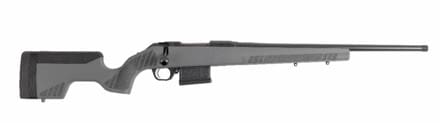
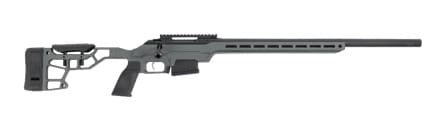
Coming January 2024 from Ridgeline Defense, an out-of-the-box sub-one minute Recce Rifle.

Email list members get first dibs.

Coming January 2024 from Ridgeline Defense, an out-of-the-box sub-one minute Recce Rifle.

Email list members get first dibs.

The Small Lightweight Acquisition Marker Designator (SLAM D) from Safran Optics1 is a handheld laser acquisition marker which can also be tripod-mounted. This high-power designator also features a high-power NIR pointer with pulse feature, see-spot observation device with laser spot tracking and PRF code counting. Designed for one handed operation, it was envisioned to safely designate a target at 5 km but in testing they have performed out past 8 km.

Capabilities:
– NIR Pointer (830nm)
– Marker (1064 NM) >35mj
– Designator (1063 NM) >50mj
– 2hz & 5hz Pulse mode for CFF
– Deciphers up to 3 PRF codes simultaneously
– SWIR See-Spot
Learn more at www.optics1.com/products/slam-d.

SCHOFIELD BARRACKS, Hawaii — The blue Pacific is now saturated with Army green as allies and partners join forces to prepare for large-scale combat operations.
As the Army adapts and evolves its network to reduce complexity and tailor capabilities at echelon, it relies on persistent experimentation, fielding and Soldier feedback to refine network operational concepts.
The 25th Infantry Division has been a critical experimentation partner in this effort, most recently during the Joint Pacific Multinational Readiness Center 24-01 exercise at Schofield Barracks employing the Integrated Tactical Network, or ITN, for its networked communications.

“Here in the Pacific, we’re faced with unique environmental considerations, from triple canopy jungles to the mountains and volcanoes,” said Maj. Justin James, division deputy communications officer (G6) for the 25th ID. “The ITN is going to help us communicate over terrain in which we couldn’t before.”

The ITN is comprised of a flexible network kit that incorporates commercial capabilities such as tactical data radios, commercial cell technologies, and tactical cross domain solutions that integrate into the Army’s network foundation. The flexibility of the ITN allows higher echelons to take on complex network planning and management, while retaining necessary network capabilities for commanders at lower echelons who are focusing on the fight.
One priority for the 25th ID during the execution of JPMRC 24-1 was to exercise and fight on the Sensitive but Unclassified – Encrypted, or SBU-E, network to the greatest extent possible. The use of the SBU-E enclave supported communications across echelons and the joint and coalition communities.

“In a future fight, the U.S. will have to fight with its partners and allies and to make that interoperability real, our network has to be as flat, fast and accurate as possible,” said Col. Rob Shaw, 3rd Infantry Brigade Combat Team, 25th Infantry Division commander. “Because it’s at an [acceptable] level of encryption I can pull in our partner nations.”
Over the past six years, nine brigade combat teams and six security force assistance brigades have successfully conducted operations using SBU-E at brigade and below to provide increased operational flexibility, interoperability, and security, while retaining secret voice and data communications where required.
During the experimentations, the 3-25 established communications up to division and down to the tactical command post using SBU-E to follow each tactical operations center movement. This provided Army network developers with data to inform network design.

Persistent Experimentation: Extending the Network
To complement the existing ground-based ITN capabilities, the Army inserted new aerial tier experiments by incorporating the ITN’s tactical radios into fixed wing drones, which significantly extended the network across intra- and inter-island terrains and onto a UH-60 Blackhawk for air to ground communications.
The Aerial Tier Network Extension featured a K-1000 drone, which completed a 26-hour flight carrying full motion video with the radio creating a single mesh network to significantly extend the mesh network.

The Aerial Integrated System, also known as ITN in the air, provided shared position location information between the pilot down to dismounted troops equipped with end user devices.
“As soon as the helicopter comes into the line of sight, the system creates a communications bubble between the pilot, who is tracking the mission on a tablet, and the ground forces, who are communicating with the pilot and each other using their end user devices,” said Maj. John Azbill, 3-25 S6. “Air to ground communications are especially critical during our night time air assault operations.”
The unit also successfully experimented with a joint-enabled radio for shore-to-ship joint call for fires, which enabled the forward observer to initiate the fires chain up to a U.S. Navy destroyer offshore to launch a notional fires mission.
“We’re in the Pacific, so joint fires missions are probably what we’re going to most rely upon to fight,” Shaw said.
The 25th ID will continue to participate in operational exercises in 2024, where it will refine its ITN capabilities and provide the Army with additional feedback on how to implement a strategic communications link across the Indo-Pacific.
Story and photos Kathryn Bailey, U.S. Army Public Affairs
Some photos by Sam Brooks
On Christmas night in 1776, George Washington led American patriots across the Delaware River to attack the Hessian mercenary garrison at Trenton, New Jersey; a force which was fighting for the British.

You’ve likely seen Washington Crossing the Delaware by Emanuel Leutze, painted in 1851, aspirational to be sure, but modern artist Mort Kunstler created a much more likely depiction of events in his 2011 painting entitled, Washington’s Crossing.

It was an audacious plan; take a force of 5400, including artillery, conduct a nighttime river crossing in a storm, and with the ultimate element of surprise, attack a sleeping enemy. 2400 made the crossing, but with 3,000 troops and the artillery so crucial to the plan stranded on the wrong side of the Delaware. Regardless, Washington pressed the attack, striking out toward his prey and at 8:00 AM met the enemy. Fortune favors the bold; the defenders were still groggy from their Weinachtsfest, with many slumbering soundly in bed.
Miraculously, only three Americans were killed, while over 1000 Hessians were captured with 22 killed and 98 wounded. Unfortunately, without his additional force, Washington was forced to withdraw. But the psychological victory fed faith in the revolution.
Consequently, George Washington crossing the Delaware in the middle of a stormy night in order to kill German mercenaries remains my second favorite Christmas story.


December 22 1944 – Encircled by German forces at the Battle of the Bulge, the 101st Airborne Division, under acting commander Brigadier General McAuliffe received a message from German General Heinrich Freiherr von Lüttwitz delivered under flag of truce.
To the U.S.A. Commander of the encircled town of Bastogne.
The fortune of war is changing. This time the U.S.A. forces in and near Bastogne have been encircled by strong German armored units. More German armored units have crossed the river Our near Ortheuville, have taken Marche and reached St. Hubert by passing through Hompre-Sibret-Tillet. Libramont is in German hands.
There is only one possibility to save the encircled U.S.A. troops from total annihilation: that is the honorable surrender of the encircled town. In order to think it over a term of two hours will be granted beginning with the presentation of this note.
If this proposal should be rejected one German Artillery Corps and six heavy A. A. Battalions are ready to annihilate the U.S.A. troops in and near Bastogne. The order for firing will be given immediately after this two hours term.
All the serious civilian losses caused by this artillery fire would not correspond with the well-known American humanity.
His response was perfect.
To the German Commander.
NUTS!
The American Commander
Believe it or not, the story gets even better. Upon hearing the reply, the German envoy was confused, not understanding the context.
An American Colonel quickly set the German straight, “If you don’t understand what ‘Nuts’ means, in plain English it is the same as ‘Go to hell.’ And I will tell you something else – if you continue to attack we will kill every goddam German that tries to break into this city.”
Washington, D.C. – This week, American Humane reunited retired military working dog John with his former K-9 handler, U.S. Air Force Staff Sergeant Mike Alcala, in San Antonio, Texas. The once-inseparable pair have been apart for over two years and will now be together for the holidays as John finds his forever home to live out his retirement.
The 10-year-old German shepherd served as an explosive-detection dog at Joint Base Pearl Harbor-Hickam in Hawaii for eight years. He retired this month due to old age, ending a distinguished military career spent protecting civilians, his fellow service members, and high-profile VIPs, including American presidents, first ladies, foreign dignitaries, and more. A special retirement ceremony was conducted in his honor in Hawaii last week to celebrate his years of dedicated service.
SSgt. Alcala was John’s handler for three years, during which time the two formed an unbreakable bond. They were separated in September 2021 when SSgt. Alcala was reassigned to another base. The moment he learned that John would retire, SSgt. Alcala reached out to American Humane for help transporting his best friend home for adoption.
“We are grateful for the opportunity to bring military working dog John home for the holidays and reunite him with his best friend,” said Dr. Robin Ganzert, president and CEO of American Humane. “American Humane is honored to help give this four-legged veteran the comfortable retirement he deserves after eight years of distinguished service to our country.”
“When I found out that John was up for retirement, of course, I wanted him so bad,” said SSgt. Mike Alcala. “I heard about American Humane through a buddy of mine, so I thought I would reach out and see what American Humane could do for me and John. They were gracious to help go pick him up in Hawaii, transport him back to me, and without me having to pay anything. It’s just been a blessing for us.”
In addition to transporting John from Hawaii to San Antonio, American Humane is also covering all of John’s veterinary care for the rest of his life.
During the emotional reunion on Wednesday, Dec. 20, SSgt. Alcala and his wife, Brittany Alcala, introduced their 10-month-old daughter to John—the newest member of the Alcala family.
MILITARY WORKING DOG REUNIFICATION BACKGROUND:
• K-9 handlers and their military working dogs form unbreakable bonds while serving our country. Unfortunately, however, they are often separated when one of them retires or is reassigned.
• When a military dog is retired from service, it can be difficult for the military to track down their latest handler for adoption, let alone figure out how to transport the dog home. The extensive process involves a lot of paperwork, headaches, and red tape, and the costs and responsibilities usually fall on the handler.
• American Humane handles the complex process of international and national transport of retired K-9 veterans on behalf of their former military handlers, who are thrilled to adopt them.
• Handlers reach out to American Humane for help reuniting with their K-9 counterparts. The organization covers the travel costs to transport the dog, as well as the dog’s ongoing veterinary care.
• Like humans, K-9 veterans often retire with health complications that require expensive medical care. The government does not cover these costs. That’s why American Humane covers all veterinary bills for the working dogs it brings home—ensuring these K-9 veterans get the comfortable, dignified retirements they deserve.
WASHINGTON — The National Security Agency’s ability to recruit and retain top talent is key to meeting the demands of the future, agency Director Army Gen. Paul M. Nakasone, said today.

Nakasone said the rapid evolution of technology continues to reshape the national security landscape and how his agency responds to new threats, but people remain central to the NSA’s mission.
“A lot of times we think about the incredible technological capabilities and the high-speed computers that are there, but, at the end of the day, what makes us the agency that we are is our talent,” he said during a discussion in Washington hosted by the Intelligence and National Security Alliance, a trade organization focused on public-private national security partnerships.
Earlier this year, the National Security Agency launched its largest hiring surge in three decades with a goal of hiring more than 3,000 new employees by the end of 2023.
Spotlight: Engineering in the DOD
Nakasone said the NSA is “moving very quickly” to meet that goal, but said numbers are only part of the overall objective.
He said the agency has also focused on improvements to its recruiting and retention practices to ensure it attracts a “future-ready workforce.”
“How do we think about a population that is over 50% today millennials and [Generation Z]?” he said. “Ten years ago, 70% of our workforce was baby boomers. Five years ago, Gen Z and millennials overtook baby boomers. Five years from now, 70% will be Gen Z and millennials.”

“This is the workforce that is coming into our agency, so this is an agency that is looking much differently in how we retain our workforce,” he said.
That approach includes a focus on adapting to work-life balance demands and easing career mobility between the government and private sector.
That workforce will be on the frontlines of significant change as the agency adapts to technologies — such as artificial intelligence and quantum computing — that Nakasone said will have a significant impact on the national security landscape.
Spotlight: Artificial Intelligence
The NSA has been forward-leaning in its approach to game these game changers.
Earlier this year, Nakasone, who also commands U.S. Cyber Command and serves as the chief of the Central Security Service, announced the creation a new entity to oversee the development and integration of artificial intelligence capabilities within U.S. national security systems.
The AI Security Center will become the focal point for developing best practices, evaluation methodology and risk frameworks with the aim of promoting the secure adoption of new AI capabilities across the national security enterprise and the defense industrial base.

The new entity will consolidate the agency’s various artificial intelligence, security-related activities.
Nakasone said on Friday that the AI Security Center has begun bringing together a series of partners to tackle the issues linking AI to national security.
Recently, he said, the group released a report on AI security infrastructure in partnership with the Cybersecurity and Infrastructure Security Agency, the United Kingdom’s Government Communications Headquarters and other organizations.
“Artificial intelligence is probably the most transformative things that we’re going to experience in our lifetime,” he said. “We have to ensure that the information, the infrastructure, [and] the ability for AI to operate within this nation [is] secure.”
“That’s where the National Security Agency comes in,” he said.
By Joseph Clark, DOD News