TYR Tactical

Stuff I Like – Black Diamond Session Approach Shoes

July 9th, 2022

I pick on my wife telling her that she wears the adult equivalent of toddler clothes around the house, but truth be told I’m doing the same thing.

Since COVID hit I’ve taken to wearing an ersatz uniform around the house and on short errands consisting of Vuori climbing pants, an Arc’teryx T-shirt and Black Diamond Session Approach Shoes*. If it’s raining, or I’m going for a hike, I stick with the Salewa Alpine Trainer Low. It’s not that I’m bouldering anymore, it’s really about comfort.

So why would I wear approach shoes? A couple of reasons. Although the soles are in fact sticky and offer sure footedness, these are really casual shoes. Plus, thanks to the stretch-fit heel they are slip-ons. That is the biggest factor.

The EVA mod-sole makes them comfy and I like the rubber toe rand. I’m now on my third pair since I started wearing them, so expect about a year’s worth of wear.

Offered in sizes 6-14 in several colors.

www.blackdiamondequipment.com/en_US/product/session-ms-shoes

*If you’re curious about my underwear it’s Saxx boxer briefs and Point6 socks. If I like something, I buy six pair.

US Army Tests Ground Robotics in Multinational Exercise

July 9th, 2022

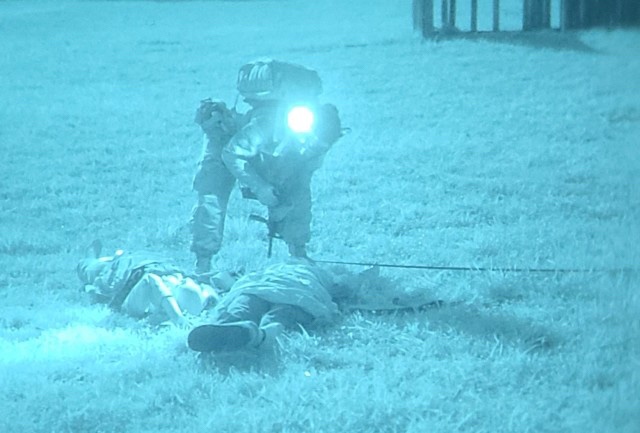
HOHENFELS, Germany — The U.S. Army’s most recent Soldier Operational Experiment, or SOE, confirmed the value position of Robotics and Autonomous Systems, also known as RAS, in a coalition environment. This is a position that provides their human counterpart with the following benefits: enhanced lethality, improved options, and a degraded threat.

Project Origin, a technology demonstrator that supports the Robotic Combat Vehicle, or RCV, development effort and other RAS programs, enabled the OPFOR at the Joint Multinational Readiness Center to expose the rotational unit to capabilities that our adversaries are developing while at the same time evaluating emerging technology in a relevant tactical environment. This SOE provided the Army with Soldier feedback and technical data required to inform the RCV’s requirements and develop use cases that will enable future formations to dominate the dynamic, lethal, and contested battlefields of 2030 and beyond.

During the SOE, U.S. Army DEVCOM Ground Vehicle Systems Center and its industry partners from General Dynamics Land Systems integrated the latest robotic technology into both OPFOR and the rotational unit’s formations. While the rotational unit consisted of a diverse number of NATO countries partnering with U.S. forces primarily from the 3d Infantry Division, the OPFOR comprised of Soldiers assigned to 1st Battalion, 4th Infantry Regiment.

The OPFOR employed Project Origin in various missions ranging from breaching obstacles to raiding Forward Arming and Refueling Points, also known as FARPs, during Operation Combined Resolve XVII. Similar to last year’s SOE at the Joint Readiness Training Center, the Project Origin team concluded that the grueling operational tempo and dynamic environments associated with combat training centers enable them to learn more in two weeks than they do during an entire year of smaller-scale experiments. In addition to integrating Project Origin into the rotation, the Ground Vehicle Systems Center — or GVSC — also fielded the Army’s Autonomous Transport Vehicle, or ATV, to evaluate the Army’s autonomous logistic resupply capability in this challenging multinational environment.

Regarding Project Origin, the OPFOR employed the platforms to support human maneuver by leveraging payloads such as the Common Remotely Operated Weapon Station Javelin, smoke generator, tethered unmanned aerial system, and electronic warfare components. Meanwhile, GVSC enabled the rotational unit with un-crewed logistic resupply missions through the use of the ATV robotic Palletized Load System vehicles. These robotic resupply vehicles reduced the number of Soldiers required to transport the equipment and materiel necessary to support both U.S. forces and Soldiers from 12 additional NATO countries during the rotation.

Both Project Origin and ATV exposed 5,600 Soldiers from the 3rd Infantry Division and NATO allies to the capabilities and benefits of RAS. In Project Origin’s case, the rotational unit learned that U.S. adversaries’ RAS can achieve lethal effects and degrade their combat power before they make contact with actual humans. Further, the rotational unit learned that RAS enables a formation to employ enabling combat effects such as obscuration and aerial surveillance instantaneously.

Project Origin’s modular mission payloads provided the OPFOR with these capabilities at the point of need without having to wait for their higher headquarters to processes and prioritize similar requests with available assets. The OPFOR’s FARP raid was one such example. During this mission, the OPFOR raided a FARP to prevent the rotational unit’s AH-64 helicopters from interdicting an on-going OPFOR air assault. Project Origin’s operators identified an opportunity to employ the obscuration payload and “smoked out” the entire FARP. As a result, the AH-64s could not take off until the smoke cleared and thus prevented them from interdicting the OPFOR air assault.

An added benefit of a combat training center rotation like this one is that the Project Origin team identifies scenarios or instances during which Origin achieved significant success, then “red teams” those moments to develop “Counter RAS” concepts.

“Our adversaries are developing these systems, so the Army must learn how to defeat them in training environments prior to meeting them in combat,” said Maj. Cory Wallace, Robotic Requirements Lead with the Next Generation Combat Vehicle Cross Functional Team. “Further, the Origin team identifies the capability or use case that contributed to Origin’s success and then leverages them to shape and inform the RCV program of record,” he said.

The JMRC SOE highlights the importance of considering how RAS operates in a coalition environment and where operational and technical interoperability are paramount.

“The United States Army European Command asked GVSC to bring Project Origin robots to this JMRC rotation in order to find out if the Army is on the right path for developing technology and behaviors for use in the European theater of operation, as well as allowing our Coalition forces to fight against unmanned ground systems,” said Todd Willert, GVSC’s Project Origin Program Lead.

“Technology is not slowing down, so we have to make sure we’re on the cutting edge and rapidly developing new capabilities that align with our operational units spread across the world.

“Project Origin, through Soldier Touchpoints, is defining the future of these revolutionary systems through informing required capabilities and transitioning technology and behaviors to the Army’s robotic programs,” Willert said.

Willert defined the most memorable engagement of the rotation as one during which “we heard a Soldier from the rotational unit yell, ‘I am attacking it, but it’s not human,’ while engaging one of the Origin platforms.”

The criticality of the software driving the RCV’s development effort cannot be overlooked. Project Origin and the ATV program enable the Army to collect Soldier feedback and technical data to direct its software development efforts so that they align with user requirements.

During Combined Resolve XVII, GVSC allowed Soldiers to evaluate the effectiveness of the Modular Open Systems Approach (MOSA) based autonomy, Robotics Technology Kernel (RTK), and a common user interface known as Warfighter Machine Interface (WMI). GVSC collected feedback from the OPFOR employing the Origin platforms as well as the rotational unit who conducted logistic resupply missions using ATVs.

“Building a MOSA-based, common approach to ground autonomy software lets the Army collaborate with a wide range of industry-leading partners while controlling current and future costs,” said Bernard Theisen, GVSC’s Division Chief for Ground Vehicle Robotics. “RTK, the Army’s library of modular software package, can be tailored to meet the needs of autonomous ground platforms. Autonomy—at various levels—offers great opportunity for different platforms to perform different tasks that improve Soldier safety and reduce cognitive burdens.”

“Advances in ground robotics and autonomy will provide Army formations new capabilities that will help achieve its goals for Multi-Domain Operations,” Theisen said. “GVSC’s autonomy projects such as Project Origin and ATV have shown Army leaders so much about what autonomy can do, which allows them to make informed decisions about what the force needs in this space going forward.”

Finally, Combined Resolve XVII highlights the benefits of the partnership between industry and the Army’s research centers.

“This partnership is imperative to achieving the collective goals associated with the Army’s modernization efforts. Having our industry partners integrated in the process enables them to identify issues, develop potential solutions and deliver better reliability during future experiments,” Wallace said.

The Army has learned from previous modernization efforts that industry must integrate into the process from the development of draft requirements to the delivery of the final product. Project Origin’s success is a testament to this methodology.

Combined Resolve XVII is but a single event in the Army’s collective campaign of learning that leverages multiple SOEs in both CONUS and OCONUS environments to collect Soldier and commander feedback as well as technical data to develop the capabilities that future formations require to dominate multiple domains on tomorrow’s battlefields.

“This aggressive experimentation approach speaks to the fundamental approach of the Army’s modernization effort which places the user as the focal point of the development process,” Wallace said. “The Army then continues to iterate until the user is satisfied in order to ensure that future formations have the equipment necessary to achieve tactical relevance in any operating environment.

“Speaking plainly, equipment that is not useful or reliable rarely leaves the motor pool and wastes money and time during its development. Prototypes and theoretical use cases are interesting, but they are meaningless until we give them to Soldiers to use in the mud and rain in the most brutal operating environments we can find. We cannot conclude that we built something right if it does not work in the worst conditions. We must test in relevant multinational environments to build towards operational and technical interoperability. Opportunities such as JMRC provide the Army with these opportunities and will allow us to win tomorrow’s fight by building today’s equipment right,” Wallace said.

By Jerome Aliotta

Schiebel Camcopter S-100 Delivers Enhanced Maritime Situational Awareness For The Icelandic Coast Guard

July 8th, 2022

Vienna, 7 July 2022 – Schiebel’s CAMCOPTER® S-100 is supporting the Icelandic Coast Guard both day and night delivering enhanced maritime situational awareness for an array of operational tasks, through a contract with the European Maritime Safety Agency (EMSA).

Currently deployed from the patrol vessel ICGV Thor and from ICGV Freyja, the Remotely Piloted Aircraft System (RPAS) is operated by Schiebel. The CAMCOPTER® S-100 gives the Icelandic Coast Guard the possibility of gaining better coverage of its large Exclusive Economic Zone (EEZ). The main task is being able to identify vessels and activities of interest at a much greater range than normal, thereby substantially extending the ship’s situational awareness. The activities include fisheries inspection and control, maritime safety, ship and port security, environmental protection and response, as well as supporting Search and Rescue (SAR) when needed.

The S-100 executes these various tasks equipped with a Trakka TC-300 (and in future with an MX-10 Gen-4) Electro-Optical / Infra-Red (EO/IR) camera gimbal, an Overwatch Imaging PT-8 Oceanwatch wide area camera, a Becker Avionics BD406 Emergency Beacon Locator and an Automatic Identification System (AIS) receiver.

Hans Georg Schiebel, Chairman of the Schiebel Group, said: “This operation is delivered as part of our ongoing service contracts with EMSA. It is great to witness that ever more European maritime authorities are making use of the exceptional capabilities of the S-100. Especially in the maritime domain, the CAMCOPTER® S-100 is demonstrating its solid level of performance and experience.”

US Air Force Selects LIFT Airborne Technologies to Develop New Aircrew Helmet

July 8th, 2022

Photo: Staff Sgt. Dana Tourtellotte

 
For Immediate Release | Los Angeles, California, USA – July 8th, 2022

The United States Air Force, through its Program Management Office, formally announced that LIFT Airborne Technologies through its LIFT Aviation division is the Final Winner of the multi-year Next Generation Fixed Wing-Helmet (NGFWH) Competition to continue with prototype development of a new helmet for Air Force fixed-wing aircrew.

It’s with great pride that our Company has worked tirelessly on the Design, Development, Engineering and Testing throughout this project resulting in victory over all other competitors in this competition. LIFT Airborne Technologies is now the sole Contractor moving forward in the NGFWH project.

This project started in 2018 through the USAF AFWERX program (www.afwerx.com), which was implemented to increase competition, reduce time to delivery, encourage innovation, attract new technologies, and entice non-traditional / small business companies to work with the government through a streamlined process which mitigates barriers to entry for defense contracting. The AFWERX Helmet Challenge began with over 100 competitors from around the world that included the Who’s Who in the global Fixed Wing Flight Helmet market and other subject matter experts. In the end, LIFT Airborne’s Product Development Team demonstrated that our helmet was the most advanced, effective, and efficient solution to provide value for the airborne warfighter.

Jason Barnes, VP of Product Design for LIFT Airborne, commented: “We’re now moving forward with final development on the helmet along a pre-determined path, hand-in-hand with the USAF and their Engineering Team as well as their Contracting Team. We are now honored and humbled to finally be partnered with the USAF to refine the ultimate product after several years of competition.”

Over the course of development of the LIFT AV2.2 NGFWH we’ve already connected with many potential customers for this amazing helmet and we’re excited to further that engagement with any new partners, that like the USAF, are compelled to field the most advanced Fixed Wing Flight Helmet ever developed for their warfighters and commercial sectors. Our Business Development Team is ready to meet your specific needs and provide the world class responsiveness and quality that Lift is known for.

Guido Rietdyk, President and CEO of LIFT Airborne stated: “Our Company wouldn’t have had this much success if it wasn’t for the incredible work delivered day in, day out by our Engineering Staff, the USAF agencies and our numerous Technology Partners that made the vision of the NGFWH a reality both for us and our USAF Customer. We hereby want to thank both our Engineering Staff and our Technology Partners for their never-ending energy and drive to make it to this finish line today.” A big word of thanks also for the entire team at the USAF Program Management Office for their years of dedicated work with us and our competition in arriving at this major decision. Working with the PMO team was a great experience and the good outcome is in many ways due to their expertise and advanced process which culminated in the ultimate helmet solution…our LIFT AV2.2 Next Generation Fixed Wing Helmet!

www.liftairborne.com

Safran Acquires Orolia and Plans to Become the World Leader in Resilient PNT

July 8th, 2022

ROCHESTER, N.Y. – July 8, 2022 – After an exclusive negotiation process that began in December 2021, Orolia — a company recognized globally for its positioning, navigation and timing (PNT) and related activities, technologies and equipment — today joins Safran Electronics & Defense, the European leader and world number three in inertial navigation systems.

Orolia employs more than 435 people in Europe and North America and has revenues of around €100 million. Its solutions include atomic clocks, time servers*, simulation and resilience equipment for GNSS** signals, as well as emergency locator beacons for commercial aviation and military applications. These make Orolia a highly complementary and synergistic part of Safran Electronics & Defense’s activities as it meets the challenges of positioning, navigation and synchronization in contested and vulnerable environments.

In most situations, GNSS systems are the reference providers of time and position data. Still, they need to be secured by combining them with accurate, high-integrity autonomous time or inertial references.

Through this partnership with Orolia, a foremost provider of time management solutions, Safran Electronics & Defense, a leader in positioning and navigation solutions, will offer a complete and cohesive set of resilient PNT architectures and equipment to meet the challenges of integrity and robustness for the aviation, defense, space, transportation, new mobility and critical infrastructure markets.

Jean-Yves Courtois, CEO of Orolia, commented: “Orolia could not imagine a better fit than with Safran to secure its growth and leverage its PNT leadership positions. Thanks to the addition of best-in-class timing and inertial technologies, premier access to the largest defense and aerospace markets, and a proven track record in government program capture and execution, Safran and Orolia now have all the cards in hand to establish themselves as the Resilient PNT leader.”

Martin Sion, CEO of Safran Electronics & Defense, said: “The acquisition of Orolia makes Safran one of the only companies with the full complement of PNT technologies, bringing together Orolia’s precise time referencing and Safran Electronics & Defense’s proven inertial navigation solutions. Our shared ambition is to become the world leader in resilient PNT for all conventional and strategic applications.”

Safran is an international high-technology group, operating in the aviation (propulsion, equipment and interiors), defense and space markets. Its core purpose is to contribute to a safer, more sustainable world, where air transport is more environmentally friendly, comfortable and accessible. Safran has a global presence, with 76,800 employees and sales of 15.3 billion euros in 2021, and holds, alone or in partnership, world or regional leadership positions in its core markets.

Safran is listed on the Euronext Paris stock exchange and is part of the CAC 40 and Euro Stoxx 50 indices. For more information: www.safran-group.com

GBRS Group Hydra Mount Overview

July 8th, 2022

The new Hydra Mount from GBRS Group has certainly been the subject of a lot of discussion. To alleviate some of the questions, the guys have produced this video.

SureFire Field Notes Ep. 71: Precision Rifle Tripod Techniques with Sean Murphy

July 8th, 2022

In this episode, Sean Murphy of Nightforce Optics discusses several ways to utilize a tripod in precision rifle shooting.

Sean Murphy is the Training Manager for Nightforce Optics and highly successful competitive shooter. Starting with an interest in firearms from a young age, Sean has been shooting competitively since 2006 and has worked in the firearms industry since 2011. He has experience with pistols, carbines and rifles; competing and training in many different shooting sports across the United States.

www.nightforceoptics.com

www.surefire.com

FirstSpear Friday Focus: STRANDHÖGG V3

July 8th, 2022

The Newly Redesigned Strandhögg V3 Now Available

Made in the USA, the new Strandhögg V3 SAPI Cut Plate Carrier maximizes 6/12 technology and rapid closure systems provided by the FirstSpear Tubes® fasteners for easy donning and doffing. The redesigned front panel has an internal zippered admin pocket along with a 4″x9″ loop field for identifiers. Along the bottom of the front panel is a second loop field, which has been added to facilitate use with the all new FirstSpear Admin Placard and Magazine Pocket Placard.

The newly designed Instant Access Back Panel allows for easier access to adjust your cummerbund. Both the front and back of the carrier feature interior facing channels for foam to add comfort and ventilation. These foam inserts can be removed for a more streamlined carrier. The front and back have the ability to hold both soft armor and plates that are the same size and cut of the carrier.

Check out FirstSpear to find all the gear and apparel for America’s Warfighter.